Showing posts with label scores. Show all posts
Showing posts with label scores. Show all posts
Thursday, December 20, 2012
All The Music A Clarinetist Will Ever Need.
I've written a new set of pieces for solo clarinet, 100,000,000,000,000 of them, to be exact. It's an homage to Raymond Queneau and his Cent mille milliards de poèmes, with which my set of character pieces shares the same combinatorial flip-book structure, although Queneau's poems are French sonnets (abab abab cce dde in alexandrines) and mine are English sonnets (abab cdcd efef gg in a pentameter.) The provisional score (provisional meaning I reserve the right to make changes) is available online and it's free to download, here. The music is diverse — from ambiguously modal to not-quite-tonal to the ornithologically a-tonal to none-of-the-above — yet should have enough connecting features to render a useful percentage of the combinations sensibly unified, another useful percentage with satisfyingly broken continuities and the remaining pieces everywhere in-between. While these pieces are intended for concert performance, either en-bloc or scattered through a program, played by any size or combination of clarinets, there is also a degree of progressive increases in technical challenges through the collection, so they may be useful for teaching as well. A complete performance of 100,000,000,000,000 Pieces for Clarinet would take, non-stop at the given tempo with a few seconds in-between pieces, more than 285 million years, and as such now constitutes the vast bulk of the solo clarinet repertoire, which is an audacious little factoid. I don't expect to hear all of them, but would enjoy hearing from any player who plays some selection of them! Thanks to Taylan Susam for asking for the pieces and to Danyel Franque for advice on matters clarinetic.


Thursday, May 24, 2012
Eventful Words

Word Events : Perspectives on Verbal Notation, edited by the composers John Lely and James Saunders has just been published. It's both an anthology of word/text/prose/verbal scores and a significant bit of thinking-through-writing about prose scores and the general nexus of composition-notation-performance, with writings both by anthologized composers and, in particular the substantial new introduction and essays by the editors. The composers included encompass both the usual suspects (Cage, Wolff, Young, Brecht, Bryars, Corner, Oliveros, Johnson, Cardew, Stockhausen), many who have built upon their work (Beuger, Pisaro, Walshe, Werder, even a certain wayward Californian), and a few important composers whose works with prose scores have been unjustly neglected. I'm particularly grateful that work of Kenneth Maue is here; so grateful, in fact, that I've decided to perform one of Maue's pieces and put my copy of Word Events in the kitchen freezer and leave it there. (But not, of course, until I've read it once more through.)
Wednesday, August 10, 2011
Of late...
Here are three of my recent scores, downloadable for your perusal or playing pleasure:
— Field & Stream, for five computers.
— Among the Wires, an Illusion Space, piano solo for Alvin Lucier on his 80th.
— A Map Drawn from Memory, portrait of Nanne Meyer in two parts, a small piano piece.
These are small pieces, two of them occasional, so I won't say much about them, but that Field & Stream came out of work with some young people, writing for an increasingly common ensemble (i.e. laptops) but not to be in the business of writing software or patches or collecting samples, but rather to compose a structure (another Beckett-Gray code piece BTW) for musicians who do all of those things well and not to get in the way of their individual approaches. And it's about sounds of water: rain, river, ocean, drippage & drainage. Among the Wires, an Illusion Space, is a study in acoustical beating and microtones for an unprepared piano, featuring near-unison harmonics, and is a direct homage to the music of its dedicee. I think of it as a kind of electronic music without electronics. And A Map Drawn from Memory was simply through-composed, after seeing a gallery exhibition by Nanne Meyer.
Tuesday, September 01, 2009
Melodica!
Melodica!*, the first international online anthology of new music for melodica is now open for visits, via a provisional title page, here. The collection includes 17 18 works for melodica solo or ensemble by 12 13 composers, including: Jon Brenner, Stephen Chase, Kieran Daly, Paul A. Epstein, Graham Flett, Ben.Harper, Aaron Hynds, Jukka-Pekka Kervinen, Kondo Kohei, Nomura Makoto, Ushijima Akiko**. There is considerable variety here, with a stylistic range from neo-classicism to minimalism, and from virtuoso use of extended techniques (I expect that Mr Flett's score, for example, will define the extended technical resources of the instrument for some time to come) to more conceptual/theatrical projects or explorations of acoustic phenomena.
This project is not yet closed to new contributors and some promised scores are, indeed, still outstanding, so check in at the site again in the future. This has been a great experience: getting to know the work of some new colleagues as well as becoming familar with the history, technique and potential of an underappreciated instrument. I hope that these pieces will have more exposure in the future and be widely played, that the melodica will receive more compositional attention and, not least of all, that this be a spur to more online collections of playable music for a diversity of resources, styles, techniques, and themes. Being present, e.g. online, is a necessary first step to letting the world know about the liveliness, depth, and diversity of the new music.
Please also visit A Winter Album, an online collection of works for solo piano. Contributions are still sought for A Spring Album, of percussion music.
_____
* aka "melodica factorial".
** I hope that I am excused for including two pieces of my own, the second of which was a late effort intended to make up for the absence of a late-50's/early-60's virtuoso serial bebop melodica piece, a bit of music history fiction along the lines of "what would it have been like if Severino Gazzelloni had played the melodica instead of the flute?"
Thursday, May 28, 2009
Melodica!
While free-reed instruments have enormous prestige in East Asian and Southeast Asian musics, they have often been a bit undervalued in the west, more associated with popular and pedagogical repertoire. Occasionally, however, individual free-reed instruments have proven themselves to be valuable in art music as well -- just think of the harmonium in Rossini's Petite Messe Solemnelle, the accordion in Ives' Second Orchestral Set, Thomson's Four Saints in Three Acts, and many pieces by Oliveros and Skempton, or the bandoneon in Mumma's Pontpoint, Tudor's Bandoneon! or Kagel's Tango Alemán. (Not to mention the original orchestration of Die Dreigroschenoper or Oliveros' See-Saw (a duo for Accordion and Bandoneon with Possible Mynah Bird Obbligato). The number of composers who have written for the harmonic is long (here's one list), so I'll only note concertos by Cowell and Hovhaness.
There has, however, been too little written for the friendliest of the free-reeds, the melodica. Composer Christian Wolff has often used it as his axe of choice whether playing his music with others and an early tape phasing piece of Steve Reich carries the name Melodica and uses a toy example as its sole sound source. Now is the time to remedy this lack of repertoire.
SO HERE'S A CALL FOR SCORES for the first online anthology of new music for melodica. Pieces may be for any solo or combination of melodicas (although solos and four-part ensembles seem to be the most popular). If you use specific pitches, I suggest using the range f to e''', which will cover both the most popular Hohner and generic models (the Thomann model, for example, widely used around these parts, has the range f to f'''). Please send scores in PDF format to me by the first of September, 2009.
For some sound examples of the Amsterdam-Based Melodica Quartet ((Jeremiah Runnels, Sander Breure, Graham Flett and Taylan Susam - founder), composer and melodicaist Taylan Susam has usefully posted these:
Christian Wolff: Exercise 1
Mark So - Collateral (4)
Also, see this previous item about new music melodica, here.
Friday, December 12, 2008
Tangled

A (slightly menacing) homage to Virgil Thomson, sketched out this morning on the back of an envelope. (Click image to enlarge).
Monday, December 01, 2008
Winter, revisited
With seasons changing, this is a reminder to visit A WINTER ALBUM, an online collection of piano pieces, here. It includes works by Dennis Báthory-Kitsz, Jon Brenner, Steed Cowart, Thomas Dent, Elaine Fine, Hauke Harder, Ben.Harper, Jeff Harrington, Steve Hicken, Aaron Hynds, Lloyd Rodgers, Jonathan Segel, Charles Shere, and Bhisma Xenotechnites.
(The invitation to contribute to A SPRING ALBUM, of percussion music, is still open).
Sunday, November 02, 2008
Morning,Idle
A piece for household use:
Morning, Idle
for leaky faucet, three china teacups, chopsticks, and whistling teapot
Fill the teapot, place on stove & set to boil.
Adjust the faucet to a steady, moderate, drip, possibly amplified by an inverted bowl — floating, perhaps — placed in the sink immediately below the faucet.
Pour water into the teacups so that each cup has a different pitch, arrange the cups before you from low to high. (The water must be freshly poured or the cups will have a deadened ring).
Listening closely to the faucet, repeatedly strike the edge of the lowest-pitched teacup as precisely as possible between each drip.
Now alternate between the low and the middle cups, repeatedly,
then, repeatedly, between the low and the high
then, repeatedly, between the middle and the high.
Take a leisurely pause.
Now, doubling the speed, so that every second strike coincides with a drip, play the three cups in sequences,
repeating first low then middle then high,
then repeating low then high then middle,
then repeating high then low then middle,
then repeating high then middle then low,
then repeating middle then high then low,
then repeating middle then low then high.
Take another leisurely pause.
Now, double the speed again, so that every fourth strike coincides with a drip,
repeating first low then middle then high,
then middle then low then high,
then low then high then middle,
then high then low then middle,
then high then middle then low,
then middle then high then low.
The piece ends when the teapot whistles.
With practice, adjust the amount of water in the pot and the number of repetitions to an optimally matched duration. Experiment with versions in which the the strikes additionally accelerate to three or five times the original speed. Other gray codes may be substituted for the sequences above. Experiment with versions with more than three cups or in which the cups are moved slightly or the chopsticks tilted into the cups so that the pitches are varied. If the tempo of the drip is slow, additional strikes of the chopsticks against one another may be interpolated between the teacup strikes.
2.11.2008
Friday, August 29, 2008
Joseph Byrd: FISH (1961)
FISH: A BALLET FOR WOODWINDS

The duration may be fixed arbitrarily in minutes and seconds, etc., or it may be determined by allowing the number of cards (see below) chosen by the players to work out the length ad lib.
a. Cut along the lines dividing the page; this will produce a group of small cards, to be mixed up in any order.
b. Each performer chooses a number of cards* (previously determined); these are divided into
1. single sustained notes.
2. groups of 2 or 3 notes to be repeated several times.
They are read as follows:
1. notes are at concert pitch (treble clef).
2. tempo of groups may be (quarter) = 40-80
(average quarter = 60 = extremes of either tempo range are to be avoided).
3. dynamics may be p-f (extremes: pp-ff or special effects such as sudden crescendo, fp, etc., are to be avoided.
c. After cards are chosen the performer begins reading them in this manner:
1. sustained notes are held the length of one breath or about 20-30 seconds.
2. repetitive groups are to be played, alternately, 6,11,14, or 20 times (that is, the performer may begin with any sequence but should use up all 4 possibilities before he returns to the first).
NB After each card is played, the performer must change his physical position, that is, move to another part of the performance area. These movements should be as expeditious and quiet as possible, and the only time during the performance when the performer is to be silent (except, of course, rests which are part of the groups). Movement among, behind, to the side of, or over the audience, if any is acceptable. "Theatrical" actions not necessary to the performance of the piece are to be avoided.
*The number of cards may be increased to any number necessary for performance; this may be done in any number of ways, obtaining additional copies, duplicating this copy, or copying the groups by hand.
June 1961
New York City
Copyright (c) 1961 by Joseph Byrd, reproduced here by kind permission of the composer.
______
Joseph Byrd is one of the key figures in the radical music, and was active on both coasts, as a student of Barney Childs in Arizona, at Stanford in the Bay Area, later in New York, where his activities included membership in the Fluxus movement, and then in Southern California, where he began a deep study of American traditional music and eventually became well known for the albums The United States of America and The American Metaphysical Circus. He was also active in film scoring and arranged and produced Ry Cooder's album Jazz. Today, Mr. Byrd lives in Northern California where he teaches music at the College of the Redwoods.
FISH: A Ballet for Woodwinds contains a number of features shared with other contemporary and near-contemporary works in the radical repertoire. Among these are the repetition of small groups of tones and a resulting static harmony (on the basis of these two features, FISH could be thought of as an In D, albeit in a D that is ambiguously posed at once in major and minor as it is composed only of the tones d', f', f#', a', c'', & c#'' (i.e. overlaying major, minor, dominant seventh, minor seventh and major seventh chords; the distribution of pitches among the individual groups is done with a rigor that approaches serial styles of the day but does not insist upon complete aggregates, a broken serialism, if you will), an overall slow pace allowing listeners to "get inside" sounds (Young's formulation), a relatively open instrumentation, and a form that is mobile with regard to the sequence of local patterns yet globally ergodic. As well, it includes a theatrical and spatial element — it is literally a ballet for woodwinds — that resonates with work both in the Bay Area and in the nascent Fluxus activities.

The duration may be fixed arbitrarily in minutes and seconds, etc., or it may be determined by allowing the number of cards (see below) chosen by the players to work out the length ad lib.
a. Cut along the lines dividing the page; this will produce a group of small cards, to be mixed up in any order.
b. Each performer chooses a number of cards* (previously determined); these are divided into
1. single sustained notes.
2. groups of 2 or 3 notes to be repeated several times.
They are read as follows:
1. notes are at concert pitch (treble clef).
2. tempo of groups may be (quarter) = 40-80
(average quarter = 60 = extremes of either tempo range are to be avoided).
3. dynamics may be p-f (extremes: pp-ff or special effects such as sudden crescendo, fp, etc., are to be avoided.
c. After cards are chosen the performer begins reading them in this manner:
1. sustained notes are held the length of one breath or about 20-30 seconds.
2. repetitive groups are to be played, alternately, 6,11,14, or 20 times (that is, the performer may begin with any sequence but should use up all 4 possibilities before he returns to the first).
NB After each card is played, the performer must change his physical position, that is, move to another part of the performance area. These movements should be as expeditious and quiet as possible, and the only time during the performance when the performer is to be silent (except, of course, rests which are part of the groups). Movement among, behind, to the side of, or over the audience, if any is acceptable. "Theatrical" actions not necessary to the performance of the piece are to be avoided.
*The number of cards may be increased to any number necessary for performance; this may be done in any number of ways, obtaining additional copies, duplicating this copy, or copying the groups by hand.
June 1961
New York City
Copyright (c) 1961 by Joseph Byrd, reproduced here by kind permission of the composer.
______
Joseph Byrd is one of the key figures in the radical music, and was active on both coasts, as a student of Barney Childs in Arizona, at Stanford in the Bay Area, later in New York, where his activities included membership in the Fluxus movement, and then in Southern California, where he began a deep study of American traditional music and eventually became well known for the albums The United States of America and The American Metaphysical Circus. He was also active in film scoring and arranged and produced Ry Cooder's album Jazz. Today, Mr. Byrd lives in Northern California where he teaches music at the College of the Redwoods.
FISH: A Ballet for Woodwinds contains a number of features shared with other contemporary and near-contemporary works in the radical repertoire. Among these are the repetition of small groups of tones and a resulting static harmony (on the basis of these two features, FISH could be thought of as an In D, albeit in a D that is ambiguously posed at once in major and minor as it is composed only of the tones d', f', f#', a', c'', & c#'' (i.e. overlaying major, minor, dominant seventh, minor seventh and major seventh chords; the distribution of pitches among the individual groups is done with a rigor that approaches serial styles of the day but does not insist upon complete aggregates, a broken serialism, if you will), an overall slow pace allowing listeners to "get inside" sounds (Young's formulation), a relatively open instrumentation, and a form that is mobile with regard to the sequence of local patterns yet globally ergodic. As well, it includes a theatrical and spatial element — it is literally a ballet for woodwinds — that resonates with work both in the Bay Area and in the nascent Fluxus activities.
Monday, August 18, 2008
12 KLEINE PRÆLUDIEN (2006)
A small advertisement for my own music: I've just got round to assembling a complete PDF file of my 12 KLEINE PRÆLUDIEN (2006) a compositional project somewhat associated with my new music blogging. This collection of 12 pieces — with two alternatives as circumstances require — is intended, cheerfully, for domestic music making. The collection may be played in whole or in parts, and if played in whole, I prefer the printed circle of fifths order, beginning with Ab and ending with C#. The premise here is the notion that a prelude is a cadence elevated to a minor epiphany. Feel free to download it here.
Tuesday, April 29, 2008
Long-Wave
 Often in the west coast radical music the focus is on the low and the slow, acoustic territory in which magic can readily happen. Here is the score (a big file, 3.6MB scan of the public domain ms. score) to the LONG-WAVE QUINTET of Bhisma Xenotechnites, for 3 contrabassi, bass tuba and contrabassoon, with gran casa. (The composer wrote to me: "To the question of Why six players in a quintet? I can only answer, Why four players in a Trio Sonata?".)
 Seven points to anyone who recognizes the source -- almost verbatim -- of the bass drum part.
I have placed some other scores by this composer online: a Piano Sonata, a String Quartet, and a set of Watergate Rounds.
Sunday, October 07, 2007


Thursday, May 17, 2007
The pleasures of the open score
David Toub has a nice post on the advantages of composing an open score. He was fortunate to have a piece played by the Diverse Instrument Ensemble (aka D.I.E.) at CSU Fullerton. D.I.E. is an innovation of Prof. Lloyd Rodgers (a fine composer and a teacher), and something that every self-respecting music department should have -- an on-going ensemble without a fixed instrumentation as an opportunity to get ears and hands into a wide range of music -- early music, new music, all the stuff in-between, and perhaps even a glance at non-western traditions, with the emphasis on experimenting as a group with ways to make the music come off the page rather than replicating a received performance tradition. In other words, the exact opposite of the usual band, orchestra, and choir.
A while back, I made a suggestion that there should be an "Online Book of Consort Lesson", a page with links to scores with open instrumentation. Let's make this happen.
Added: To get things going, here's a transcription from the Salunding (archaic iron gamelan) repertoire of the Bali Aga village of Tenganan. Play the whole thing several times, a bit slower with the upper cengceng (a nest of small cymbals -- try substituting a closed high hat) part, a bit livelier with the lower part:
A while back, I made a suggestion that there should be an "Online Book of Consort Lesson", a page with links to scores with open instrumentation. Let's make this happen.
Added: To get things going, here's a transcription from the Salunding (archaic iron gamelan) repertoire of the Bali Aga village of Tenganan. Play the whole thing several times, a bit slower with the upper cengceng (a nest of small cymbals -- try substituting a closed high hat) part, a bit livelier with the lower part:
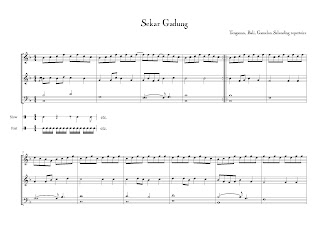
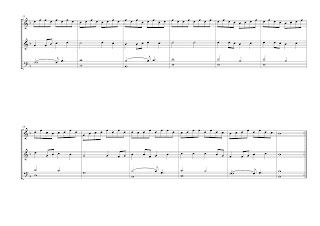
Thursday, May 03, 2007

Monday, March 26, 2007
Leedy: The Leaves Be Green, again
I've hosted an online copy of the manuscript score to Douglas Leedy's The Leaves Be Green. Stephen Malinowski has now made an edition (online here in PDF form) that is much easier on the eyes than my scan, and also has the score nicely lined-up to facilitate the introduction of extemporaneous repetitions of variations encouraged by the composer. The Leaves Be Green is a work for solo harpsichord or clavichord in (quarter-comma) meantone temperament, at once an hommage to an old traditon of keyboard variations, to South Indian tala cycles, and an excellent example of the range of west coast music experiment to boot.
Malinowski has also made an arrangement of The Leaves Be Green for viol quartet, ingeniously solving some intonation problems by using a quartet of two basses and two trebles. I can imagine that, without the built-in decay and sympathetic resonances of the keyboard instruments over the long tones, this will be quite a different piece, but nevertheless quite a beautiful one. If anyone is interested, I can provide copies of the scores and parts to this arrangement. Many thanks to Mr. Malinowski!
Malinowski has also made an arrangement of The Leaves Be Green for viol quartet, ingeniously solving some intonation problems by using a quartet of two basses and two trebles. I can imagine that, without the built-in decay and sympathetic resonances of the keyboard instruments over the long tones, this will be quite a different piece, but nevertheless quite a beautiful one. If anyone is interested, I can provide copies of the scores and parts to this arrangement. Many thanks to Mr. Malinowski!
Sunday, February 04, 2007
Topical Music
Pliable, has a post about the first-ever outbreak of the Avian Flu in Britain. Here's a recent prose score by the composer Bhishma Xenotechnites related to the same topic:
H5N1 (Environmental Music )
This music is for whistlers, or very high treble instruments from any musical tradition (either/or, I think, but maybe one or two whistlers could be in a qroup of instrumentalists, but not vice-versa) . Winds or whistlers need to produce a steady tone of at least 20 seconds' duration. Time is to be indicated by the sound of antique cymbals at intervals as will be specified below. No sounds may be produced or amplified by means of electronics.
Sound any pitch at all (not just "scale pitches") above f''' (which is ca. 1400 Hz.) . There is no upper limit. Choose a pitch and let it sound out steadily (no vibrato) for as long as it can be held; violins, 30 seconds or so up to around a minute (not more). Coming to the end of a tone, take a silent rest of one to two thirds the length of the tone that you just completed. Then repeat the same cycle using next a different pitch. The level of the loudness: not particularly high, but make a full sound. (Crescendo at the start and at the end a fade are good, so long as the pitch is steady.)
The performance will last at least six minutes, or longer, if the performers agree on a duration; the composer thinks the best result will probably ensue if the tone-rest sequence is performed at least a dozen times, and perhaps not more than about twenty, though a still longer performance could be done.
At the first sounded note, the piece will begin. The antique cymbals, as a sort of marker, will be struck three times, at well spaced intervals, and then twice in close succession at the end — five seconds or so apart. On hearing this signal, the performers will finish the tones, one by one, that they may be sounding, and when the last tone falls silent, the performance ends.
Listeners: what you will hear is what you get.
Bhishma Xenotechnites
2006
(some minor revisions, 2007)
(cc) Part of the Public Domain, 2006.
Tuesday, January 23, 2007
Scores
The act of writing a score, rather than improvising or committing something to a fixed recording is a fundamentally optimistic act. It is a signal of a relationship placed in the future rather than of immediate gratification. It implies faith that future performers of the score will approach it in goodwill, as well as acceptance that that future performers will bring the unexpected into the work. Richard Winslow's law, that if you want to repeat some music precisely, you ought to transmit it orally, while if you want to guarantee that the music will change over time, you should write it down, applies. A score may also have a touch of a love letter about it, addressee unknown. The recipient of this letter, the "whom" it concerns, is expected to be active, enaged, participatory, a fundamental rejection of passivity in the face of the world as it is.
Sunday, December 24, 2006

Saturday, December 23, 2006
A Small Prelude in F#

(One of a set of 12 small preludes, composed in early 2006. See also the Prelude in Ab, Prelude in Eb, Prelude in F.)
Monday, December 18, 2006
Rzewski Scores
Composer Frederic Rzewski has placed a number of his scores online here. (A second site, here, does not appear to be working; Rzewski also has a note here (scroll down) on "copyleft"; I believe, however, that he intends the copyleft status to apply to his sheet music (which can be freely downloaded or printed out, or ordered from his manager, when properly attributed) but he has not released the performance rights into the public domain. I may be a broken record on this topic, but it is really the way to go for most composers).
Subscribe to:
Posts (Atom)