The twenty-ninth of February is a day to cherish; it's an extra 24 hours squeezed into the calendar at regular, but sufficiently distant, intervals, so that when it comes 'round again, it's always a bit of surprise, and I think we could generally do a better job of celebrating the surprise of this welcome surplus by treating it as a day of exemption from the routine, an excuse to break any regular rhythms one has fallen into, and to dare do something one would otherwise not.
Rossini, my secret favorite composer*, was born on a 29th of February, so today is also an opportunity to celebrate the 52nd birthday of a composer for whom the interior figures and accompaniment were often of more interest than the surface, a profligate composer who also knew how and when to be usefully lazy, a composer who retired publicly from music to better delights in his kitchen, leaving, however, some musical sins of his old age, remarkably forward looking pieces of music, assembled with wit and wisdom surely connected to the leisure of a man whose life, from birth, could be taken at one-quarter the tempo of the 99.931...% of us without leapday birthdays.
_____
*Everyone needs a secret favorite composer, and may even reserve the right to have more than one.
Friday, February 29, 2008


Thursday, February 28, 2008
Public musicians and intellectuals
In the political blogosphere, there is a bit of lamentation that the US is now lacking in the prominent public intellectuals, that there is a fall in public discourse from the days of Galbraith Buckley to the Coulters and Moores of our time. But isn't it rather the case that the Galbraiths and Buckleys were never that deep and we've always had entertainers who have seized upon political themes, and run reckless with them?
However, even a quick look at one very small sample of blogging today, those by contemporary composers, reveals an encouraging state of affairs, with public discourse that is both elevated and approachable, as well as deep or light as the muse requires. From today's offerings alone (and Thursday is the slow day for blogging!): Charles Shere, a lifelong reader of Gertrude Stein, finds a way into her Blood on the Dining Room Floor, a work with an unlikely surface genre; Nico Muhly has a path to Peter Grimes that is both charmingly autobiographical (the prodigious are always charmingly autobiographical) and dares to introduce a few musical-technical ideas to a lay audience while simultaneously, if only suggestively, staking out some of his own aesthetic and technical territory; and Steve Hickens opens a dialogue about the complex issues located in what might be thought of as a three-dimensional space with axes for medium, genre, and the continuum between art and entertainment. And this is all is on top of widespread discussion of the New York Philharmonic's junket to the dim lights of Pyongyang.
I don't expect that composers will ever play a central role in partisan public political discourse (in fact, composers have often been embarrassing when playing such roles), but we should insist both that our music is important and talking or writing about our music is relevant to public life in general. At the very least, knowing our music makes the listener a more interesting, more critical listener, which seems to me to be a reasonable public good. A few of the more established political bloggers* have picked up on this; if they paid more attention, perhaps they would not be so glum.
_____
* Curiously, I've noted more attention from libertarians (Tyler Cowan, Julian Sanchez) than leftists -- perhaps a legacy of the left's long embrace of popular culture, and the possible over-identification of that culture with only those musical commodities which receive mass marketing?
However, even a quick look at one very small sample of blogging today, those by contemporary composers, reveals an encouraging state of affairs, with public discourse that is both elevated and approachable, as well as deep or light as the muse requires. From today's offerings alone (and Thursday is the slow day for blogging!): Charles Shere, a lifelong reader of Gertrude Stein, finds a way into her Blood on the Dining Room Floor, a work with an unlikely surface genre; Nico Muhly has a path to Peter Grimes that is both charmingly autobiographical (the prodigious are always charmingly autobiographical) and dares to introduce a few musical-technical ideas to a lay audience while simultaneously, if only suggestively, staking out some of his own aesthetic and technical territory; and Steve Hickens opens a dialogue about the complex issues located in what might be thought of as a three-dimensional space with axes for medium, genre, and the continuum between art and entertainment. And this is all is on top of widespread discussion of the New York Philharmonic's junket to the dim lights of Pyongyang.
I don't expect that composers will ever play a central role in partisan public political discourse (in fact, composers have often been embarrassing when playing such roles), but we should insist both that our music is important and talking or writing about our music is relevant to public life in general. At the very least, knowing our music makes the listener a more interesting, more critical listener, which seems to me to be a reasonable public good. A few of the more established political bloggers* have picked up on this; if they paid more attention, perhaps they would not be so glum.
_____
* Curiously, I've noted more attention from libertarians (Tyler Cowan, Julian Sanchez) than leftists -- perhaps a legacy of the left's long embrace of popular culture, and the possible over-identification of that culture with only those musical commodities which receive mass marketing?
Monday, February 25, 2008
Classical Music: Cranked up to 11
Since the 15th of February, a new directive has been in place in the European Union to protect the safety and health of employees from endangerment through physical effects. It included a noise limit with an upper level of 87db. An article in the Süddeutsche Zeitung describes the problem for classical music, here and much of what follows is cribbed from there.
Orchestras regularly exceed such a dynamic level, with brass instruments especially problematic. However, the duration of the peak loudnesses is surely an additional factor, and live musics without amplification tend to have a differentiated dynamic profile.
Some orchestras have taken pro-active measures to better protect their players from possible risks. Plexiglass shields, for example, have sometimes been introduced (via player contracts) to protect the players directly in front of the brass, but the reflections of sound from the plexiglass results in an increase for the brass players themselves. Other orchestras have experimented with orchestral seating arrangements, with the needs to create a coherent, communicative, and well-mixed ensemble sometimes conflicting with acoustical safety.
The situation is particularly difficult in opera houses, with small and semi-enclosed orchestral pits and no more so than in the famous pit at Bayreuth, in which the sound projected to the audience is remarkably clear, focused, and attenuated, but the sound for the players in the all-but-enclosed pit is both muddy and extremely loud (the heat in the pit is also intense, and well-above existing standards for worker safety, but that's another topic). Instrumentalists playing there often report that it takes several weeks, if not months, time for their ears to recover from the experience.
Many musicians have taken to using ear protection, but this is usually a private initiative, and musicians lack concrete and reliable information and advice from acoustic and medical professionals. Given the diversity of playing environments, I would suspect that a greater investment in research and analysis of particular halls and ensemble layouts with recommendations based on that research would probably be more appropriate than a blanket regulation for a single decibel level.
Orchestras regularly exceed such a dynamic level, with brass instruments especially problematic. However, the duration of the peak loudnesses is surely an additional factor, and live musics without amplification tend to have a differentiated dynamic profile.
Some orchestras have taken pro-active measures to better protect their players from possible risks. Plexiglass shields, for example, have sometimes been introduced (via player contracts) to protect the players directly in front of the brass, but the reflections of sound from the plexiglass results in an increase for the brass players themselves. Other orchestras have experimented with orchestral seating arrangements, with the needs to create a coherent, communicative, and well-mixed ensemble sometimes conflicting with acoustical safety.
The situation is particularly difficult in opera houses, with small and semi-enclosed orchestral pits and no more so than in the famous pit at Bayreuth, in which the sound projected to the audience is remarkably clear, focused, and attenuated, but the sound for the players in the all-but-enclosed pit is both muddy and extremely loud (the heat in the pit is also intense, and well-above existing standards for worker safety, but that's another topic). Instrumentalists playing there often report that it takes several weeks, if not months, time for their ears to recover from the experience.
Many musicians have taken to using ear protection, but this is usually a private initiative, and musicians lack concrete and reliable information and advice from acoustic and medical professionals. Given the diversity of playing environments, I would suspect that a greater investment in research and analysis of particular halls and ensemble layouts with recommendations based on that research would probably be more appropriate than a blanket regulation for a single decibel level.
Friday, February 22, 2008
Blocked in China? Forget the Olympics.
Following Pliable's lead, I pointed out earlier (here) that this blog is blocked in the People's Republic of China. Matthew Guerrieri found out that his blog, too, is blocked. As far as I'm concerned, if Chinese Internet users cannot view this or any other blog due to censorship, the Chinese government should not expect me to be a customer for their products or a audience to their propaganda, so I will avoid both as much as possible, and, in particular, will not watch any of the upcoming Olympics.
I encourage all bloggers to check this out for their own sites and consider a similar boycott.
I encourage all bloggers to check this out for their own sites and consider a similar boycott.
Thursday, February 21, 2008
Je m'appelle
Here's a minor annoyance: when I joined GEMA (which is the German rights organization equivalent to ASCAP or BMI in the States), I was told that I had to use my whole name (first, middle, last) because another Daniel Wolf (whose works include the apparently immortal Birdie McGinnis, Stand by the Navy and French Lessons) was already registered with ASCAP, and that there was an agreement 'tween the organizations not to duplicate names. I didn't mind so much, as I had often used my whole name, or at least the abbreviations (some close friends call me Deej, others Dan'l; Mrs. Robbins is the only person on the planet allowed to call me Danny, but that's another story), and it wasn't like poor Johannes Walter, who, born without a middle name (zweite Vorname), had to GEMA-fy his name with the addition of a "Caspar" up front, which was sort of cool (i.e. like the painter Caspar David Friedrich) until strangers started addressing him as Caspar (BTW, Caspar Johannes Walter is a superb composer. See here.) But it is a hassle to always have to insist to concert organizers that the name on programs, recordings, and broadcast reports always has to be in one form. GEMA and ASCAP and BMI are nothing if not companies with huge investments in computing technology. So, it ought to be clear to even the data base of littl'est brain that ASCAP's Daniel Wolf, who is long gone from this coil, is not adding any more titles to his catalogue, so as long as I never call a piece French Lessons, it ought not be a problem with matching my name, without middle name, to any of my titles.
On the other hand, maybe I really ought to write a piece with the title French Lessons.
On the other hand, maybe I really ought to write a piece with the title French Lessons.
Wednesday, February 20, 2008
George Brecht
Jill Johnston has an article about George Brecht and the event-score here. Johnston's writings are always an experience of their own, as they are so cheerfully ill-behaved, mixing the autobiographical with the scholarly and running on from one thought to the next, allowing the argument to take its own course, rather than force it into a conventional essay format. I've long admired Brecht's notebooks (Walther König : Köln 1991- ), which began during his composition course with John Cage at the New School, which are both the best available record of Cage as a teacher and the record of an artist following the rigorous consequences of one line of inquiry.
Searching
Search is a new online open access "Journal for New Music and Culture." The editorial staff and authors in the first issue come -- without apologies -- from the complexier corners of Newmusicland. I'm pretty much a foreigner in those parts of our little republic, but from what I've read here and elsewhere, as much as the content interests me, I have to register some disappointment that the prose style common in those corners tends to slip into an acceptable dialect of current academic English, with well-made essays and all the essential emblematic phrases, instead of venturing even a bit of the formal experimentation that one finds in the music itself. In other words, it bores before it has a chance to provoke and it ought to be the other way around. So, to the gents (and the ed board and writers in the first issue happen all to be male) of Search: I wish you well, but I hope that you will take some opportunity to apply the same compositional courage summoned up by your music to the words you choose to accompany the music.
Tuesday, February 19, 2008
Landmark Triangulation
One or the other among the three of you reading this page might have noticed the series of "Landmarks" (an index of all the Landmarks to date is to be found on the right-hand sidebar). I began the list without any conscious constraints upon it other than the individual pieces must be pieces that have changed the way I listen to and understand music and that continue to challenge. As time has gone on, the list has taken on a certain structure and life of its own, and each new entry has to conform to a set of rules that have emerged seemingly on their own. Each entry has to distinguish itself from its neighbors in some way, and some spread over time and geography within a very broadly taken "western art music" tradition seems to be implied. I've struggled with a few pieces that have been essential personally, but would seem to break some rules the precise nature of which remain obscure -- for example, to date, not a single composer has been represented by more than one work and I'm not sure if holding out for the K. 516 Quintet is in response to an implicit rule about this, or just biding time; or, I've often been tempted to add a Javanese work -- Gambir Sawit, the Patalon Wayangan, Gadhung Mlathi, or Gendhing Tukung -- or the Navajo Blessing Way, but my sense of the list is that adding any of these exquisite works might be taken as a form of musical tourism or worse. In any case, at any moment, I've got two or three pieces which are wrestling for a position in the series but the decision to actually add one always comes suddenly and unexpectedly: yes, damn it, this is important music and I have something, however small, to share about it.
Putting A Face On It
An item in the paper this morning mentioned a Scottish anthropologist, Caroline Wilkinson, who has reconstructed the face of J.S. Bach on the basis of Bach's death mask, a bronze cast of his skull, and other data. According to the report, the only great uncertainty in this project is the color of the composer's eyes, as some contemporary paintings rendered them blue, others brown.
Why we should be interested in what Bach -- or any other historical composer, for that matter -- looked like? A desire to hear what his organ playing, for example, sounded like, is natural (although tempered, in my case at least, by joy in the astonishing variety of interpretations possible for the written scores), but curiosity about the face that had once been attached to the musical works is something else altogether. I am frequently disappointed by portraits of composers; they never match the intensity of emotion that has built in my relationship to individual pieces of music, and the portraits always belong to particular moments in a life (think: portly, barbate Brahms), and so are hardly a match for an entire catalogue of music and rarely a match for a single piece in that catalogue, that life.
There are exceptions, of course -- that forward-leaning photo of Ives, the intense stare of Schoenberg, Cage's wide-open-mouthed laugh, even some caricatures of Wagner -- but a composer doesn't get into this business because of his or her good looks, and those looks, the physiognomy as Teddy Adorno put it, are not to be confused with our sounds, however handsome, they too, may be. If there is resemblance between musical and bodily physiognomies, it is probably accidental, and always a matter of surface. Need one mention the handful of composers who happen to be honestly ugly folk yet produce music that angels envy? Yeah, there's a face for every piece of music, but most need not become familiar.
Why we should be interested in what Bach -- or any other historical composer, for that matter -- looked like? A desire to hear what his organ playing, for example, sounded like, is natural (although tempered, in my case at least, by joy in the astonishing variety of interpretations possible for the written scores), but curiosity about the face that had once been attached to the musical works is something else altogether. I am frequently disappointed by portraits of composers; they never match the intensity of emotion that has built in my relationship to individual pieces of music, and the portraits always belong to particular moments in a life (think: portly, barbate Brahms), and so are hardly a match for an entire catalogue of music and rarely a match for a single piece in that catalogue, that life.
There are exceptions, of course -- that forward-leaning photo of Ives, the intense stare of Schoenberg, Cage's wide-open-mouthed laugh, even some caricatures of Wagner -- but a composer doesn't get into this business because of his or her good looks, and those looks, the physiognomy as Teddy Adorno put it, are not to be confused with our sounds, however handsome, they too, may be. If there is resemblance between musical and bodily physiognomies, it is probably accidental, and always a matter of surface. Need one mention the handful of composers who happen to be honestly ugly folk yet produce music that angels envy? Yeah, there's a face for every piece of music, but most need not become familiar.
Saturday, February 16, 2008
Food
Wolf's Law: There are composers who don't care about what they eat and there are good composers. Several blogging composers feature food from time to time, whether it's a spontaneous recipe for seared whale or some seriously expensive dining, but the best is Charles Shere's food diary: simple, elegant, local, ethical, and delicious.
And some more food for thought for the paranoid: this posting by aimai at If I Ran The Zoo.
And some more food for thought for the paranoid: this posting by aimai at If I Ran The Zoo.
Wednesday, February 13, 2008
Stopped in my tracks
I haven't been able to put two notes together in any meaningful way for a couple of weeks. This isn't being blocked but being shocked. One source of this shock was my recent "hats off, Gents" moment after hearing Richard Ayres orchestral piece No. 37B . I'm willing to go out on a limb, having heard the piece only once, and say that it's the best and liveliest work by a composer of my generation, and that Ayres is the most technically accomplished and imaginative orchestrator around, with any given moment in the work both strikingly new and punningly close to the familiar. Moreover, his apparent ability to compose serenely in the middle of the minefield between the traditional, the systematic (whether experimental or complex) and the intuitive just adds to one serious case of composers' envy. (For some audio excerpts of other works by Ayres, see here). But even putting such subjective assertions of the superlative aside, No. 37B has been a call for me to radically reassess ideas about musical continuity (i.e. what follows what else), and here I am, in the middle of that reassessment. The recognition that I might have been seriously underestimating musics capacity for a variegated continuity is a terrific opportunity and I can't wait to hear what happens next.
Tuesday, February 12, 2008
The Illusionist
I finally saw The Illusionist (2006), with its score by Phillip Glass. Two features in the score are worth mention -- the first is the slow burn of its build-up over the course of the film, from piano to not much more than mezzo-forte, with the most dense activity saved for the musical coda which accompanies the dramatic denouement*; and the second is that while the tonal and rhythmic materials (arpeggios, tuplets, top-of-the-minor-scale chromatism etc.) never stray from from familiar Glass territory, the orchestration is disciplined down to a scale appropriate to the turn-of-the-century Vienna shown in the film, with the musical continuity carried, in classical fashion, by the string ensemble, colored by winds, and just the lightest amount of orchestral percussion (I found that the use of tambourine, at one point, was touching; an oddly registered celesta, over the closing credits kept things nicely out of balance, and made clear that the credits were something apart from the film proper). Glass never writes fake Viennese music here, as many others would have been tempted, and his style never allows for even a touch of Wiener espressivo, but instead, and wisely so Ithinks, he uses the orchestration to allow the music to maintain Viennese classicism as a topic in the music.
_____
* There is a nice musical-visual counterpoint throughout, but particularly in the coda, in which the tendency to tonal stasis in Glass's music gets mirrored by the director's focus on actor Paul Giamatti's face.
_____
* There is a nice musical-visual counterpoint throughout, but particularly in the coda, in which the tendency to tonal stasis in Glass's music gets mirrored by the director's focus on actor Paul Giamatti's face.
Monday, February 11, 2008
These Bagatelle Days
The Winter Album (online here *) is not alone. Universal Edition has just announced a new volume of shorter piano pieces by composers Georges Aperghis, Pierre Boulez, Ivan Fedele, Cristóbal Halffter, Michael Jarrell, György Kurtág, Peter Eötvös, Luis de Pablo, Salvatore Sciarrino. A page with score samples is here.
Two more pieces have been received for A WINTER ALBUM. Perhaps we should start planning the next volume -- A Spring or Summer Album? For what instrument(s)? Perhaps with singing? Any ideas?
Two more pieces have been received for A WINTER ALBUM. Perhaps we should start planning the next volume -- A Spring or Summer Album? For what instrument(s)? Perhaps with singing? Any ideas?
Just another new music blog you can't read in China
Yep. I just followed a tip from On an Overgrown Path's Pliable, and visited WebSitePulse, which indicated that this blog also is blocked in the PRC. The failure of western countries not to press for liberalization in the PRC while pursuing all economic opportunities is perhaps the single ugliest story of the past two decades. The fact that this particular page can't be read in China is trivial, but in aggregate with all the other blocked sites, it's a tragedy.
Friday, February 08, 2008
Guilty Pleasures
Mozart, Fantasie K.475. If I were drinking and eating chocolate, playing this at home, for myself, would be accompanied by a shot of Laphraoig and bar of Munz dark chocolate inlaid with those huge slices of orange. Theorists and musicologists are troubled by this Fantasy -- they want to make it work as a composition, when it's really an improvisation, and one that refuses to grown up and become a real boy. In its refusal, it's playful and indulgent (hence the Scotch and the Swiss chocolate). Yes, they laughed when I sat down at the keyboard, the music meandered, stuffed with diminished seventh chords and tremolo'd dominants and cadential runs both chromatic and diatonic, but I broke their hearts with the Andantino, and the sudden changes from piano to forte soon lost their lightness as the legs of the lightly-framed fortepiano must have shaken in their wake. The Fantasie was published as a prelude, to the C minor Sonata, K.457, a piece carefully balanced between classical form and more progressive concerns, and one recognizes in this Fantasy the perfect satisfaction of a need to warm up, cogitate, and play before settling down into the well-ordered and -composed world of the Sonata.
Selling Musical Science
It's fascinating to watch how bits of scientific research on musical topics get picked up by the mainstream press. The latest example concerns three Australian researchers who have studied the use of vocal tract resonances in saxophone playing. Although seldom couched in scientific terms, it's no secret to teachers of wind technique that, in addition to embouchure and breathing techniques, vocal tract resonances play an important role in sound quality and range. Stuart Dempsters The Modern Trombone: A Definition of Its Idioms (1979), for example, emphasizes the importance of vocal resonances in trombone tone color. The team from New South Wales has demonstrated that altissimo range sax playing is achieved by the player tuning the second partial of their vocal tract resonance slightly above the desired pitch. What's interesting now is to read how the press treats this storu. A google on "vocal tract resonances in saxophone playing" will now turn up a long series of articles on the newly discovered secret of sexy sax playing.
Landmarks (32)
Harry Partch: Castor and Pollux (1952) for kithara, surrogate kithara, harmonic canon,
diamond marimba, cloud chamber bowls & bass marimba.
One of three Plectra and Percussion Dances, Castor & Pollux is at once Partch's most formally clear and compact composition and the work which decisively embraces the capacity of his instruments to enjoy a full spectrum of tonal relationships well beyond the simple harmonic relationships usually favored by practitioners of just intonation. [The emphases in Partch's music changed and developed over time: the initial impulse was to accompany the microtonal contours of a speaking/reciting voice; later, his harmonic ideas (the tonality diamond, in which a harmonic series is crossed with its subharmonic inversion, ironically duplicating the structure of the twelve-tone array) took precedence, but the translation of these tonal materials to his ever-increasing ensemble featuring idiophones and plucked strings, invited Partch to apply his tonal materials with ever greater freedom, eventually even using the word "atonal".*]
The form carries the narrative of the dance: the seduction of Leda by Zeus-disguised-as-a-Swan, followed by conception, incubation, and the birth of twins is assigned to a repeated structure of three duets and a sextet made of the superimposed duets: first Castor and then Pollux. This "process" -- Partch's own word, and it's use here is significant and prescient -- ritualizes the sequence of rape, gestation, and birth, in a pattern not unknown in some traditions outside of the west (the Javanese Patalon, for example, the overture to shadow puppet plays, in which each part represents a successive stage of life). One suspects that Partch, never a simple man, and someone who elsewhere referred to birth as a "decent and honorable mistake", was very much intent on this surprising mixture of emotional distance in the duets and celebratory violence in the sextets. I have never seen Castor & Pollux on the stage, but as the dance world is always in need of more work for evil swans, it ought to be a repertoire item.
*****
I first encountered the music of Partch when I was 13, from a chance encounter with a public TV documentary. I was hooked and then quickly spent paper route money on the two then-available discs, and, a few years later, Partch's book Genesis of a Music. The workbench in my parents' garage soon became the scene of countless instrument-building experiments, as much a musical education as practicing my trombone or doing harmony exercises from MacHose or Piston. Eventually, through the good offices of Erv Wilson and Lou Harrison who owned sets of scores, I was able to transcribe a good number of Partch pieces into a notation of my own devising, and got something of a handle on how he did what he did. That was quite an education in itself, but perhaps more importantly, Partch showed me an example of a how "a music" (that indefinite article means everything!) could be built from research and experiment, negotiating between first principles and traditions.
*****
* The cloud chamber bowls contributed to this in no small way, due to breakage, the parts for this array of suspended glass carboys had to be rewritten many times, with Partch each time re-imagining the harmonic, melodic, and timbral qualities of an unpredictably evolving instrument.
diamond marimba, cloud chamber bowls & bass marimba.
One of three Plectra and Percussion Dances, Castor & Pollux is at once Partch's most formally clear and compact composition and the work which decisively embraces the capacity of his instruments to enjoy a full spectrum of tonal relationships well beyond the simple harmonic relationships usually favored by practitioners of just intonation. [The emphases in Partch's music changed and developed over time: the initial impulse was to accompany the microtonal contours of a speaking/reciting voice; later, his harmonic ideas (the tonality diamond, in which a harmonic series is crossed with its subharmonic inversion, ironically duplicating the structure of the twelve-tone array) took precedence, but the translation of these tonal materials to his ever-increasing ensemble featuring idiophones and plucked strings, invited Partch to apply his tonal materials with ever greater freedom, eventually even using the word "atonal".*]
The form carries the narrative of the dance: the seduction of Leda by Zeus-disguised-as-a-Swan, followed by conception, incubation, and the birth of twins is assigned to a repeated structure of three duets and a sextet made of the superimposed duets: first Castor and then Pollux. This "process" -- Partch's own word, and it's use here is significant and prescient -- ritualizes the sequence of rape, gestation, and birth, in a pattern not unknown in some traditions outside of the west (the Javanese Patalon, for example, the overture to shadow puppet plays, in which each part represents a successive stage of life). One suspects that Partch, never a simple man, and someone who elsewhere referred to birth as a "decent and honorable mistake", was very much intent on this surprising mixture of emotional distance in the duets and celebratory violence in the sextets. I have never seen Castor & Pollux on the stage, but as the dance world is always in need of more work for evil swans, it ought to be a repertoire item.
*****
I first encountered the music of Partch when I was 13, from a chance encounter with a public TV documentary. I was hooked and then quickly spent paper route money on the two then-available discs, and, a few years later, Partch's book Genesis of a Music. The workbench in my parents' garage soon became the scene of countless instrument-building experiments, as much a musical education as practicing my trombone or doing harmony exercises from MacHose or Piston. Eventually, through the good offices of Erv Wilson and Lou Harrison who owned sets of scores, I was able to transcribe a good number of Partch pieces into a notation of my own devising, and got something of a handle on how he did what he did. That was quite an education in itself, but perhaps more importantly, Partch showed me an example of a how "a music" (that indefinite article means everything!) could be built from research and experiment, negotiating between first principles and traditions.
*****
* The cloud chamber bowls contributed to this in no small way, due to breakage, the parts for this array of suspended glass carboys had to be rewritten many times, with Partch each time re-imagining the harmonic, melodic, and timbral qualities of an unpredictably evolving instrument.
Tuesday, February 05, 2008
Stephen Scott
NPR has a nice spot here on Stephen Scott and his music for bowed piano. I can recall hearing this for the first time at a concert at Scripps College sometime in the late '70s, using techniques greatly amplified from those developed first by C. Curtis-Smith. The concert was introduced by Gail Kubik, of all people, an extremely conservative composer on the faculty at Scripps (best known perhaps for his Oscar-winning score to Gerald McBoing-Boing), who was nevertheless completely bowled over by Scott's music and the virtuosity of his Colorado College-based ensemble.
Spaghetti Non-Western
This is a film score to wait for: According to yesterday's Süddeutsche Zeitung (which cites the dpa, which in turn cites the Iranian press service Mehra), the 79-year old Ennio Morricone has been commissioned to score a film about Ayatollah Ruhollah Khomeini, to be directed by Behrouz Afkhami. As much as I like the idea of a Morricone score -- in addition to his well-known film scores, Morricone has real avant garde street creds, even participating in Franco Evangelisti's Nuova Consonanza project -- I was kinda hoping for something more like an Indian musical. As Emma Goldman put it, "if I can't dance I don't want to be in your revolution," and unless the militants and Mullahs are willing to sing and dance, I sure don't want to watch their revolution.
Astounding
I guess that if you're a big name dead tree critic you can get away with just making stuff up. Here's a Norman Lebrecht column on Stockhausen with an astonishing number of simple factual errors. Here are a few --
"Gyorgy Ligeti, hearing the first broadcast in 1956 as Soviet tanks rolled through Budapest, fled the country and turned up at Stockhausen’s apartment, where he lived for several months." Ligeti and his wife fled to Vienna in December 1956; in February 1957, Ligeti went on alone to Cologne where he arrived first at Herbert Eimert's house, and then stayed for six weeks with Stockhausen.
"...in Hymnen (1968) he experimented with Indian mantras and Californian minimalism." (Has Lebrecht even heard Hymnen? Got it confused with Stimmung, a piece directly related to Stockhausen's contact with the music of La Monte Young?)
"In Wednesday, a string quartet tried to make itself heard from an airborne helicopter." (The quartet is distributed among four helicopters, and their radio signals are mixed together for the audience in the hall.)
"Isolated, adulated, fenced in by his own myth, he left the final two days of his opera unfinished and apparently unwanted. " (All seven operas of Licht were finished and the music had all been premiered; Stockhausen had moved on to near-completion of his next project, Klang, and plans for complete performances of the Licht cycle were in progress at the time of his death.)
Lebrecht also gets the history and rationale for Stockhausen's separation from UE and DG spectacularly wrong -- they were either unable or unwilling to produce the works in his desired formats, to do so in a timely fashion, or to keep the works in print and distributed. Further, his speculation about the future of the estate and works is completely misinformed, as Stockhausen, with excellent legal counsel, created a foundation for these purposes and secured (through agreement or buy-outs) the agreement of his heirs.
Finally, may I simply note that Stockhausen's demand to keep the recording of his interview with Lebrecht is entirely wise, and not the plea of an eccentric. If a journalist is prepared to go into hard print with as many errors as Mr Lebrecht produces here, then any interviewee damn well will want to have the recording for their own potential self-defense.
"Gyorgy Ligeti, hearing the first broadcast in 1956 as Soviet tanks rolled through Budapest, fled the country and turned up at Stockhausen’s apartment, where he lived for several months." Ligeti and his wife fled to Vienna in December 1956; in February 1957, Ligeti went on alone to Cologne where he arrived first at Herbert Eimert's house, and then stayed for six weeks with Stockhausen.
"...in Hymnen (1968) he experimented with Indian mantras and Californian minimalism." (Has Lebrecht even heard Hymnen? Got it confused with Stimmung, a piece directly related to Stockhausen's contact with the music of La Monte Young?)
"In Wednesday, a string quartet tried to make itself heard from an airborne helicopter." (The quartet is distributed among four helicopters, and their radio signals are mixed together for the audience in the hall.)
"Isolated, adulated, fenced in by his own myth, he left the final two days of his opera unfinished and apparently unwanted. " (All seven operas of Licht were finished and the music had all been premiered; Stockhausen had moved on to near-completion of his next project, Klang, and plans for complete performances of the Licht cycle were in progress at the time of his death.)
Lebrecht also gets the history and rationale for Stockhausen's separation from UE and DG spectacularly wrong -- they were either unable or unwilling to produce the works in his desired formats, to do so in a timely fashion, or to keep the works in print and distributed. Further, his speculation about the future of the estate and works is completely misinformed, as Stockhausen, with excellent legal counsel, created a foundation for these purposes and secured (through agreement or buy-outs) the agreement of his heirs.
Finally, may I simply note that Stockhausen's demand to keep the recording of his interview with Lebrecht is entirely wise, and not the plea of an eccentric. If a journalist is prepared to go into hard print with as many errors as Mr Lebrecht produces here, then any interviewee damn well will want to have the recording for their own potential self-defense.
Monday, February 04, 2008
Some Politics
I got an email asking for a blog item on politics. "Big politics in the sky", as Terry Riley once put it, as opposed to our narrow musical politics.
*****
I just voted online in the Democrats Abroad primary. It's good that Dems Abroad have got their act together so well, and good for me personally, given the fact that my county back home has rarely been able to get me a ballot before election day. But it definitely does not have the same feeling as going to your local fire station or school or a neighbor's garage and doing your civic duty with a mark on a piece of paper that is eventually counted, by hand, by some of your fellow or sister citizens.
*****
May I make one prediction about the election in 2008? Because of the accelerated primary schedule, I predict that the candidate who sews up their party nomination first will be the loser in the general election. Yep, voter fatigue and remorse will only increase with the length of their tenure as the nominee-elect, so the longer that uncertainty reigns in any nomination race, the better. The greatest gift that Obama and Clinton (or Romney and McCain) could give one another is a deadlocked convention.
*****
One interesting thing about the Democratic debates was that the final three candidates, each accomplished attorneys, displayed three distinct lawyering styles -- Clinton was a model corporate attorney, an insider in command of her facts, Edwards an tort attorney, making a plea that attempted to match emotions to pocket books, and Obama a professor of consitutional law, interested most in articulating broad principles, but at the ready with case examples. I'm surprised not to have read such a characterization anywhere.
As for the Republican debates, the parochiality of their style and the primitive reductionism of the content were astonishing, and, I've frequently found, impossible to explain with any success to non-Americans. The political range of both large US parties is narrow, as both are (clasically) liberal parties with bits of social democracy or social conservatism thrown in, and populism floating between the parties over generations. Both parties are nationalist in character, but take great sport in diminishing the other as insufficiently patriotic on decidedly different grounds. Both parties are actually coalitions of interests, and changes in power from one party to the other are achieved by slicing the coalitions just large enough to acquire majorities in winner-take-all districts and states. It appears that the Democratic currently have the edge, and this is in no part due to the managerial incompetency of the present Republican presidency. As an anarchist by inclination, I don't have long-term faith in either party, as both are statist enterprises, but in the short term, I can recognize that the Democrats are less likely to use the state apparatus for violence, self-enrichment, or the upward redistribution of wealth and more likely to assure equal access to resources, opportunities, and basic services and to act diplomatically in the world. It's a compromise, but all democratic politics is compromise.
*****
Enough said.
*****
I just voted online in the Democrats Abroad primary. It's good that Dems Abroad have got their act together so well, and good for me personally, given the fact that my county back home has rarely been able to get me a ballot before election day. But it definitely does not have the same feeling as going to your local fire station or school or a neighbor's garage and doing your civic duty with a mark on a piece of paper that is eventually counted, by hand, by some of your fellow or sister citizens.
*****
May I make one prediction about the election in 2008? Because of the accelerated primary schedule, I predict that the candidate who sews up their party nomination first will be the loser in the general election. Yep, voter fatigue and remorse will only increase with the length of their tenure as the nominee-elect, so the longer that uncertainty reigns in any nomination race, the better. The greatest gift that Obama and Clinton (or Romney and McCain) could give one another is a deadlocked convention.
*****
One interesting thing about the Democratic debates was that the final three candidates, each accomplished attorneys, displayed three distinct lawyering styles -- Clinton was a model corporate attorney, an insider in command of her facts, Edwards an tort attorney, making a plea that attempted to match emotions to pocket books, and Obama a professor of consitutional law, interested most in articulating broad principles, but at the ready with case examples. I'm surprised not to have read such a characterization anywhere.
As for the Republican debates, the parochiality of their style and the primitive reductionism of the content were astonishing, and, I've frequently found, impossible to explain with any success to non-Americans. The political range of both large US parties is narrow, as both are (clasically) liberal parties with bits of social democracy or social conservatism thrown in, and populism floating between the parties over generations. Both parties are nationalist in character, but take great sport in diminishing the other as insufficiently patriotic on decidedly different grounds. Both parties are actually coalitions of interests, and changes in power from one party to the other are achieved by slicing the coalitions just large enough to acquire majorities in winner-take-all districts and states. It appears that the Democratic currently have the edge, and this is in no part due to the managerial incompetency of the present Republican presidency. As an anarchist by inclination, I don't have long-term faith in either party, as both are statist enterprises, but in the short term, I can recognize that the Democrats are less likely to use the state apparatus for violence, self-enrichment, or the upward redistribution of wealth and more likely to assure equal access to resources, opportunities, and basic services and to act diplomatically in the world. It's a compromise, but all democratic politics is compromise.
*****
Enough said.
Blogging New Music
For new musics to have a real and useful presence online we must better convey the fact that we believe that our musics are both lively and deep and that they are well worth paying some attention. Our web presences have to be thicker with sounds, scores, useful information and opinions, we have to be more active, updating and introducing new material at a more rapid and regular pace, and we have go to take greater risks, with both our sounds and our statements. We have to bring more voices to the table and cultivate contrariness and controversy.
Composing is (usually) an individual sport, and most composing bloggers have, naturally, been soloists, sometimes in isolated blogs, other times imbedded into their webpages. That's my excuse (well, that and a little problem with getting along well with others). But this isn't the only way to blog and a group blog, like that at Sequenza 21, has some advantages. I like the fact that Sequenza 21 does not have a staff style, and the loose community that has grown around it is a real achievement. But I miss a sense of urgency there -- days go by with no new postings, and conveying urgency is an essential factor in conveying the vitality of our music. The Score, the New York Times' attempt at a blogging platform for four selected composers, came in March last year, with little fanfare (to be fair, being hidden behind paid admission didn't help) and went out again in April with less fanfare and no laments. I think that the fit of blogging to an institution like the Times was not quite right (the exception, proving the rule, would later be Erroll Morris's blog, Zoom, but even that seems to have ceased activity).
A group blog for new music should bring some advantages -- a variety of voices and interests, even if the authors share some general aesthetic ideas, introducing some discipline to insure regular posting (so that readers feel invited to turn up just as regularly), perhaps a bit more editorial control for typos and layout (not to mention verbal excess, a la Dr Wolf), and finally a bit of coaching within the group to encourage both controversy and cooperation -- that it would be a shame not to try it.
Composing is (usually) an individual sport, and most composing bloggers have, naturally, been soloists, sometimes in isolated blogs, other times imbedded into their webpages. That's my excuse (well, that and a little problem with getting along well with others). But this isn't the only way to blog and a group blog, like that at Sequenza 21, has some advantages. I like the fact that Sequenza 21 does not have a staff style, and the loose community that has grown around it is a real achievement. But I miss a sense of urgency there -- days go by with no new postings, and conveying urgency is an essential factor in conveying the vitality of our music. The Score, the New York Times' attempt at a blogging platform for four selected composers, came in March last year, with little fanfare (to be fair, being hidden behind paid admission didn't help) and went out again in April with less fanfare and no laments. I think that the fit of blogging to an institution like the Times was not quite right (the exception, proving the rule, would later be Erroll Morris's blog, Zoom, but even that seems to have ceased activity).
A group blog for new music should bring some advantages -- a variety of voices and interests, even if the authors share some general aesthetic ideas, introducing some discipline to insure regular posting (so that readers feel invited to turn up just as regularly), perhaps a bit more editorial control for typos and layout (not to mention verbal excess, a la Dr Wolf), and finally a bit of coaching within the group to encourage both controversy and cooperation -- that it would be a shame not to try it.
Saturday, February 02, 2008
Just What My Library Needs
From the inbox:
Dear Amazon.com Customer,
We've noticed that customers who have purchased or rated Treatise on Instrumentation by Hector Berlioz have also purchased Music Composition For Dummies (For Dummies (Lifestyles Paperback)) by Scott Jarrett.
Friday, February 01, 2008
The News
This evening, Roland Kluttig conducted a brilliant program with the hr-Sinfonieorchester: Elliot Carter: Three Occasions, Earle Brown: Cross Sections and Color Fields, Richard Rijnvos: Times Square Dance, and Richard Ayres: No. 37b.
Having the Carter and Brown played side-by-side by an orchestra that has the chops in ready reserve to go beyond reading the scores and offers reasonable rehearsal time to actually make real music was instructive. I have never heard orchestral works by either composer played as well, and when well-played, the differences in the achievements of the two composers were a revelation. Although the three Carter pieces were models of a certain style -- which might be called academic, with each note probably the product of reason and craft, each line appearing to do just what a well-made line should do, and the ensembles holding those lines together (or letting them come apart, as is often the case) with considerable clarity -- the pieces just didn't sound, with chord after chord just falling flat with a lack of resonance and character. Further, the amount of work given to the musicians in order to realize their notated parts suggests inefficiencies that are a scarce return on the investment.
I have not had a good handle on Brown's music, until this evening. I had played a number of pieces from Brown's early Folio, in an ensemble including the composer, in Hartford many years ago, and as much as I enjoyed, indeed treasured, his company, the music never really came together and he was far from clear about how we were to navigate the graphic notation. But tonight, the orchestra and conductor were both tightly together -- with sonority after sonority just taking off in terms of resonance, beating, and overtones popping out of the texture -- and flexible enough to place the extemporaneously-selected elements into a lively and intense sequence. The orchestra that played the Brown was cheerfully musical and this was due to the formal efficiency of the score, more than a few extraordinary sounds, and the clear direction from Kluttig. There are weaknesses in the piece -- the sequencing is in the conductor's hands, so there is some inevitable delay in ensemble articulation and the effect is usually monolinear -- but it was as if it were an entirely different orchestra from that which had played the Carter.
The News of the Day, however, was Ayres No. 37b (2003/2006) which -- never mind the neutral title -- was symphonic and of classical formal proportions. The composer, a gifted and exuberant orchestrator, invited the orchestra to do everything that an orchestra can do well, and the orchestra honored the challenge with equal exuberance. The writing for the brass and string harmonics was especially good, some passages for the trumpets touched my heart with a drag that resembled something in-between New Orleans funeral marches and mariachi playing. Ayres has also raised the process of muting a tuba to a musical skill of the first art. Ayre's score is a more than a bit of a madcap adventure, comic in genre, but with the entire range of comic expression in use, from droll to intense and from gentle to slapstick. A comic symphony is naturally more classical than romantic, and the rapid cuts and transitions, always moving forward, if sometimes detoured by cul de sacs and hairpin curves, seize that same cinematic impulse that was captured in the some of the best works of early 20th century neo-classicism. In fact, I kept asking myself: Why isn't real movie music ever this good?
Having the Carter and Brown played side-by-side by an orchestra that has the chops in ready reserve to go beyond reading the scores and offers reasonable rehearsal time to actually make real music was instructive. I have never heard orchestral works by either composer played as well, and when well-played, the differences in the achievements of the two composers were a revelation. Although the three Carter pieces were models of a certain style -- which might be called academic, with each note probably the product of reason and craft, each line appearing to do just what a well-made line should do, and the ensembles holding those lines together (or letting them come apart, as is often the case) with considerable clarity -- the pieces just didn't sound, with chord after chord just falling flat with a lack of resonance and character. Further, the amount of work given to the musicians in order to realize their notated parts suggests inefficiencies that are a scarce return on the investment.
I have not had a good handle on Brown's music, until this evening. I had played a number of pieces from Brown's early Folio, in an ensemble including the composer, in Hartford many years ago, and as much as I enjoyed, indeed treasured, his company, the music never really came together and he was far from clear about how we were to navigate the graphic notation. But tonight, the orchestra and conductor were both tightly together -- with sonority after sonority just taking off in terms of resonance, beating, and overtones popping out of the texture -- and flexible enough to place the extemporaneously-selected elements into a lively and intense sequence. The orchestra that played the Brown was cheerfully musical and this was due to the formal efficiency of the score, more than a few extraordinary sounds, and the clear direction from Kluttig. There are weaknesses in the piece -- the sequencing is in the conductor's hands, so there is some inevitable delay in ensemble articulation and the effect is usually monolinear -- but it was as if it were an entirely different orchestra from that which had played the Carter.
The News of the Day, however, was Ayres No. 37b (2003/2006) which -- never mind the neutral title -- was symphonic and of classical formal proportions. The composer, a gifted and exuberant orchestrator, invited the orchestra to do everything that an orchestra can do well, and the orchestra honored the challenge with equal exuberance. The writing for the brass and string harmonics was especially good, some passages for the trumpets touched my heart with a drag that resembled something in-between New Orleans funeral marches and mariachi playing. Ayres has also raised the process of muting a tuba to a musical skill of the first art. Ayre's score is a more than a bit of a madcap adventure, comic in genre, but with the entire range of comic expression in use, from droll to intense and from gentle to slapstick. A comic symphony is naturally more classical than romantic, and the rapid cuts and transitions, always moving forward, if sometimes detoured by cul de sacs and hairpin curves, seize that same cinematic impulse that was captured in the some of the best works of early 20th century neo-classicism. In fact, I kept asking myself: Why isn't real movie music ever this good?
A Most Modern Listening Machine
John Cage famously separated musical labours in composition, performance, and audition and then posed the question "what do they possibly have to do with one another?" When musicians get hooked up with electronics, our engagements typically reflect this division of labour: like many composers, computer-assisted composition has gotten more of my attention than computer-assisted performance, and even less, computer-assisted audition. Music Matters, a blog on music cognition that has passed under my radar until now, recently posed the very smart question: What should a listening machine be able to do? A listening machine is a marvelous and non-trivial idea. A "listening machine" of some sort has been the component of several online services designed to advise purchasers of recorded music that "if you like this, you'll like that". But such programs are usual just manipulating data bases constructed around the evaluations of real human listeners, and that's a very weak version of the idea, which is really about music cognition writ large. And that's something that should be very interesting to composers and performers, as listening is still filled with mysteries -- especially, methinks, regarding the extent and limits of our listening capacities and regarding the nature of musical time (especially regarding our conflicting perceptions of music as stretches of time and as moments -- "now"s -- in time, and how we reconcile the two).
||: Repetition :||
For a time, say '78 through '84, my music used a lot of literal repetitions, notated often between happy pairs of ||: :||s. Repetition was a useful element in music which was more immediately static than dynamic, more about being somewhere, than going somewhere. Of course, no repetition was ever precisely identical to that which was being repeated, the most careful of human performances always carried traces of subtle alterations, and even in the most mechanical repetition, the context, of time delayed and experienced, altered the identity relationship in a fundamental way.
For a time, say say '78 through '84, my music used a lot of literal repetitions, notated often between happy pairs of ||: :||s. Repetition in music was useful for creating contexts that well self-sustaining and self-similar. Canons were a particularly useful extension of repetitive techniques, as the music was simultaneously asserting something about where one was, where one had been, and where one might be going. Canons became increasingly important to me in the late 1980's, and now I can't imagine working without them, but they are increasingly loose, rather than strict, in character. Letting a voice which had been trailing gradually move to a leading position in a contrapuntal environment (John Cage, borrowing an idea about Gagaku from Henry Cowell, called this a "Japanese Canon"; Morton Feldman would brilliantly use this same idea, borrowed perhaps from simultaneous Torah recitation in the Orthodox Schul -- in the same breath he said that had he thought that he had been writing a canon he would have killed himself --, and Jo Kondo's idea of a "shape" and its "shadow" was definitely in the same ballpark) was literally like getting ahead of oneself.
Before I get ahead of myself: For a time, say '78 through '84, my music used a lot of literal repetitions, notated often between happy pairs of ||: :||s. Attracted initially by the impossibility of the exact repetition, I became more attracted to the idea of an explicitly imperfect or quasi-repetition. An example of quasi-repetition which continues to haunt me is Jo Kondo's Sight Rhythmics, in which the same piece is "repeated" six times, but from each "repetition" to the next, one element in each measure is altered, with alterations accumulating until the sixth "repetition", called a Skolion, in which the material is rewritten altogether. But the changes here always remain clearly within the territory, the ballpark if you will, of repetitions rather than variations, because the sensation is always one of sameness rather than the variety a proper variation would demand.
But I'm getting ahead of myself: For a time, say '78 through '84, my music used a lot of literal repetitions, notated often between happy pairs of ||: :||s. I've recently been writing some music in which there are lots of literal repetitions, but repetitions which find themselves in conetxts which change enough that I'm not comfortable fitting them between pairs of ||: :||, no matter how happy they might be. The context has changed the material enough identifying any of it as a repetition now seems somewhat dishonest. I suppose I ought to write something now about not dipping into the same river twice, but having come 'round to recognizing that the same river is not a particularly useful idea (as a river is more of a process than an object), let's leave it at that, and you'll have some idea of the ballpark about which I'm currently bopping. Or something like that idea, but entirely your own, so not quite a repetition.
(An encore posting from December 2006).
For a time, say say '78 through '84, my music used a lot of literal repetitions, notated often between happy pairs of ||: :||s. Repetition in music was useful for creating contexts that well self-sustaining and self-similar. Canons were a particularly useful extension of repetitive techniques, as the music was simultaneously asserting something about where one was, where one had been, and where one might be going. Canons became increasingly important to me in the late 1980's, and now I can't imagine working without them, but they are increasingly loose, rather than strict, in character. Letting a voice which had been trailing gradually move to a leading position in a contrapuntal environment (John Cage, borrowing an idea about Gagaku from Henry Cowell, called this a "Japanese Canon"; Morton Feldman would brilliantly use this same idea, borrowed perhaps from simultaneous Torah recitation in the Orthodox Schul -- in the same breath he said that had he thought that he had been writing a canon he would have killed himself --, and Jo Kondo's idea of a "shape" and its "shadow" was definitely in the same ballpark) was literally like getting ahead of oneself.
Before I get ahead of myself: For a time, say '78 through '84, my music used a lot of literal repetitions, notated often between happy pairs of ||: :||s. Attracted initially by the impossibility of the exact repetition, I became more attracted to the idea of an explicitly imperfect or quasi-repetition. An example of quasi-repetition which continues to haunt me is Jo Kondo's Sight Rhythmics, in which the same piece is "repeated" six times, but from each "repetition" to the next, one element in each measure is altered, with alterations accumulating until the sixth "repetition", called a Skolion, in which the material is rewritten altogether. But the changes here always remain clearly within the territory, the ballpark if you will, of repetitions rather than variations, because the sensation is always one of sameness rather than the variety a proper variation would demand.
But I'm getting ahead of myself: For a time, say '78 through '84, my music used a lot of literal repetitions, notated often between happy pairs of ||: :||s. I've recently been writing some music in which there are lots of literal repetitions, but repetitions which find themselves in conetxts which change enough that I'm not comfortable fitting them between pairs of ||: :||, no matter how happy they might be. The context has changed the material enough identifying any of it as a repetition now seems somewhat dishonest. I suppose I ought to write something now about not dipping into the same river twice, but having come 'round to recognizing that the same river is not a particularly useful idea (as a river is more of a process than an object), let's leave it at that, and you'll have some idea of the ballpark about which I'm currently bopping. Or something like that idea, but entirely your own, so not quite a repetition.
(An encore posting from December 2006).
Budget Cuts
Tim Rutherford-Johnson has a post on budget cuts by the Arts Council England. I am not familiar with the situation in England in any detail, but it is possible to recognize patterns that appear to be true across borders, and funding reductions for the arts are as global a phenomena as any:
- the cuts are made first to the younger and more innovative groups; they affect musicians with the least institutional pull first;
- working musicians -- ensemble players -- are greatly disadvantaged in comparison with the international class of name soloists and conductors;
- and when the cuts are announced, the last voices in protest to be heard, if at all, are far too often those from the most select class.
Thursday, January 31, 2008
Elementary Set Theory
 The internet is a great way to meet people with common interests. In all seriousness, however, it is useful (or at least useful for an old anarchist like myself) to distinguish between ensemble works that may be conducted and those which may not: dirigibles, and non-dirigibles.
Momentary excess
It's an irony of our times that the most excessive compositional activity is no longer the composition of a singular monster of the imagination, a romantic ideal, but something rather more classical, to venture a series, indeed a repertoire, of pieces within a genre. There's no more juice in writing the great (fill in your nationality) symphony or string quartet, but writing 1001 Sonatas or 151 (and counting) Symphonies will still be taken as a sign of serious excess. Neither the single masterwork nor the volume discount masterwork-through-near-repetition necessarily represents a quantitative measure of greater or lesser originality, and in times like these-- in which the first performance is usually the last -- each working model carries the same probability that the composer's labours will ultimately be lost. But there is a distinct stylistic difference, and in that difference I recognize that the idea of writing many pieces rather than trying to writing the one ideal piece allows one to better embrace error as a resource and risk as a virtue.
Monday, January 28, 2008
PR
I just sent off some materials for program notes. Jeez, composing music is sure easy compared with assembling p.r. materials. The organizer wanted a short bio, and I wanted to write something that was suggestive of my music rather than just compile a list of my embarassingly extensive credentials, awards, prizes and other brownie points (none of which would have been meaningful to anyone outside the fraternity). This is the kind of work that makes a more anonymous career, like data processing or motel night clerking, an attractive alternative.
The organizer wanted a photo, too, and being increasingly camera shy and/or adverse to graven imagery, finding anything more recent than adolescence was almost impossible. As a matter of fact, I was just about an inch away from submitting this nice picture of the young Brahms (a kid with a lifetime of bad haircuts and overeating still well ahead of him) instead: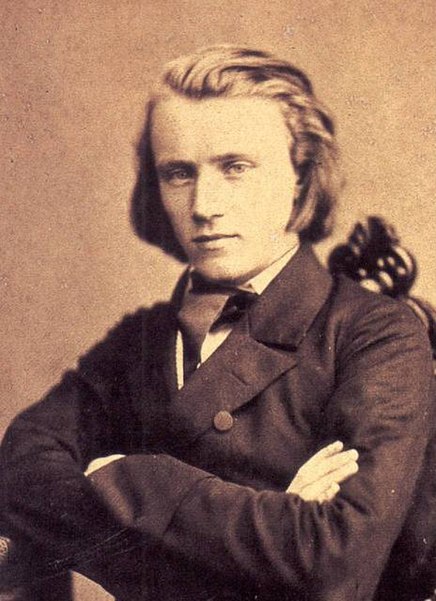
The organizer wanted a photo, too, and being increasingly camera shy and/or adverse to graven imagery, finding anything more recent than adolescence was almost impossible. As a matter of fact, I was just about an inch away from submitting this nice picture of the young Brahms (a kid with a lifetime of bad haircuts and overeating still well ahead of him) instead:
Sunday, January 27, 2008
What's controversial around here?
When a topic on a new music blog inspires passion, you have to pay attention. I've learned, for example, that expressing any reservation about the music of Shostakovich will guarantee a passionate response, but not necessarily a response informed by any musical argument. Shostakovich was a composer with brilliant technique and a tragic biography; he just wasn't an inventive or subtle composer, in my book. Having been burned on Shostakovich, I have generally refrained from bringing up music that doesn't work for me and instead concentrated on music that does. Risking further passionate controversy, I will readily admit that there are a number of composers -- including Shostakovich, Krenek, Britten, Bernstein, Henze, Zorn, and Kernis -- whose music just doesn't take me anywhere interesting, and I really do demand that music take me someplace never travelled.
Two topics, musical economics and musical institutions, are guaranteed to fill my email inbox with messages, both of approval and disapproval, but seldom do they appear as online comments. This was particularly true of my items critical of composition competitions, for which I received a striking amount of support. However, disappointingly few were willing to go public about wanting better competitions.
As to economics, I will readily admit that it's a field well outside the expertise of this musician, but nevertheless I can't help but be fascinated with little data points that add to a thick description of the world that's bopping about my music. Marginal Revolution often touches on cultural issues, Brad DeLong is a very smart guy, I've learned more about the recent credit crisis in the US from the Irvine Housing Blog, and this paper, An Empirical Analysis of Street-Level Prostitution by Levitt and Venkatesh, which noted that prostitutes with pimps may have some advantages in terms of marketing and protection, raised interesting questions for me about the comparative advantages of composers as free-lancers and with managers or institutional affiliations, and specifically in those areas of marketing and protection (e.g. provision of health care insurance).
I probably catch the most flak for my critical stance towards big musical institutions. Let me be clear that I'm perfectly aware that a certain amount of institutional structure is necessary to make some musical things happen, but one has to be persistently vigilant that the institutions not turn away from their service function for the music itself and invest ever more money, time, and oxygen in their own self-support. In a way, it's curious that my institutional critique receives any attention at all, in that the critics and bloggers and devotees of those very same institutions often spend as many words on changes in, say, opera house management or gossipy materials leaked by publicists, as the do on the aesthetics of opera.
As long as we're talking about opera houses, my critique is the opposite of the famous one of Pierre Boulez, who suggested blowing the places up. In fact, I think that if they're going to be mammoth places for upper class spectacle, simulcast in cinemas and on pay-per-view, they really don't go far enough. I would suggest that they instead follow the model of mega-churches. Put a parking lot in front of the house and glass-in one wall of the theatre for those who like to worship/watch without leaving the familiar comforts of their cars. Embrace amplification and other contemporary theatrical technologies. Let George Lukas and Joel Osteen stage these things. Opera loves stage magic and there's no reason that operas shouldn't be as vivid as a Rodger Rabbit cartoon. Heck, maybe they should even incorporate as churches -- they won't have to charge admission, as tax-deductible love offerings and cinema/pay-per-view income will surely more than cover costs. And then, the rest of us, who happen to like hearing unamplified voices in intimate surroundings can get to it.
That's probably enough to feed the passions for today.
Two topics, musical economics and musical institutions, are guaranteed to fill my email inbox with messages, both of approval and disapproval, but seldom do they appear as online comments. This was particularly true of my items critical of composition competitions, for which I received a striking amount of support. However, disappointingly few were willing to go public about wanting better competitions.
As to economics, I will readily admit that it's a field well outside the expertise of this musician, but nevertheless I can't help but be fascinated with little data points that add to a thick description of the world that's bopping about my music. Marginal Revolution often touches on cultural issues, Brad DeLong is a very smart guy, I've learned more about the recent credit crisis in the US from the Irvine Housing Blog, and this paper, An Empirical Analysis of Street-Level Prostitution by Levitt and Venkatesh, which noted that prostitutes with pimps may have some advantages in terms of marketing and protection, raised interesting questions for me about the comparative advantages of composers as free-lancers and with managers or institutional affiliations, and specifically in those areas of marketing and protection (e.g. provision of health care insurance).
I probably catch the most flak for my critical stance towards big musical institutions. Let me be clear that I'm perfectly aware that a certain amount of institutional structure is necessary to make some musical things happen, but one has to be persistently vigilant that the institutions not turn away from their service function for the music itself and invest ever more money, time, and oxygen in their own self-support. In a way, it's curious that my institutional critique receives any attention at all, in that the critics and bloggers and devotees of those very same institutions often spend as many words on changes in, say, opera house management or gossipy materials leaked by publicists, as the do on the aesthetics of opera.
As long as we're talking about opera houses, my critique is the opposite of the famous one of Pierre Boulez, who suggested blowing the places up. In fact, I think that if they're going to be mammoth places for upper class spectacle, simulcast in cinemas and on pay-per-view, they really don't go far enough. I would suggest that they instead follow the model of mega-churches. Put a parking lot in front of the house and glass-in one wall of the theatre for those who like to worship/watch without leaving the familiar comforts of their cars. Embrace amplification and other contemporary theatrical technologies. Let George Lukas and Joel Osteen stage these things. Opera loves stage magic and there's no reason that operas shouldn't be as vivid as a Rodger Rabbit cartoon. Heck, maybe they should even incorporate as churches -- they won't have to charge admission, as tax-deductible love offerings and cinema/pay-per-view income will surely more than cover costs. And then, the rest of us, who happen to like hearing unamplified voices in intimate surroundings can get to it.
That's probably enough to feed the passions for today.
Friday, January 25, 2008
The truth about the Jedi
My old friend Tom Hilton has a brilliant and timely analysis of Jedi politics, here.
Our economic history
Blogging economist Brad DeLong, in explaining why he thinks historians should study economic history, writes:
I have written before that our continuous music-historical memory extends only into the late 18th century, with musical repertoires predating that era all to be re-discovered, and, in their way, remade as contemporary musics. (The various forms of "nationalist" musics that emerge (and continue to emerge) in the past two centuries are less instances of the faithful transmission of local traditions but of local assertion of participation in the global music culture with local colors, often without much traditional precedent.) A partially economic explanation for pre-classical musical amnesia seems reasonable.
Art and literary history already follow economic history and identify modernity roughly with the turn of the 19th century. I'm now curious as to how music came to unique identify modernity with the 20th century. (No, the invention of sound recording can't be the initial impulse for this.) In fact, it might be more than interesting to rethink classical music history since 1789 or so without 1900 as the major turning point, but rather as just another marker of generational change in a more complex historical texture, with waves to and fro greater or lesser complexity, additions of new resources, ensemble or textural density, etc. while paying closer attention to the patterns of geographical transmission and reception.
...certainly since 1800 and perhaps since 1500, what is most extraordinary and salient about our global society is primarily economic and scientific, so you cannot do post-1500 history without knowing economics anymore than you can do early Byzantine history without knowing theology.I'm not certain how much economic history music historians should know, but those two dates -- or a generation earlier for 1800 -- do ring all sorts of music-historical bells. They locate moments in which local European musical traditions innovate in connection with reception by new music-consuming classes and simultaneously begin to have reach beyond local communities, across European borders and, eventually, globally.
I have written before that our continuous music-historical memory extends only into the late 18th century, with musical repertoires predating that era all to be re-discovered, and, in their way, remade as contemporary musics. (The various forms of "nationalist" musics that emerge (and continue to emerge) in the past two centuries are less instances of the faithful transmission of local traditions but of local assertion of participation in the global music culture with local colors, often without much traditional precedent.) A partially economic explanation for pre-classical musical amnesia seems reasonable.
Art and literary history already follow economic history and identify modernity roughly with the turn of the 19th century. I'm now curious as to how music came to unique identify modernity with the 20th century. (No, the invention of sound recording can't be the initial impulse for this.) In fact, it might be more than interesting to rethink classical music history since 1789 or so without 1900 as the major turning point, but rather as just another marker of generational change in a more complex historical texture, with waves to and fro greater or lesser complexity, additions of new resources, ensemble or textural density, etc. while paying closer attention to the patterns of geographical transmission and reception.
Wednesday, January 23, 2008
Who's your teacher?
While some composers are entirely self-taught, and the best composers inevitably have to become self-taught, most classical composers have teachers, and -- usually with pride, but sometimes in defiance -- add their names to our resumes, sometimes even the names of our "grandteachers", attaching ourselves through that lineage to a tradition.
But the precise nature of the teacher-student relationship, however institutionalized in CVs and dictionary entries, is far from fixed, and indeed, often very mysterious. While there are some lineages in which the students' music can be heard to be continuing the work of the master, there are as many in which the relationship to the master's music is ambivalent, critical, negative, or simply not recognizable. But neither of these styles of musical relationships to the teacher and her/his tradition says one bit about the personal relationship, which may be tender or tendentious either way.
The composition classes at UC Berkeley in the late 1950s and early 1960's are illustrative. These classes were one of the birthplaces of the radical music which would come to include the more promoted minimalism of the early 1970's, and included a number of students (Young, Riley, Rush, Leedy, Oliveros) who have become well-known. The composition staff at UCB was, however, a bit difficult to square with the nascent radical aesthetic, including names like Andrew Imbrie, Juaquin Nin-Culmel, Seymour Shifrin, and William Denny. The first two of these names were active opponents of the young radical, while the latter two, although coming from very different aesthetics became important teachers. Shifrin, a friend from youth of Morton Feldman, was committed both to a high art tradition and an atonal style that is best described as academic. One member of Shifrin's seminar said "we argued all the time with Seymour, but we loved him to death, he was a mensch." And Denny was game enough for the new ideas that he accompanied his graduate students to a festival in Provo, Utah, where he took part in a performance of La Monte Young's Poem for Chairs, Tables, Benches, etc., by playing catch onstage with Terry Riley. A visiting professorship by Robert Erickson brought a more like-minded teacher into the mix, but the fact is that these young musicians found a positive impulse in working with teachers whose own music was far from their own.
A further complication is the quantitative aspect of a teaching relationship. Some students can go in week after week for years of lessons with the same teacher and never profit from the effort. Other students are sparked for life by a pair of words at the right moment from a composer who will otherwise be a perfect stranger. A lot of resumes are padded these days with "studied with" lines for a visit to Tanglewood or Darmstadt, in which the relationship was transient, while the more decisive orchestration or counterpoint teacher back home goes unmentioned. What of all the composers who have made a summer pilgrimage to the Stockhausen Courses in Kürten in recent years? Stockhausen lectured on his own works but did not give private compositional instruction as he did earlier. While one might now speak of a small contemporary "School of Stockhausen", it's not quite accurate to identify the members of this school as Stockhausen's students.
The relationship to a teacher changes over time, too. I had the luck to have some great composition teachers, and one of the pleasures of this life has been the gradual unfolding over time -- and a long time, at that -- of what exactly I learned from these good people. It's a continual surprise. I was recently writing a eccentric little passacaglia, and suddenly realized that my fussiness about balance and symmetries owed everything to Gordon Mumma, with whom I did not explicitly study counterpoint; indeed I do think that he ever used the term in my presence. But it turns out Gordon taught me a lot about counterpoint and his ideas about balance and density are inescapable parts of my toolkit.
But the precise nature of the teacher-student relationship, however institutionalized in CVs and dictionary entries, is far from fixed, and indeed, often very mysterious. While there are some lineages in which the students' music can be heard to be continuing the work of the master, there are as many in which the relationship to the master's music is ambivalent, critical, negative, or simply not recognizable. But neither of these styles of musical relationships to the teacher and her/his tradition says one bit about the personal relationship, which may be tender or tendentious either way.
The composition classes at UC Berkeley in the late 1950s and early 1960's are illustrative. These classes were one of the birthplaces of the radical music which would come to include the more promoted minimalism of the early 1970's, and included a number of students (Young, Riley, Rush, Leedy, Oliveros) who have become well-known. The composition staff at UCB was, however, a bit difficult to square with the nascent radical aesthetic, including names like Andrew Imbrie, Juaquin Nin-Culmel, Seymour Shifrin, and William Denny. The first two of these names were active opponents of the young radical, while the latter two, although coming from very different aesthetics became important teachers. Shifrin, a friend from youth of Morton Feldman, was committed both to a high art tradition and an atonal style that is best described as academic. One member of Shifrin's seminar said "we argued all the time with Seymour, but we loved him to death, he was a mensch." And Denny was game enough for the new ideas that he accompanied his graduate students to a festival in Provo, Utah, where he took part in a performance of La Monte Young's Poem for Chairs, Tables, Benches, etc., by playing catch onstage with Terry Riley. A visiting professorship by Robert Erickson brought a more like-minded teacher into the mix, but the fact is that these young musicians found a positive impulse in working with teachers whose own music was far from their own.
A further complication is the quantitative aspect of a teaching relationship. Some students can go in week after week for years of lessons with the same teacher and never profit from the effort. Other students are sparked for life by a pair of words at the right moment from a composer who will otherwise be a perfect stranger. A lot of resumes are padded these days with "studied with" lines for a visit to Tanglewood or Darmstadt, in which the relationship was transient, while the more decisive orchestration or counterpoint teacher back home goes unmentioned. What of all the composers who have made a summer pilgrimage to the Stockhausen Courses in Kürten in recent years? Stockhausen lectured on his own works but did not give private compositional instruction as he did earlier. While one might now speak of a small contemporary "School of Stockhausen", it's not quite accurate to identify the members of this school as Stockhausen's students.
The relationship to a teacher changes over time, too. I had the luck to have some great composition teachers, and one of the pleasures of this life has been the gradual unfolding over time -- and a long time, at that -- of what exactly I learned from these good people. It's a continual surprise. I was recently writing a eccentric little passacaglia, and suddenly realized that my fussiness about balance and symmetries owed everything to Gordon Mumma, with whom I did not explicitly study counterpoint; indeed I do think that he ever used the term in my presence. But it turns out Gordon taught me a lot about counterpoint and his ideas about balance and density are inescapable parts of my toolkit.
A Recipe for Hard Times
In the face of a recession, it looks like the White House and US Congress will soon put together a massive economic stimulus package with some mixture of tax reductions and spending, the latter perhaps in the form of direct grants. The idea is to get additional money circulating in the economy as fast as possible through both spending and investment. The economist Lawrence Summers writes that: "...fiscal stimulus only works if it is spent so it must be targeted . Targeting should favour those with low incomes and those whose incomes have recently fallen for whom spending is most urgent." May I make the suggestion that a modest portion of this package be directed the way of musicians, and composers in particular? Our incomes tend to be low and, in these days, falling, and we're particularly well suited to spending money as fast as possible. Without a doubt, any direct grants sent our way will be disposed of with astonishing velocity.
Tuesday, January 22, 2008
R.W., the action figure
 I suppose that it's obvious -- if any composer were going to be a minature action figure, it'd have to be Richard Wagner (who, at around 150cm tall was pretty much a miniature action figure in the flesh). The manufacturer also has a Mozart on offer, but wouldn't a Gesualdo have been more like it?
Bring it on!
The ever-observant Robert Gable of Aworks links to a commentary thread on the recent US Democratic debates with this comment:
So, yes, let's have some public gut-chewing, or at least some verbal fisticuffs, for a change. I can imagine a couple of composer-on-composer forensic pairings that would make a presidential debate or a bloggingheads episodes look like a walk hand-in-hand through a field of daisies. Bring it on!
"The podiums are whisked away and it's a nice friendly sit-down between three candidates who want to chew each other's guts out." Wouldn't it be great if composers had the same kind of debates?I'm all in favor of putting our disputes out in the open -- at the moment, we pretend in public as if there are no controversies and let those in positions of power manage our disputes through the quiet backroom processes of handing out scholarships, jobs, awards, and commissions. The illusion of harmonious getting along for getting along's sake contribute, however, to the false public impression that there is no heat, no passion, no action, and no innovation in our field. This is bad for the public life of our music. Simultaneously, the reduction of debate to the distribution of our pitiful spoils is bad for the life of the music itself, not to mention the livelihoods of those eclipsed by any local or temporal orthodoxy.
So, yes, let's have some public gut-chewing, or at least some verbal fisticuffs, for a change. I can imagine a couple of composer-on-composer forensic pairings that would make a presidential debate or a bloggingheads episodes look like a walk hand-in-hand through a field of daisies. Bring it on!
Saturday, January 19, 2008
Your own chunk of the moon
Slate has an article about private claims to lunar real estate. Until very recently, the question of private travel to the moon has been a theoretical one and claims to chunks of property on our satellite have either been in the realm of fantasy or scams. With increasing likelihood for commercial travel to the moon -- whether for tourism, homesteading, or helium-3 mining -- claims to acreage up there are becoming everless virtual and evermore plausible and deciding who gets to own and exploit the moon may actually become serious.
Until then, however, music will still share some vital qualities with lunar real estate. Music tends to the ephemeral -- is it located in the air molecules we push around, or in a score, or in storage media (scores, recordings), or is it a platonic ideal of some sort? -- and the ownership of a music is unclear. Does it belong to the composer or the performer or the passionate listener? Is it a gift channeled from (the) god(s)? Is it a state or public good or is it a gift to humankind? Can it be bought, bartered, or sold? Is it a gift without market value? Heck, even the very idea that one could own a music is far from clear.
Talking about music as property is always bound to be uncomfortable, and I suspect that we're in for some particularly uncomfortable times, as the parties with substantial material interests in this question are just getting warmed up.
In the western legal tradition, we've already been through three major historical steps in the development of ideas as properties. The first was biblical, in the Decalogue, in which God forbid the making of graven imagery (thus asserting state control over creative work) and in the latter books, in which authors receive attribution (again, the attribution is controlled by institutional apparatus; the veracity of those attributions has been controversial ever since). The second step was in the assertion of states, royal, republican, or authoritarian, that intellectual property was a public good to be licensed and authors were granted (very slowly, in the case of musicians), limited periods of limited control over their work, after which the work fell into a "public" domain (we owe the word "royalties" to this). The third stage came with the age of private capital, and private persons, individually and collectively, sought to create a number of measures and institutions designed to protect and extend rights as well as to maximize income from the protected properties. We're still somewhere in this stage, but witnessing significant changes in the circumstances: "legal persons", corporations, which do not live naturally long lives, are now asserting rights well beyond those demanded earlier by real persons and technological developments in the media and transmission methods for intellectual property are changing at breathtaking speed, with unclear implications for the future of control over and income generation from that property. Furthermore, we're witnessing an intense conflict between the beneficiaries of this third stage, associated still with a liberal assertion of rights around the turn of the 20th century, and those who view the new technological circumstances as an opportunity to move away from, if not eliminate, the notion of property, a liberal assertion in its own terms, but one connected with the turn of the 21st century. How this will all turn out is anyone's guess at the moment, but I think that the moment is an opportune one to step back from the legal questions and consider instead exactly what it is we would like to achieve from an assertion of property rights to intellectual property, and music in particular, and do so in ethical rather than legal terms.
The estimable Carl Stone has a nice item over at the New Musicin the Box, about the appropriation of music by others into one's own work. There is indeed a long tradition of this in music (parody, anyone?), but the appropriation of mechanically or electronically recorded material seems to go several steps further, in that one is not borrowing a bit of code* from a piece of music (a tune, for example), but excising a vertical slice of a complete musical product, including both composition and performance or realization. The legal situation is heated, often turning on the question of the size of the borrowed sample ("how big is a musical breadbox?"), and has created a nice side job for a handful of academically-trained musicians in the creepily-named field of "forensic musicology"; likewise heated is the question of monetary returns from a sample. I think that this problem is eminently soluble, however. Creators of music differ on their degree of attachment to their work, with some unconcerned -- even enthusiastic -- about subsequent appropriation, others willing to sanction it based upon a fee, and other so attached to their work in a particular form that they wish that no appropriations be licensed, regardless of any fee proffered. I believe that there is an ethical responsibility to respect these wishes with regard to the creative work of an individual, simply because we recognize that a relationship to one's creative work can be intimate and intimate, and his or her music falls in a private sphere around a person that deserves protection regardless of the precise legal or economic status of the property. Furthermore, it is not difficult to assert -- via a notation in a score or a signature on some data format -- the precise wish of the composer: to permit all usage, to permit all licensed usage, or to limit usage to a particular instance.
_____
* I've had a long argument with open source advocates about music, among them Richard Stallman, that music is substantially different from software in that the source code of music is always open to anyone with ears, so that protecting property rights for music is not a barrier to the further development of the underlying codes.
Until then, however, music will still share some vital qualities with lunar real estate. Music tends to the ephemeral -- is it located in the air molecules we push around, or in a score, or in storage media (scores, recordings), or is it a platonic ideal of some sort? -- and the ownership of a music is unclear. Does it belong to the composer or the performer or the passionate listener? Is it a gift channeled from (the) god(s)? Is it a state or public good or is it a gift to humankind? Can it be bought, bartered, or sold? Is it a gift without market value? Heck, even the very idea that one could own a music is far from clear.
Talking about music as property is always bound to be uncomfortable, and I suspect that we're in for some particularly uncomfortable times, as the parties with substantial material interests in this question are just getting warmed up.
In the western legal tradition, we've already been through three major historical steps in the development of ideas as properties. The first was biblical, in the Decalogue, in which God forbid the making of graven imagery (thus asserting state control over creative work) and in the latter books, in which authors receive attribution (again, the attribution is controlled by institutional apparatus; the veracity of those attributions has been controversial ever since). The second step was in the assertion of states, royal, republican, or authoritarian, that intellectual property was a public good to be licensed and authors were granted (very slowly, in the case of musicians), limited periods of limited control over their work, after which the work fell into a "public" domain (we owe the word "royalties" to this). The third stage came with the age of private capital, and private persons, individually and collectively, sought to create a number of measures and institutions designed to protect and extend rights as well as to maximize income from the protected properties. We're still somewhere in this stage, but witnessing significant changes in the circumstances: "legal persons", corporations, which do not live naturally long lives, are now asserting rights well beyond those demanded earlier by real persons and technological developments in the media and transmission methods for intellectual property are changing at breathtaking speed, with unclear implications for the future of control over and income generation from that property. Furthermore, we're witnessing an intense conflict between the beneficiaries of this third stage, associated still with a liberal assertion of rights around the turn of the 20th century, and those who view the new technological circumstances as an opportunity to move away from, if not eliminate, the notion of property, a liberal assertion in its own terms, but one connected with the turn of the 21st century. How this will all turn out is anyone's guess at the moment, but I think that the moment is an opportune one to step back from the legal questions and consider instead exactly what it is we would like to achieve from an assertion of property rights to intellectual property, and music in particular, and do so in ethical rather than legal terms.
The estimable Carl Stone has a nice item over at the New Music
_____
* I've had a long argument with open source advocates about music, among them Richard Stallman, that music is substantially different from software in that the source code of music is always open to anyone with ears, so that protecting property rights for music is not a barrier to the further development of the underlying codes.
Friday, January 18, 2008
Orchestral Style
While opinions about the quality of contemporary opera singing differ, there's probably a general agreement that we're in a golden age for playing by opera orchestras. Opera orchestras are different herds from concert hall orchestras and have to master a considerably different skill set. As accompanists, they have to master fairly complex figuration, often long-winded and repetitive, and a great deal of the time off the beat, and they have to respond flexibly and extemporaneously to the circumstances onstage. While the opera orchestra definitely has moments in the forefront, much of their responsibility is for the music beneath the surface and that's too often undervalued (I am a great admirer of internal instrumental parts in the operas of Rossini). It occurs to me that minimal(ist) music, when it goes orchestral, is too often assigned to concert rather than operatic ensembles, which would have a natural edge with a music in which an unambiguous surface is often absent. With a few exceptions (Glass, Adams, and...) that's clearly an opportunity missed.
Lessons for the young
Neglect. There is probably no greater difficulty for a composer than negotiating an uneasy economy in which the personal value of ones work will never satisfactorily equate with a market value. Musical works and their authors are also subject to the unpredictable caprices of style (now in, now out) and the unexplainable inequities of musical politics (fighting over bloody nothing). It is no wonder that composers are often prone to melancholy, bitterness, anger, even paranoia, and the most inventive among us, sometimes directly as a result of those personal qualities which make one inventive in the first place, tend to suffer most.
The greatest rock and roll band of their time, Spot 1019, put out an album with the title "The World Owes Me A Buzz"; their sarcasm could not have been stated any better: not only does the world has no notion of any debt to you, most of your working life will be spent doing anything but that which you do best of all, simply in order to survive, and everything you will ever produce belongs to the "public domain" with your possession granted only temporarily.
I owe a lot to John Cage, both from his music and his way of organizing his work, but perhaps nothing more than his example of how to be a composer and not be bitter in the face of neglect. If I understood correctly, it was the combination of the negative example of his teacher Adolph Weiss and his own sunny disposition that made Cage determined not to become bitter, and by and large, he managed it.
If you can learn early on not to have any illusions about the material circumstances of our profession, you'll be at an advantage. It's useful to think about your work in terms of that which your compose out of your own desires and that which is composed as work-for-hire, and cherish the few opportunities when the two impulses coincide. It's also an advantage, methinks, to have a comfortable enough home and place to work. Realize that your work requires time, and purchasing time often means giving up something else. If you're social and familial, making time for loved ones is important, too.
The greatest rock and roll band of their time, Spot 1019, put out an album with the title "The World Owes Me A Buzz"; their sarcasm could not have been stated any better: not only does the world has no notion of any debt to you, most of your working life will be spent doing anything but that which you do best of all, simply in order to survive, and everything you will ever produce belongs to the "public domain" with your possession granted only temporarily.
I owe a lot to John Cage, both from his music and his way of organizing his work, but perhaps nothing more than his example of how to be a composer and not be bitter in the face of neglect. If I understood correctly, it was the combination of the negative example of his teacher Adolph Weiss and his own sunny disposition that made Cage determined not to become bitter, and by and large, he managed it.
If you can learn early on not to have any illusions about the material circumstances of our profession, you'll be at an advantage. It's useful to think about your work in terms of that which your compose out of your own desires and that which is composed as work-for-hire, and cherish the few opportunities when the two impulses coincide. It's also an advantage, methinks, to have a comfortable enough home and place to work. Realize that your work requires time, and purchasing time often means giving up something else. If you're social and familial, making time for loved ones is important, too.
Wednesday, January 16, 2008
Biographic
I'm ambivalent about biographies and autobiographies, and especially so about those of composers. While on the one hand, there is the fascination of a tale well-told, sometimes real -- and movingly so -- connections between my own experiences and those of the biograph-ed, and there are occasional flashes that brilliantly illuminate the music itself. But the other hand is an inevitable voyeuristic element, and that makes me decidedly uncomfortable. Fascinated, but uncomfortable about it.
I once began writing a monograph about a contemporary composer's music, but had to give it up because, as a writer, I couldn't get a handle certain aspects of his life that had bearing on his music (sex, drugs, religion, criminal rap sheet...). I'm realist enough to recognize that musicians are not their music, they can be cads and cheats and slobs and scoundrels without any of that playing out in their music and ideally, I 'd like the music to speak for itself, but the real world does have a tendency to penetrate the music, and sometimes that effect is inescapable.* I trust that this blog has reflected my ambivalence.
So with all of those reservations, let me note that composer David Cope has placed an autobiographical work, Tinman, online here, a series of 150 reminiscences . I am also looking forward to reading a pair recently published biographical works, as it happens, about dance -- Janice Ross's new biography of the dancer Anna Halprin, an essential figure in experimental dance, and one somewhat neglected by having worked on the left coast, and Carolyn Brown's Chance and Circumstance: Twenty Years with Cage and Cunningham.
_____
* The most civil exchange I've had online was with the late musicologist Philip Brett, a pioneer in queer musicology. We strongly disagreed about the role that sexuality played in John Cage's work, but I believe that our dialogue caused each of us to move a bit from our extreme positions; whereas I had previously been convinced that it was a non-issue, I am now convinced that there are in fact a handful of pieces -- among them The Perilous Night, Letters to Erik Satie with Sound Anonymously Received, and One^11 and 103 -- in which Cage's intimate biography plays an essentially role. I deeply regret not having met Prof. Brett
I once began writing a monograph about a contemporary composer's music, but had to give it up because, as a writer, I couldn't get a handle certain aspects of his life that had bearing on his music (sex, drugs, religion, criminal rap sheet...). I'm realist enough to recognize that musicians are not their music, they can be cads and cheats and slobs and scoundrels without any of that playing out in their music and ideally, I 'd like the music to speak for itself, but the real world does have a tendency to penetrate the music, and sometimes that effect is inescapable.* I trust that this blog has reflected my ambivalence.
So with all of those reservations, let me note that composer David Cope has placed an autobiographical work, Tinman, online here, a series of 150 reminiscences . I am also looking forward to reading a pair recently published biographical works, as it happens, about dance -- Janice Ross's new biography of the dancer Anna Halprin, an essential figure in experimental dance, and one somewhat neglected by having worked on the left coast, and Carolyn Brown's Chance and Circumstance: Twenty Years with Cage and Cunningham.
_____
* The most civil exchange I've had online was with the late musicologist Philip Brett, a pioneer in queer musicology. We strongly disagreed about the role that sexuality played in John Cage's work, but I believe that our dialogue caused each of us to move a bit from our extreme positions; whereas I had previously been convinced that it was a non-issue, I am now convinced that there are in fact a handful of pieces -- among them The Perilous Night, Letters to Erik Satie with Sound Anonymously Received, and One^11 and 103 -- in which Cage's intimate biography plays an essentially role. I deeply regret not having met Prof. Brett
Tuesday, January 15, 2008
Not yet musically conscious
Weekday mornings, after getting my daughter to Kindergarten, are delicate hours. Between precompositional insomnia and a biological clock still set to Pacific time, I get to bed late, and the early wakeup comes after a bare minimum of quality sleep, so the ends of all my nerves attached to any musically relevant perceptual organs are still numb. The only solution is to play some music. Although a wind player by training, morning hours are not quite the right ones for idle Bläserei, so I stumble to the piano and do some sight reading.
But what to play? Some musical traditions have repertoire which is classified as being appropriate to particular hours of the day. Both Hindustani and Karnatic musics identify ragas with morning afternoon, evening, or late night. Aside from liturgical music, western classical music is basically repertoire for evening concerts, music made for formal wear and decorum, for artificial light and a particular social setting. Not for morning alone, half-conscious, in slippers at an upright piano. In the absence of a specialized repertoire, I've invented my own. I read through The Fitzwilliam Virginal Book, The Art of the Fugue, Mikrokosmos and Kurtág's Játékok. I've grown attached to the little character pieces gathered among the sins of Rossini's old age, many of the mysterious small pieces by Liszt, and Satie has always been there (I find that the early "gothic" pieces only work for me in the morning). Sometimes I'll croak out an Ives song, and small pieces by Mumma ("from the Sushi box"), Jennings, Cage, Feldman, Hovhaness (I especially like Bare November Day), and some of John White's Sonatas are more recent parts of the mix.
This is private music making, for myself, and as much ritual and therapy as musical training, and although my personal repertoire is often a bit dark in character, this is all joyful music-making, something that Herr Doctor Wolf recommends to all.
But what to play? Some musical traditions have repertoire which is classified as being appropriate to particular hours of the day. Both Hindustani and Karnatic musics identify ragas with morning afternoon, evening, or late night. Aside from liturgical music, western classical music is basically repertoire for evening concerts, music made for formal wear and decorum, for artificial light and a particular social setting. Not for morning alone, half-conscious, in slippers at an upright piano. In the absence of a specialized repertoire, I've invented my own. I read through The Fitzwilliam Virginal Book, The Art of the Fugue, Mikrokosmos and Kurtág's Játékok. I've grown attached to the little character pieces gathered among the sins of Rossini's old age, many of the mysterious small pieces by Liszt, and Satie has always been there (I find that the early "gothic" pieces only work for me in the morning). Sometimes I'll croak out an Ives song, and small pieces by Mumma ("from the Sushi box"), Jennings, Cage, Feldman, Hovhaness (I especially like Bare November Day), and some of John White's Sonatas are more recent parts of the mix.
This is private music making, for myself, and as much ritual and therapy as musical training, and although my personal repertoire is often a bit dark in character, this is all joyful music-making, something that Herr Doctor Wolf recommends to all.
Monday, January 14, 2008
Good Fortune
Before I fall into my routine of rants, let's take a moment to note some of the real good news out there, in Newmusicland, and beyond:
The most important festival for new music is now the Ostrava Days in the Czech Republic; it has talent and attitude.
Wordless Music, in NYC, seems to be doing very good things, too.
There are many musicians specializing in new music that ought to be mentioned, but none is more important than the Belgian pianist Daan Vandewalle. Another pianist to pay attention to is Satoko Inoue.
Following in the tall shadows of Kronos and Arditti is not easy, but there are a number of younger quartets who play new music as it should be played. I think that the Quatour Bozzini deserves special attention.
The musical blogoplan is full of daily surprises. Among my composing colleagues, I always learn something new from the blogs of Charles Shere and Nico Muhly, with perspectives different from mine (note to Magister Muhly: your blog always makes my Opera browser crash!). Loose Poodle is an indispensable guide to film music, a world at a cheerful tangent to my own.
Outside of musical blogs, I give thanks for Blogging Heads, for a dose of smarts and civility in US public political discourse (I recommend the conversations between Joshua Cohen and Glenn Loury in particular, and one can easily avoid anything with Mickey Kaus or those folks with National Review credentials), and at random: Crooked Timber, Strange Maps, Cosmic Variance, Language Log, Savage Minds, and Silliman's Blog. I'm still looking for good blogs about dance and classics and I wish there was more at Errol Morris's blog Zoom,
The most important festival for new music is now the Ostrava Days in the Czech Republic; it has talent and attitude.
Wordless Music, in NYC, seems to be doing very good things, too.
There are many musicians specializing in new music that ought to be mentioned, but none is more important than the Belgian pianist Daan Vandewalle. Another pianist to pay attention to is Satoko Inoue.
Following in the tall shadows of Kronos and Arditti is not easy, but there are a number of younger quartets who play new music as it should be played. I think that the Quatour Bozzini deserves special attention.
The musical blogoplan is full of daily surprises. Among my composing colleagues, I always learn something new from the blogs of Charles Shere and Nico Muhly, with perspectives different from mine (note to Magister Muhly: your blog always makes my Opera browser crash!). Loose Poodle is an indispensable guide to film music, a world at a cheerful tangent to my own.
Outside of musical blogs, I give thanks for Blogging Heads, for a dose of smarts and civility in US public political discourse (I recommend the conversations between Joshua Cohen and Glenn Loury in particular, and one can easily avoid anything with Mickey Kaus or those folks with National Review credentials), and at random: Crooked Timber, Strange Maps, Cosmic Variance, Language Log, Savage Minds, and Silliman's Blog. I'm still looking for good blogs about dance and classics and I wish there was more at Errol Morris's blog Zoom,
Someone else's career
A friend just emailed with this observation:
While I have to agree that doubt -- or at least a good, steady dose of self criticism -- is operative for me, I don't think that the notion of belief, or in this case, an absence of belief, is meaningfully opposed to doubt. Doubt, for me, is the recognition of opportunity to do something else, or to find an alternative approach, and to be open to the possibility of failure. David Feldman (another good friend) has talked about this aspect as having a tragic aspect, in that the methods I use may create music that almost replicates some familiar music, but ultimately falls short. I find that rather interesting, and sometimes even comic rather than tragic, and if there is a tragic element, it is in the simple fact that "familiar music" has become rather strange. We cannot satisfactorily recover the context in which it was made and understood. I have a tremendous attachment, for example, to repertoires of music in which a body of conventions of figure and affect were understood and in play, but my personal attachment is not the same as and not a substitute for being a part of the communities in which those conventions were functional and meaningful. The same goes for my accidentally ex-pat status in Europe: I'm here, but I'll never be from here, and the best I can do is approach the musical culture here with the distance of an ethnomusicologist rather than that of another Yanqui composer on the make.
What then, about belief? There are communities of believers, and they often share repertoires of music, believing in the conventional and habitual as well as the special elements in those repertoires. Although I've been tempted, I don't happen to identify with any such community. And, although a "new music" necessarily implies a positive or negative challenge to an existing repertoire, there are individual composers who are able to assert their musical choices with all of the authority that comes with belief in one's own work. Although I've been impressed by the examples of some of my composing colleagues who have such belief in their own work, I can't really follow their examples, and I am, in many cases, left with considerable doubt. (Stockhausen is the canonical example -- either he believed what he claimed to believe or he didn't believe it and it was all an elaborate marketing scheme; neither possibility strikes me as particularly attractive.)
Karl Rove, the political advisor to the current Bush told the journalist Christopher Hitchens that
"I’m not fortunate enough to be a person of faith", a sentiment that I find impossible to follow. If one identifies having faith as fortunate, then one seems to be, however indirectly, asserting a form of faith. I suspect Rove, however, was simply admitting to a cynical, Straussian, use of believers for his politically ends, which is even worse. If I have any fortune at all as a composer, I suspect it is the fortune of being a person of doubt.
Deej,
...you know, you'd have had an entirely different career if belief in your work had been the operating principle rather than doubt...
While I have to agree that doubt -- or at least a good, steady dose of self criticism -- is operative for me, I don't think that the notion of belief, or in this case, an absence of belief, is meaningfully opposed to doubt. Doubt, for me, is the recognition of opportunity to do something else, or to find an alternative approach, and to be open to the possibility of failure. David Feldman (another good friend) has talked about this aspect as having a tragic aspect, in that the methods I use may create music that almost replicates some familiar music, but ultimately falls short. I find that rather interesting, and sometimes even comic rather than tragic, and if there is a tragic element, it is in the simple fact that "familiar music" has become rather strange. We cannot satisfactorily recover the context in which it was made and understood. I have a tremendous attachment, for example, to repertoires of music in which a body of conventions of figure and affect were understood and in play, but my personal attachment is not the same as and not a substitute for being a part of the communities in which those conventions were functional and meaningful. The same goes for my accidentally ex-pat status in Europe: I'm here, but I'll never be from here, and the best I can do is approach the musical culture here with the distance of an ethnomusicologist rather than that of another Yanqui composer on the make.
What then, about belief? There are communities of believers, and they often share repertoires of music, believing in the conventional and habitual as well as the special elements in those repertoires. Although I've been tempted, I don't happen to identify with any such community. And, although a "new music" necessarily implies a positive or negative challenge to an existing repertoire, there are individual composers who are able to assert their musical choices with all of the authority that comes with belief in one's own work. Although I've been impressed by the examples of some of my composing colleagues who have such belief in their own work, I can't really follow their examples, and I am, in many cases, left with considerable doubt. (Stockhausen is the canonical example -- either he believed what he claimed to believe or he didn't believe it and it was all an elaborate marketing scheme; neither possibility strikes me as particularly attractive.)
Karl Rove, the political advisor to the current Bush told the journalist Christopher Hitchens that
"I’m not fortunate enough to be a person of faith", a sentiment that I find impossible to follow. If one identifies having faith as fortunate, then one seems to be, however indirectly, asserting a form of faith. I suspect Rove, however, was simply admitting to a cynical, Straussian, use of believers for his politically ends, which is even worse. If I have any fortune at all as a composer, I suspect it is the fortune of being a person of doubt.
Wednesday, January 09, 2008
Moondog remembered
I've just finished reading Robert Scotto's biography of Moondog (Louis Hardin), Moondog: The Viking of 6th Avenue. The details of his life are really outside of my portfolio -- a sometime street musician, blinded as a youth, with a thing for Viking-inspired garb, and apparently some ugly opinions -- but his music is charming and, in its own way, important, an example of a music benefiting from the constraints of an aesthetic niche, but also making interesting connections to other contemporary musics, in Moondog's case to music life in New York from the Rodzinski years at the Philharmonic to 1950's jazz and 1960's minimalism.
Moondog specialized in composing rounds and canons, sometimes to a ground, and usually over steady percussion accompaniment, which he played on a kit of triangular drums struck with a clave and a maraca as mallets. The counterpoint is quite strict, tonal or modal, but with frequent quintuple and septuple metres, which I've found makes the music especially suitable for teaching musicianship. (I recommend the rounds (Moondog called them madrigals) on the second Columbia recording, Moondog 2.) Scotto poses the question of how a technique so focused upon a minor genre like the round can be used to generate larger forms, and it clearly troubled the composer, but it really shouldn't trouble us, as good things are not diminished by small packages.
The best part of the book is the attached cd, with some rare recordings, including some of the madrigals performed by an all-stars-to-be grouping including Moondog, Phillip Glass, Steve Reich, and Jon Gibson. (Drawing a connection from Moondog's piano piece, To a Seahorse, to some later minimalism, is almost inescapable.) Unfortunately my copy came with defects in the surface, making half the tracks unplayable... has anyone else noticed that the quality of cds has been slipping, just like lps in their last years?
Moondog specialized in composing rounds and canons, sometimes to a ground, and usually over steady percussion accompaniment, which he played on a kit of triangular drums struck with a clave and a maraca as mallets. The counterpoint is quite strict, tonal or modal, but with frequent quintuple and septuple metres, which I've found makes the music especially suitable for teaching musicianship. (I recommend the rounds (Moondog called them madrigals) on the second Columbia recording, Moondog 2.) Scotto poses the question of how a technique so focused upon a minor genre like the round can be used to generate larger forms, and it clearly troubled the composer, but it really shouldn't trouble us, as good things are not diminished by small packages.
The best part of the book is the attached cd, with some rare recordings, including some of the madrigals performed by an all-stars-to-be grouping including Moondog, Phillip Glass, Steve Reich, and Jon Gibson. (Drawing a connection from Moondog's piano piece, To a Seahorse, to some later minimalism, is almost inescapable.) Unfortunately my copy came with defects in the surface, making half the tracks unplayable... has anyone else noticed that the quality of cds has been slipping, just like lps in their last years?
Monday, January 07, 2008
A WINTER ALBUM, expanded
A WINTER ALBUM of small piano pieces has now been joined by A Mind of Winter (after Wallace Stevens) by Steve Hicken. The album -- no publisher, no editor, but plenty of presence and some community -- is online here, and is not yet closed to contributions.
Sunday, January 06, 2008
Late 20th Century Ringtones
If you could have any bit of fairly well-known late 20th-century serious music as a ringtone for your cellular/mobile phone, what would it be? David Feldman, without skipping a beat, said Lucier's I am sitting in a room ("...different from the one you are in now..."), which should have been obvious, but it would nevertheless be interesting to encounter a bit of serial bebop or classic minimalism while in a crowded cafe, underground, or shopping mall. Perhaps the more interesting question would be: what is the piece of late 20th-century music least likely to be used as a ringtone? And no, 4'33'' doesn't count.
Saturday, January 05, 2008
The uses of enchantment
More musings from a fever'd mind. The talk these days is of Barack Obama's win in the Iowa Democratic Caucuses and his victory speech, and for good reason: we were treated to a bit of now-rare oratory in which speech sometimes aspires to the condition of music. In these moments of aspiration words acquire definite pitches, sequences of words melodic contour, and vowels are sometimes extended in time to allow a contour to form a distinct rhythm. But Obama, to his complete credit, has absolute control and never quite allows his speech to become song. His rhythms never relax in an easy metre and his word choices favor quasi-repetition over exact reiterations. He is a serious man and respects the line between logic and rhetoric, applied to convince an audience of an argument, and rhapsody, which -- as Plato warned in the Ion -- is designed to go beyond conviction to the non-rational states of possession, whether by muses -- amusement -- or the gods -- enthusiasm.
Music and speech are too easily confused, and that confusion has its uses, both for better and for worse. Music and speech often share acoustical features and -- perhaps evolutionarily "piggy-backed" upon one another -- a set of perceptual and cognitive organs, but beyond those organs, music and speech appear to light up entirely different pathways through the brain. The important counter-example of sign languages shows that an acoustic component is not necessary to language and the capacity for music to function in entirely non-communicative contexts as well as to use sounds that are linguistically meaningless shows important material and semantic distances of music to speech. Nevertheless, there will always be forms of music which are informed and enriched by a relationship to language, and there will always be forms of speech will aspire to the condition of music.
Music and speech are too easily confused, and that confusion has its uses, both for better and for worse. Music and speech often share acoustical features and -- perhaps evolutionarily "piggy-backed" upon one another -- a set of perceptual and cognitive organs, but beyond those organs, music and speech appear to light up entirely different pathways through the brain. The important counter-example of sign languages shows that an acoustic component is not necessary to language and the capacity for music to function in entirely non-communicative contexts as well as to use sounds that are linguistically meaningless shows important material and semantic distances of music to speech. Nevertheless, there will always be forms of music which are informed and enriched by a relationship to language, and there will always be forms of speech will aspire to the condition of music.
Tuesday, January 01, 2008
A WINTER ALBUM is online
A WINTER ALBUM of small pieces for piano is now online here. It includes works by Dennis Báthory-Kitsz, Jon Brenner, Steed Cowart, Elaine Fine, Hauke Harder, Ben.Harper, Jeff Harrington, Aaron Hynds, Lloyd Rodgers, Jonathan Segel, and Charles Shere. A few more pieces have been promised and -- thanks to the magic of the internet -- may well still appear in the album.
Sunday, December 30, 2007
What's Opera, Doc?
Gratuitous opera posting designed to improve blog ratings. But then again, any cultural history that fails to take into account the importance of Bugs Bunny's transvestism is seriously lacking.
Saturday, December 29, 2007
A Fever'd Mind Seldom Rests
A thought experiment: We all wake up one morning having forgotten music, what music is, and what music does to us. Three things can happen: (1) we re-invent music, more or less as it was before, or (2) we re-invent music, but it differs in substantial ways from what it had been, or (3) we get about with our lives but without any music. What have we lost and what have we gained in each scenario? What does this suggest about the nature and value of music? To what degree do these three possibilities reflect the working methods of a composer?
Friday, December 28, 2007
Broadsided
This blog has been quiet because I've been horizontal (bronchitis; it's going around; three cheers for decent health care). In the past three years (and 757 posts) I've had it worse, in fact I've had a couple of operations, and still managed to blog a bit, but this time, the world can wait.
In any case, The Winter Album will be online on the 1st of January, 2008 and it will be well worth the wait.
In any case, The Winter Album will be online on the 1st of January, 2008 and it will be well worth the wait.
Saturday, December 22, 2007
Allen Strange's Taqueria
I divide composers into two classes, those who care about cooking and those who don't. (It also happens that the class of composers who write music I like is more or less coterminus with those who care about cooking, but in a universe with many happy coincidences, should that be altogether a surprise?)
Newly returned to the internet is composer Allen Strange's Manual for Mexican Street Cooking, available here. This is a nice resource, with a personal and pragmatic take on some matters strictly gourmand. Strange, long a professor of music in San Jose, has retired to places North, continues to make music, and also has written, with violinist Patricia Strange, a valuable book of instrumentation recipes for composers, The Contemporary Violin.
Growing up in Southern California, the present season has always been one intimately associated with tamales. Yes, if you stuff it in dough, I'll probably eat it, but tamales are in a class by themselves, whether sweet (filled with pineapple, mango, jam) or savory (my ideal is the long lost Atascadero tamale of my childhood). The recipes I use come mostly from an ancient copy of Maria A De Garbia's Mexico en la cocina de MARICHU, which I picked up somewhere in Mexico City a long time ago, but at this point, I tend to go freestyle with my tamale stuffings, improvising with whatever is at hand, and remaining resolutely un-PC with my tamale dough, happily enriched with dangerous quantities of manteca (yep, lard).
Newly returned to the internet is composer Allen Strange's Manual for Mexican Street Cooking, available here. This is a nice resource, with a personal and pragmatic take on some matters strictly gourmand. Strange, long a professor of music in San Jose, has retired to places North, continues to make music, and also has written, with violinist Patricia Strange, a valuable book of instrumentation recipes for composers, The Contemporary Violin.
Growing up in Southern California, the present season has always been one intimately associated with tamales. Yes, if you stuff it in dough, I'll probably eat it, but tamales are in a class by themselves, whether sweet (filled with pineapple, mango, jam) or savory (my ideal is the long lost Atascadero tamale of my childhood). The recipes I use come mostly from an ancient copy of Maria A De Garbia's Mexico en la cocina de MARICHU, which I picked up somewhere in Mexico City a long time ago, but at this point, I tend to go freestyle with my tamale stuffings, improvising with whatever is at hand, and remaining resolutely un-PC with my tamale dough, happily enriched with dangerous quantities of manteca (yep, lard).
Friday, December 21, 2007
Venture Capital and Composition
Check out this website for recombinant, a start-up firm offering music automation solutions in the emerging field of media genomics, with core competencies in music analysis, recognition, and recomposition. Consulting on copyright infringement litigation appears to be a major part of the business. It's co-led by composer David Cope (who was one of my teachers).
Music: The Animation of the Moment
To my question (inspired by Errol Morris's cogitations on a pair of photographs):
I don't think that my claim is contradicted by Charles' point; in fact, I suspect that my claim is the necessary precondition to a music which -- perhaps dialectically, perhaps intuitively -- is all about allowing us to get beyond, or even forget the moment with its beginning and end and to transcend our everyday experience of time as duration.
This is a process which began, as far as I can tell, with the notion of polyphony and was later dramatically expanded with the use of multiple topics in late Viennese classicism. Polyphony, at root, is about doing different things (making different sounds) at the same time, allowing them to share a moment, and music history illustrates a course in which the definition of "different" was continuously expanded (systematic musicology would describe this on a continuum from more alike to more differentiated, or homophony to heterophony). Notable way stations on this path include the polytextual motet, the simultaneous tempi of Monteverdi's Concitato style (which is a rather simple relation to the extraordinary Javanese irama system*), the three simultaneous dances in Don Giovanni, and continue through the network technique of Wagner, Ives' use of polyphony to evoke physical spaces, etc..
The initial fork in the road is that between music as heightened speech communication and music as an aesthetic marking of time's passing. There have, in fact, been very good examples of music which has attempted to reconcile this, and often the means have been polyphonic; the contradictory accompaniments in Schumann's Im wunderschönen Monat Mai and Ives' The River come first to mind. But the more influential path seems to me to be in the diachronic play of musical topics which emerges an an alternative to the rhetorical systems cultivated in the baroque and classical eras and emerges most clearly with the late works of Mozart and throughout Beethoven's catalog. It is most central to the "figure in a clearing" topic, which I would date in absolute works to Beethoven's Pastorale Symphony**; this topic is characterized by a musical background (not yet an accompaniment, just an atmosphere) without significant temporal markers of its own before which foreground events occur. This topic is important to each of the composers Charles mentioned, and I would add Mahler, Ives, Cage (in the works with rhythmic structures and, later, time brackets) and Feldman (the composer on the grid) as well as any composer who begins by first laying down a persistant groove and then putting things on top of it.
_____
* Paradoxically parallel tempi, creating environments in which it is unclear whether the prevailing tempo is slow or fast are fascinating. My favorite recent example is that of Alvin Lucier's string quartet, Navigations for Strings, in which the notes played by the strings are articulated at a very slow speed, but the resultant beats from the microtonal tuning often emerge as the vivid surface of the music, and are at times quite fast. Or another example from the history of film -- here's Jonathan Rosenbaum's article about tempo in the films of the extraordinary director Yasujiro Ozu, Is Ozu Slow?.
** The Pastorale is absolute music with a programmatic veneer: you get over the program quickly enough to realize that there really is music there.
Isn't much of music -- at least that much that is not about speech-like communication -- the attempt to fill in the space between two moments of time?Charles Shere posted a serious response:
Well, not to me, no. I mean, yes: music as it was thought of in its Great European Age, say Bach to 1950, yes: it's attempts to fill in "space" between moments. Or so we think of it, though I feel that many masters manage to do this sort of mechanically (though very well indeed) when in fact they have a completely different idea in mind, and that's what I like about a lot of Berlioz, Schubert, Bruckner, Sibelius: their music may be about filling a duration, but it's also about getting completely away from a concern with that.
Point is, a lot of newer music (including much of my own) is not about moving from moment to moment, but about existing within time, doesn't matter what moments one might choose as kickers or closers.
I don't think that my claim is contradicted by Charles' point; in fact, I suspect that my claim is the necessary precondition to a music which -- perhaps dialectically, perhaps intuitively -- is all about allowing us to get beyond, or even forget the moment with its beginning and end and to transcend our everyday experience of time as duration.
This is a process which began, as far as I can tell, with the notion of polyphony and was later dramatically expanded with the use of multiple topics in late Viennese classicism. Polyphony, at root, is about doing different things (making different sounds) at the same time, allowing them to share a moment, and music history illustrates a course in which the definition of "different" was continuously expanded (systematic musicology would describe this on a continuum from more alike to more differentiated, or homophony to heterophony). Notable way stations on this path include the polytextual motet, the simultaneous tempi of Monteverdi's Concitato style (which is a rather simple relation to the extraordinary Javanese irama system*), the three simultaneous dances in Don Giovanni, and continue through the network technique of Wagner, Ives' use of polyphony to evoke physical spaces, etc..
The initial fork in the road is that between music as heightened speech communication and music as an aesthetic marking of time's passing. There have, in fact, been very good examples of music which has attempted to reconcile this, and often the means have been polyphonic; the contradictory accompaniments in Schumann's Im wunderschönen Monat Mai and Ives' The River come first to mind. But the more influential path seems to me to be in the diachronic play of musical topics which emerges an an alternative to the rhetorical systems cultivated in the baroque and classical eras and emerges most clearly with the late works of Mozart and throughout Beethoven's catalog. It is most central to the "figure in a clearing" topic, which I would date in absolute works to Beethoven's Pastorale Symphony**; this topic is characterized by a musical background (not yet an accompaniment, just an atmosphere) without significant temporal markers of its own before which foreground events occur. This topic is important to each of the composers Charles mentioned, and I would add Mahler, Ives, Cage (in the works with rhythmic structures and, later, time brackets) and Feldman (the composer on the grid) as well as any composer who begins by first laying down a persistant groove and then putting things on top of it.
_____
* Paradoxically parallel tempi, creating environments in which it is unclear whether the prevailing tempo is slow or fast are fascinating. My favorite recent example is that of Alvin Lucier's string quartet, Navigations for Strings, in which the notes played by the strings are articulated at a very slow speed, but the resultant beats from the microtonal tuning often emerge as the vivid surface of the music, and are at times quite fast. Or another example from the history of film -- here's Jonathan Rosenbaum's article about tempo in the films of the extraordinary director Yasujiro Ozu, Is Ozu Slow?.
** The Pastorale is absolute music with a programmatic veneer: you get over the program quickly enough to realize that there really is music there.
Subscribe to:
Posts (Atom)