Monday, September 25, 2006

You broke it, you own it

Henry Farell of Crooked Timber, in a review of a new book by Tyler Cowan, asks a rich question:

...if a significant number of people value art not only as passive consumers, but also because they can remix and reuse that art in novel and unexpected ways, should public funding of art be conditioned, say, on this art being released under a Creative-Commons type license where possible?
The more that one considers the knot that is identifying artistic work as intellectual property, the idea of a (when not the) public domain, and the question of whether patronage inevitably leads to ownership, the more one realizes what a total mess of a knot we're in, the kind of knot with a level of complexity that my four-year-old daughter typically creates with shoelaces.

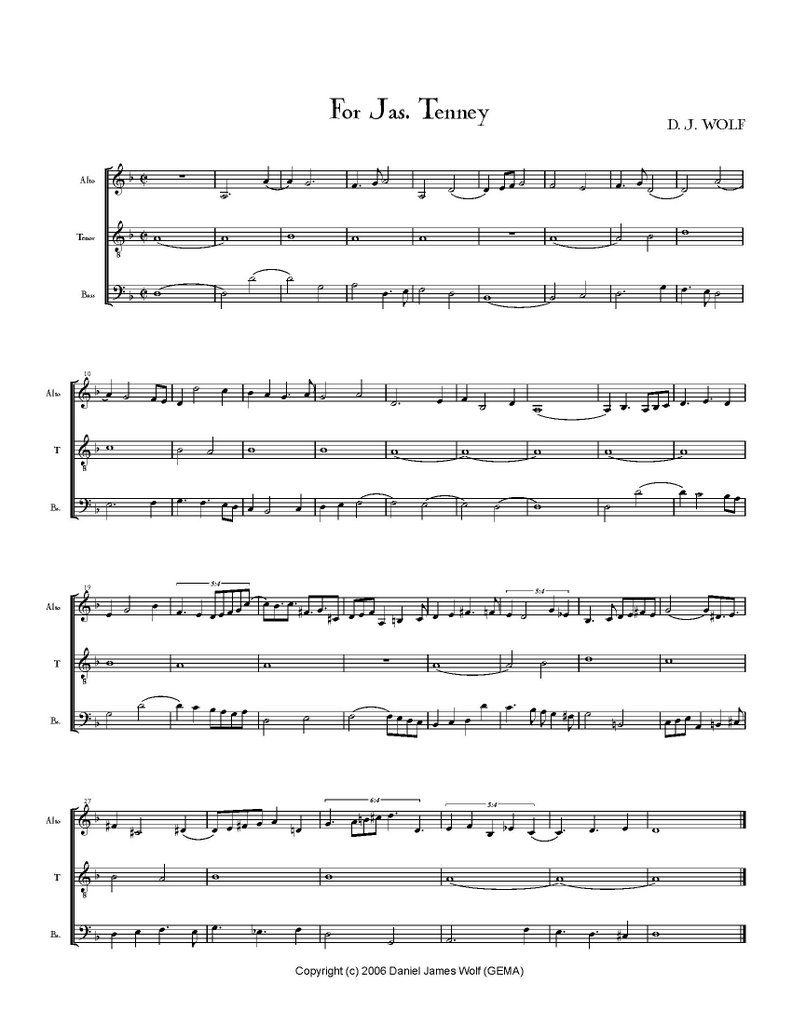
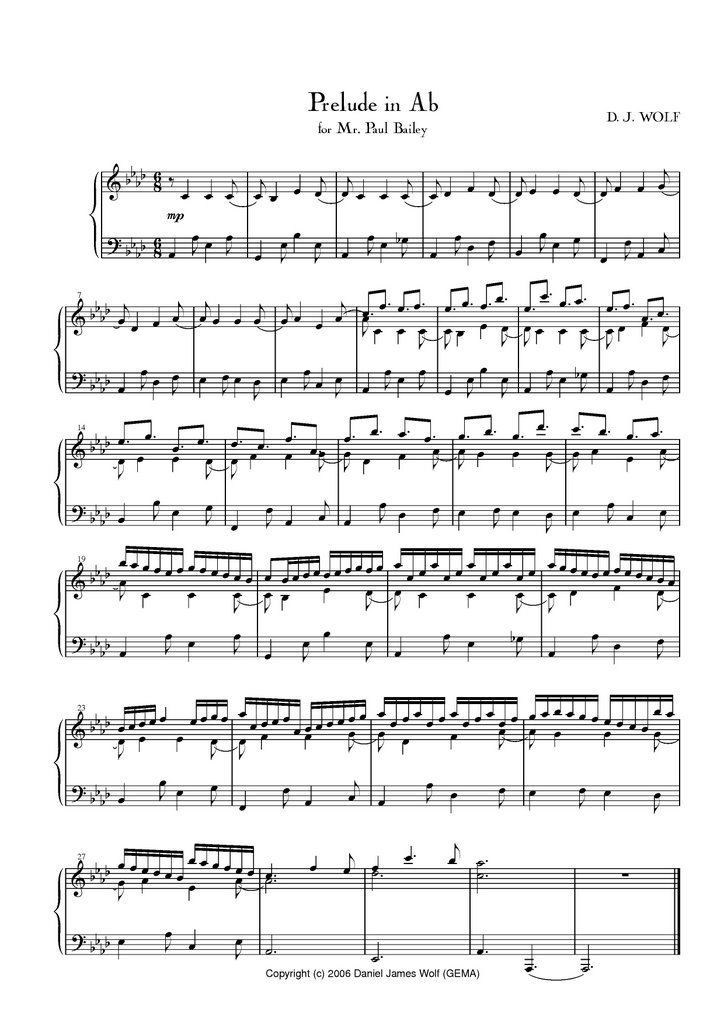
I've completed a number of pieces with my own resources, on my own time, and satisfying no demands other than those of my own curiosity. This is work in which external patronage, whether private or state, has not played, does not play, and probably will never play a role. My investment in these pieces is one of time, musical and intellectual energy, and emotion. My attachment to these pieces is a private and emotional one. And yet, the premise of existing legal and economic frameworks is that the work belongs to the public, which may ultimately use, reuse, mix, and abuse it as it sees fit, and my custody over the work is both temporary and limited. My alternatives are to either assert a temporary claim to the work, in the form of ordinary copyright, or explicitly give up that claim, letting the public have more immediate and flexible access, through claiming a Creative Commons or copyleft-style status.

This is a profoundly unsatisfactory situation, especially in that it does not distinguish between properties which are real consumer goods with real market values and work that simply doesn't want to play that game. I believe that there is a fundamental difference between controlling the trademark on Ricky Rodent (or any other negotiable property) and say, La Monte Young's wish to controll the way in which his music is played and presented. The present environment appears to give the corporate owners of the cartoon rat more consideration that they do a living composer's wish to make his own music in the way he wants it. How do we stop having to play this game?

Sunday, September 24, 2006

Handmade

Computer notation programs are now so obiquitous, that it's easy to forget how the work was done before we had these machines. Courtesy of Henle Editions, the most traditional of the traditional German music publishers, is a must-see video (WMV format) featuring one of the last virtuoso Notenstecher (music engraver) at work, scratching and hammering a metal plate in preparation for printing. Virtuosity here means eight hours work for a single page of music. This video, which I heard about via the Finale Users's list, is something I'd show to everyone studying music, if only to restore a little wonder about something we tend to take for granted.

Saturday, September 23, 2006

Orchestrators

Orchestrators -- a set including but not limited to composers -- fall into three broad groups. There are members of each who orchestrate wonderfully and inventively, but they do tend to hold ideas about their craft that are incompatible with the ideas of their colleagues in other confessions. The three groups are

(1) The well-trained, who go by the textbook definitions of range, register, combinations, scoring patterns and devices.

(2) The idealists, who will write the sounds they want to hear, regardless of what the textbooks say, and expect the players to come up with ways to realise those sounds.

(3) The optimizers, who are not so interested in extremes as in using resources optimally. When Morton Feldman was composing a score for the Brandeis Chamber Choir, he asked Alvin Lucier about the range of the choir. Lucier responded with a list of extremes, which Feldman rejected. "What's the range?" he asked again, wanting to know not the possible ranges but instead the ranges in which each singer sounded at their best.

My own sympathies are with the idealists and optimizers, but they work at the peril of ever having a well-trained orchestrator judge their work. A well-trained orchestrator will condemn the optimizer for conservatism, and the idealist for impracticality. I once witnessed a well-trained orchestrator who rejected a score (I believe by Henze) for having a low double-B natural in the contrabass. His critique was that the composer was another one of those impractical idealists, asking for the impossible. The textbooks, after all, say that the bass goes down to E, and sometimes to C. Too bad that the well-trained orchestrator had never heard the Berlin Philharmonic live, with their full set of five-string tuned-in-fourths-down-to-B contrabasses!

Friday, September 22, 2006

Landmarks (18)

Christian Wolff: Burdocks (1970-71) for one or more groups of five or more players.

Burdocks is not a through-composed score but rather a collection of ten parts or pieces from which an ensemble performance can be assembled. The individual pieces are each quite different in character from one another. In part, they summarize a body of techniques that Wolff had investigated over many years, but some new ideas were added as well, chief among them the suggestion of possible solutions to questions of ensemble performance in a cooperative, non-authoritarian environment. Conventional staff notation is minimal here. Some pieces have quite elaborate graphic scores, some mix text instructions and graphics, some are primarily text, and one piece consists of the single word "flying", without further interpretive guidance. Wolff's series of scores in which continuity and simultaneity are derived from a variety of cuing techniques between ensemble members and with environmental awareness receives a provisional summation in Burdocks and, slightly later, in Changing the System (1972-73), in which the social dimension of the cuing process aquires an explicit political element.

Burdocks is orchestral but not symphonic; it is written for a community of musicians, but not one that has come together in a particular configuration to submit to agreed authority, as is required by the symphonic tradition. Wolff has described Burdocks as a "messy" piece (he named the piece for a weed, after all) and has also said that he had the image of the Scratch Orchestra in mind, before ever having heard the group. I have been involved three times in performances of Burdocks and have found that both the communal and anarchic potentials of the score play themselves out in unexpected ways through the rehearsal and performance process. Each time, I was left with the distinct impression that I had become a better musician, and perhaps, a somewhat better person.

Potlatch

Over at the website of the American Music Junta Center, Dennis Báthory-Kitsz has done a survey of composers on the subject of productivity, as part of his "We Are All Mozart" project.


Readers of this page know that I am not shy of terminology borrowed -- and often quite loosely -- from the dismal science, but in this case I'm rather uncertain about the importance of production in a gift economy, like that of new music.


In general, the exchanges involving works of music in our community are of such modest monetary value that even a description in the most micro of microeconomic terms would be an exaggeration. But the exchanges we make must have real value by some other measure, or we surely wouldn't be bothered with the enterprise, let alone engage in it with such passion. A more useful description might rather be in terms of an exchange of gifts, with any accompanying exchange of money a matter of incidental if not random noise. But it's difficult for me to imagine that the value of a gift can be meaningfully or consistantly related to a level of productivity.


Moreover, if I am reading Báthory-Kitsz's article correctly, the implication is that high productivity in music has value in itself. It's far from clear to me that this should be so. Indeed, it is precisely because I can hear new music as an opportunity - when not an imperative - for resistance to the prevailing musical culture (as well as the larger culture around that music) that I have to reject a simple attachment of music-making to the prevailing work ethic.

Wednesday, September 20, 2006

Aggregates

The term aggregate is used in two ways by musicians.

The first, associated with Cage and Harrison, but probably coming from Cowell and Seeger, indicates an ensemble or complex of tones, articulated together. In Cage's music, the complex tones of the prepared piano lead directly - and explicitly so in the Concerto for Prepared Piano and Chamber Orchestra - to the use of collections, or gamuts, including combinations of single tones, aggregates, noises, and silences. A melody may then be composed not only of a single tones, but of a succession of events including single tones, aggregates, noises, and silences. (Christian Wolff has written about this best, and applied the ideas consequently in his own music).

The second usage, associated with Babbitt, indicates the consumption, horizontally and/or vertically, of complete sets of all of the pitch classes in the temperament. In Babbitt's music, this number is inevitably 12, although some relatively recent techniques for creating arrays of aggregates have introduced the possibility of so-called weighted aggregates, in which successive or simultaneous sets of 12 tones are deficient by at least one pitch class and, consequently, redundant by at least one pitch class.

The two usages are markers of fundamentally different ideas about how a musical universe is put together, as well as different ideas about the identity of the elements that make up that universe. In the Babbitt-style usage, all elements are "notes", sharing all properties and potentiality except for pitch, and aggregates measure successive exhaustions of the supply. The fundamental issues in this music are determining which aggregate should follow another, and making a case for that determination through through the way in which the successions are articulated. In the Cagian usage, aggregates are themselves elements in the gamut of a piece, and sets of elements do not necessarily share any properties such that exhaustion of a set would have any particular significance.

(There is, incidentally, some middle ground in this terminological field, in Stravinsky's "verticals" - in which simultaneously played rotations of row segments fan out from the unisons found on the diagonal of a row matrix -, for example, or in the "chord multiplication" technique associated with Boulez. The latter, of course, knew the aggregate idea directly from his exchanges with Cage, and there is some resemblance between chord multiplication and the aggregate techniques of Cage found in Winter Music, the vituosic piano and violin Etudes, and in the "Number" pieces for keyboards, the use of lists of possible chords. However accidental, there is also a certain aural affinity between late Stravinsky and the music of Cage in the late 1940's and early 1950's.)

Whither concert?

Most of my colleagues seem to be using the word "show" instead of "concert" these days. Hope you can come to my show on Thursday. Doing a show next week at Red Hat. Did a show with Ensemble Modern in Cologne. I suppose it came from playing in clubs and other non-traditional concert halls (in popular music, the word "concert" dates, apparently, as very 1970's/AOR), but it's definitely crossed over into use for regular concert halls. Personally, I can't bring myself to making the substitution. I'm not embarassed about the word concert, and "show" makes me think immediately of "hey, kids, let's put on a..." which is fingernails on a blackboard for my ears.

But is persisting with the use of the word "concert" elitist, or just quaintly retrograde? I dunno, but I do know this: My father used to define an intellectual as someone who could hear the William Tell Overture and not think of The Lone Ranger. Nowadays, anyone who can hear the William Tell Overture and think of The Lone Ranger is either aged or a postmodernist. Personally, I hear the William Tell Overture and think of Doodles Weaver. Elitism or just the product of a liberal education?

Monday, September 18, 2006

Looking back at the future

In the twentieth century, one couldn't avoid the notion that things were moving forward, optimistically improving upon all that had gone before, even when going forward meant taking a few cautious steps backward (small is beautiful, food is better when slow, and even music can be renewed). But our present century has begun with a deep pessimism: supplies of vital resources have peaked, technological fixes might not come soon enough, the rational is competing with unthinking fundamentalism, and there is great uncertainty about a world where theocratic and billion-strong nationalist states are emerging as unavoidable forces. How much of the present conservatism in music has been composed over this pessimistic background?

*****
Heinz-Klaus Metzger and Rainer Riehn aptly named the Varese-volume of their MusikKonzepte series Varese: A Look Back at the Future. They were spot on; the future in Varese's music has become a nostalgic one, with non-trivial connections to now-tired utopian visions ranging from the futurists to marxists. The most currently pervasive utopian visions -- whether of a new caliphate or a networked pax (corporate) Americana or the China that gets rich before it gets old -- don't seem to be inspiring much in the way of the new in new music. (I can't help but think of the title of that late Nono piece: La lontananza nostalgica utopica futura.)

*****
It's a bit shocking to consider the possibility that some of the "most modern" music ever composed was composed in the 1920s and '30s. The cool serial and indeterminant works of the 1950's, dressed up in a flat international style, are often honest about their mysticism. Certainly so in Messiaen, Goeyvaerts, Stockhausen, but Cage's appeals to Eastern thought, Nono's to Marx, and even Babbitt's positivism each have mystical qualities of their own (isn't there an element of the mystical in the notions of projecting and hearing a set class or an agggregate?). The divisions of those years -- sacred/meditative, social/political, quasi-scientific -- continued to inflect music in the next generations.

*****
Varese's, like the futurists, dipped constantly in the reserves of the romance of modern science and technology. Consider just his titles: Hyperprism, Ionization, Density 21.5. Varese's music combined great gestures stripped of their expressive referents, alongside suggestions of mechanical rhythms, but static and dynamic, and the continuous functions of portamenti, sirens, and the Ondes Martenot. But the futurists, like Varese, were also primitivists. While this is a trope shared with the Stravinsky of Le Sacre or Antheil's Ballet Mechanique or Revueltas' Sensamaya, the balance between these two elements defines almost all of Varese's music. (There is after all, nothing both more primitive and more modern than the rhythms of a machine.) From the Ondes Martenot-accompanied Popul Vuh text in Equatorial to the ethnological recordings interrupting Poeme Electronique, Varese was completely at ease in such juxtapositions. (Xenakis, too, would find a distinct balance between his most calculated or abstract materials and material that connects directly to his own folk music culture).

*****
Varese's personality is the one among major 20th century composers that is most difficult to approach. The music has traces of his fury and his sensitivity; he was as attached to early, particular vocal, music as to the ultra-modern, and his own achievement was one mostly for winds and percussion; the small number of scores and their broken chronology are marks of a complicated psychology. What are we to make of the anti-semitism that turns up in his letters? Connecting to Varese and to his music becomes increasingly difficult, as difficult as it is to connect to the now-aged vision of the future his music everywhere expresses.

(These remarks are due to the chance juxtaposition, on my desk, of a summary of the recent, controversial, speech in Augsburg by the Bishop of Rome, and a copy of the score to Hyperprism).

Sunday, September 17, 2006

Putting it online

Here's a small list of contemporary composers who are putting a substantial number of their scores online. Many composers have samples of scores online, I've only listed those with complete scores for free downloading. Please let me know of more addresses to add (djwolf AT online DOT de).

Dennis Báthory-Kitsz
David Feldman (Postscript)
Daniel Goode
John Greschak
Jeff Harrington
Larry Polansky
Larry Polansky's collection of Rounds

Here are some historical collections:

Mildred Couper
Leo Ornstein

Here are some favorite scores by colleagues that I've put online:

Douglas Leedy, Piano Sonata 1994, Watergate Rounds
Markus Trunk, Boötische Riten

Friday, September 15, 2006

The Future of Sheet Music Publishing

As a student, I received a lot of advice about publishing sheet music. Funny thing was, none of those teachers giving me advice, all of it traditional (i.e. write your scores on ozalids, use sizes of paper other than letter or legal, do not photocopy, write a good cover letter), were conventionally published themselves. Already by the early 1980's, things had clearly changed in the music publishing world*, and no one on the composers' side of things seemed to be talking about it directly. The historical importance of publishing was clear -- publishers had helped composers secure their rights and the income from those rights, they produced useable (and sometimes beautiful) editions of the music, they dealt with all the details of getting materials here and there and back again, and, not least, they promoted the works in their catalogs. But are publishers still providing these services? And if so, are traditional publishers now the optimal providers of these services?

*****
First some anecdotes:

About ten years ago, I joined a composer friend (whom we'll call C.)for a few hours at the Musik Messe (Music Trade Fair) in Frankfurt. C. publishes his own music, and he had hired space at the Fair to promote his scores to presenters and retailers. At that time, C's evening-length comic opera, in German, was in the middle of extremely successful parallel runs at a number of opera houses throughout Germany. I watched that afternoon, in astonishment, as one big music publisher's rep. after another sauntered over to the table and offered to "publish" his opera. What exactly were they offering? They weren't offering to typset the score, as the existing score had proved sufficient for performing. They weren't really offering to promote the piece, which, as one representative put it, was both a guaranteed audience draw and so easily presented on a limited budget that it "really sold itself". What they were offering to do was manage the rentals of the materials (all of which C. had prepared by her/himself), in return for half the royalties.

More recently, another composer friend ("D.") took a moment to show me a recent statement from her/his publisher. The balance of the statement was a negative number; it turns out that the publisher was billing the composer, D., for making corrections so that the score would fit the "house style" of formatting. The composer was not being asked to pay for wrong notes, or any other errors on the composer's part, but for comformity with the house editorial style. This wasn't publishing in any form that I could recognize, but rather a partnership between composer and publisher in which the composer was clearly assuming a portion of the financial risk.

And then there are all of those big publishers, for whom an overpriced, spiral-bound photocopy of the composer's manuscript is considered state-of-the-art publication.** That and fifty percent of the royalties, of course. Plus, consider the case of any of those big publishers with a huge back catalog of work still under copyright protection: getting existing catalog items broadcast, recorded, or played in concert is going to have a natural financial priority over acquiring and preparing new works for the catalog, as the old properties represent sleeping investments that can be milked until the copyrights run out. As attractive as it would appear to share a publisher with Richard Strauss or Orff or Schreker, a more contemporary composer is always going to be at a disadvantage in getting services from her or his publisher, as that would represent a new and risky capital outlay.

*****

I'll be blunt: Traditional music publishing does not now offer a good deal for most contemporary composers. This comes at an interesting moment, in which ownership of the means of reproduction is no longer monopolized by publishers. Because of this, more than a few composers have recognized the writing on the wall and begun to take alternative paths to music publication. The first alternative is for composers, alone or collectively, to go into the cottage industry of publishing their own work, printing and selling sheet music, essentially duplicating the work done by traditional publishers.

There are two objections that come up again'n'again when self-publication is discussed. The first is that giving scores away for free eliminates the possibility of making money from the sale of a score. Answer: unless you can guarantee that a score will sell many copies (many = at least 500) and that it will continue to sell for generations, then there is no money to be made in selling sheet music. That is why publishers will invest editorial time in a new edition of the Beethoven sonatas, designed to sell for scores of years, but not in preparing editions of your scores. Real money comes from commissions, licenses, and royalties. A very small number of composers might eventually be able to sell their original manuscripts, but don't do your retirement planning on that basis. This is one of the great lessons seldom taught to young composers. All together now: There is no money in selling sheet music. Real money comes from commissions, licenses, and royalties. The second objection is that self-publication is vanity publication. Short and snappy answer: let me know the name of a composer who isn't vain about her/his music. Longer answer: Publication of musical scores has never been the equivalent of academic publication vetted by editorial or peer review; editorial and peer review in music comes about from performances, broadcasts, and recordings. Publication, and that includes self-publication, is simply a means toward getting those performances, broadcasts, and recordings.

There are many examples of self- and composer-organized group publication (e.g. the Wa-Wan Press, Charles Ives' publishing his 114 Songs, or helping to subsidize the operations of Henry Cowell's New Music Edition). A more recent operation, and still a going concern, is that of Karlheinz Stockhausen, who, dissatisfied with both his sheet music publisher and his recording firm, set up his own shop. The initial impulse seems to have been a need for greater control over the quality of the publications, and dissatisfaction with production delays, but I believe that the added advantage of retaining all of the licenses and royalties soon became just as important an impulse. Stockhausen is far from the only cottage publisher -- Tom Johnson, Christopher Fox, Hans-Joachim Hespos also come to mind. In addition to self-publishing solo composers there are the entrepreneurs and collectivists, with catalogues of music by several composers -- Composer/Performer Edition, Feedback Verlag, Frog Peak Music, Material Press, or the Thürmchen Verlag. But all of these ventures are still basically dealing with paper -- whether published in advance or on demand -- and still have to deal with packing that paper, figuring out how to ship it from point a to b, and sometimes back again, figuring out how to pay for it (currency transactions can often cost more than it's worth) and doing it all within a reasonable period of time. (For musicians, a "reasonable amount of time" for getting a score is usually "now", and not infrequently, "yesterday").

The second alternative, and the one I believe that is most important to the future of new music is to get out of the paper-handling business and bypass the post altogether. Already, with my own commissioned works, the usual practice has become one of producing Postscript or PDF files and emailing them directly to commissioners or players. With the resources of my own home studio, I can produce scores in any format the players would like to have (American or European paper norms, miniature, short, or full scores, and sets of parts, transposed or not) and don't have to worry about packaging. This flexibility is particularly useful for new music, as some musicians prefer to play from score, others from parts, and almost every musician has their own preferences about how pages should be hooked together or pasted to poster board or shrunk or blown-up to suit eyes or fit music stands. Moreover, musicians can get a score as soon as it's been proofread (and -- admittedly a down-side -- often before that) or a score can be put online for even wider access. By putting the score online and making it available free to the public, the traditional composer-publisher-retailer-player chain is shortened dramatically. Players can peruse scores online, download and print out whatever they like, and any royalties or licenses, should they choose to publicly perform or record a piece, can go undivided back to the composer via their rights organizations. And in the best of cases, such a shortened chain of transmission invites more direct communication between composers and performers.

Is there still room for beautiful, bound editions of music? Absolutely, and sales to libraries and collectors may still be a vital market for some scores, but such editions are not essential to getting music played. Is there room left for traditional publishers? Sure, if they can provide services to those composers who cannot or will not do them on their own and are willing to share their royalties.

_____
* The early 1980's also mark the point in time when traditional engraving was dying off and computer "engraving" was not yet practiced widely.
** A particularly poignant example of this is to be found in the catalog of C.F. Peters. Why did it take so many years -- and years after the deaths of both composers -- to figure out that more money could be made by collecting piano (and prepared piano) scores by Cage and Feldman into modestly-priced anthologies than by continuing to sell handmade ozalids and photocopies of individual pieces one-by-one? On the basis of sales to academic libraries alone, such anthologies had guaranteed sales in the hundreds. But not only institutional sales -- buying up expensive Peters scores one-by-one with hard-earned paper-route money was a real bummer, and for the price of one score published the old way kids now can get a whole repertoire of pieces in a single volume. This is good all-around -- for the composers' estates, for Peters, for players, and for young people trying to get a sense of these musical landmarks.

Ives and Mahler

Someone will someday write the definitive book on Ives and Mahler, the two major landscape artists among composers. For the moment, and very tentatively, let me note one major difference between the two. Mahler's landscapes are always heard from a single, optimal vantage point, the vantage of a cool and detached listener. In Ives, the vantage point can also be dynamic: in his most complex landscapes (the Scherzo of the Fourth Symphony, Putnam's Camp, parts of the Second Orchestral Set and Holidays) the composer -- and, vicariously, the listener -- is constantly on the move, changing his or her perspective on the scene. Ives' landscapes are all drawn from memory, and sometimes even second-hand memories, so that this movement and the consequent fragmentation of the musical continuity has a double purpose, recording not only the disjunctions of acoustic events in real public spaces, but also those in private memory spaces. This is critical, in that Ives can use the pace of these disjuctions and the density of overlaid materials to carry his own commentary on the experience. In contrast, Mahler's commentary tends to be imbedded in more traditional means of musical continuity, albeit always imbued with his own distinctive nostalgia.

There is something of Emerson's "floating eyeball" in Ives' landscapes. Emerson, in Nature: I become a transparent eye-ball; I am nothing; I see all... But Ives' ears are not transparent, they are not anonymous, and they do not hear all; they are very much a particpant in the civic life of the landscapes. The impression of Ives' biography is everywhere, and the point of audition is very much human and selective. Moreover, Ives always appears open to the possibility that not only does the observer change position, the observer can also be changed by the experience. But then perhaps Emerson's metaphor was always more applicable to Mahler: In these cases, by mechanical means, is suggested the difference between the observer and the spectacle, -- between man and nature. Hence arises a pleasure mixed with awe; I may say, a low degree of the sublime is felt from the fact, probably, that man is hereby apprized, that, whilst the world is a spectacle, something in himself is stable.

Wednesday, September 13, 2006

Revolutions

Well, today, I've finished 45 trips around the sun. If anything at all has been learned in these 45 years, it's dwarfed by the extent of everything still to be learned. The possibility of surprise and change to come, despite my present and abundant ignorance, is as good a reason as it gets to keep working.

Is there any old saying more misleading than nihil novi sub sole ("there's nothing new under the sun")? My grandfather, now 97, is putting the finishing touches on his first novel, with a fictionalized account growing up on a 65,000-acre ranch in central-coastal California in the 'teens. My daughter, four, just delivered a stack of drawings; her discoveries in perspective, proportion, contrast, color, are daily reminders of the capacity to look at this old world in ever new ways. If I'm able to summon up even a fraction of the creative energy that those two have, then I'll be good to go for at least the next 45 trips.

Bravura

Jeff Harrington was probably the first new music composer to stake his career online, a brave and pioneering move. (The first musician I heard talk about the internet as a resource was Ron Kuivila, who, back in 1993, kept going on about making music with "mosaic sites" -- with reference to that early browser -- as an extension of the networked music making of groups like The League of Automatic Music Composers and The Hub; interestingly, Kuivila has himself stubbornly avoided establishing an online presence for his own work). Harrington's was a brave move not least because it signaled independence from all of the traditional means composers have had for getting music out into the world as well as from many of the institutions that mediate between a composer and the public. His pioneering work includes making scores and electronic realizations or mock-ups of scores freely available: folks, this is the way publishing is going, and any composer who places his or her scores in the hands of a traditional publisher is simply allowing themselves to be ripped off and, eventually, neglected. Harrington's web site is well worth a visit with its rich offerings in scores and audio (I'm off recordings this year, so my aquaintance is with his scores).

Harrington is also a brave composer. A case in point for me is his Horn Trio. It's in the nature of a horn trios to be very difficult to write as the instrumental combination (violin, horn, piano) presents real challenges in balance, registration, and articulation. (I speak from experience: my own horn trio has been a work-in-progress for more than 2o years). Further, the repertoire is dominated by the example of the trio by Brahms, and for many, that of Ligeti. I think Harrington made a correct decision not to make a large, multi-movement work in the Brahms/Ligeti mode, and further broke that mode by avoiding any direct historical references. Instead, his trio is a single through-composed movement with a sustained motoric energy and figural character of its own.

Harrington's musical sensibility is very different to my own -- probably not surprising in that he's a Julliard-trained composer with a commitment to an idea of tonal music and a southerner with a deep personal connection to the vernacular traditions of New Orleans and the Delta -- but, after all, isn't the possibility of an encounter with another sensibility the great advantage of finding music online?

Stoic Hands Rehearsing Ernestly

Rehearsing is fascinating, and often more engaging than "real" performing. Here's raw video footage of Edward Gorey rehearsing the puppets of Le Theatricule Stoique.

Tuesday, September 12, 2006

Landmarks (17)

Charles E. Ives, Symphony Nr. 4 (ca. 1910-16, revised ca. 1921-25).

Had long known the Fourth from recordings, the first complete recording, under Stokowski, was only a suggestion of what the piece might be, and the quad recording under Serebrier made a great advance, especially in finding a path through the second movement, as dense a landscape as Ives would ever compose, and one in which not only sounds in the landscape are transient but the observer moves, and is moved, as well. The fourth movement, perhaps the most mysterious music Ives would ever compose, was finally made clear by Peter Eötvös, conducting here in Frankfurt (a typical story: the yank had to move to Europe to hear this piece live). When the chorus began singing Watchman, my heart stopped, and has never beat the same again. I believe that that moment is for an American listener as close as he or she will ever come to knowing what O Freunde, nicht diese Töne! can be for Europeans.

*****

Making this list of landmarks involves a bit of gamesmanship. Although the list is neither ranked nor limited in number of entries, each addition suggests a new set of relationships to the pieces already listed as well as pieces yet to come. A work -- or works -- by Ives was bound to come soon, but which one and when? The Fourth and the Second Orchestral Set are the pieces to which I'm most attached, but Ives' catalog is so full of astonishing works that any choice is practically a chance operation.

Fermata

Fundamentalists and materialists have this in common: both are unable to sustain a poetic wonder and humility in the living world.
-- Mary Catherine Bateson (found here)

Monday, September 11, 2006

Memory and Allegory

Among the works of art which have been made to commemorate the events of September 11, 2001, I suspect that none will be the subject of more serious discussion than the large painting by Graydon Parrish, The Cycle of Terror and Tragedy: September 11, 2001, in the New Britain (Connecticut) Museum of Art. (For images with more detail, scroll down this page).

Parrish is an artist with prodigious classical technique -- French Academic technique to be precise -- and however classical his realist figures and landscapes may be, his subjects are contemporary (the work which established Parrish's reputation, Remorse, Despondence, and Acceptance of an Early Death concerned AIDS).

Parrish's treatment of his subject is allegorical: the images stand for concrete ideas, and the composed ensemble carries both literal and allegorical messages. Parrish's classical technique is exactly what is required to pull off an allegory. However, I am far from certain that the moment for an allegorical treatment of such recent history, one in which the real images are still vivid while the message remains unclear, has yet come. Because of this, Parrish's moves -- again, classical, with the male twins in the middle, for example -- come off as staged and forced.

That said, the work is one of an enormously brave artist, and I can hardly imagine making a public musical work to compare. Composers have an advantage over realist visual artists when it comes to memorials -- it's in the nature of our medium that we needn't make any committment to sounds as literal images or to compositions of those sounds as allegories* -- and choosing particular sounds exposes a composer in a very different way from that in which a viewer associates particular images intimately with the artist. Successful musical commemorizations of historical events are rare (Schoenberg's A Survivor from Warsaw and String Trio, certainly; Adam's On the Transmigration of Souls, perhaps), with the temptation to go "over the top" ever-present (Penderecki's Threnody for the Victims of Hiroshima, for example).

____
* Some argue for a parallel status for visual realism and tonal music, an argument that just doesn't fly with me, Wilbur. See my last post on surface.

Sunday, September 10, 2006

Surface, not veneer

Years ago, in an exhibition in California, a couple of small drawings by Don Weygandt stood out. They were just still lives, maybe even bowls of fruit, but they were so well composed that the relationship between his delicate lines and the space around them quickly erased the images from my mind, but those lines and that articulated space have remained with me ever since. Weygandt later explained that his own teacher had been an abstract expressionist, and that although he used concrete images in his work, his working method had been imformed deeply by that his teacher.

In a few sentences, Weygandt had explained something very hard to me, and something that is also hard about music: surface appearances, the immediate sensation or impression of a work, can often be incidental rather than essential to the work itself. In my own work, I have come to understand that the surface, which may be modal or tonal or anti- or atonal or none/all-of -the-above, is often simply the accidental by-product of compositional concerns that lie elsewhere. Often, the surface may be more than suggestive of some historical music, but that rarely comes from an impulse to imitate existing music, it comes instead from some fairly abstract ways of working with musical materials, and it is often unclear whether my methods have anything at all to do with the methods of the composers of the works my music resembles. (Which should not be too surprising, as there are always alternative algorithms for arriving at the same result). I enjoy the possibility of a musical universe in which "work like Mumma, sound like Monteverdi" (or the other way 'round) is a real possibility.

There is a notion with considerable currency in the music community that new music should be given a veneer -- packaged, one might say -- so that the work is more immediately attractive to a wider audience. Such a veneer typically appeals to aural habits or supposed natural preferences. (Advocates for a program of tonality-or-bust often make an appeal to nature that becomes tenuous when one starts to define precisely what that tonality may or may not be; written too broadly the definition collapses under inclusiveness, written too narrowly the definition evaporates in the real evidence of alternative tonal practices around the globe). I have to reject this notion, and not only because I wish to reserve the right to use whatever surface happens to project my ideas best, even when my choice is at wide variance from the surfaces on offer for standard off-the-shelf market commodities. I have to reject it because this is a fundamentally pessimistic, if not cynical, assessment of the human capacity to listen. While musical practice and music-cognitive research have defined to some extent the extent and limits of music perception as it has been practiced, it is far from clear to be that they have defined the extent and limits of music as it might be practiced; and that is something that can only be defined through new compositions.

It might be argued that mine is an elitist stance, making unneccesary demands on listeners, but I disagree. For one, it hardly represents a the position of a real power-wielding elite of any sort; it is the interests that mass-produce musical commodities and compete for market share and profitability who can yield such real power, and can even be connected to real political power (if you have any doubt: just try to aquire a major market broadcast license). But more importantly, the idea that music can challenge listening habits and that listening to music is a highly individual activity is an optimistic idea. I am optimistic that listeners can attend to more than surface, that listeners can be open to the possibility of learning and changing through the listening experience, and that individual character and quality of response to music is the individual sign and symptom of a universal music-perceptual competence.

Thursday, September 07, 2006

Private

Although the end-product of composing is usually* a public good** the act of composition itself is generally a private affair. Morton Feldman described his composing as a performance, and it's hard to to get around the performative aspects of many composers at work -- the speed, the preparations, the corrections, the tension between the calculated or planned and the spontaneous. But most of us choose to do this performance alone. Some of us like to share the work a bit along the way, testing it out with foreign, but trusted ears. A few of my teachers have shared their work in progress with me, and it was a real honor to have seen working scores by Cage and Feldman (in the case of Feldman, the composer's pride over the draft for Words and Music was evident in the enthusiasm with which he shared the sketches; the man was almost giddy). But only a very few of us will open the composing performance up entirely; the only examples I can think of are a handful of young composers scribbling away at cafeteria tables in Darmstadt, Wolfgang Rihm doing his scribbling during a concert, and David Cope, who, during a stint as an administrator, once lined the walls of a conference room adjacent to his office with a score in progress, and in-between bureaucratic wranglings, found welcome relief in tending to his piece.

Since starting Renewable Music, I have received some surprisingly strong feedback*** from colleagues on the topic of blogging. While most have been supportive of this project, some composers have been taken a bit back by the form. For some of them, a blogging style invites or even demands a breach of composerly privacy, through both talking shop too openly and through what might be called a "confessional" tone, including too much of one's private life. Although I have generally tried to exclude purely personal issues, and have tried to discuss my own work in progress in the most general terms, my fondness for the anecdotal has probably got the better of me and brought in details from the private sphere too often for the comfort of some. On the other hand, there are some excellent blogs by composers out there that make a good case for not drawing a sharp line between life and work, and if I had the needed lightness in my prose to bring it off, I could be persuaded otherwise. But that's not the case: I fight with every word, and usually lose, and so the public/private balance around here will probably stay about the same.

_____
* There is, in fact, a profoundly important sub-genre of music that is made specifically for private use. Tom Johnson probably named the genre with his collection of Private Pieces (1976), but there are other important precendents to be found, both when composers have chosen to take the positive musical advantages of a private performance situation into account, and when composers have been forced by musical or other reasons to take refuge in a private environment.
** Legally, the public (the state, the crown...) even owns the stuff, granting us only temporary custody. Don't take this as support for the ongoing mickeymouse-made mess of laws designed to extend that custody for ever longer periods of time. The conflict between making the best of the intellectual property environment as it is and as it ought to be is a major practical and ethical issue for composers. I have no idea how it should be resolved.
*** I receive three or four offline email comments for every comment posted online. Another privacy issue?

Wednesday, September 06, 2006

Nature or nurture

I'm usually content with the full battery of biographical elements I can bring to an explanation for my preference, no my passion, for new and experimental musics. However, recognizing that such a passion is a deviation from the norm is not difficult, and in the apparent loneliness of my audition I sometimes wonder if I actually hear things differently from others, and if there's a physiological reason for my stubbornly "wrong" ears.

For unrelated reasons I won't go into, I recently had a full set of CT and MRI scans of my head. Contemplating the images is fascinating and, without expert guidance, at first a bit unsettling. All of the lumps and wrinkles and asymmetries stand out, and as you start to imagine what it all might mean you might start to worry: aha! that's where the sounds go wrong. But no worry, comes the expert opinion, all of these lumps and wrinkles and asymmetries are well within the range of normal human anatomical variation, the anatomy is perfectly normal. Now the disappointment sets in for a moment before I realize what this means: your ears are perfectly normal, but your life....

Monday, September 04, 2006

Landmarks (16)

John Cage: Cheap Imitation (1969) Through a set of capricious circumstances, Cage found a way of making new music from old, in this case, from Satie's Socrate. Denied the rights to perform his two-piano, four-hands, arrangement of Socrate as accompaniment to a dance by Merce Cunningham, Cage devised a new piece that retained the rhythms and tempi of the Satie, but systematically substituted a new melody (and a few portions of the accompaniment) for the old. Cage's technique was based upon a non-trivial analysis of Satie's tonal practice, as a marriage or matrix of diatonic modes and chromatic tonalities, and performed a transformation (in contrasting rates of transformation, "harmonic rhythms" if you will, in each of the three movements) that was a consequent projection of that analysis. Through Cage's replication of the temporal structure of Socrate, Cunningham was able to retain the choreography he had already devised for the Satie; the dance was subsequently renamed Second Hand, but traces of the original dance remained clear, in particular, an emotional solo moment by Cunningham, corresponding to the death of Socrates in Satie's score.

The melodic character of Socrate is, at times, white to the point of anonymity, and the sectional changes of tonality and texture are often, if deliberately and charmingly, awkward. Cage's imitation of Satie breaks through both the anonymity and awkwardness, managing to hold restless and unpredictable chromatic modulations and local modal fragments in a surprisingly lucid balance. A friend once played Cheap Imitation in a late night concert and reports that although the tonal moves of the score are practically unpredictable, he had the unique sensation that he no longer was reading the score, but the piece played by itself, his hands guided by something independent of his usual score reading routines. Although, by temperament, deeply skeptical of such claims, I have played the score for myself or friends many times, and can independently verify the experience.

Cage's score was initially for solo piano, he subsequently authorized solo versions for violin and guitar (for Paul Zukofsky and Ned Sublette, respectively) and later (1972), made his own arrangements for orchestra of 24-95 players, without conductor. The failure of orchestras to successfully realize the piece without a conductor was a matter of great musical and social disappointment to Cage. Fortunately, I believe, Cage was able to channel that disappointment into the development of the variety of alternative techniques for coordinating conductorless ensembles that feature in many of his late pieces.

It's probably unneccesary to note that I find Cheap Imitation to be a particularly beautiful example of musical renewal. It is understated and lyrical but relentless and systematic, old but new, locally modal but globally chromatic, all of a piece but unpredictable, and posed, uniquely in my experience, between a meditative stasis and tonal turbulence.

Sunday, September 03, 2006

Innovation and genre

It's often overlooked, but in the common practice era, music theatre, both opera and ballet, was a major source for innovation while concert music was largely a domain for the conservation and perfection of established forms. Opera and ballet, while never dispensing altogether with conventions of their own (after all: singers must breath and dancers must land after leaping), were natural testing grounds for new possibilities in orchestration, texture, figuration, harmony, and even spatial effects. In the music theatre, the attraction of finding new and dramatically useful effects simply overruled any prior constraints on form or content.

I don't think that it's mistaken to observe that these roles have largely been reversed in contemporary serious music, and this is acutely so in the US. This probably wasn't a necessary development, especially when one notes the importance of making challenging music for the stage for composers from Debussy and (at least early) Strauss to Thomson and to Philip Glass and John Moran in the opera, as well as from Stravinsky to John Cage in dance. I'd add to that the experimental music theatre of Kagel and his students, the "theatre piece" of the 1950's and '60s, the theatre and television works of Ashley and perhaps a handful of contemporary European operas (Zimmermann, Rihm, Andriessen, Lachenmann). All of these connections between music and theatre pushed the envelope in both domains but, as far as I can tell, none of the "major" US operatic premieres of the past couple years can be characterized by significant musical innovation. In fact, the typical characterizations are in terms of lyricism, narrative and dramatic effectiveness, a high level of competence in orchestration, and a generally conservative tonal language, and seldom, if ever, for innovation in musical technique. While one can easily speculate about the causes of this conservatism -- one suspects that marketing, institutional structure and identity, and private networking each play a role -- and there is some precedence for new work to be created in parallel in both conservative and progressive idioms, the dominant presence is a conservative one and should be recognized as such.

I must admit that I come basically empty-handed to this topic. The only concrete suggestion I have is that music theatre might usefully investigate the innovations in narrative complexity and episode structure currently taking place in television and other electronic media. In any case, the possibility that further innovation might be closed is a disconcerting one, and the topic should be open to discussion.

Friday, September 01, 2006

Hit and Run Theorists

Composers have a certain amount of luxury when it comes to music theory. We can invent it, and we can consume it, but we don't really have to commit ourselves to a theory in the same manner that a professional theorist would. Let me be clear: theories of music are extremely useful to composers in laying out possible materials or relationships and ways of ordering or evaluating those materials or relationships, but the way in which we use those materials in an actual work of music can be, in a word, arbitrary. And composers can be fairly promiscuous in their choice of theoretical partners: if it works in a piece of music, we don't really care where an idea comes from. (On the other hand, there are examples of composers who have tried to trim their works too closely to a particular theory, the late, revisionary, Hindemith is the best example, and the results were, at times, unfortunate).

That said, composers can be marvelous theory teachers, and I would hope that those composers who are in academia will not stand blindly by as their tenure-track lines are handed over to professional theorists. There are some talented composers out there who could use the day job, and their perspective, arbitrary and promiscuous as it may be, is a practical one, and one would wish that the teaching of music has not been so hardened by specialization and institutionalization that we can't liven up our personnel choices from time to time, with some inter- and intradisciplinary flexibility. (Performers and musicologists and ethnomusicologists can also be wonderful theory teachers, and composers and theorists can usefully teach music history or ethnomusicology or coach performance as well).

There's a story about John Cage and David Tudor. Cage was preparing for his first extended invitation to the Center for Advanced Studies at Wesleyan. He asked Tudor about how he should act there, and Tudor replied "Like a hit and run driver". As someone whose own visits to academe have become rare, I'd say that's a fair approach to music theory as well.

Thursday, August 31, 2006

Please, not that.

Just heard the phrase emerging composers, and to be perfectly honest, I'd rather not encounter it again soon. From where are they supposed to be emerging? Under a rock, covered with slime, beating their chests at the first sign of light? From rows of petri dishes in the basement of some big School of Music or some big management agency? Or are they the inevitable if unpredictable output of a cellular automaton gone to town? And, most importantly, who's going to make sure that they're stuffed right back into that place before they start getting too comfortable around here?

Wednesday, August 30, 2006

Déploration


This sentence is the title of another blog item at Renewable Music

This sentence plays one prelude and two-fifths of a fugue from The Well-Tempered Clavier each morning before breakfast. This sentence intends to create a distraction to keep the counterpoint teacher from discovering a pair of avoidable parallel fifths. This sentence can argue for hours about the optimal Abigaille in Nabucco, but secretly prefers to Nat King Cole to any opera singer. This sentence never managed to get into Britten, Schostakovich, or Henze, but has weak spots for Sibelius, Hovhaness, and Martin Denny. This sentence once knew a cellist who only used rosined fingers when disrobing a lover. This sentence wrote twelve-tone music in order to get a PhD but now writes tonal Broadway musicals and film scores under the pen name J. This sentence once signed in as "Mrs. Stockhausen" in a Amsterdam hotel. This sentence was written by a critic named K. who wants us to cut the crap and start talking about the piece K. wrote in 1974 in which K. invented the triplet. This sentence is angry because it was told that it would have to pay for a full-page ad in Fanfare if it wanted to end with a guaranteed ! This sentence used to play horn with the Xville Philharmonic, but lost the job after biting too late into an eclair, causing a split tone on the solo and spraying a mouthful of creme patisserie onto the flautists in front. This sentence just failed the instrumental auditions and has decided to become a conducting major. This sentence has never listened to a full work by Richard Wagner without the assistance of hallucinogenic drugs. (Like many parenthetical sentences, this sentence was plagiarized from Hugo Riemann and promptly discredited as overly-mathematical and insufficiently musical by a mob of angry Schenkerians). This sentence likes the music of Boulez and anything else requiring whips, chains, and large-curd cottage cheese. This sentence, like others in the neighborhood, thought at 19 that it had learned everything it would ever need to know, and had learned most of it from Tom Robbins. This sentence was smart and hid its parallel fifths next to the weapons of mass destruction. And this sentence is just happy to be hanging out at Renewable Music, getting read by you, and you, and the other one, yes, you, with the begonia in your lapel.

Scale

James Tenney was not really one of my composition teachers, but he did help me out a lot with one issue, and that was scale. At some point in my journeyman years, I realized that I was not going to be a composer who made a lot of very big pieces, long in duration or demanding of resources. At the time, I worried that this would be a signal of a lack of ambition or seriousness as a composer. When I told Tenney about my concern, he simply said: "Relax. As long as the scale fits the idea, you're never wrong." He was absolutely right, of course, and his own catalog has been a model for this.

*****

The term "scale", when not refering to a collection of tones ordered by frequency, seems to enter music theory in Ann Arbor, Michican, with the composers of the ONCE group. Gordon Mumma used the term as part of the title of some pieces mentioned previously. But the definitive use of "scale" comes in Robert Ashley's Public Opinion Descends Upon the Demonstrators (1961), a piece realizeable in several scales, from the initimate (a handful of people in a living room) to the mass (from a large concert hall to a filled stadium to the entire population of a large urban area), with the duration and character of the score adjusted appropriately (the imitimate event last a couple of hours and the sounds are quiet and intimate, the large urban even has a short duration and is extremely loud, perhaps thermonuclear).

Saturday, August 26, 2006

Tenney

Never to be forgotten: staying up, too late, in a snooker club in Scheveningen, in Den Haag, trying to play that (to us) mysterious game on those immense tables with the composers James Tenney, Clarence Barlow, and Tom Johnson. We never really figured out how the game was supposed to have been played, but the beer flowed and play we did, and Tenney in particular was game for the adventure, so long as one principle prevailed: once we had decided upon a rule, it had to be carried out no matter what the consequences.

Sad news has come that James Tenney has died. A composer for whom the concept and sound of a musical work were uniquely inseperable, he was devoted to and became himself a main branch in the American experimental tradition. His experimental approach was a model for me, and our shared interest in intonation was a point of connection. Though I knew of his work and had corresponded with him from the 1970's, I didn't really get to spend any time with him until the 1990's, and, ironically, in Europe: in Darmstadt, in Krems, in Frankfurt, and in Den Haag.

I was twice asked to write about Tenney's music, both times asked explicitly to explain his music and ideas to a non-American audience. Both times I failed. I think that many Americans, and Tenney and Tom Johnson in particular, posed a unique challenge to the European new music establishment, in that they made intellectually rigorous musics, but neither necessarily produced musical endproducts with surfaces that adhered to the cliches of modernism. Moreover, the total identification of the musical idea with the musical content, meant that these composers were willing to jetison any extraeneous traditional musical elements. In a sense, then, this was music that was "more modern" than their own "modern music".

I constantly come back to Tenney's music: the early tape pieces, the postcard pieces, Harmonium 2 for string trio, Bridge for two retuned pianos, four hands, Change for six retuned harps, Critical Band for ensemble, and ever ofter, the Spectral Canon for Conlon Nancarrow. That piece executes one simple process -- 24 tones in a harmonic series, entering initially with the second partial playing once for every two beats of the fundamental, then the third every three beats, and so on, but shifting gradually so that the relationship is inverted by the end of the piece. Couldn't be more strict in construction, but the sounding result, when played from the piano roll Nancarrow punched himself, is an experience akin to hearing thunder for the first time. His mastery was one that found monuments in smaller forms, but always the right forms.

Friday, August 25, 2006

Doing the work

There's an interesting article at the New Yorker by Sylvia Nasar and David Gruber about the solution to the Poincaré conjecture. It describes two fundamentally different views of being creative in mathematics - one in which reputation, career, competition, and institution-building play a role, or at least a driving force, and another in which the purity of the work itself is everything - a state of affairs that I recognized immediately in musical creation as well.

My sympathies are obvious: of the two principle actors in the story Nasar and Gruber have framed, both are mathematicians with historical stature, and the contribution of Shing-Tung Yau to the institutions of mathematics (both in the US and in China) and future productivity in the field through both his own work and the work of his protogés is remarkable. But it is Grigory Perelman, who has simply stood away from* all the intellectually uneccessary apparatus of the academic world, who comes across as a man with a unique dignity and a committment that is, in the end, aesthetic.

As I read the article, I recognized the same emotion in my reading as some years ago I witnessed the composers - of historical stature - Ligeti and Nancarrow on a stage together in Cologne. Nancarrow's rejection, no, refusal, no, nothing so violent, his preference not to play the role of the Great Composer was completely apparent as he sat reserved, almost laconic, next to the gregarious Ligeti: it's all about the music. If a question could be answered with yes or no, then for Nancarrow, yes or no sufficed, and if he disagreed, he disagreed rather than get caught up in the storm of Ligeti's flights. Let me be clear, I love the music of both men, and I probably do recognize in Ligeti my own nervous tendency to bubble over with my enthusiams, but that zenish, gelassenen, place where Nancarrow was was definitely where I would like to be.
_____
*Is it perverse that I recognize the same dignity in Melville's Bartleby?

True One-Minute Stories for the End of August (2)

When asked by his Harvard students what he thought of the prepared piano, on the day after a concert in Cambridge by John Cage, Walter Piston said: "There must have been fifty cents in there."

Thursday, August 24, 2006

True One-Minute Stories for the End of August (1)

Once I came home from Junior High to find a group of people - including a local medium who also wrote a gossip column for the weekly paper, an retired Highway Patrolman, and a large and extravagant guy with a ragged plaid coat, wild hair, and the air of a committed career drinker - trying to get my father to invest in a machine invented by the big man, who was referred to as a "genus" and "the professor". The effectiveness of the as-yet-unfinished machine, secreted away in a garage that the cop had someplace in Pomona, was supposed to generate more energy than it output, and its use in separating salt from water and extracting gold from "other elements", was attested to by the medium who had touched the closed door of the garage, as she, not-yet-a-paid-investor, had not been allowed to see the prototype. The working principle, the inventor staged-whispered to us, was air pressure. After my father showed the unsuccessful sales team to the door, he sent me straight to the Britannica to read up on the laws of thermodynamics. The inventor and the retired cop were later jailed for the scheme, the medium continues to give readings from her living room in Montclair.

Should we be concerned?

The material health of New Music has never been robust, but vitality in other domains has - perhaps improbably - sustained musical innovation and experiment for generations. Despite my personal optimism, a decline in excitement made public over new combinations of sounds old and new with the capacity to challenge both sense and intellect seems impossible to ignore lately. Either there is something of a real trend now, or New Musicians are just plain doing a lousy job in communicating their excitement. Our little Newmusiconlineand has been next-to silent this summer. The bit of optimism I have comes mostly from a handful of independent musicians I've discovered online. While I think that there is some real blame to be laid at the tired institutions which continue to get the lion's share of material nourishment from the small trough from which we all forced to feed while programming ever more minor if more polished variations on the same old same old - I mean, seriously, who's actually going to come back from a Darmstadt or a Tanglewood this Fall with a thrilling and convincing story about "what I heard during my summer vacation and how it changed my life forever"* - there are now more ways of doing one's own work outside of an institutional context than ever, so blame can be spread around pretty well.

Okay, then, what have you heard lately that has changed your life?

_____
* With all apologies to Rilke, I will just note that the greatest tragedy of my apprentice career as a composer was that the Burdocks Festival did not continue; a lesser tragedy was that the greatest controversy of the Darmstadt courses I attended concerned the combined lack of adequate ventilation and a seriously inept catering service, against that sensory foreground, the music was weak background radiation; at the same time, the greatest fortunes of those years was getting programmed at the Cabrillo Festival (back when they actually did experimental music) and by the Gesellschaft für Akustisches Lebenshilfe in Kiel.

Wednesday, August 23, 2006

Markus Trunk

I'm happy to play host to a recent score by Markus Trunk, his Böotische Riten, subtitled "the fragments of the Plataea Manuscript in a transcription for piano" (2005). A PDF file is available here.

Thursday, August 17, 2006

On the road

I'll be away for the next five days, with the family in Budapest. As the poet says: keep cool, but care.

Tuesday, August 15, 2006

Contrition

Okay, I used the word "habermasian" in my last post. How many posts about the use of Chinese slang in Firefly will it take to make up for it?

Friendships

John Holbo, a philosopher who blogs at Crooked Timber, writes:
Does it ever seem weird to you that Hegel and Hölderlin and Schelling were college roommates? Or, for that matter, that Hamann and Jacobi were housemates? The whole business strikes me as quite suspicious.
Friendships among composers have their own sociological interest. While some composers may group themselves for strategic or tactical reasons, the music biz being cutthroat at times, many friendships among composers simply represent good friendships, and can sometimes even overcome serious aesthetic differences.

In music history texts, you sometimes find artwork or photos with two or more contemporary composers gathered together. The fifteenth century seems to have been particular rich in friendships among musicians: to my ears, Josquin's Deploration on the death of Ockeghem is not just a tribute to an older master, but is musical evidence of a close friendship. Bach's relationship to Telemann, Schumann's to the young Brahms, Liszt to Wagner, Bartok to Kodaly: all are examples of relationships that were more than temporary tactical alliances.

Groups of composers can be analysed (as is sociological fashion) in terms of networks: of student/teacher relationship, of private liasons, of influence, mentoring and patronage, and even fissures or breaks in groupings can be interesting (try Cologne from ca 1952 -ca 1965). I've written before about networks of teachers -- if you study with A, you may only be able to do further study with B or C, or with D not at all... The colleagial "New York School" of the 1950's can be diagrammed with John Cage in the middle and with spokes out to Morton Feldman, Earle Brown, and Christian Wolff. A solid arrow goes from Feldman to Wolff, a shaky line from Feldman to Brown (with a firmer line returning to Feldman), reflecting a tenuous professional and personal relationship, and there is little or no direct connection from Brown to Wolff (they liked and admired one another, but just happened not to have been in much contact). There are further lines going out to Varese and Volpe, to Cage's older circle with Harrison and Cowell and perhaps Thomson, to younger colleagues in the Tone Roads group, or the Once group and, naturally, David Tudor plays a major role in making still more connections, especially to Europe. When the network is extended to Europe, one senses that tactical relationships start to play a more important role, indeed trying to re-cover the personal friendship between a Boulez and a Cage behind the damage trail of their broken professional relationship is all but impossible.

Once, at a festival celebrating John Cage's 75th birthday, I was invited to join a group of composers for lunch in advance of a panel discussion, in which they were to talk about "Cage's influence" or something like that. I think that the idea was that I could help them focus on a few topics around which they could frame their public discussion. The group -- which included Earle Brown, Christian Wolff, Alvin Lucier and Gordon Mumma -- was immediately a meeting of old friends, and at once so jovial and loquatious that my assistance was superfluous. In any case the privilege of seeing a group of composers together who enjoyed each others company, admired each others work and were curious about their current work and lives, without a single hint of competitiveness, was all mine, and has remained with me to this day.

It has been a particular joy in the past year-and-a-half of blogging to recognize something of a similar spirit in the small community of composing bloggers. What is most exciting for me has been to encounter and to learn about people with the same job title ("composer"), but have job descriptions that are entirely different from mine. I have learned a lot from one blogger who does mostly sacred vocal music and another who writes for film, some composers have much deeper connections to pop music than I (and even to music with commodity characteristics that prevent me from hearing it as music!), and I suppose that a lot of music that might make my landmarks list isn't even proper "music", for some of them. And that's okay with me. The point is that we've got some dialogue, it's civil and productive in practically Habermasian terms, and there's too damn little of this about these days. As far as I'm concerned, being civil and exchanging viewpoints about something in which we all have passionate but radically different viewpoints, is acting both responsibly and musically.

Sunday, August 13, 2006

A Small Prelude in Ab

Composes, conducts, knits, plays telephone

From an interview with Pierre Boulez in today's Der Spiegel:

SPEIGEL: On the other hand, are composers ideally always also conductors?
Boulez: For me, it's imperative. I experience this with my own pieces: I have knitted a jacket, and now I try to wear the jacket for the first time. It doesn't stay here, it doesn't fit there. Every time, I must confront the necessity of corrections. A "Pli Selon Pli" had to be reworked over decades, until I could finally finish it in 1988.
...
SPIEGEL: What is tradition?
Boulez: There's a game that we played as children: You sit at a table, the first whispers a sentence in the ear of his neighbor: "The hankerchief is in my pocket". The entence travels, from ear to ear, ever faster, and how does it go at the end? "The cat is eating chocolate". Tja. That's tradition - often only the inheritence of mannerisms. One is imitating gestures without understanding their spirit.

(My translation).

Saturday, August 12, 2006

Seismic

A report about scientists transcribing seismic patterns into musical scores. I wonder if the researchers involved realize that they are, in part, following work by composer Gordon Mumma. Employed for a time in a research project engaged with the question of distinguishing seismographs of underground nuclear explosions from those of earthquakes, Mumma transcribed a number of these into a series of works for piano: Large Size Mograph 1962 (solo), Medium Size Mograph 1962 (any number of pianos and pianists), Very Small Size Mograph 1962 (piano any number of players), Medium Size Mograph 1963 (four-hands & cybersonic circuitry), Very Small Size Mograph 1963 (four-hands), Medium Size Mograph 1964 (four-hands).

Communication

From an untitled lecture by Heinz-Klaus Metzger in the current issue of MusikTexte (my translation):
There is no lack of theoretically-, even morally-based opinions, impressing upon us that art is, once and for all, communication. Therefore, stand in front of the high altar of the Cathedral in Toledo, or Malewitsch's Black Square, and ask yourself: who the hell is actually trying to communicate with whom? May I count myself to the historical remnant, the vanishing or already almost completely vanished minority of those who, in art, still find the reservation of the unsayable, the relic of those who strive to protect that which does not communicate?
The issue also includes a substantial amount of material about the composer Kaija Saariaho, interesting articles by Hechtle (Composing After Rihm and Spahlinger) and Mainka (Is there a Traditionless Music?) as well as the usual news and reviews. In German, of course.

Friday, August 11, 2006

The Private Theorist

Here's a free dissertation topic for someone: the private theorist. Over the years, a number of theorists have developed their own comprehensive explaination of how music works or might work, and many of those have gone into teaching, hanging up their own shingles. Schenker, Schönberg (before his appointment to a chair in Berlin), and Hauer had private studios in Vienna. In the States, Joseph Schillinger and Leo Ornstein opened their own schools (the Schillinger House, in Boston, would become the Berklee School of Music, and the Ornstein School of Music, in Philadelphia, which closed with Ornstein's retirement in 1955; both schools were notably successful in training Jazz musicians). I myself learned about musical tuning systems at the dining table of independent theorist Erv Wilson in Los Angeles.

Now music theory often falls somewhere between revelation and snake oil, and the more convinced a theorist may be, the more likely his pronouncements are to sound like sales pitches for aforementioned snake oil*, but sometimes you have to work in the wilderness for a while before the establishment notices. Note only that while Schenker, for example, is standard academic fare nowadays, some of the establishment theorist of the not so distant past are now considered eccentric: McHose, anyone? In recent times, I don't find myself thinking about Schoenberg's or Schenker's theories much, I do think about Hauer's a bit, and I have found Wilson's can be used productively.

In the end, though, the proof is in the pieces: does a theory help you to understand a piece that you listen to, or want to perform, or does it help you to make new pieces?

_____
* I'm not sure that it's entirely relevant, but I thought that I ought to mention that I was once given a sales pitch by Ornette Coleman - a composer with an idiosyncratic theory - for the Dick Gregory diet plan, and another theorist once tried to sign me up for the Bates Method, a course of exercise said to improve vision. Maybe the whole message of this post is actually that missionary zeal can often follow from musical zeal. Or maybe not. Maybe the message is this: musicians are just odd.

What about German composer-bloggers?

I don't know of any German composers who are blogging, and a search of Blogger for "Komponist" went empty. In part, this must be because Germans in general are latecomers to blogging, but also - and this is only a guess - the whole Feuilleton culture here raises expectations about writings from artists, with high value placed on serious pronouncements about anything. (You know: Dichter und Denker. Alles über Musik, Gott, und die Welt. Dem Wahren, Schönen, Guten. Etc..) A more casual form of writing, perhaps posing more questions than answers, like blogging, may just not fit easily into the old job description of Ein Kunstler.

Academic composers and blogging

Very few composers with blogs have institutional affiliations, and those academics who are blogging tend to be low-intensity.

While I happen to be fond of the present mix of composers holding forth online, I do have some curiousity about why so many of the famous composer-incubators maintain net silence. I get a lot of emails asking for recommendations for schools, and I can give some private or anecdotal information, but it seems to me that these places are missing some competitive opportunities in not better presenting their activities online. Is the activity in the breeding and training rooms really so intense that there's just no time for public small-, medium-, and largetalk? Is there fear by the untenured that risking a controversial viewpoint before an unknown audience can be a career-buster? Are they afraid of leaking to many tricks-of-the-trade, bon mots, or lecture-filling anecdotes? Or is that music faculties - traditionally among the most structually conservative departments of universities - are just slow to recognize value in the medium?

Addendum - I should have mentioned Roger Bourland's blog Red Black Window, the exception - a genuine tenured composition professor from a really big school with a lively blog - that proves the rule. There is also that blog by the composer-critic-musicologist- who-shall-not-be-named, so I won't.

Thursday, August 10, 2006

Criticism: Caveat Lector

There's been quite a bit of discussion about criticism around online newmusicland of late. Two separate issues seem to have come to the forefront: what qualifications should a critic have? and can a reviewing journal demand some advertising in return for placing a review?

The first question is easily answered: Anyone with ears, an opinion, and an ability to make the case for that opinion can be a critic. A critic doesn't need a PhD or any other degree in music, and as much as it might help, doesn't need to be a performing musician. It's all the same if the judgement of the critic is good, bad, or indifferent, the important thing is to present some sign that the critic's gray matter jello is wiggling, if not actually alive and warm. It's nice, but not neccessary to encounter a critical voice with an apparent passion for one music or another. And caveat lector: readers have got to learn to follow descriptions and arguments closely enough to separate BS* from the plausibly factual, and to decide if the argument supports the conclusion well. In other words, in order to read a piece of criticism, you have to read critically.** Basta.

The second question should be answered with no. The decision to review a concert or a recording or not to review it is the first, and most critical, editorial decision (remember: good, bad, or indifferent, all publicity can be spun as good publicity and is better than none at all). Knowing what is now known about Fanfare's lack of a firewall between advertising and editorial departments, and despite the frequent high quality of the writing, it has to be discounted as a source of reliable information. As long as placing ads can guarantee a review, editorial judgement will have to be questioned. While I suspect that reviews of recordings will soon move to non-print media, printed reviews ought to be in journals that either refuse advertising for recordings, or any advertising at all (a model might be Cook's Illustrated, which has no advertising, in order to protect the integrity of their reviews of food products and cooking tools).
_____
* Yes, Virginia, there are some critics who have not actually attended concerts or listened to recordings before writing a review, sometimes easily retrievable background information gets screwed up, and sometimes a reviewer is just in a nasty mood.
** In my limited experience with teaching American undergrads in a survey course, this was a difficult concept to get across. When asked to express their opinion about a concert, many didn't understand that I had no vital interest in their opinion, but rather in how well they expressed it, how they arrived at it, and how well they were able to assimilate the technical terms and ideas taught in the course.

Wednesday, August 09, 2006

Sesquialtera, or Philomathes Beats His Brains About

The Fredösphere notes the resemblance between the title music in Bernard Hermann's score to North by Northwest* and parts of Philip Glass's score to Koyaanisqatsi. A key point of resemblance is the alternation between measures in 6/8 and 3/4 metres sharing a common duration and basic pulse, creating a propulsive effect which features in a lot of other music -- familiar examples are to be found in Bernstein, John Adams and many others. In much early music a similar propulsive effective occurs between sections of a piece, also in the 3:2 proportion, or sesquialtera, three and two subdividing a common larger unit but not necessarily sharing a common pulse, so, for example, a measure of two halves will have the same duration as a measure with three halves in the neighboring section. As a matter of course there are more complex examples of such modulation in both old and new music**. Here's the master himself, Thomas Morley (from A Plain & Easy Introduction to Practical Music), with a list of proportions that probably includes all of those within a practical limit of accurate human performance:

Philomathes. Come then to Sesquialtera, what is it?
Master. It is when three notes are sung to two of the same kind, and is known by a number containing another once, and his half 3/2 6/4 9/6 the example of this you shall have amongst the others. Sesquitertia is when four notes are sung to three of the same kind, and is known by a number set before him, containing another once, and his third part thus. 4/3 8/6 12/9 And these shall suffice at this time: for knowing these, the rest are easily learned. But if a man would engulf himself to learn to sing, and set down all them which Franchinus Gafurius hath set down in his book De proportionibus musicis, he should find it a matter not only hard, but almost impossible. But if you think you would be curious in proportions, and exercise yourself in them at your leisure. Here is a Table where you may learn them at full.
A table containing all the usual proportions.


As for the use of this Table, when you would know what proportion any one number hath to another, find out the two numbers in the Table, then look upward to the triangle enclosing those numbers, and in the angle of concourse, that is, where your two lines meet together, there is the proportion of your two numbers written: as for example, let your two numbers be 18 and 24. Look upward, and in the top of the triangle covering the two lines which enclose those numbers, yon find written sesquitertia, so likewise 24. and 42. you find in the Angle of concourse written super tripartiens quartas, and so of others.
Phi. Here is a Table indeed containing more than ever I mean to beat my brains about.
Aha! The modulation between 3/4 and 6/8 is a proportion sesquialtera (and if we read further in Morley) between tempus perfectum, prolation imperfect and tempus inperfectum, prolation imperfect.

_____
* Hermann, a marvelously uneven composer might just be the most important unadmitted (becaused he's academically unadmitable) influence on younger composers. In addition to his scores, he should be well remembered for his championship of the music of Charles Ives. The other film composer I always find interesting is Alex North.
** You know all the usual suspects.

Tuesday, August 08, 2006

Landmarks (15)

Henry Purcell: Fantazias and In Nomines (ca. 1680) for viol consort. Written when the composer was only around 22, these pieces demonstrate a complete internalization of tradition, particularly of Elizabethan vocal polyphony, but they look ahead at all points. Purcell was able to take a small number of ideas, motives if you like, and string them into a tight but continuously refreshed network. With only a couple of variation techniques -- simple transposition and inversion -- his focus was on the juxtaposition and succession of those ideas, so that each of the lines has its own contour, yet the genetic resemblance is ever present. This is music that looks ahead to later, invertible, counterpoint, yet is paradoxically both more primitive, in its tonal wanderings, and more supple in its combinational virtuosity.

Purcell was not the inventor of the viol consort and its (can I say it?) ravishing sound, but the Fantazias are a substantial part of the viol repertoire, and the progressive character of these pieces is suggestive of one of those future paths that music history happens not to have followed. (The historical viol consort effectively ends with Purcell, although the bass viol and its variants were still to have their day as solo and continuo bass instruments). But AFAIC, the potential of the viol consort to play a role in another new music is far from exhausted.

(It is cheating a bit to take all of the Fantazias and the In Nomines, but - aside from a bit more admiration for the compositional skill shown by the three-voice Fantazias - choosing among the collection is impossible. The list-maker here is also the rule-maker, so all of them may stay.)

Sunday, August 06, 2006

Playing Favorites

Consider the orchestra as an assemblage of musicians from different guilds. Strings came from the quiet, indoor music, woodwinds from outdoor bands. The horn came into the orchestra from the hunt, the trumpet from the court and military, the trombone from the sacred Posaunen Chor. Although the instruments have now been playing together for a good long time, their individual orgins have not been erased, and these identities even continue to be associated with their "home" tonalities. The trumpet's D was as regal and celebratory a key for Handel and Mozart, as for Stravinsky or Britten, and Eb/Bb remain the favored keys for Waldmusik. C is always white-key bland, and sharp keys are generally considered to be "bright" while flat keys are "mellow".

These identities were not usually a function of absolute pitch height, which has gone up and down by wide margins over the years (in modern orchestras the tendency these days is to go up -- A 442, 443, or 445, while early music and pop music bands tend to go downward (a lot of early music and heavy metal can be heard around A 415 (a half-step below A 440)). But these key identities were often reflected in well temperaments, in which keys with fewer sharps or flats were smoother and sharp and flat keys were tempered differently.

With the establishment of twelve-tone equal temperament, the invention of mechanisms to maintain that tuning, and at least a century of repertoire in which transposition without change in real interval sizes was freely available, pitch and key identities ought to have lost much of their distinctiveness. But that's just not the case; these identities still carry substantial weight in musical thinking. Josef Straus's fine book on late Stravinsky is persuasive that particular pitches carried extra-musical significance for the composer. Arguably, these identities can be found in work from Britten to Nono, and from Stockhausen to Feldman or Reich.

In part these associations are a technical artifact (fingering a key with more sharps or flats will usually be more difficult than one with fewer sharp or flats), in part a psychological artifact (reading a score will be more difficult if there is more black matter on the page). Sometimes they are acoustical artifacts -- the c#'' on the old San Francisco Broadwood in my parent's living room had a character and a resonance that I will never forget. That c#'', on that piano, in that room, can be found again'n'again in the deep memory of many of my pieces. I suspect that most of my colleagues have their own repertoires of favorite notes or sounds gathered similarly from memory, artifact, association; not having them would be like jetisoning a part of yourself.

Friday, August 04, 2006

Fake Counterpoint

There's a term, "fake counterpoint", that I believe I picked up from Douglas Leedy, and recently noticed in a blog item by composer Paul Bailey. When I use the term, I refer to an ensemble texture that appears, initially, to be composed of multiple, differentiated, lines, but on closer inspection turns out to be a single line distributed onto an ensemble via doublings, octave doublings, simultaneous variations, and sometimes slight delays or "Japanese canons"*, loosely creating an illusion of "real counterpoint". It's something that's clearly related to ensemble practice in much non-classical music** (the opening to Renard imitates such a texture). I find "fake counterpoint" to be particularly useful in my own music, as a texture of its own, and as one intermediate to a single melody and an ensemble of different melodies.

Can anyone out there can help me locate the origins of the term?

______
*Henry Cowell's term, picked up by Cage and Harrison and their students, derived from the Hichirichi playing in the introductory, Netori section of some Gagaku repertoire in which the instruments are loosely alligned and can move ahead or behind one another.
**In school, you might have encountered the term "heterophonic",and it may or may not have been correctly applied. In systematic musicology, ensemble textures are described quantitatively as monophonic or polyphonic, and the individual lines in an ensemble are characterized as similar ("homophonic") or differentiated ("heterophonic"). These descriptions necessarily represent continua, and real musics have relative, not absolute positions in them.