 The internet is a great way to meet people with common interests. In all seriousness, however, it is useful (or at least useful for an old anarchist like myself) to distinguish between ensemble works that may be conducted and those which may not: dirigibles, and non-dirigibles.
Thursday, January 31, 2008
Elementary Set Theory
The internet is a great way to meet people with common interests. In all seriousness, however, it is useful (or at least useful for an old anarchist like myself) to distinguish between ensemble works that may be conducted and those which may not: dirigibles, and non-dirigibles.


Momentary excess
It's an irony of our times that the most excessive compositional activity is no longer the composition of a singular monster of the imagination, a romantic ideal, but something rather more classical, to venture a series, indeed a repertoire, of pieces within a genre. There's no more juice in writing the great (fill in your nationality) symphony or string quartet, but writing 1001 Sonatas or 151 (and counting) Symphonies will still be taken as a sign of serious excess. Neither the single masterwork nor the volume discount masterwork-through-near-repetition necessarily represents a quantitative measure of greater or lesser originality, and in times like these-- in which the first performance is usually the last -- each working model carries the same probability that the composer's labours will ultimately be lost. But there is a distinct stylistic difference, and in that difference I recognize that the idea of writing many pieces rather than trying to writing the one ideal piece allows one to better embrace error as a resource and risk as a virtue.
Monday, January 28, 2008
PR
I just sent off some materials for program notes. Jeez, composing music is sure easy compared with assembling p.r. materials. The organizer wanted a short bio, and I wanted to write something that was suggestive of my music rather than just compile a list of my embarassingly extensive credentials, awards, prizes and other brownie points (none of which would have been meaningful to anyone outside the fraternity). This is the kind of work that makes a more anonymous career, like data processing or motel night clerking, an attractive alternative.
The organizer wanted a photo, too, and being increasingly camera shy and/or adverse to graven imagery, finding anything more recent than adolescence was almost impossible. As a matter of fact, I was just about an inch away from submitting this nice picture of the young Brahms (a kid with a lifetime of bad haircuts and overeating still well ahead of him) instead: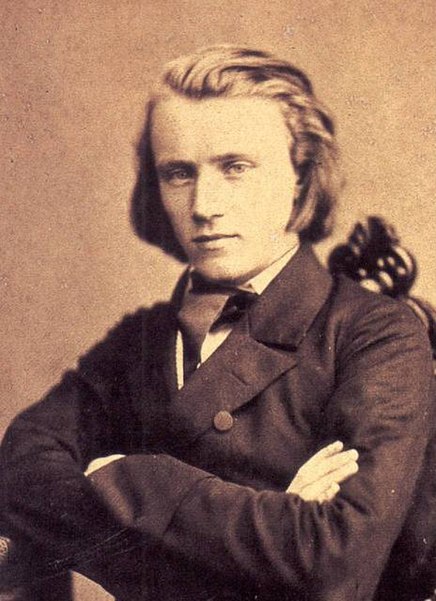
The organizer wanted a photo, too, and being increasingly camera shy and/or adverse to graven imagery, finding anything more recent than adolescence was almost impossible. As a matter of fact, I was just about an inch away from submitting this nice picture of the young Brahms (a kid with a lifetime of bad haircuts and overeating still well ahead of him) instead:
Sunday, January 27, 2008
What's controversial around here?
When a topic on a new music blog inspires passion, you have to pay attention. I've learned, for example, that expressing any reservation about the music of Shostakovich will guarantee a passionate response, but not necessarily a response informed by any musical argument. Shostakovich was a composer with brilliant technique and a tragic biography; he just wasn't an inventive or subtle composer, in my book. Having been burned on Shostakovich, I have generally refrained from bringing up music that doesn't work for me and instead concentrated on music that does. Risking further passionate controversy, I will readily admit that there are a number of composers -- including Shostakovich, Krenek, Britten, Bernstein, Henze, Zorn, and Kernis -- whose music just doesn't take me anywhere interesting, and I really do demand that music take me someplace never travelled.
Two topics, musical economics and musical institutions, are guaranteed to fill my email inbox with messages, both of approval and disapproval, but seldom do they appear as online comments. This was particularly true of my items critical of composition competitions, for which I received a striking amount of support. However, disappointingly few were willing to go public about wanting better competitions.
As to economics, I will readily admit that it's a field well outside the expertise of this musician, but nevertheless I can't help but be fascinated with little data points that add to a thick description of the world that's bopping about my music. Marginal Revolution often touches on cultural issues, Brad DeLong is a very smart guy, I've learned more about the recent credit crisis in the US from the Irvine Housing Blog, and this paper, An Empirical Analysis of Street-Level Prostitution by Levitt and Venkatesh, which noted that prostitutes with pimps may have some advantages in terms of marketing and protection, raised interesting questions for me about the comparative advantages of composers as free-lancers and with managers or institutional affiliations, and specifically in those areas of marketing and protection (e.g. provision of health care insurance).
I probably catch the most flak for my critical stance towards big musical institutions. Let me be clear that I'm perfectly aware that a certain amount of institutional structure is necessary to make some musical things happen, but one has to be persistently vigilant that the institutions not turn away from their service function for the music itself and invest ever more money, time, and oxygen in their own self-support. In a way, it's curious that my institutional critique receives any attention at all, in that the critics and bloggers and devotees of those very same institutions often spend as many words on changes in, say, opera house management or gossipy materials leaked by publicists, as the do on the aesthetics of opera.
As long as we're talking about opera houses, my critique is the opposite of the famous one of Pierre Boulez, who suggested blowing the places up. In fact, I think that if they're going to be mammoth places for upper class spectacle, simulcast in cinemas and on pay-per-view, they really don't go far enough. I would suggest that they instead follow the model of mega-churches. Put a parking lot in front of the house and glass-in one wall of the theatre for those who like to worship/watch without leaving the familiar comforts of their cars. Embrace amplification and other contemporary theatrical technologies. Let George Lukas and Joel Osteen stage these things. Opera loves stage magic and there's no reason that operas shouldn't be as vivid as a Rodger Rabbit cartoon. Heck, maybe they should even incorporate as churches -- they won't have to charge admission, as tax-deductible love offerings and cinema/pay-per-view income will surely more than cover costs. And then, the rest of us, who happen to like hearing unamplified voices in intimate surroundings can get to it.
That's probably enough to feed the passions for today.
Two topics, musical economics and musical institutions, are guaranteed to fill my email inbox with messages, both of approval and disapproval, but seldom do they appear as online comments. This was particularly true of my items critical of composition competitions, for which I received a striking amount of support. However, disappointingly few were willing to go public about wanting better competitions.
As to economics, I will readily admit that it's a field well outside the expertise of this musician, but nevertheless I can't help but be fascinated with little data points that add to a thick description of the world that's bopping about my music. Marginal Revolution often touches on cultural issues, Brad DeLong is a very smart guy, I've learned more about the recent credit crisis in the US from the Irvine Housing Blog, and this paper, An Empirical Analysis of Street-Level Prostitution by Levitt and Venkatesh, which noted that prostitutes with pimps may have some advantages in terms of marketing and protection, raised interesting questions for me about the comparative advantages of composers as free-lancers and with managers or institutional affiliations, and specifically in those areas of marketing and protection (e.g. provision of health care insurance).
I probably catch the most flak for my critical stance towards big musical institutions. Let me be clear that I'm perfectly aware that a certain amount of institutional structure is necessary to make some musical things happen, but one has to be persistently vigilant that the institutions not turn away from their service function for the music itself and invest ever more money, time, and oxygen in their own self-support. In a way, it's curious that my institutional critique receives any attention at all, in that the critics and bloggers and devotees of those very same institutions often spend as many words on changes in, say, opera house management or gossipy materials leaked by publicists, as the do on the aesthetics of opera.
As long as we're talking about opera houses, my critique is the opposite of the famous one of Pierre Boulez, who suggested blowing the places up. In fact, I think that if they're going to be mammoth places for upper class spectacle, simulcast in cinemas and on pay-per-view, they really don't go far enough. I would suggest that they instead follow the model of mega-churches. Put a parking lot in front of the house and glass-in one wall of the theatre for those who like to worship/watch without leaving the familiar comforts of their cars. Embrace amplification and other contemporary theatrical technologies. Let George Lukas and Joel Osteen stage these things. Opera loves stage magic and there's no reason that operas shouldn't be as vivid as a Rodger Rabbit cartoon. Heck, maybe they should even incorporate as churches -- they won't have to charge admission, as tax-deductible love offerings and cinema/pay-per-view income will surely more than cover costs. And then, the rest of us, who happen to like hearing unamplified voices in intimate surroundings can get to it.
That's probably enough to feed the passions for today.
Friday, January 25, 2008
The truth about the Jedi
My old friend Tom Hilton has a brilliant and timely analysis of Jedi politics, here.
Our economic history
Blogging economist Brad DeLong, in explaining why he thinks historians should study economic history, writes:
I have written before that our continuous music-historical memory extends only into the late 18th century, with musical repertoires predating that era all to be re-discovered, and, in their way, remade as contemporary musics. (The various forms of "nationalist" musics that emerge (and continue to emerge) in the past two centuries are less instances of the faithful transmission of local traditions but of local assertion of participation in the global music culture with local colors, often without much traditional precedent.) A partially economic explanation for pre-classical musical amnesia seems reasonable.
Art and literary history already follow economic history and identify modernity roughly with the turn of the 19th century. I'm now curious as to how music came to unique identify modernity with the 20th century. (No, the invention of sound recording can't be the initial impulse for this.) In fact, it might be more than interesting to rethink classical music history since 1789 or so without 1900 as the major turning point, but rather as just another marker of generational change in a more complex historical texture, with waves to and fro greater or lesser complexity, additions of new resources, ensemble or textural density, etc. while paying closer attention to the patterns of geographical transmission and reception.
...certainly since 1800 and perhaps since 1500, what is most extraordinary and salient about our global society is primarily economic and scientific, so you cannot do post-1500 history without knowing economics anymore than you can do early Byzantine history without knowing theology.I'm not certain how much economic history music historians should know, but those two dates -- or a generation earlier for 1800 -- do ring all sorts of music-historical bells. They locate moments in which local European musical traditions innovate in connection with reception by new music-consuming classes and simultaneously begin to have reach beyond local communities, across European borders and, eventually, globally.
I have written before that our continuous music-historical memory extends only into the late 18th century, with musical repertoires predating that era all to be re-discovered, and, in their way, remade as contemporary musics. (The various forms of "nationalist" musics that emerge (and continue to emerge) in the past two centuries are less instances of the faithful transmission of local traditions but of local assertion of participation in the global music culture with local colors, often without much traditional precedent.) A partially economic explanation for pre-classical musical amnesia seems reasonable.
Art and literary history already follow economic history and identify modernity roughly with the turn of the 19th century. I'm now curious as to how music came to unique identify modernity with the 20th century. (No, the invention of sound recording can't be the initial impulse for this.) In fact, it might be more than interesting to rethink classical music history since 1789 or so without 1900 as the major turning point, but rather as just another marker of generational change in a more complex historical texture, with waves to and fro greater or lesser complexity, additions of new resources, ensemble or textural density, etc. while paying closer attention to the patterns of geographical transmission and reception.
Wednesday, January 23, 2008
Who's your teacher?
While some composers are entirely self-taught, and the best composers inevitably have to become self-taught, most classical composers have teachers, and -- usually with pride, but sometimes in defiance -- add their names to our resumes, sometimes even the names of our "grandteachers", attaching ourselves through that lineage to a tradition.
But the precise nature of the teacher-student relationship, however institutionalized in CVs and dictionary entries, is far from fixed, and indeed, often very mysterious. While there are some lineages in which the students' music can be heard to be continuing the work of the master, there are as many in which the relationship to the master's music is ambivalent, critical, negative, or simply not recognizable. But neither of these styles of musical relationships to the teacher and her/his tradition says one bit about the personal relationship, which may be tender or tendentious either way.
The composition classes at UC Berkeley in the late 1950s and early 1960's are illustrative. These classes were one of the birthplaces of the radical music which would come to include the more promoted minimalism of the early 1970's, and included a number of students (Young, Riley, Rush, Leedy, Oliveros) who have become well-known. The composition staff at UCB was, however, a bit difficult to square with the nascent radical aesthetic, including names like Andrew Imbrie, Juaquin Nin-Culmel, Seymour Shifrin, and William Denny. The first two of these names were active opponents of the young radical, while the latter two, although coming from very different aesthetics became important teachers. Shifrin, a friend from youth of Morton Feldman, was committed both to a high art tradition and an atonal style that is best described as academic. One member of Shifrin's seminar said "we argued all the time with Seymour, but we loved him to death, he was a mensch." And Denny was game enough for the new ideas that he accompanied his graduate students to a festival in Provo, Utah, where he took part in a performance of La Monte Young's Poem for Chairs, Tables, Benches, etc., by playing catch onstage with Terry Riley. A visiting professorship by Robert Erickson brought a more like-minded teacher into the mix, but the fact is that these young musicians found a positive impulse in working with teachers whose own music was far from their own.
A further complication is the quantitative aspect of a teaching relationship. Some students can go in week after week for years of lessons with the same teacher and never profit from the effort. Other students are sparked for life by a pair of words at the right moment from a composer who will otherwise be a perfect stranger. A lot of resumes are padded these days with "studied with" lines for a visit to Tanglewood or Darmstadt, in which the relationship was transient, while the more decisive orchestration or counterpoint teacher back home goes unmentioned. What of all the composers who have made a summer pilgrimage to the Stockhausen Courses in Kürten in recent years? Stockhausen lectured on his own works but did not give private compositional instruction as he did earlier. While one might now speak of a small contemporary "School of Stockhausen", it's not quite accurate to identify the members of this school as Stockhausen's students.
The relationship to a teacher changes over time, too. I had the luck to have some great composition teachers, and one of the pleasures of this life has been the gradual unfolding over time -- and a long time, at that -- of what exactly I learned from these good people. It's a continual surprise. I was recently writing a eccentric little passacaglia, and suddenly realized that my fussiness about balance and symmetries owed everything to Gordon Mumma, with whom I did not explicitly study counterpoint; indeed I do think that he ever used the term in my presence. But it turns out Gordon taught me a lot about counterpoint and his ideas about balance and density are inescapable parts of my toolkit.
But the precise nature of the teacher-student relationship, however institutionalized in CVs and dictionary entries, is far from fixed, and indeed, often very mysterious. While there are some lineages in which the students' music can be heard to be continuing the work of the master, there are as many in which the relationship to the master's music is ambivalent, critical, negative, or simply not recognizable. But neither of these styles of musical relationships to the teacher and her/his tradition says one bit about the personal relationship, which may be tender or tendentious either way.
The composition classes at UC Berkeley in the late 1950s and early 1960's are illustrative. These classes were one of the birthplaces of the radical music which would come to include the more promoted minimalism of the early 1970's, and included a number of students (Young, Riley, Rush, Leedy, Oliveros) who have become well-known. The composition staff at UCB was, however, a bit difficult to square with the nascent radical aesthetic, including names like Andrew Imbrie, Juaquin Nin-Culmel, Seymour Shifrin, and William Denny. The first two of these names were active opponents of the young radical, while the latter two, although coming from very different aesthetics became important teachers. Shifrin, a friend from youth of Morton Feldman, was committed both to a high art tradition and an atonal style that is best described as academic. One member of Shifrin's seminar said "we argued all the time with Seymour, but we loved him to death, he was a mensch." And Denny was game enough for the new ideas that he accompanied his graduate students to a festival in Provo, Utah, where he took part in a performance of La Monte Young's Poem for Chairs, Tables, Benches, etc., by playing catch onstage with Terry Riley. A visiting professorship by Robert Erickson brought a more like-minded teacher into the mix, but the fact is that these young musicians found a positive impulse in working with teachers whose own music was far from their own.
A further complication is the quantitative aspect of a teaching relationship. Some students can go in week after week for years of lessons with the same teacher and never profit from the effort. Other students are sparked for life by a pair of words at the right moment from a composer who will otherwise be a perfect stranger. A lot of resumes are padded these days with "studied with" lines for a visit to Tanglewood or Darmstadt, in which the relationship was transient, while the more decisive orchestration or counterpoint teacher back home goes unmentioned. What of all the composers who have made a summer pilgrimage to the Stockhausen Courses in Kürten in recent years? Stockhausen lectured on his own works but did not give private compositional instruction as he did earlier. While one might now speak of a small contemporary "School of Stockhausen", it's not quite accurate to identify the members of this school as Stockhausen's students.
The relationship to a teacher changes over time, too. I had the luck to have some great composition teachers, and one of the pleasures of this life has been the gradual unfolding over time -- and a long time, at that -- of what exactly I learned from these good people. It's a continual surprise. I was recently writing a eccentric little passacaglia, and suddenly realized that my fussiness about balance and symmetries owed everything to Gordon Mumma, with whom I did not explicitly study counterpoint; indeed I do think that he ever used the term in my presence. But it turns out Gordon taught me a lot about counterpoint and his ideas about balance and density are inescapable parts of my toolkit.
A Recipe for Hard Times
In the face of a recession, it looks like the White House and US Congress will soon put together a massive economic stimulus package with some mixture of tax reductions and spending, the latter perhaps in the form of direct grants. The idea is to get additional money circulating in the economy as fast as possible through both spending and investment. The economist Lawrence Summers writes that: "...fiscal stimulus only works if it is spent so it must be targeted . Targeting should favour those with low incomes and those whose incomes have recently fallen for whom spending is most urgent." May I make the suggestion that a modest portion of this package be directed the way of musicians, and composers in particular? Our incomes tend to be low and, in these days, falling, and we're particularly well suited to spending money as fast as possible. Without a doubt, any direct grants sent our way will be disposed of with astonishing velocity.
Tuesday, January 22, 2008
R.W., the action figure
 I suppose that it's obvious -- if any composer were going to be a minature action figure, it'd have to be Richard Wagner (who, at around 150cm tall was pretty much a miniature action figure in the flesh). The manufacturer also has a Mozart on offer, but wouldn't a Gesualdo have been more like it?
Bring it on!
The ever-observant Robert Gable of Aworks links to a commentary thread on the recent US Democratic debates with this comment:
So, yes, let's have some public gut-chewing, or at least some verbal fisticuffs, for a change. I can imagine a couple of composer-on-composer forensic pairings that would make a presidential debate or a bloggingheads episodes look like a walk hand-in-hand through a field of daisies. Bring it on!
"The podiums are whisked away and it's a nice friendly sit-down between three candidates who want to chew each other's guts out." Wouldn't it be great if composers had the same kind of debates?I'm all in favor of putting our disputes out in the open -- at the moment, we pretend in public as if there are no controversies and let those in positions of power manage our disputes through the quiet backroom processes of handing out scholarships, jobs, awards, and commissions. The illusion of harmonious getting along for getting along's sake contribute, however, to the false public impression that there is no heat, no passion, no action, and no innovation in our field. This is bad for the public life of our music. Simultaneously, the reduction of debate to the distribution of our pitiful spoils is bad for the life of the music itself, not to mention the livelihoods of those eclipsed by any local or temporal orthodoxy.
So, yes, let's have some public gut-chewing, or at least some verbal fisticuffs, for a change. I can imagine a couple of composer-on-composer forensic pairings that would make a presidential debate or a bloggingheads episodes look like a walk hand-in-hand through a field of daisies. Bring it on!
Saturday, January 19, 2008
Your own chunk of the moon
Slate has an article about private claims to lunar real estate. Until very recently, the question of private travel to the moon has been a theoretical one and claims to chunks of property on our satellite have either been in the realm of fantasy or scams. With increasing likelihood for commercial travel to the moon -- whether for tourism, homesteading, or helium-3 mining -- claims to acreage up there are becoming everless virtual and evermore plausible and deciding who gets to own and exploit the moon may actually become serious.
Until then, however, music will still share some vital qualities with lunar real estate. Music tends to the ephemeral -- is it located in the air molecules we push around, or in a score, or in storage media (scores, recordings), or is it a platonic ideal of some sort? -- and the ownership of a music is unclear. Does it belong to the composer or the performer or the passionate listener? Is it a gift channeled from (the) god(s)? Is it a state or public good or is it a gift to humankind? Can it be bought, bartered, or sold? Is it a gift without market value? Heck, even the very idea that one could own a music is far from clear.
Talking about music as property is always bound to be uncomfortable, and I suspect that we're in for some particularly uncomfortable times, as the parties with substantial material interests in this question are just getting warmed up.
In the western legal tradition, we've already been through three major historical steps in the development of ideas as properties. The first was biblical, in the Decalogue, in which God forbid the making of graven imagery (thus asserting state control over creative work) and in the latter books, in which authors receive attribution (again, the attribution is controlled by institutional apparatus; the veracity of those attributions has been controversial ever since). The second step was in the assertion of states, royal, republican, or authoritarian, that intellectual property was a public good to be licensed and authors were granted (very slowly, in the case of musicians), limited periods of limited control over their work, after which the work fell into a "public" domain (we owe the word "royalties" to this). The third stage came with the age of private capital, and private persons, individually and collectively, sought to create a number of measures and institutions designed to protect and extend rights as well as to maximize income from the protected properties. We're still somewhere in this stage, but witnessing significant changes in the circumstances: "legal persons", corporations, which do not live naturally long lives, are now asserting rights well beyond those demanded earlier by real persons and technological developments in the media and transmission methods for intellectual property are changing at breathtaking speed, with unclear implications for the future of control over and income generation from that property. Furthermore, we're witnessing an intense conflict between the beneficiaries of this third stage, associated still with a liberal assertion of rights around the turn of the 20th century, and those who view the new technological circumstances as an opportunity to move away from, if not eliminate, the notion of property, a liberal assertion in its own terms, but one connected with the turn of the 21st century. How this will all turn out is anyone's guess at the moment, but I think that the moment is an opportune one to step back from the legal questions and consider instead exactly what it is we would like to achieve from an assertion of property rights to intellectual property, and music in particular, and do so in ethical rather than legal terms.
The estimable Carl Stone has a nice item over at the New Musicin the Box, about the appropriation of music by others into one's own work. There is indeed a long tradition of this in music (parody, anyone?), but the appropriation of mechanically or electronically recorded material seems to go several steps further, in that one is not borrowing a bit of code* from a piece of music (a tune, for example), but excising a vertical slice of a complete musical product, including both composition and performance or realization. The legal situation is heated, often turning on the question of the size of the borrowed sample ("how big is a musical breadbox?"), and has created a nice side job for a handful of academically-trained musicians in the creepily-named field of "forensic musicology"; likewise heated is the question of monetary returns from a sample. I think that this problem is eminently soluble, however. Creators of music differ on their degree of attachment to their work, with some unconcerned -- even enthusiastic -- about subsequent appropriation, others willing to sanction it based upon a fee, and other so attached to their work in a particular form that they wish that no appropriations be licensed, regardless of any fee proffered. I believe that there is an ethical responsibility to respect these wishes with regard to the creative work of an individual, simply because we recognize that a relationship to one's creative work can be intimate and intimate, and his or her music falls in a private sphere around a person that deserves protection regardless of the precise legal or economic status of the property. Furthermore, it is not difficult to assert -- via a notation in a score or a signature on some data format -- the precise wish of the composer: to permit all usage, to permit all licensed usage, or to limit usage to a particular instance.
_____
* I've had a long argument with open source advocates about music, among them Richard Stallman, that music is substantially different from software in that the source code of music is always open to anyone with ears, so that protecting property rights for music is not a barrier to the further development of the underlying codes.
Until then, however, music will still share some vital qualities with lunar real estate. Music tends to the ephemeral -- is it located in the air molecules we push around, or in a score, or in storage media (scores, recordings), or is it a platonic ideal of some sort? -- and the ownership of a music is unclear. Does it belong to the composer or the performer or the passionate listener? Is it a gift channeled from (the) god(s)? Is it a state or public good or is it a gift to humankind? Can it be bought, bartered, or sold? Is it a gift without market value? Heck, even the very idea that one could own a music is far from clear.
Talking about music as property is always bound to be uncomfortable, and I suspect that we're in for some particularly uncomfortable times, as the parties with substantial material interests in this question are just getting warmed up.
In the western legal tradition, we've already been through three major historical steps in the development of ideas as properties. The first was biblical, in the Decalogue, in which God forbid the making of graven imagery (thus asserting state control over creative work) and in the latter books, in which authors receive attribution (again, the attribution is controlled by institutional apparatus; the veracity of those attributions has been controversial ever since). The second step was in the assertion of states, royal, republican, or authoritarian, that intellectual property was a public good to be licensed and authors were granted (very slowly, in the case of musicians), limited periods of limited control over their work, after which the work fell into a "public" domain (we owe the word "royalties" to this). The third stage came with the age of private capital, and private persons, individually and collectively, sought to create a number of measures and institutions designed to protect and extend rights as well as to maximize income from the protected properties. We're still somewhere in this stage, but witnessing significant changes in the circumstances: "legal persons", corporations, which do not live naturally long lives, are now asserting rights well beyond those demanded earlier by real persons and technological developments in the media and transmission methods for intellectual property are changing at breathtaking speed, with unclear implications for the future of control over and income generation from that property. Furthermore, we're witnessing an intense conflict between the beneficiaries of this third stage, associated still with a liberal assertion of rights around the turn of the 20th century, and those who view the new technological circumstances as an opportunity to move away from, if not eliminate, the notion of property, a liberal assertion in its own terms, but one connected with the turn of the 21st century. How this will all turn out is anyone's guess at the moment, but I think that the moment is an opportune one to step back from the legal questions and consider instead exactly what it is we would like to achieve from an assertion of property rights to intellectual property, and music in particular, and do so in ethical rather than legal terms.
The estimable Carl Stone has a nice item over at the New Music
_____
* I've had a long argument with open source advocates about music, among them Richard Stallman, that music is substantially different from software in that the source code of music is always open to anyone with ears, so that protecting property rights for music is not a barrier to the further development of the underlying codes.
Friday, January 18, 2008
Orchestral Style
While opinions about the quality of contemporary opera singing differ, there's probably a general agreement that we're in a golden age for playing by opera orchestras. Opera orchestras are different herds from concert hall orchestras and have to master a considerably different skill set. As accompanists, they have to master fairly complex figuration, often long-winded and repetitive, and a great deal of the time off the beat, and they have to respond flexibly and extemporaneously to the circumstances onstage. While the opera orchestra definitely has moments in the forefront, much of their responsibility is for the music beneath the surface and that's too often undervalued (I am a great admirer of internal instrumental parts in the operas of Rossini). It occurs to me that minimal(ist) music, when it goes orchestral, is too often assigned to concert rather than operatic ensembles, which would have a natural edge with a music in which an unambiguous surface is often absent. With a few exceptions (Glass, Adams, and...) that's clearly an opportunity missed.
Lessons for the young
Neglect. There is probably no greater difficulty for a composer than negotiating an uneasy economy in which the personal value of ones work will never satisfactorily equate with a market value. Musical works and their authors are also subject to the unpredictable caprices of style (now in, now out) and the unexplainable inequities of musical politics (fighting over bloody nothing). It is no wonder that composers are often prone to melancholy, bitterness, anger, even paranoia, and the most inventive among us, sometimes directly as a result of those personal qualities which make one inventive in the first place, tend to suffer most.
The greatest rock and roll band of their time, Spot 1019, put out an album with the title "The World Owes Me A Buzz"; their sarcasm could not have been stated any better: not only does the world has no notion of any debt to you, most of your working life will be spent doing anything but that which you do best of all, simply in order to survive, and everything you will ever produce belongs to the "public domain" with your possession granted only temporarily.
I owe a lot to John Cage, both from his music and his way of organizing his work, but perhaps nothing more than his example of how to be a composer and not be bitter in the face of neglect. If I understood correctly, it was the combination of the negative example of his teacher Adolph Weiss and his own sunny disposition that made Cage determined not to become bitter, and by and large, he managed it.
If you can learn early on not to have any illusions about the material circumstances of our profession, you'll be at an advantage. It's useful to think about your work in terms of that which your compose out of your own desires and that which is composed as work-for-hire, and cherish the few opportunities when the two impulses coincide. It's also an advantage, methinks, to have a comfortable enough home and place to work. Realize that your work requires time, and purchasing time often means giving up something else. If you're social and familial, making time for loved ones is important, too.
The greatest rock and roll band of their time, Spot 1019, put out an album with the title "The World Owes Me A Buzz"; their sarcasm could not have been stated any better: not only does the world has no notion of any debt to you, most of your working life will be spent doing anything but that which you do best of all, simply in order to survive, and everything you will ever produce belongs to the "public domain" with your possession granted only temporarily.
I owe a lot to John Cage, both from his music and his way of organizing his work, but perhaps nothing more than his example of how to be a composer and not be bitter in the face of neglect. If I understood correctly, it was the combination of the negative example of his teacher Adolph Weiss and his own sunny disposition that made Cage determined not to become bitter, and by and large, he managed it.
If you can learn early on not to have any illusions about the material circumstances of our profession, you'll be at an advantage. It's useful to think about your work in terms of that which your compose out of your own desires and that which is composed as work-for-hire, and cherish the few opportunities when the two impulses coincide. It's also an advantage, methinks, to have a comfortable enough home and place to work. Realize that your work requires time, and purchasing time often means giving up something else. If you're social and familial, making time for loved ones is important, too.
Wednesday, January 16, 2008
Biographic
I'm ambivalent about biographies and autobiographies, and especially so about those of composers. While on the one hand, there is the fascination of a tale well-told, sometimes real -- and movingly so -- connections between my own experiences and those of the biograph-ed, and there are occasional flashes that brilliantly illuminate the music itself. But the other hand is an inevitable voyeuristic element, and that makes me decidedly uncomfortable. Fascinated, but uncomfortable about it.
I once began writing a monograph about a contemporary composer's music, but had to give it up because, as a writer, I couldn't get a handle certain aspects of his life that had bearing on his music (sex, drugs, religion, criminal rap sheet...). I'm realist enough to recognize that musicians are not their music, they can be cads and cheats and slobs and scoundrels without any of that playing out in their music and ideally, I 'd like the music to speak for itself, but the real world does have a tendency to penetrate the music, and sometimes that effect is inescapable.* I trust that this blog has reflected my ambivalence.
So with all of those reservations, let me note that composer David Cope has placed an autobiographical work, Tinman, online here, a series of 150 reminiscences . I am also looking forward to reading a pair recently published biographical works, as it happens, about dance -- Janice Ross's new biography of the dancer Anna Halprin, an essential figure in experimental dance, and one somewhat neglected by having worked on the left coast, and Carolyn Brown's Chance and Circumstance: Twenty Years with Cage and Cunningham.
_____
* The most civil exchange I've had online was with the late musicologist Philip Brett, a pioneer in queer musicology. We strongly disagreed about the role that sexuality played in John Cage's work, but I believe that our dialogue caused each of us to move a bit from our extreme positions; whereas I had previously been convinced that it was a non-issue, I am now convinced that there are in fact a handful of pieces -- among them The Perilous Night, Letters to Erik Satie with Sound Anonymously Received, and One^11 and 103 -- in which Cage's intimate biography plays an essentially role. I deeply regret not having met Prof. Brett
I once began writing a monograph about a contemporary composer's music, but had to give it up because, as a writer, I couldn't get a handle certain aspects of his life that had bearing on his music (sex, drugs, religion, criminal rap sheet...). I'm realist enough to recognize that musicians are not their music, they can be cads and cheats and slobs and scoundrels without any of that playing out in their music and ideally, I 'd like the music to speak for itself, but the real world does have a tendency to penetrate the music, and sometimes that effect is inescapable.* I trust that this blog has reflected my ambivalence.
So with all of those reservations, let me note that composer David Cope has placed an autobiographical work, Tinman, online here, a series of 150 reminiscences . I am also looking forward to reading a pair recently published biographical works, as it happens, about dance -- Janice Ross's new biography of the dancer Anna Halprin, an essential figure in experimental dance, and one somewhat neglected by having worked on the left coast, and Carolyn Brown's Chance and Circumstance: Twenty Years with Cage and Cunningham.
_____
* The most civil exchange I've had online was with the late musicologist Philip Brett, a pioneer in queer musicology. We strongly disagreed about the role that sexuality played in John Cage's work, but I believe that our dialogue caused each of us to move a bit from our extreme positions; whereas I had previously been convinced that it was a non-issue, I am now convinced that there are in fact a handful of pieces -- among them The Perilous Night, Letters to Erik Satie with Sound Anonymously Received, and One^11 and 103 -- in which Cage's intimate biography plays an essentially role. I deeply regret not having met Prof. Brett
Tuesday, January 15, 2008
Not yet musically conscious
Weekday mornings, after getting my daughter to Kindergarten, are delicate hours. Between precompositional insomnia and a biological clock still set to Pacific time, I get to bed late, and the early wakeup comes after a bare minimum of quality sleep, so the ends of all my nerves attached to any musically relevant perceptual organs are still numb. The only solution is to play some music. Although a wind player by training, morning hours are not quite the right ones for idle Bläserei, so I stumble to the piano and do some sight reading.
But what to play? Some musical traditions have repertoire which is classified as being appropriate to particular hours of the day. Both Hindustani and Karnatic musics identify ragas with morning afternoon, evening, or late night. Aside from liturgical music, western classical music is basically repertoire for evening concerts, music made for formal wear and decorum, for artificial light and a particular social setting. Not for morning alone, half-conscious, in slippers at an upright piano. In the absence of a specialized repertoire, I've invented my own. I read through The Fitzwilliam Virginal Book, The Art of the Fugue, Mikrokosmos and Kurtág's Játékok. I've grown attached to the little character pieces gathered among the sins of Rossini's old age, many of the mysterious small pieces by Liszt, and Satie has always been there (I find that the early "gothic" pieces only work for me in the morning). Sometimes I'll croak out an Ives song, and small pieces by Mumma ("from the Sushi box"), Jennings, Cage, Feldman, Hovhaness (I especially like Bare November Day), and some of John White's Sonatas are more recent parts of the mix.
This is private music making, for myself, and as much ritual and therapy as musical training, and although my personal repertoire is often a bit dark in character, this is all joyful music-making, something that Herr Doctor Wolf recommends to all.
But what to play? Some musical traditions have repertoire which is classified as being appropriate to particular hours of the day. Both Hindustani and Karnatic musics identify ragas with morning afternoon, evening, or late night. Aside from liturgical music, western classical music is basically repertoire for evening concerts, music made for formal wear and decorum, for artificial light and a particular social setting. Not for morning alone, half-conscious, in slippers at an upright piano. In the absence of a specialized repertoire, I've invented my own. I read through The Fitzwilliam Virginal Book, The Art of the Fugue, Mikrokosmos and Kurtág's Játékok. I've grown attached to the little character pieces gathered among the sins of Rossini's old age, many of the mysterious small pieces by Liszt, and Satie has always been there (I find that the early "gothic" pieces only work for me in the morning). Sometimes I'll croak out an Ives song, and small pieces by Mumma ("from the Sushi box"), Jennings, Cage, Feldman, Hovhaness (I especially like Bare November Day), and some of John White's Sonatas are more recent parts of the mix.
This is private music making, for myself, and as much ritual and therapy as musical training, and although my personal repertoire is often a bit dark in character, this is all joyful music-making, something that Herr Doctor Wolf recommends to all.
Monday, January 14, 2008
Good Fortune
Before I fall into my routine of rants, let's take a moment to note some of the real good news out there, in Newmusicland, and beyond:
The most important festival for new music is now the Ostrava Days in the Czech Republic; it has talent and attitude.
Wordless Music, in NYC, seems to be doing very good things, too.
There are many musicians specializing in new music that ought to be mentioned, but none is more important than the Belgian pianist Daan Vandewalle. Another pianist to pay attention to is Satoko Inoue.
Following in the tall shadows of Kronos and Arditti is not easy, but there are a number of younger quartets who play new music as it should be played. I think that the Quatour Bozzini deserves special attention.
The musical blogoplan is full of daily surprises. Among my composing colleagues, I always learn something new from the blogs of Charles Shere and Nico Muhly, with perspectives different from mine (note to Magister Muhly: your blog always makes my Opera browser crash!). Loose Poodle is an indispensable guide to film music, a world at a cheerful tangent to my own.
Outside of musical blogs, I give thanks for Blogging Heads, for a dose of smarts and civility in US public political discourse (I recommend the conversations between Joshua Cohen and Glenn Loury in particular, and one can easily avoid anything with Mickey Kaus or those folks with National Review credentials), and at random: Crooked Timber, Strange Maps, Cosmic Variance, Language Log, Savage Minds, and Silliman's Blog. I'm still looking for good blogs about dance and classics and I wish there was more at Errol Morris's blog Zoom,
The most important festival for new music is now the Ostrava Days in the Czech Republic; it has talent and attitude.
Wordless Music, in NYC, seems to be doing very good things, too.
There are many musicians specializing in new music that ought to be mentioned, but none is more important than the Belgian pianist Daan Vandewalle. Another pianist to pay attention to is Satoko Inoue.
Following in the tall shadows of Kronos and Arditti is not easy, but there are a number of younger quartets who play new music as it should be played. I think that the Quatour Bozzini deserves special attention.
The musical blogoplan is full of daily surprises. Among my composing colleagues, I always learn something new from the blogs of Charles Shere and Nico Muhly, with perspectives different from mine (note to Magister Muhly: your blog always makes my Opera browser crash!). Loose Poodle is an indispensable guide to film music, a world at a cheerful tangent to my own.
Outside of musical blogs, I give thanks for Blogging Heads, for a dose of smarts and civility in US public political discourse (I recommend the conversations between Joshua Cohen and Glenn Loury in particular, and one can easily avoid anything with Mickey Kaus or those folks with National Review credentials), and at random: Crooked Timber, Strange Maps, Cosmic Variance, Language Log, Savage Minds, and Silliman's Blog. I'm still looking for good blogs about dance and classics and I wish there was more at Errol Morris's blog Zoom,
Someone else's career
A friend just emailed with this observation:
While I have to agree that doubt -- or at least a good, steady dose of self criticism -- is operative for me, I don't think that the notion of belief, or in this case, an absence of belief, is meaningfully opposed to doubt. Doubt, for me, is the recognition of opportunity to do something else, or to find an alternative approach, and to be open to the possibility of failure. David Feldman (another good friend) has talked about this aspect as having a tragic aspect, in that the methods I use may create music that almost replicates some familiar music, but ultimately falls short. I find that rather interesting, and sometimes even comic rather than tragic, and if there is a tragic element, it is in the simple fact that "familiar music" has become rather strange. We cannot satisfactorily recover the context in which it was made and understood. I have a tremendous attachment, for example, to repertoires of music in which a body of conventions of figure and affect were understood and in play, but my personal attachment is not the same as and not a substitute for being a part of the communities in which those conventions were functional and meaningful. The same goes for my accidentally ex-pat status in Europe: I'm here, but I'll never be from here, and the best I can do is approach the musical culture here with the distance of an ethnomusicologist rather than that of another Yanqui composer on the make.
What then, about belief? There are communities of believers, and they often share repertoires of music, believing in the conventional and habitual as well as the special elements in those repertoires. Although I've been tempted, I don't happen to identify with any such community. And, although a "new music" necessarily implies a positive or negative challenge to an existing repertoire, there are individual composers who are able to assert their musical choices with all of the authority that comes with belief in one's own work. Although I've been impressed by the examples of some of my composing colleagues who have such belief in their own work, I can't really follow their examples, and I am, in many cases, left with considerable doubt. (Stockhausen is the canonical example -- either he believed what he claimed to believe or he didn't believe it and it was all an elaborate marketing scheme; neither possibility strikes me as particularly attractive.)
Karl Rove, the political advisor to the current Bush told the journalist Christopher Hitchens that
"I’m not fortunate enough to be a person of faith", a sentiment that I find impossible to follow. If one identifies having faith as fortunate, then one seems to be, however indirectly, asserting a form of faith. I suspect Rove, however, was simply admitting to a cynical, Straussian, use of believers for his politically ends, which is even worse. If I have any fortune at all as a composer, I suspect it is the fortune of being a person of doubt.
Deej,
...you know, you'd have had an entirely different career if belief in your work had been the operating principle rather than doubt...
While I have to agree that doubt -- or at least a good, steady dose of self criticism -- is operative for me, I don't think that the notion of belief, or in this case, an absence of belief, is meaningfully opposed to doubt. Doubt, for me, is the recognition of opportunity to do something else, or to find an alternative approach, and to be open to the possibility of failure. David Feldman (another good friend) has talked about this aspect as having a tragic aspect, in that the methods I use may create music that almost replicates some familiar music, but ultimately falls short. I find that rather interesting, and sometimes even comic rather than tragic, and if there is a tragic element, it is in the simple fact that "familiar music" has become rather strange. We cannot satisfactorily recover the context in which it was made and understood. I have a tremendous attachment, for example, to repertoires of music in which a body of conventions of figure and affect were understood and in play, but my personal attachment is not the same as and not a substitute for being a part of the communities in which those conventions were functional and meaningful. The same goes for my accidentally ex-pat status in Europe: I'm here, but I'll never be from here, and the best I can do is approach the musical culture here with the distance of an ethnomusicologist rather than that of another Yanqui composer on the make.
What then, about belief? There are communities of believers, and they often share repertoires of music, believing in the conventional and habitual as well as the special elements in those repertoires. Although I've been tempted, I don't happen to identify with any such community. And, although a "new music" necessarily implies a positive or negative challenge to an existing repertoire, there are individual composers who are able to assert their musical choices with all of the authority that comes with belief in one's own work. Although I've been impressed by the examples of some of my composing colleagues who have such belief in their own work, I can't really follow their examples, and I am, in many cases, left with considerable doubt. (Stockhausen is the canonical example -- either he believed what he claimed to believe or he didn't believe it and it was all an elaborate marketing scheme; neither possibility strikes me as particularly attractive.)
Karl Rove, the political advisor to the current Bush told the journalist Christopher Hitchens that
"I’m not fortunate enough to be a person of faith", a sentiment that I find impossible to follow. If one identifies having faith as fortunate, then one seems to be, however indirectly, asserting a form of faith. I suspect Rove, however, was simply admitting to a cynical, Straussian, use of believers for his politically ends, which is even worse. If I have any fortune at all as a composer, I suspect it is the fortune of being a person of doubt.
Wednesday, January 09, 2008
Moondog remembered
I've just finished reading Robert Scotto's biography of Moondog (Louis Hardin), Moondog: The Viking of 6th Avenue. The details of his life are really outside of my portfolio -- a sometime street musician, blinded as a youth, with a thing for Viking-inspired garb, and apparently some ugly opinions -- but his music is charming and, in its own way, important, an example of a music benefiting from the constraints of an aesthetic niche, but also making interesting connections to other contemporary musics, in Moondog's case to music life in New York from the Rodzinski years at the Philharmonic to 1950's jazz and 1960's minimalism.
Moondog specialized in composing rounds and canons, sometimes to a ground, and usually over steady percussion accompaniment, which he played on a kit of triangular drums struck with a clave and a maraca as mallets. The counterpoint is quite strict, tonal or modal, but with frequent quintuple and septuple metres, which I've found makes the music especially suitable for teaching musicianship. (I recommend the rounds (Moondog called them madrigals) on the second Columbia recording, Moondog 2.) Scotto poses the question of how a technique so focused upon a minor genre like the round can be used to generate larger forms, and it clearly troubled the composer, but it really shouldn't trouble us, as good things are not diminished by small packages.
The best part of the book is the attached cd, with some rare recordings, including some of the madrigals performed by an all-stars-to-be grouping including Moondog, Phillip Glass, Steve Reich, and Jon Gibson. (Drawing a connection from Moondog's piano piece, To a Seahorse, to some later minimalism, is almost inescapable.) Unfortunately my copy came with defects in the surface, making half the tracks unplayable... has anyone else noticed that the quality of cds has been slipping, just like lps in their last years?
Moondog specialized in composing rounds and canons, sometimes to a ground, and usually over steady percussion accompaniment, which he played on a kit of triangular drums struck with a clave and a maraca as mallets. The counterpoint is quite strict, tonal or modal, but with frequent quintuple and septuple metres, which I've found makes the music especially suitable for teaching musicianship. (I recommend the rounds (Moondog called them madrigals) on the second Columbia recording, Moondog 2.) Scotto poses the question of how a technique so focused upon a minor genre like the round can be used to generate larger forms, and it clearly troubled the composer, but it really shouldn't trouble us, as good things are not diminished by small packages.
The best part of the book is the attached cd, with some rare recordings, including some of the madrigals performed by an all-stars-to-be grouping including Moondog, Phillip Glass, Steve Reich, and Jon Gibson. (Drawing a connection from Moondog's piano piece, To a Seahorse, to some later minimalism, is almost inescapable.) Unfortunately my copy came with defects in the surface, making half the tracks unplayable... has anyone else noticed that the quality of cds has been slipping, just like lps in their last years?
Monday, January 07, 2008
A WINTER ALBUM, expanded
A WINTER ALBUM of small piano pieces has now been joined by A Mind of Winter (after Wallace Stevens) by Steve Hicken. The album -- no publisher, no editor, but plenty of presence and some community -- is online here, and is not yet closed to contributions.
Sunday, January 06, 2008
Late 20th Century Ringtones
If you could have any bit of fairly well-known late 20th-century serious music as a ringtone for your cellular/mobile phone, what would it be? David Feldman, without skipping a beat, said Lucier's I am sitting in a room ("...different from the one you are in now..."), which should have been obvious, but it would nevertheless be interesting to encounter a bit of serial bebop or classic minimalism while in a crowded cafe, underground, or shopping mall. Perhaps the more interesting question would be: what is the piece of late 20th-century music least likely to be used as a ringtone? And no, 4'33'' doesn't count.
Saturday, January 05, 2008
The uses of enchantment
More musings from a fever'd mind. The talk these days is of Barack Obama's win in the Iowa Democratic Caucuses and his victory speech, and for good reason: we were treated to a bit of now-rare oratory in which speech sometimes aspires to the condition of music. In these moments of aspiration words acquire definite pitches, sequences of words melodic contour, and vowels are sometimes extended in time to allow a contour to form a distinct rhythm. But Obama, to his complete credit, has absolute control and never quite allows his speech to become song. His rhythms never relax in an easy metre and his word choices favor quasi-repetition over exact reiterations. He is a serious man and respects the line between logic and rhetoric, applied to convince an audience of an argument, and rhapsody, which -- as Plato warned in the Ion -- is designed to go beyond conviction to the non-rational states of possession, whether by muses -- amusement -- or the gods -- enthusiasm.
Music and speech are too easily confused, and that confusion has its uses, both for better and for worse. Music and speech often share acoustical features and -- perhaps evolutionarily "piggy-backed" upon one another -- a set of perceptual and cognitive organs, but beyond those organs, music and speech appear to light up entirely different pathways through the brain. The important counter-example of sign languages shows that an acoustic component is not necessary to language and the capacity for music to function in entirely non-communicative contexts as well as to use sounds that are linguistically meaningless shows important material and semantic distances of music to speech. Nevertheless, there will always be forms of music which are informed and enriched by a relationship to language, and there will always be forms of speech will aspire to the condition of music.
Music and speech are too easily confused, and that confusion has its uses, both for better and for worse. Music and speech often share acoustical features and -- perhaps evolutionarily "piggy-backed" upon one another -- a set of perceptual and cognitive organs, but beyond those organs, music and speech appear to light up entirely different pathways through the brain. The important counter-example of sign languages shows that an acoustic component is not necessary to language and the capacity for music to function in entirely non-communicative contexts as well as to use sounds that are linguistically meaningless shows important material and semantic distances of music to speech. Nevertheless, there will always be forms of music which are informed and enriched by a relationship to language, and there will always be forms of speech will aspire to the condition of music.
Tuesday, January 01, 2008
A WINTER ALBUM is online
A WINTER ALBUM of small pieces for piano is now online here. It includes works by Dennis Báthory-Kitsz, Jon Brenner, Steed Cowart, Elaine Fine, Hauke Harder, Ben.Harper, Jeff Harrington, Aaron Hynds, Lloyd Rodgers, Jonathan Segel, and Charles Shere. A few more pieces have been promised and -- thanks to the magic of the internet -- may well still appear in the album.
Sunday, December 30, 2007
What's Opera, Doc?
Gratuitous opera posting designed to improve blog ratings. But then again, any cultural history that fails to take into account the importance of Bugs Bunny's transvestism is seriously lacking.
Saturday, December 29, 2007
A Fever'd Mind Seldom Rests
A thought experiment: We all wake up one morning having forgotten music, what music is, and what music does to us. Three things can happen: (1) we re-invent music, more or less as it was before, or (2) we re-invent music, but it differs in substantial ways from what it had been, or (3) we get about with our lives but without any music. What have we lost and what have we gained in each scenario? What does this suggest about the nature and value of music? To what degree do these three possibilities reflect the working methods of a composer?
Friday, December 28, 2007
Broadsided
This blog has been quiet because I've been horizontal (bronchitis; it's going around; three cheers for decent health care). In the past three years (and 757 posts) I've had it worse, in fact I've had a couple of operations, and still managed to blog a bit, but this time, the world can wait.
In any case, The Winter Album will be online on the 1st of January, 2008 and it will be well worth the wait.
In any case, The Winter Album will be online on the 1st of January, 2008 and it will be well worth the wait.
Saturday, December 22, 2007
Allen Strange's Taqueria
I divide composers into two classes, those who care about cooking and those who don't. (It also happens that the class of composers who write music I like is more or less coterminus with those who care about cooking, but in a universe with many happy coincidences, should that be altogether a surprise?)
Newly returned to the internet is composer Allen Strange's Manual for Mexican Street Cooking, available here. This is a nice resource, with a personal and pragmatic take on some matters strictly gourmand. Strange, long a professor of music in San Jose, has retired to places North, continues to make music, and also has written, with violinist Patricia Strange, a valuable book of instrumentation recipes for composers, The Contemporary Violin.
Growing up in Southern California, the present season has always been one intimately associated with tamales. Yes, if you stuff it in dough, I'll probably eat it, but tamales are in a class by themselves, whether sweet (filled with pineapple, mango, jam) or savory (my ideal is the long lost Atascadero tamale of my childhood). The recipes I use come mostly from an ancient copy of Maria A De Garbia's Mexico en la cocina de MARICHU, which I picked up somewhere in Mexico City a long time ago, but at this point, I tend to go freestyle with my tamale stuffings, improvising with whatever is at hand, and remaining resolutely un-PC with my tamale dough, happily enriched with dangerous quantities of manteca (yep, lard).
Newly returned to the internet is composer Allen Strange's Manual for Mexican Street Cooking, available here. This is a nice resource, with a personal and pragmatic take on some matters strictly gourmand. Strange, long a professor of music in San Jose, has retired to places North, continues to make music, and also has written, with violinist Patricia Strange, a valuable book of instrumentation recipes for composers, The Contemporary Violin.
Growing up in Southern California, the present season has always been one intimately associated with tamales. Yes, if you stuff it in dough, I'll probably eat it, but tamales are in a class by themselves, whether sweet (filled with pineapple, mango, jam) or savory (my ideal is the long lost Atascadero tamale of my childhood). The recipes I use come mostly from an ancient copy of Maria A De Garbia's Mexico en la cocina de MARICHU, which I picked up somewhere in Mexico City a long time ago, but at this point, I tend to go freestyle with my tamale stuffings, improvising with whatever is at hand, and remaining resolutely un-PC with my tamale dough, happily enriched with dangerous quantities of manteca (yep, lard).
Friday, December 21, 2007
Venture Capital and Composition
Check out this website for recombinant, a start-up firm offering music automation solutions in the emerging field of media genomics, with core competencies in music analysis, recognition, and recomposition. Consulting on copyright infringement litigation appears to be a major part of the business. It's co-led by composer David Cope (who was one of my teachers).
Music: The Animation of the Moment
To my question (inspired by Errol Morris's cogitations on a pair of photographs):
I don't think that my claim is contradicted by Charles' point; in fact, I suspect that my claim is the necessary precondition to a music which -- perhaps dialectically, perhaps intuitively -- is all about allowing us to get beyond, or even forget the moment with its beginning and end and to transcend our everyday experience of time as duration.
This is a process which began, as far as I can tell, with the notion of polyphony and was later dramatically expanded with the use of multiple topics in late Viennese classicism. Polyphony, at root, is about doing different things (making different sounds) at the same time, allowing them to share a moment, and music history illustrates a course in which the definition of "different" was continuously expanded (systematic musicology would describe this on a continuum from more alike to more differentiated, or homophony to heterophony). Notable way stations on this path include the polytextual motet, the simultaneous tempi of Monteverdi's Concitato style (which is a rather simple relation to the extraordinary Javanese irama system*), the three simultaneous dances in Don Giovanni, and continue through the network technique of Wagner, Ives' use of polyphony to evoke physical spaces, etc..
The initial fork in the road is that between music as heightened speech communication and music as an aesthetic marking of time's passing. There have, in fact, been very good examples of music which has attempted to reconcile this, and often the means have been polyphonic; the contradictory accompaniments in Schumann's Im wunderschönen Monat Mai and Ives' The River come first to mind. But the more influential path seems to me to be in the diachronic play of musical topics which emerges an an alternative to the rhetorical systems cultivated in the baroque and classical eras and emerges most clearly with the late works of Mozart and throughout Beethoven's catalog. It is most central to the "figure in a clearing" topic, which I would date in absolute works to Beethoven's Pastorale Symphony**; this topic is characterized by a musical background (not yet an accompaniment, just an atmosphere) without significant temporal markers of its own before which foreground events occur. This topic is important to each of the composers Charles mentioned, and I would add Mahler, Ives, Cage (in the works with rhythmic structures and, later, time brackets) and Feldman (the composer on the grid) as well as any composer who begins by first laying down a persistant groove and then putting things on top of it.
_____
* Paradoxically parallel tempi, creating environments in which it is unclear whether the prevailing tempo is slow or fast are fascinating. My favorite recent example is that of Alvin Lucier's string quartet, Navigations for Strings, in which the notes played by the strings are articulated at a very slow speed, but the resultant beats from the microtonal tuning often emerge as the vivid surface of the music, and are at times quite fast. Or another example from the history of film -- here's Jonathan Rosenbaum's article about tempo in the films of the extraordinary director Yasujiro Ozu, Is Ozu Slow?.
** The Pastorale is absolute music with a programmatic veneer: you get over the program quickly enough to realize that there really is music there.
Isn't much of music -- at least that much that is not about speech-like communication -- the attempt to fill in the space between two moments of time?Charles Shere posted a serious response:
Well, not to me, no. I mean, yes: music as it was thought of in its Great European Age, say Bach to 1950, yes: it's attempts to fill in "space" between moments. Or so we think of it, though I feel that many masters manage to do this sort of mechanically (though very well indeed) when in fact they have a completely different idea in mind, and that's what I like about a lot of Berlioz, Schubert, Bruckner, Sibelius: their music may be about filling a duration, but it's also about getting completely away from a concern with that.
Point is, a lot of newer music (including much of my own) is not about moving from moment to moment, but about existing within time, doesn't matter what moments one might choose as kickers or closers.
I don't think that my claim is contradicted by Charles' point; in fact, I suspect that my claim is the necessary precondition to a music which -- perhaps dialectically, perhaps intuitively -- is all about allowing us to get beyond, or even forget the moment with its beginning and end and to transcend our everyday experience of time as duration.
This is a process which began, as far as I can tell, with the notion of polyphony and was later dramatically expanded with the use of multiple topics in late Viennese classicism. Polyphony, at root, is about doing different things (making different sounds) at the same time, allowing them to share a moment, and music history illustrates a course in which the definition of "different" was continuously expanded (systematic musicology would describe this on a continuum from more alike to more differentiated, or homophony to heterophony). Notable way stations on this path include the polytextual motet, the simultaneous tempi of Monteverdi's Concitato style (which is a rather simple relation to the extraordinary Javanese irama system*), the three simultaneous dances in Don Giovanni, and continue through the network technique of Wagner, Ives' use of polyphony to evoke physical spaces, etc..
The initial fork in the road is that between music as heightened speech communication and music as an aesthetic marking of time's passing. There have, in fact, been very good examples of music which has attempted to reconcile this, and often the means have been polyphonic; the contradictory accompaniments in Schumann's Im wunderschönen Monat Mai and Ives' The River come first to mind. But the more influential path seems to me to be in the diachronic play of musical topics which emerges an an alternative to the rhetorical systems cultivated in the baroque and classical eras and emerges most clearly with the late works of Mozart and throughout Beethoven's catalog. It is most central to the "figure in a clearing" topic, which I would date in absolute works to Beethoven's Pastorale Symphony**; this topic is characterized by a musical background (not yet an accompaniment, just an atmosphere) without significant temporal markers of its own before which foreground events occur. This topic is important to each of the composers Charles mentioned, and I would add Mahler, Ives, Cage (in the works with rhythmic structures and, later, time brackets) and Feldman (the composer on the grid) as well as any composer who begins by first laying down a persistant groove and then putting things on top of it.
_____
* Paradoxically parallel tempi, creating environments in which it is unclear whether the prevailing tempo is slow or fast are fascinating. My favorite recent example is that of Alvin Lucier's string quartet, Navigations for Strings, in which the notes played by the strings are articulated at a very slow speed, but the resultant beats from the microtonal tuning often emerge as the vivid surface of the music, and are at times quite fast. Or another example from the history of film -- here's Jonathan Rosenbaum's article about tempo in the films of the extraordinary director Yasujiro Ozu, Is Ozu Slow?.
** The Pastorale is absolute music with a programmatic veneer: you get over the program quickly enough to realize that there really is music there.
Thursday, December 20, 2007
Music, photography, science
Filmmaker Errol Morris's extraordinary blog, Zoom, has a paragraph that hit me like a brick:
I know. It is insane, but I would like to make the claim that the meaning of photography is contained in these two images. By thinking about the Fenton photographs we are essentially thinking about some of the most vexing issues in photography – about posing, about the intentions of the photographer, about the nature of photographic evidence – about the relationship between photographs and reality. We also have the first motion picture because we have two images in sequence. We just don’t know (at first) what the sequence is because they are not conjoined in celluloid. One further point. Isn’t much of science the attempt to fill in what happened between two moments of time, t₀ and t₁? To explain how and why something changed?Isn't much of music -- at least that much that is not about speech-like communication -- the attempt to fill in the space between two moments of time?
Decoding Composer Biographies, Lesson One
Here, then, are quotes from real & official composer biographies found on the web:
(n.n.) is one of America's most distinguished artistic figures.
"Distinguished" means older, academy-dwelling, and out-of-fashion. "One of (the) most" describes neither the size nor the selector of the cohort. "Artistic figure" is a phrase designed to lift the subject out of the lowly class of musicians (you get an even more exaggerated effect in German by insisting that "Ich bin Kunstler").
The compositional and intellectual wisdom of (n.n.) has influenced a wide range of contemporary musicians.
"Wisdom" inevitably means aged. Note that the compositional and intellectual influence is noted but not the music itself. This particular quote is a surprising one to find on a publisher's page, since a publisher should be interested in promoting the works more than teaching skills of the composer, and if you're staking a claim for influence, give some evidence and argue the point. Note also that "contemporary", in this context is an insider signal for "uptown": Danger, Will Robinson! There's never anything less novel than self-described "contemporary music".
(n.n.) is a member of the American Academy of Arts and Letters and a Fellow of the American Academy of Arts and Sciences.
Who cares? I side with Groucho Marx: Any club that would have me -- or any other composer -- as a member is suspect. The same goes for a list of prizes: keep them buried in your resumé for your colleagues and your tenure committee to discover and admire, but curious performing musicians and lay people out looking for interesting new music really don't give a flying fermata.
(n.n.) is one of America's most successful composers
Again, who's in the cohort? How is "successful" defined? Pocketbook? Performances? Notoriety?
(n.n. is) among the first composers of his generation dedicated to the combination of music, science and computer technology.
Don't use "first" (even when qualified by "among") when it is falsifiable. ("Leading" (as in "a leading composer for toy piano") is a frequently encountered alternative, safe but wishy-washy.) And by all means, don't use these kinds of qualifications in an autobiographical context -- wait for someone else to make the claim for you. Stick with the facts: "n.n. is a composer dedicated to the combination of music, science, and computer technology" does just fine.
Next Lesson: Some official composer biographies to admire.
(n.n.) is one of America's most distinguished artistic figures.
"Distinguished" means older, academy-dwelling, and out-of-fashion. "One of (the) most" describes neither the size nor the selector of the cohort. "Artistic figure" is a phrase designed to lift the subject out of the lowly class of musicians (you get an even more exaggerated effect in German by insisting that "Ich bin Kunstler").
The compositional and intellectual wisdom of (n.n.) has influenced a wide range of contemporary musicians.
"Wisdom" inevitably means aged. Note that the compositional and intellectual influence is noted but not the music itself. This particular quote is a surprising one to find on a publisher's page, since a publisher should be interested in promoting the works more than teaching skills of the composer, and if you're staking a claim for influence, give some evidence and argue the point. Note also that "contemporary", in this context is an insider signal for "uptown": Danger, Will Robinson! There's never anything less novel than self-described "contemporary music".
(n.n.) is a member of the American Academy of Arts and Letters and a Fellow of the American Academy of Arts and Sciences.
Who cares? I side with Groucho Marx: Any club that would have me -- or any other composer -- as a member is suspect. The same goes for a list of prizes: keep them buried in your resumé for your colleagues and your tenure committee to discover and admire, but curious performing musicians and lay people out looking for interesting new music really don't give a flying fermata.
(n.n.) is one of America's most successful composers
Again, who's in the cohort? How is "successful" defined? Pocketbook? Performances? Notoriety?
(n.n. is) among the first composers of his generation dedicated to the combination of music, science and computer technology.
Don't use "first" (even when qualified by "among") when it is falsifiable. ("Leading" (as in "a leading composer for toy piano") is a frequently encountered alternative, safe but wishy-washy.) And by all means, don't use these kinds of qualifications in an autobiographical context -- wait for someone else to make the claim for you. Stick with the facts: "n.n. is a composer dedicated to the combination of music, science, and computer technology" does just fine.
Next Lesson: Some official composer biographies to admire.
Our Happy House of Cards
If you take a course in calculus or quantum mechanics, the content of the course is pretty much going to be the same wherever you go -- sure, there'll be different emphases, and certainly different pedagogical styles, and the environment (both physical and human) in which you study does make a real difference, but there is a more-or-less settled consensus on what is essential to know, what is useful to know how to do, and what the shared terminology for the subject is.
In musical studies, we are very far away from such a consensus. The canon of music history is increasingly loose and evermore less centered around "classical" concert and operatic works of late 18th- to late 19th-century central Europe, and the repertoire of works studied as part of an historical narrative is increasingly variable from school to school and from one teacher to the next. In music theory (which is actually more practice than theory), there have always been local styles of analysis and terminology (yes, Virgina, there's an invisible line running roughly along the Germany-Austria border separating the scale-step theorists from the functional theorists, so that the tribes shall never mix) , but the local practices in (or even within) individual schools in the US often take this to an extreme, such that unless a student is flexible and a very quick study, it's rarely possible to jump from the middle of a theory course "sequence" in one locale to another. Add to this the complication of parallel sequences taught in many places for jazz or vernacular musics. Or how about electronic music, an even more extreme case? At some schools, an electronic music course will cover "classical" (love that word, so useful in so many contexts) studio techniques, including old-fashioned tape splicing, in others, it may be digital recording techniques or computer music (synthesis or computer-assisted composition), and in others it will be using the studio to make digital mock-ups of instrumental scores, and in still others, you may lay hands on circuits and wield your soldering gun to roll your own electronic instruments.
I happen to think that this lack of consensus is a very good thing. The diversity and liveliness of music demands a diversity of approaches and musical studies has long since grown out of the idea that a single aesthetic, as described historical or analytically, has value above others equivalent to the value of truth over falsity in domains like math or physics. William Austin's Music in the Twentieth Century told a fantastic story beginning with Debussy while Alex Ross's recent book tells another compelling story beginning with Strauss's Salome and neither story cancels the other out. Having these alternative accounts of the same time period gives our sense of history dimensional depth and texture. I think that there is a lot of study to be done on the ramifications of having parallel historical accounts or parallel theoretical systems for the production of real music and the parallel streams should be crossing one another more often, invisible line at the Austrian border be damned. Indeed, voice leading scholars may have something to tell jazz musicians (who focus on chords and scales) while a student of the Javanese gender has really interesting things to say about counterpoint.
In musical studies, we are very far away from such a consensus. The canon of music history is increasingly loose and evermore less centered around "classical" concert and operatic works of late 18th- to late 19th-century central Europe, and the repertoire of works studied as part of an historical narrative is increasingly variable from school to school and from one teacher to the next. In music theory (which is actually more practice than theory), there have always been local styles of analysis and terminology (yes, Virgina, there's an invisible line running roughly along the Germany-Austria border separating the scale-step theorists from the functional theorists, so that the tribes shall never mix) , but the local practices in (or even within) individual schools in the US often take this to an extreme, such that unless a student is flexible and a very quick study, it's rarely possible to jump from the middle of a theory course "sequence" in one locale to another. Add to this the complication of parallel sequences taught in many places for jazz or vernacular musics. Or how about electronic music, an even more extreme case? At some schools, an electronic music course will cover "classical" (love that word, so useful in so many contexts) studio techniques, including old-fashioned tape splicing, in others, it may be digital recording techniques or computer music (synthesis or computer-assisted composition), and in others it will be using the studio to make digital mock-ups of instrumental scores, and in still others, you may lay hands on circuits and wield your soldering gun to roll your own electronic instruments.
I happen to think that this lack of consensus is a very good thing. The diversity and liveliness of music demands a diversity of approaches and musical studies has long since grown out of the idea that a single aesthetic, as described historical or analytically, has value above others equivalent to the value of truth over falsity in domains like math or physics. William Austin's Music in the Twentieth Century told a fantastic story beginning with Debussy while Alex Ross's recent book tells another compelling story beginning with Strauss's Salome and neither story cancels the other out. Having these alternative accounts of the same time period gives our sense of history dimensional depth and texture. I think that there is a lot of study to be done on the ramifications of having parallel historical accounts or parallel theoretical systems for the production of real music and the parallel streams should be crossing one another more often, invisible line at the Austrian border be damned. Indeed, voice leading scholars may have something to tell jazz musicians (who focus on chords and scales) while a student of the Javanese gender has really interesting things to say about counterpoint.
Around & About
Some composing bloggers have been very busy of late:
Paul Bailey is putting up more recordings of his opera, retrace our steps.
Dennis Báthory-Kitsz is in the final stretches of his year-long project We Are All Mozart.
Matthew Guerrieri has been writing a wassail a day for a week.
Jodru of ANABlog has been tracing Stockhausen's steps. (Ben Harper, of Boring Like a Drill also has some more smart things to say about KS).
Man, do I feel like an aging expat when I read Nico Muhly's blog -- his lively diction seems to belong to a language that hadn't yet been invented when I left the States and I can only parse the half of it.
Elaine Fine has the very good idea of blogging her thematic catalog.
Me? I'm resting on my laurels.
Paul Bailey is putting up more recordings of his opera, retrace our steps.
Dennis Báthory-Kitsz is in the final stretches of his year-long project We Are All Mozart.
Matthew Guerrieri has been writing a wassail a day for a week.
Jodru of ANABlog has been tracing Stockhausen's steps. (Ben Harper, of Boring Like a Drill also has some more smart things to say about KS).
Man, do I feel like an aging expat when I read Nico Muhly's blog -- his lively diction seems to belong to a language that hadn't yet been invented when I left the States and I can only parse the half of it.
Elaine Fine has the very good idea of blogging her thematic catalog.
Me? I'm resting on my laurels.
Wednesday, December 19, 2007
Crossing Fields
Since 1977, when I first took a lesson with the tuning theorist Ervin Wilson, I've found it useful to think about pitch relationships in terms of a lattice (or, more precisely, a manifold, but this is music theory, so we needn't be too fussy) in which classes of intervals -- octaves, fifths, major third, etc. -- are each assigned their own axis and pitches are located at discreet points in the space described. (The tradition of thinking about pitches in this way originates with the German theorist Hugo Riemann, with an important precedent in the Dutch scientist Huygens; it was further developed by Shohe Tanaka, Adrian Fokker, Walter O'Connell, Wilson, James Tenney and more recently, in the tuning community and, to some extent, among, "neo-Riemannian" music theorists).
The whole point of such spatial representations of pitches is that spatial proximity represents one form of audible proximity, or harmonic distance, and this is important in real music. With pitches, there is an additional form of proximity, and that is in terms of absolute distance in frequency. The two forms of proximity interact in subtle and musically important ways. Two tones an octave apart will be usually (= played on instruments with harmonic spectra in a middle register) heard as more similar to one another than two tones a major seventh apart. Although the major seventh is a smaller interval, the octave is a less complex interval described by a very simple harmonic relationship, thus trumping the major seventh.
While one can devise metrics for these two ways of measuring intervals and from the metrics derive some formulae for comparing intervals, in real music this is an extremely delicate business, subject to a large number of variables, and ultimately, the way in which a composer decides to wander about a pitch lattice may mostly be a function of personal taste, habit, or even chance. Nevertheless, I find it an enormously useful way of managing pitches and intervals.
The same structure may also be usefully applied to dimensions other than pitch. It is possible, for example, to view musical tempi as described by the duration of a basic pulse. Such pulses can be assigned places on an n-dimensional lattice in which each dimension describes a distinct form of rational relationship between tempi. An X lattice corresponds to the powers-of-two axis in harmonic space -- each discreet step on the lattice is a doubling or halving in duration. Thus, one moves from eighths to quarters to halves to wholes. Perpendicular to this is an axis with powers of three -- moving in one direction triples, in the other divides in thirds. If the two axes meet at a quarter note, then this second axis continues in one direction with a dotted half, and in the other with triplet eighths. In the space describe by the two axes, one can soon locate all the pulses described by augmentation dots or as parts of triplets. In this way, the simplest rational relationships between tempi are represented graphically, and one can move among them via a handful of common counting units. Thus you can get a sweet little field of tempi through which one may securely modulate -- i.e. mm 60:80:90:120 -- by notating only with quarters, dotted eighths, triplet quarters, and eighth notes.* If one adds to this "harmonic" set of rational tempo relationships the possibility of speeding up or slowing down the basic pulse in absolute terms, this is equivalent to the second type of pitch relationship described above and, as in the pitch dimension, the range of possibilities for subtle yet recognizable relationships expands tremendously.
___
* If you're interested in pursuing this further, the two obvious English-language sources to turn to are Morley's Plain & Easy Introduction to Practical Music and Cowell's New Musical Resources, two books no composer should be without.
The whole point of such spatial representations of pitches is that spatial proximity represents one form of audible proximity, or harmonic distance, and this is important in real music. With pitches, there is an additional form of proximity, and that is in terms of absolute distance in frequency. The two forms of proximity interact in subtle and musically important ways. Two tones an octave apart will be usually (= played on instruments with harmonic spectra in a middle register) heard as more similar to one another than two tones a major seventh apart. Although the major seventh is a smaller interval, the octave is a less complex interval described by a very simple harmonic relationship, thus trumping the major seventh.
While one can devise metrics for these two ways of measuring intervals and from the metrics derive some formulae for comparing intervals, in real music this is an extremely delicate business, subject to a large number of variables, and ultimately, the way in which a composer decides to wander about a pitch lattice may mostly be a function of personal taste, habit, or even chance. Nevertheless, I find it an enormously useful way of managing pitches and intervals.
The same structure may also be usefully applied to dimensions other than pitch. It is possible, for example, to view musical tempi as described by the duration of a basic pulse. Such pulses can be assigned places on an n-dimensional lattice in which each dimension describes a distinct form of rational relationship between tempi. An X lattice corresponds to the powers-of-two axis in harmonic space -- each discreet step on the lattice is a doubling or halving in duration. Thus, one moves from eighths to quarters to halves to wholes. Perpendicular to this is an axis with powers of three -- moving in one direction triples, in the other divides in thirds. If the two axes meet at a quarter note, then this second axis continues in one direction with a dotted half, and in the other with triplet eighths. In the space describe by the two axes, one can soon locate all the pulses described by augmentation dots or as parts of triplets. In this way, the simplest rational relationships between tempi are represented graphically, and one can move among them via a handful of common counting units. Thus you can get a sweet little field of tempi through which one may securely modulate -- i.e. mm 60:80:90:120 -- by notating only with quarters, dotted eighths, triplet quarters, and eighth notes.* If one adds to this "harmonic" set of rational tempo relationships the possibility of speeding up or slowing down the basic pulse in absolute terms, this is equivalent to the second type of pitch relationship described above and, as in the pitch dimension, the range of possibilities for subtle yet recognizable relationships expands tremendously.
___
* If you're interested in pursuing this further, the two obvious English-language sources to turn to are Morley's Plain & Easy Introduction to Practical Music and Cowell's New Musical Resources, two books no composer should be without.
Tuesday, December 18, 2007
Blog Rolls
I haven't quite figured out blog rolls, neither the etiquette nor the tactics. I've listed music blogs and web pages that I actually read in full, but I have the impression that some people consider it good form to cross-blog roll one another, which makes me a bit uncomfortable (it's not as bad as cross-citing in scholarship, but it is distinctly like trolling for friends on myspace & I'm just too damn old to get into that without embarrassing myself). Some blogs have adopted the policy of dropping well-known blogs from their rolls, on the principle that they don't need your help, and the lesser ones do; others have adopted the strategy of only listing the top blogs, hoping to be judged by the apparent company you keep; still others have figured out that the blog roll doesn't matter much or even at all and favor instead links within articles, or simply don't want to give the competition even the slightest edge.
Where particular people congregate
Composing is usually a solitary activity (for some exceptions, see here) and composers compete with one another for gigs, commissions, attention, so it's no wonder that most blogging composers blog as solo acts. But there have been a few attempts at collectivization (Sequenza 21) and a few more attempts to install composers as columnists in magazine-like blogs. The latter include the ArtsJournal, staffed by print journalists, including at least two composers who do criticism on the side (or vice versa), and the NY Times, which tried it by inviting four composers to write for a blog The Score (which appears to have been inactive since April, although access is now free).
There would definitely be some advantages to joining a group effort -- the pace for the individual contributors could be slower*, but if they shared the discipline of writing at regular intervals, it would probably make the blog a more attractive daily read -- but no one is exactly inviting me, and I suspect that my fourth grade teacher got it right: highly creative; needs improvement in getting along well with others , so my act will remain a solo.
* Pace seems to be important for readership: if I stop writing for more than two days, Technorati will drop my "authority" number, recently from 48 to 39; but if I write too frequently, a similar effect takes place.
There would definitely be some advantages to joining a group effort -- the pace for the individual contributors could be slower*, but if they shared the discipline of writing at regular intervals, it would probably make the blog a more attractive daily read -- but no one is exactly inviting me, and I suspect that my fourth grade teacher got it right: highly creative; needs improvement in getting along well with others , so my act will remain a solo.
* Pace seems to be important for readership: if I stop writing for more than two days, Technorati will drop my "authority" number, recently from 48 to 39; but if I write too frequently, a similar effect takes place.
Sunday, December 16, 2007
Copy that
I've been doing some analysis lately, an odd pair of pieces: Mozart's extraordinary Streichquintett in g minor (KV 516) and Barney Childs' Eighth String Quartet. I had the ambition to do a close reading of the pieces, trying to get at as many details as possible, and I found myself doing this by actually copying the scores out. This is a very old-fashioned way of getting to know a piece of music, but it is no less valuable for being old-fashioned, especially because copying is a kind of slow motion performance and one in which each notated detail gets its own time for consideration.
In the Childs Quartet, about which I'll write more in a later post, a piece composed entirely of very slow and sustained chords, the sonorities of these chords -- their densities, balance, registration, and beating due to relative consonance or dissonance -- needed to be experienced in real time by sustained timbres not possible on a piano. For that reason, I used my notation program as a sequencer in order to hear the piece in something approaching the specified timbres, and I now have a much better idea of how the piece works or doesn't work.
With the Mozart, I've been making an arrangement for piano, four hands, because (a) it's music that I've always wanted to play, but don't happen to play the specified instruments with sufficient virtuosity, and (b) because this music is all about scoring patterns, going from one instrumental combination to another, and using the changes in patterns to project the tonal material, and the act of translating the score into another instrumental medium inevitably forces one to engage with these patterns. So far, I've been able to get away without changing any of Mozart's notes (i.e. transposing up or down octaves or doubling at octaves) but I have been led to some very interesting solutions, with, for example, at one point the "primo" pianist having to wrap her arm around her partner in order to play a melody in the bass and a countermelody in the treble, while her partner plays the accompaniment in the middle. I suspect that a polished arrangement will probably demand some registration changes, and perhaps some subtle doublings, but my working score has already proven to be a great way of getting into the nuts and bolts of a remarkable piece of music.
In the Childs Quartet, about which I'll write more in a later post, a piece composed entirely of very slow and sustained chords, the sonorities of these chords -- their densities, balance, registration, and beating due to relative consonance or dissonance -- needed to be experienced in real time by sustained timbres not possible on a piano. For that reason, I used my notation program as a sequencer in order to hear the piece in something approaching the specified timbres, and I now have a much better idea of how the piece works or doesn't work.
With the Mozart, I've been making an arrangement for piano, four hands, because (a) it's music that I've always wanted to play, but don't happen to play the specified instruments with sufficient virtuosity, and (b) because this music is all about scoring patterns, going from one instrumental combination to another, and using the changes in patterns to project the tonal material, and the act of translating the score into another instrumental medium inevitably forces one to engage with these patterns. So far, I've been able to get away without changing any of Mozart's notes (i.e. transposing up or down octaves or doubling at octaves) but I have been led to some very interesting solutions, with, for example, at one point the "primo" pianist having to wrap her arm around her partner in order to play a melody in the bass and a countermelody in the treble, while her partner plays the accompaniment in the middle. I suspect that a polished arrangement will probably demand some registration changes, and perhaps some subtle doublings, but my working score has already proven to be a great way of getting into the nuts and bolts of a remarkable piece of music.
Saturday, December 15, 2007
Angelology
The lattice of coincidence has allowed the media a unique moment to ponder two heterodox theologies, those of the Republican candidate for his party's presidential nomination, Mitt Romney, a professed Mormon, and those of Karlheinz Stockhausen, whose religious idiolect has a mixture of sources, from the Cologne-style Catholicism of his childhood -- a tradition which has persistent pre-Christian elements -- to the outer-space theogony of The Urantia Book, with a special attachment to the star Sirius.
Interestingly, both theologies have some common elements, with god-like existence beyond this plane promised to believers, a strong (if somewhat generic and decidely pre-feminist) eternal mother figure, and -- in common with a number of traditions, an antagonist angel with the name of Lucifer. The Mormon Lucifer attracted some controversy when a competitor of Mr Romney pointed out that LDS theology considered Lucifer to be the younger brother of Jesus. The press rapidly took up Romney's dismissal of this point, and the competitor, Mr Huckabee, apologized, although his remarks did, indeed, appear to restate the Mormon viewpoint (see here, for an official statement). Mormon theology is heterodox from a consensus shared by most Protestant, Catholic, and Orthodox churches on a number of issues, ranging from orginal sin to the nature of Christ and mankind in relationship to God, and in particular to the topic of slavation and heaven, so that when Mr Romney identifies Jesus as "the savior of mankind", he is not identifying a personal savior (which is unnecessary, in the absence of original sin), and speaking of a very different kind of salvation, in which all those sealed by the church (including those sealed in memoriam) will go as Gods themselves to heaven, and like God and the Great Mother continue to be fruitful and multiply.
Mr Stockhausen's theology, and in particular that expressed in the seven-day opera cycle, Licht, largely adopts the figure of Lucifer from The Urantia Book, but adds a number of characteristics, in particular a tendency towards clowning or tricksterism, not found in the rather humourless Urantia Book, but widespread among other faiths and fictions. It's probably still to early to attempt a sober analysis of the theology behind the Licht cycle, and, indeed, it may not prove to be a consistant one or one that even coincides with much precision to Stockhausen's own faith (the same can be said for Wagner and the Ring), but it is striking that, as an artwork with theogenic elements, the one great lacuna is, in fact, a deity. Indeed, given that the overwhelming narrative and textual substance of the work is a kind of free association extended rap around the composer's autobiography, it is hard to escape the conclusion that in the universe of Licht, the relationship between the composer and a creator God is largely one of identity.
Addendum: A description of Stockhausen's funeral is to be found here.
Interestingly, both theologies have some common elements, with god-like existence beyond this plane promised to believers, a strong (if somewhat generic and decidely pre-feminist) eternal mother figure, and -- in common with a number of traditions, an antagonist angel with the name of Lucifer. The Mormon Lucifer attracted some controversy when a competitor of Mr Romney pointed out that LDS theology considered Lucifer to be the younger brother of Jesus. The press rapidly took up Romney's dismissal of this point, and the competitor, Mr Huckabee, apologized, although his remarks did, indeed, appear to restate the Mormon viewpoint (see here, for an official statement). Mormon theology is heterodox from a consensus shared by most Protestant, Catholic, and Orthodox churches on a number of issues, ranging from orginal sin to the nature of Christ and mankind in relationship to God, and in particular to the topic of slavation and heaven, so that when Mr Romney identifies Jesus as "the savior of mankind", he is not identifying a personal savior (which is unnecessary, in the absence of original sin), and speaking of a very different kind of salvation, in which all those sealed by the church (including those sealed in memoriam) will go as Gods themselves to heaven, and like God and the Great Mother continue to be fruitful and multiply.
Mr Stockhausen's theology, and in particular that expressed in the seven-day opera cycle, Licht, largely adopts the figure of Lucifer from The Urantia Book, but adds a number of characteristics, in particular a tendency towards clowning or tricksterism, not found in the rather humourless Urantia Book, but widespread among other faiths and fictions. It's probably still to early to attempt a sober analysis of the theology behind the Licht cycle, and, indeed, it may not prove to be a consistant one or one that even coincides with much precision to Stockhausen's own faith (the same can be said for Wagner and the Ring), but it is striking that, as an artwork with theogenic elements, the one great lacuna is, in fact, a deity. Indeed, given that the overwhelming narrative and textual substance of the work is a kind of free association extended rap around the composer's autobiography, it is hard to escape the conclusion that in the universe of Licht, the relationship between the composer and a creator God is largely one of identity.
Addendum: A description of Stockhausen's funeral is to be found here.
Friday, December 14, 2007
Minimalism, again
The composer Ron Kuivila has a knack for clarifying matters for me (and often for cheerfully mucking them all up again, but that's another post, another post) . He recently reminded me of an old definition of minimalism, the precise origins of which are obscure, but likely from the visual arts, that works for music (or film, or dance, or writing, or architecture, or cooking, or computer programming, etc.) as well:
Minimalism is the elimination of distractions.
Kuivila naturally turned that period into a spoken-out-loud "full stop". I'll add my "basta" and we can be done with it.
Minimalism is the elimination of distractions.
Kuivila naturally turned that period into a spoken-out-loud "full stop". I'll add my "basta" and we can be done with it.
Priorities
Part of the recent good news in classical music has been the growth in endowments for US music schools, allowing for new construction and, in at least one case, for significant reductions if not eliminations of student fees. These developments are to be greeted, but also to be put into perspective: often, the best material conditions for musicians in the US will be those found in student environments, while conditions for professional music-making are often seriously underdeveloped. I want to have great facilities for music everywhere, but do find it strange that in many communities the best facilities are within educational institutions, which tend to be isolated on campuses and restricted to in-house use. There are even junior colleges in the States with better concert halls or theatres than those located in the closest big cities. In Germany, the situation is reversed, in that educational institutions are seriously under-supported, lacking the concert halls, practice and rehearsal spaces common in US schools. (A professorship here -- a title with great social prestige actually becoming a permanent part of ones legal name -- does not even guarantee that that the holder gets an office or studio.) The topic of capital investment for music is one that deserves some deeper thought, but a bit more balance in the distribution of resources would seem wise.
A Winter's Progress
The project for A WINTER ALBUM of short online scores for piano continues apace. Five scores have already been received and a large number have been promised. The album promises to be diverse and delightful, with the scores so far including pieces in traditional notation, graphic notation, a variable score composed in HTML, and one with very modest household electronic aggrandizement. New contributions are, of course, welcome, and the (impossible, but what the heck) deadline remains the first of January, 2007. Contact me (djwolf (AT) snafu (FULLSTOP) de).
Thursday, December 13, 2007
Steamed
I am a friend of steamed buns, whether plain or filled. I've encountered Chinese-style buns in California, Mexico, Indonesia, Germany and Hungary, and home-made, they've become a staple, filled with meat, leeks or cabbage, or -- when I'm not watching my sugar -- sweetened red beans. I like the meat version best, and eat it, as I learned in Indonesia, with sambal oelek and ketchap. Steamed breads probably spread westward from China across Central Asia and the variations on the Mongolian/Turkic mantu and manti are legion, with the Kazakh version, filled with a pumpkin and meat mixture deserving some special mention
One of Christina's grandmothers came from the German minority in Bessarabia, that wedge of land between the Dniester and Prut rivers that has been tossed between the larger neighboring countries for centuries and most of which now belongs to the Republic of Moldova. A favorite there were the large steam buns with a crisp crust on the bottom served with a savory sauce or with potato soup (in Germany similar buns are frequently served with a sweet vanilla sauce). I presume that this steamed bread from the Black Sea region is from the western edge of the transmission chain via Central Asia.
Dampfnudeln und Pfeffersoß
With dough hooks, mix 1 lb white flour, a package of yeast, a bit of salt, and perhaps a bit of sugar with a cup of tepid water until smooth -- about 7 minutes with my sturdy hand mixer.
Cover and let rise in a warm place for about an hour.
Rub some fat (either a mixture of ghee and oil, or lard and oil, or shortening) over the bottom of a large deep pan, cut the dough into four equal parts, and make them into balls, place the balls in the pan, add water to a depth of no more than two centimeters. Cover and let cook until all of the water has steamed away, about 40 minutes, and the buns all have a nice crust on the bottom.
Serve hot with hot or cold Pepper Sauce
made from 5 bell peppers (I use long red Turkish peppers, but my mother-in-law uses a mixture of red, yellow, and green bells) and 1 large onion, chopped to centimeter-square pieces, sauteed in a bit of oil (not olive) , sometimes later adding one medium eggplant, similarly cubed, and then a can of chopped tomatoes, some salt, some parsley, and cayenne to taste (I use 1 tablespoon of hot hungarian paprika and about a half teaspoon of cayenne). Sautee for about an hour at low temperature, adding water as needed. Can be served hot or cold, when warm, with Dampfnudeln or mashed potatoes, when cold, with bread, sausage, or fried eggs.
One of Christina's grandmothers came from the German minority in Bessarabia, that wedge of land between the Dniester and Prut rivers that has been tossed between the larger neighboring countries for centuries and most of which now belongs to the Republic of Moldova. A favorite there were the large steam buns with a crisp crust on the bottom served with a savory sauce or with potato soup (in Germany similar buns are frequently served with a sweet vanilla sauce). I presume that this steamed bread from the Black Sea region is from the western edge of the transmission chain via Central Asia.
Dampfnudeln und Pfeffersoß
With dough hooks, mix 1 lb white flour, a package of yeast, a bit of salt, and perhaps a bit of sugar with a cup of tepid water until smooth -- about 7 minutes with my sturdy hand mixer.
Cover and let rise in a warm place for about an hour.
Rub some fat (either a mixture of ghee and oil, or lard and oil, or shortening) over the bottom of a large deep pan, cut the dough into four equal parts, and make them into balls, place the balls in the pan, add water to a depth of no more than two centimeters. Cover and let cook until all of the water has steamed away, about 40 minutes, and the buns all have a nice crust on the bottom.
Serve hot with hot or cold Pepper Sauce
made from 5 bell peppers (I use long red Turkish peppers, but my mother-in-law uses a mixture of red, yellow, and green bells) and 1 large onion, chopped to centimeter-square pieces, sauteed in a bit of oil (not olive) , sometimes later adding one medium eggplant, similarly cubed, and then a can of chopped tomatoes, some salt, some parsley, and cayenne to taste (I use 1 tablespoon of hot hungarian paprika and about a half teaspoon of cayenne). Sautee for about an hour at low temperature, adding water as needed. Can be served hot or cold, when warm, with Dampfnudeln or mashed potatoes, when cold, with bread, sausage, or fried eggs.
Wednesday, December 12, 2007
It's Sweeps Week
Yes, it's time again: Scott Spiegelberg is gathering data for his survey of the top fifty or so classical music blogs. If this page is once again in the top fifty, it will be further evidence that classical music blogs are still far from finding their potential audience.
I wish to assure you that Renewable Music has not skewed its editorial content in advance of what we like to call "classical music sweeps week", and to insure a fair result, the following topics have not been mentioned here:
Tinfoil hats, engram-meters, orgone accumulators, alien abductions, neo-conservatism, dowsing, homeopathy, fired US Attorneys, creationism and/or intelligent design and/or flying spaghetti monsters, ancient astronauts, perpetual motion machines, dog-fighting NFL players, vanishing CIA torture tapes, the Huckabee diet, sacred garments in autochthonous American religions, the removal of Halliburton to Dubai, the Iranian nuclear weapons program, biodiesel, John Lott's sockpuppet, Oprah Winfrey's Obama endorsement, Bee colony die-outs, the busking Joshua Bell or the New York Philharmonic's sudden case of Pyongyong fever.
Well, okay, I did mention the bees and Bell, and recommended the Pyongyong metro website, but those were relevant...
I wish to assure you that Renewable Music has not skewed its editorial content in advance of what we like to call "classical music sweeps week", and to insure a fair result, the following topics have not been mentioned here:
Tinfoil hats, engram-meters, orgone accumulators, alien abductions, neo-conservatism, dowsing, homeopathy, fired US Attorneys, creationism and/or intelligent design and/or flying spaghetti monsters, ancient astronauts, perpetual motion machines, dog-fighting NFL players, vanishing CIA torture tapes, the Huckabee diet, sacred garments in autochthonous American religions, the removal of Halliburton to Dubai, the Iranian nuclear weapons program, biodiesel, John Lott's sockpuppet, Oprah Winfrey's Obama endorsement, Bee colony die-outs, the busking Joshua Bell or the New York Philharmonic's sudden case of Pyongyong fever.
Well, okay, I did mention the bees and Bell, and recommended the Pyongyong metro website, but those were relevant...
Edges

Some people hear sounds as colours, synaesthesia; I don't have that particular pleasure, but I do hear sounds as possesed by vivid textures. Some sounds are smooth, whether with the depth of melted chocolate or insubstantial like fog. Each sound has an edge, but some edges are hard to locate, let alone to get a grip on, while the best-defined edges crash and crunch and crackle. Sometimes the most striking edge of a sound is that at the release, where it may disappear into silence or terminate efficiently and sharply defined by silence (which may have a hard edge of its own) or the next sound. Conducting can be a marvelously tactile experience -- when it goes well, you can convince yourself that your body is actually pushing those wave fronts around, and each measured beat acquires its own hard edge in physical space.
It's useful to practice composing transitions, from this to that (or from here to there, if you prefer a spatial metaphor), and edges are essential to this. Perhaps the best practice for transitions was tape splicing, back in the days when one spliced tape. (It's of some significance, perhaps, that audio tape editing was a skill largely overtaken from film editing with its origins as a silent medium; of course, one could also argue that the aesthetics of film editing owe much to music, and opera in particular, making a sweet circle of influence). Joints between tape fragments could be vertical, a straight cut through the tape, directly from one fragment to the next (a butt joint in joinery parlance) or they could be diagonal, gradually going from one thing to the next, rather than suddenly. Or there could be space -- silence -- between the fragments, silence have articulative power of its own. Ezra Pound, in his The Theory of Harmony, argued reasonably that any sound could follow another provided the time between the two was of sufficient length, and that the more different the two sounds were, the greater the distance. This is, of course, a rough formula for making smooth transitions, and music isn't always smooth, thank Ives, and turning Mr Pound's formula on edge, is often just the thing for waking the bored and complacent and breaking the illusionary peace of a musical moment turned dull.
Monday, December 10, 2007
This is my mind imagining making money off of your mind on music
In idle moments, I've realized that if I had a tad less backbone, were a tad more evil, and were significantly more greedier than I actually am, I would probably go straight into the pop-therapy/human-potential/psych-training business with a program based on improving your life and my pocket book through immersion in environments of precisely tuned musical sounds, with the sales pitch that the right combination of intervals will sooth your psyche and cure your physical ailments, and bring the world peace and prosperity. Or something like that.
There have recently been a number of well- and even best-selling books for lay audiences on the topic of what music does to our minds (and -- the more interesting question of -- what our minds do with music), including Steven Mithen’s The Singing Neatherthals, Dan Levitin’s This is your brain on music, and Oliver Sacks' new book Musicophilia: Tales of Music and the Brain. I enjoy reading Music 00001, Victor Grauer's speculative blog on the origin of music and Martin Braun's Neuroscience of Music website has also been extremely helpful with his summaries and critiques of recent research; Scott Spiegelberg's Musical Perceptions blog presumably doesn't need introduction around here. The science of musical perception, and the neuroscience in particular is a hot and rich field at the moment, with interesting insights into everything from the origin of music to the evolution and relation between the neurological organs used for speech and for music (and the related question of the use of music as a communicative and as an absolutely aesthetic system) and on to the extent and limits of our musical perception, the last a very interesting question for composers. If I read the research well enough, it seems that we are just at the beginning of figuring out what music does and can do for us.
So back to my dastardly plan: I would devise a course, dished out in small, and ever-more-expensive units of training by lab-coated trainers in small cubicles with ultra modern decor, Lazy-boy chairs, some LED-studded machinery and very comfortable headsets, in which subjects were immersed in precisely generated synthetic environments of tones, beginning with the most simple intervals in ratios of just intonation, and moving on to ever more complex ratios. * (I would orient the course towards intervals rather than precise frequencies; although some have tried (and marketed) courses in learning absolute pitch, a disposition for AP appears to have a genetic component that is not universally distributed, and aside from AP and some military research on the use of very low and very high frequencies for crowd control, the best result I've encountered for the influence of frequency is a study indicating -- I kid not -- that certain frequencies can improve or ruin the taste of Carlsberg beer. If I were an innkeeper, that'd be useful...) Simultaneously the sounds would begin with sine waves, gradually move on to more complex and even noisy wave forms. The subjects would learn to recognize and even reproduce each new interval, and eventually chords and clusters, with the objective of mastering ever-larger vocabularies of sounds with ever more accuracy. As the trainee would be able to internalize ever more complex acoustic phenomena, the phenomena of tonal dissonance would be eventually become relative rather than an absolute, with the sales point being that ability to control a dissonant and noisy sound environment is a precondition for being able to survive and thrive in an increasingly complex, indeed dissonant, world.
In other words, a glossy new package for some old-fashioned ear training.
_____
*I would orient the course towards intervals rather than precise frequencies; although some have tried (and marketed) courses in learning absolute pitch, a disposition for AP appears to have a genetic component that is not universally distributed, and aside from AP and some military research on the use of very low and very high frequencies for crowd control, the best result I've encountered for the influence of frequency is a study indicating -- I kid not -- that certain frequencies can improve or ruin the taste of Carlsberg beer. If I were an barkeeper, that'd be useful, but I'm only a composer.
There have recently been a number of well- and even best-selling books for lay audiences on the topic of what music does to our minds (and -- the more interesting question of -- what our minds do with music), including Steven Mithen’s The Singing Neatherthals, Dan Levitin’s This is your brain on music, and Oliver Sacks' new book Musicophilia: Tales of Music and the Brain. I enjoy reading Music 00001, Victor Grauer's speculative blog on the origin of music and Martin Braun's Neuroscience of Music website has also been extremely helpful with his summaries and critiques of recent research; Scott Spiegelberg's Musical Perceptions blog presumably doesn't need introduction around here. The science of musical perception, and the neuroscience in particular is a hot and rich field at the moment, with interesting insights into everything from the origin of music to the evolution and relation between the neurological organs used for speech and for music (and the related question of the use of music as a communicative and as an absolutely aesthetic system) and on to the extent and limits of our musical perception, the last a very interesting question for composers. If I read the research well enough, it seems that we are just at the beginning of figuring out what music does and can do for us.
So back to my dastardly plan: I would devise a course, dished out in small, and ever-more-expensive units of training by lab-coated trainers in small cubicles with ultra modern decor, Lazy-boy chairs, some LED-studded machinery and very comfortable headsets, in which subjects were immersed in precisely generated synthetic environments of tones, beginning with the most simple intervals in ratios of just intonation, and moving on to ever more complex ratios. * (I would orient the course towards intervals rather than precise frequencies; although some have tried (and marketed) courses in learning absolute pitch, a disposition for AP appears to have a genetic component that is not universally distributed, and aside from AP and some military research on the use of very low and very high frequencies for crowd control, the best result I've encountered for the influence of frequency is a study indicating -- I kid not -- that certain frequencies can improve or ruin the taste of Carlsberg beer. If I were an innkeeper, that'd be useful...) Simultaneously the sounds would begin with sine waves, gradually move on to more complex and even noisy wave forms. The subjects would learn to recognize and even reproduce each new interval, and eventually chords and clusters, with the objective of mastering ever-larger vocabularies of sounds with ever more accuracy. As the trainee would be able to internalize ever more complex acoustic phenomena, the phenomena of tonal dissonance would be eventually become relative rather than an absolute, with the sales point being that ability to control a dissonant and noisy sound environment is a precondition for being able to survive and thrive in an increasingly complex, indeed dissonant, world.
In other words, a glossy new package for some old-fashioned ear training.
_____
*I would orient the course towards intervals rather than precise frequencies; although some have tried (and marketed) courses in learning absolute pitch, a disposition for AP appears to have a genetic component that is not universally distributed, and aside from AP and some military research on the use of very low and very high frequencies for crowd control, the best result I've encountered for the influence of frequency is a study indicating -- I kid not -- that certain frequencies can improve or ruin the taste of Carlsberg beer. If I were an barkeeper, that'd be useful, but I'm only a composer.
History
Charles Shere has placed his prescient 1982 (!) essay, New Music in the United States, 1950-1980, online here.
The closing paragraph is stunningly accurate and could not be more current; it's almost a summary of recent blogospheric discussions. It begins:
The closing paragraph is stunningly accurate and could not be more current; it's almost a summary of recent blogospheric discussions. It begins:
All these different streams of music are capable of further development. None of them is likely to dominate the American music of the future. Like the other arts, music in America at the beginning of the 1980s is characterized by a tremendous plurality of points of view— and, on the forefront, especially among younger composer-performers, by a preference of results to theory, of artistic expression to artistic politics. Gamelans, rock fusion, music for conceptual theater, virtuoso performer music, collage, and the pursuit of exact intonation all flourish simultaneously, driven into modest surroundings by the continued indifference of government, the media, and the musical Establishment, but responding with growing resilience and tenacity.Read the whole thing!
Sunday, December 09, 2007
A minor German paradox
One striking aspect of the West German new music scene of the fifties is how rapidly an institutional consensus formed around the importance of two young figures, Hans Werner Henze and Karlheinz Stockhausen, and how different those figures and their music have been. This development and the contrast between the two could certainly not have been predicted in 1953, when Henze established his permanent domicile in Italy and Stockhausen first began his long association with the electronic music studio at the WDR. At that point in time, both shared horrific experiences in the late war years, and both were decided modernists. Each had initiated their own path away from a 12-tone orthodoxy, one towards a less rigorous usage of the method, and the other toward more total serialism, but that was an unremarkable fact for the era, in which West Germany could look to a number of other significant composers with siomilar concerns (Fortner, Hartmann, Klebe, B.A. Zimmermann).
Musical success is a mysterious matter of determination, talent, timing, connections and some of these factors are governed more by chance than ratio, but the postwar predominance of the music of Henze and Stockhausen is that of music from an unlikely and remarkable pair. Henze, marxist and gay, was able from the distance of his Italian villa to carefully build institutional ties in Germany, as a teacher and festival organizer, and was equally careful to insure that the political content of his work never overwhelmed his musical surfaces which were approachable by a wide audience and always displayed more continuity that contrast with his received musical tradition, making it readily playable, even by the most conservative ensembles or in the most traditional opera houses. Moreover, he composed repertory pieces that could share programs and seasons with the works of others. Stockhausen, on the other hand, straighter than straight and politically disengaged, successively burned down each of his institutional bridges (Darmstadt, his publisher, his recording company, his professorship, and eventually the radio station), choosing instead to create his own institutions in their place, in pursuit of musical ideals which seldom coincided with those of institutional musical life. His catalogue has remarkably few pieces that could be played in short notice or in company with music by other composers due to unusual instrumentation or technical requirements, but mostly from design, due to his strict breaks with conventions of technique and style, which thus requires rehearsal time well in excess of that usually possible, as well as his frequent usage of specialized technologies.
Stockhausen neither read the news nor watched television, his literary interests seem to have ended with his youthful attachment to Hesse's Glasperlenspiel, his scientific investigations likewise seem to have ended in the 1950's with his study of phonology. His deeper attachments were to a spiritual impulse, one which wandered from Cologne-style catholism to religious exotica east and from outer space, but in the end was essentially a faith in his own work. Henze's Italian P.C. -style Marxism took its own twists and turns, and is, one supposes, ultimately also a faith in the work itself more than an orthodoxy and always more pragmatic than idealist, allowing him to keep a professorship in Cologne, while Stockhausen gave his up, and to lead music festivals in Italy or in Germany, successfully navigating real political -- and often very conservative -- waters. Henze has always remained informed about world affairs, and his interests in the work of others and in other art forms are far from casual or naive. Unlike Stockhausen, whose ambitions turned to writing his own libretti, Henze prefered that others provide him with words, most notably the writer Ingeborg Bachmann as well as a series of operas on classical themes.
The paradox, that the more conservative composer was politically further left, although never a populist in the socialist-realist style, while the more progressive composer sat more easily in a conservative political frame is perhaps typical and unique to post-war West Germany. I can't quite reconcile this, another symptom of the limits in my anthropological insight when it comes to this country where I happen to live, an accidental guest in a place in which music is sometimes a wonderland.
Musical success is a mysterious matter of determination, talent, timing, connections and some of these factors are governed more by chance than ratio, but the postwar predominance of the music of Henze and Stockhausen is that of music from an unlikely and remarkable pair. Henze, marxist and gay, was able from the distance of his Italian villa to carefully build institutional ties in Germany, as a teacher and festival organizer, and was equally careful to insure that the political content of his work never overwhelmed his musical surfaces which were approachable by a wide audience and always displayed more continuity that contrast with his received musical tradition, making it readily playable, even by the most conservative ensembles or in the most traditional opera houses. Moreover, he composed repertory pieces that could share programs and seasons with the works of others. Stockhausen, on the other hand, straighter than straight and politically disengaged, successively burned down each of his institutional bridges (Darmstadt, his publisher, his recording company, his professorship, and eventually the radio station), choosing instead to create his own institutions in their place, in pursuit of musical ideals which seldom coincided with those of institutional musical life. His catalogue has remarkably few pieces that could be played in short notice or in company with music by other composers due to unusual instrumentation or technical requirements, but mostly from design, due to his strict breaks with conventions of technique and style, which thus requires rehearsal time well in excess of that usually possible, as well as his frequent usage of specialized technologies.
Stockhausen neither read the news nor watched television, his literary interests seem to have ended with his youthful attachment to Hesse's Glasperlenspiel, his scientific investigations likewise seem to have ended in the 1950's with his study of phonology. His deeper attachments were to a spiritual impulse, one which wandered from Cologne-style catholism to religious exotica east and from outer space, but in the end was essentially a faith in his own work. Henze's Italian P.C. -style Marxism took its own twists and turns, and is, one supposes, ultimately also a faith in the work itself more than an orthodoxy and always more pragmatic than idealist, allowing him to keep a professorship in Cologne, while Stockhausen gave his up, and to lead music festivals in Italy or in Germany, successfully navigating real political -- and often very conservative -- waters. Henze has always remained informed about world affairs, and his interests in the work of others and in other art forms are far from casual or naive. Unlike Stockhausen, whose ambitions turned to writing his own libretti, Henze prefered that others provide him with words, most notably the writer Ingeborg Bachmann as well as a series of operas on classical themes.
The paradox, that the more conservative composer was politically further left, although never a populist in the socialist-realist style, while the more progressive composer sat more easily in a conservative political frame is perhaps typical and unique to post-war West Germany. I can't quite reconcile this, another symptom of the limits in my anthropological insight when it comes to this country where I happen to live, an accidental guest in a place in which music is sometimes a wonderland.
Sins and Fibs, a small update
I recently posted about my decision to by a crossgrade from Finale to Sibelius (music notation software) as insurance against further negative developments with Finale. I've got Sibelius up and running, but Finale is still my main axe, so I can't yet offer a thorough review. I can say, however, that Sibelius's licensing is awful, allowing only one set-up on one machine at a time. This is totally insufficient for an active composer or musical academic who might reasonably need two or three active installations, at some combination of home and office computers, and a laptop for use in-between or in the studio. Finale's licensing, allowing two active installations at once, is restrictive enough, but this is clearly inadequate.
Saturday, December 08, 2007
A Legacy
The assessment of a composer's legacy is always a function of time, a judgment speaking more of the moment than of the achievement itself. The flood of fine performances and recordings that followed Morton Feldman's death, for example, could hardly have been predicted at that time, and the present esteem for Feldman's catalogue is one of the more unforeseen and welcome developments in recent reception history.
In the case of Karlheinz Stockhausen, the work -- through authoritative, if not always wholly satisfactory, recordings, voluminous writings, extensive radio, photo, and film or video documentation, and a living tradition of performance practice -- has always been a more reasonable proposition to assess as a whole. While there are significant issues and controversies, much of them dealing with broader cultural matters only indirectly musical, it's probably safe to identify a few achievements that will be lasting. I believe that the first four piano pieces, two very different early tape pieces, Studie II and Gesang der Junglinge, Gruppen for three orchestras and Mantra for two pianos are landmarks, as well as his essay on musical time ...how time passes..., in which he proposed the serialization of tempi. (I find Kontra-Punkte, Carre, Kontakte and Sternklang to be near misses.) He was a prodigious assembler of technical means, and I would identify two broad ideas about technique -- a generalization of the serial idea and the extension of a melodic formula into works of significant length through the use of diminution -- as his most important.
Stockhausen had passionate loyalists and equally passionate former loyalists, and among the latter, the discussion over the point of disaffection was frequent. Personally, I always have the impression that he got lost in Kontakte, a score in which the principle of tight organization and a joy in improvised discovery found themselves in significant and unresolved conflict, and a similar conflict played intself between the score for instrumentalists and that for recorded sounds. Like others, I'm unable to follow Stockhausen's intellectual and, in particular, spiritual development, in which it appears that the same naiveté that surrounded the Kölner catholicism of his use was carried forward in his later engagements with such as Sri Aurobindo or the Urantia Book. (To contrast: John Cage, who for all his interests in spiritual matters and a decided ambiguity about his disciples who chose to confuse him with another J.C., kept a cool head when a famous critic claimed that one of his pieces based upon star charts would last forever, because God created the heaven so that the pieces were, in effect, written by God, responding: No, I wrote the piece and there is no God.)
But taking any composer's mythology or theology serious is probably always going to be a tricky proposition (just think of Mozart's Masonism, Liszt's Catholicism, or the Mormon elements in La Monte Young's work), and with Stockhausen, a bit of anthropological distance is always in order. In this regard, it was very helpful for me to learn that the refrain "Montag, Eva-Tag" in his opera Montag, was nothing more than a riff drawn from a bit of German cinema advertising for discount ticket night: "Montag, Kino-Tag". For as much as Stockhausen aspired to a universal musical language and status, a goal shared by many composers who came of age in the years after the second World War, as much as the pieces named above as landmarks represent a successful approach to that universal status, and as much as Stockhausen attempted to investigate (and even appropriate from) musical cultures outside of his own, the bulk of his work strikes me as a very local music, and his relative isolation, in later years, from the international new music scene, his cottage industry for self-publication (there's something telling in his leaving Universal Edition), his familial ensemble, and the summer courses in his village home are all of a piece with this.
In the case of Karlheinz Stockhausen, the work -- through authoritative, if not always wholly satisfactory, recordings, voluminous writings, extensive radio, photo, and film or video documentation, and a living tradition of performance practice -- has always been a more reasonable proposition to assess as a whole. While there are significant issues and controversies, much of them dealing with broader cultural matters only indirectly musical, it's probably safe to identify a few achievements that will be lasting. I believe that the first four piano pieces, two very different early tape pieces, Studie II and Gesang der Junglinge, Gruppen for three orchestras and Mantra for two pianos are landmarks, as well as his essay on musical time ...how time passes..., in which he proposed the serialization of tempi. (I find Kontra-Punkte, Carre, Kontakte and Sternklang to be near misses.) He was a prodigious assembler of technical means, and I would identify two broad ideas about technique -- a generalization of the serial idea and the extension of a melodic formula into works of significant length through the use of diminution -- as his most important.
Stockhausen had passionate loyalists and equally passionate former loyalists, and among the latter, the discussion over the point of disaffection was frequent. Personally, I always have the impression that he got lost in Kontakte, a score in which the principle of tight organization and a joy in improvised discovery found themselves in significant and unresolved conflict, and a similar conflict played intself between the score for instrumentalists and that for recorded sounds. Like others, I'm unable to follow Stockhausen's intellectual and, in particular, spiritual development, in which it appears that the same naiveté that surrounded the Kölner catholicism of his use was carried forward in his later engagements with such as Sri Aurobindo or the Urantia Book. (To contrast: John Cage, who for all his interests in spiritual matters and a decided ambiguity about his disciples who chose to confuse him with another J.C., kept a cool head when a famous critic claimed that one of his pieces based upon star charts would last forever, because God created the heaven so that the pieces were, in effect, written by God, responding: No, I wrote the piece and there is no God.)
But taking any composer's mythology or theology serious is probably always going to be a tricky proposition (just think of Mozart's Masonism, Liszt's Catholicism, or the Mormon elements in La Monte Young's work), and with Stockhausen, a bit of anthropological distance is always in order. In this regard, it was very helpful for me to learn that the refrain "Montag, Eva-Tag" in his opera Montag, was nothing more than a riff drawn from a bit of German cinema advertising for discount ticket night: "Montag, Kino-Tag". For as much as Stockhausen aspired to a universal musical language and status, a goal shared by many composers who came of age in the years after the second World War, as much as the pieces named above as landmarks represent a successful approach to that universal status, and as much as Stockhausen attempted to investigate (and even appropriate from) musical cultures outside of his own, the bulk of his work strikes me as a very local music, and his relative isolation, in later years, from the international new music scene, his cottage industry for self-publication (there's something telling in his leaving Universal Edition), his familial ensemble, and the summer courses in his village home are all of a piece with this.
Wednesday, December 05, 2007
Invitation: A Winter Album
This is an invitation to readers of this blog, a project in my small campaign to keep a repertoire of new music scores available online, a presence: to compose a short piece, for piano*, as many hands and fists and required, alone or aggrandized in any manner, perhaps a page or two of music, to be gathered into an online album of music, appropriate to the theme of Winter. Deadline: the 1st of January, 2008. Send me a pdf, with your own copyright atop if you'd like me to host your score, or a link to your own site which will be indexed with the album.
_____
*I know, I know, a piano piece is a fairly boring idea, but I expect that many of you out there have ideas about the piano that are anything but boring. Besides, if this project works, the next project can be that Song or Flute or Percussion Album you've always wanted.
_____
*I know, I know, a piano piece is a fairly boring idea, but I expect that many of you out there have ideas about the piano that are anything but boring. Besides, if this project works, the next project can be that Song or Flute or Percussion Album you've always wanted.
Subscribe to:
Posts (Atom)