Friday, November 30, 2007

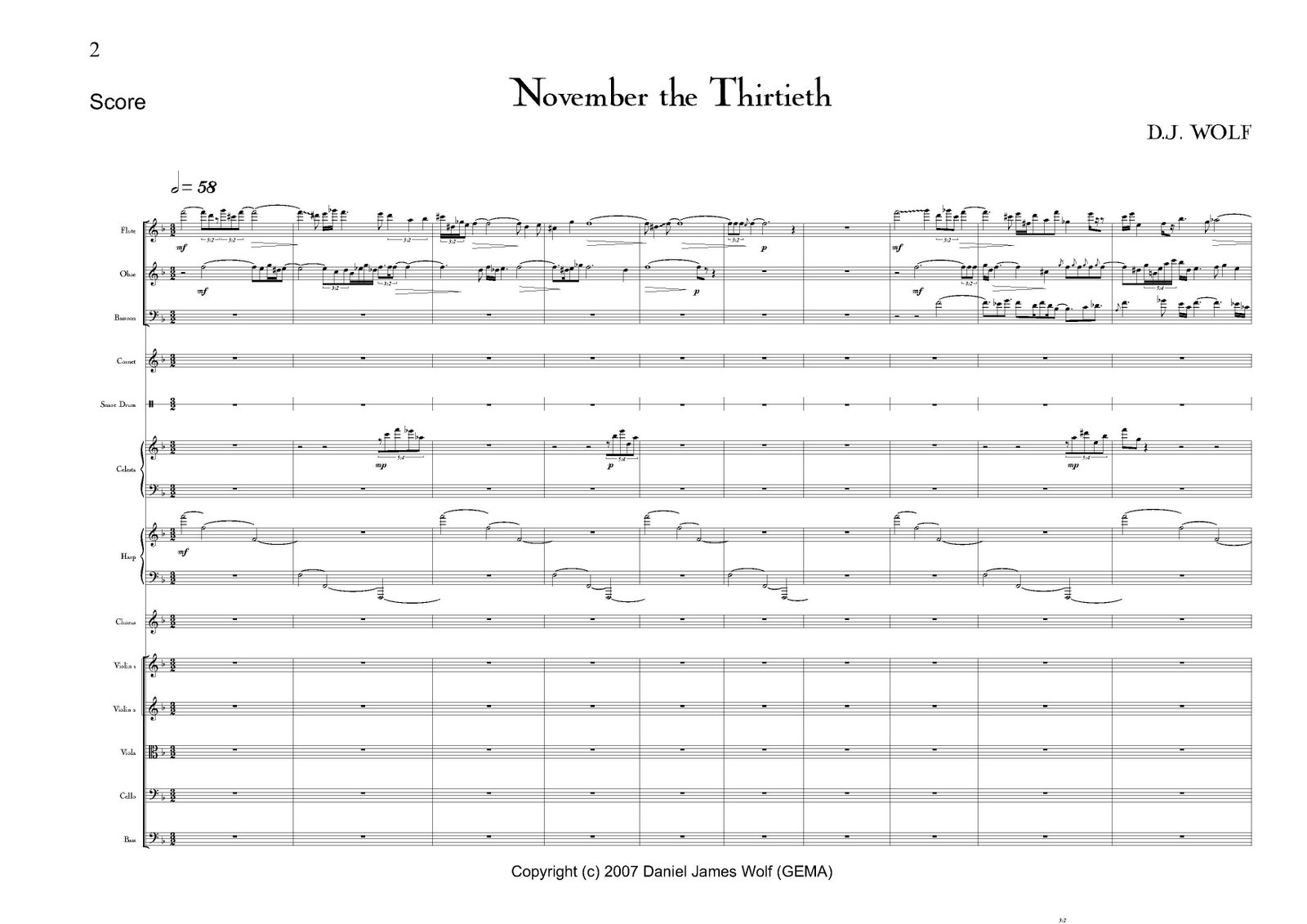
November the Thirtieth


For small orchestra and chorus (wordless). Ca. 3'. A PDF is here. A modest coda to the month.

Thursday, November 29, 2007

The Twenty-Ninth of November


For piano. PDF file (52KB) here.

Idle hands in a waiting room make for facile play. Or maybe not.

This project (30 pieces in a month with 30 days) has been, in part, about compositional efficiency in the face of a lifestyle that yields almost no "free time" to compose and what precisely the adoption of such efficiency might apply to musical quality. Entering this score, for example, into the computer (point, click) took more time than sketching the piece out (uni ball micro on the backside of a patient's information form). [Switching back to manuscript actually seems a real alternative, if speed is the only problem.] This pace has encouraged one good trend and one possibly bad trend: the good trend is that of moving toward the automation of habits, which has, paradoxically, made me more aware of, and less likely to give into, the habitual. The possibly bad trend has been a tendency to accept the first possible solution to any problem that arises rather than to be patient and wait for a better, if not the best, solution.

These have largely been unedited performances, and each is an experiment in doing something I would not otherwise have done (or at least done in public): a chorale, or a bit of classicism (neo- or not), for example. The pieces have also tended to have minimal length, to be more examples, as might be expected of experimental results, rather than finished product, but that's not automatically a bad thing. Putting the label of the experimental on this work is a bit of an alibi, I admit readily, in that it allows for both failures and successes (and much of the muddiness in-between), as well as for moving outside of one's usual proclivities, many of which are intimately associated with the professional identities that are so important nowadays.

Getting the Time Right


This story (about a group who secreted themselves into the Panthéon in Paris in order to fix the clock) touches my anarchist heart. Another hint, perhaps, that our world hasn't fall apart due to the hidden interventions of benevolent souls working outside of both state and corporate regimes and routines.

Wednesday, November 28, 2007

November the Twenty-Eighth


For three unison orchestras. Ca. 10'30''. PDF file (155KB) here.

Tuesday, November 27, 2007

The Twenty-Seventh of November

A three voice canon. Another 9x9-er for November. PDF file (46KB) here.

Reception History

Here's a time-lapse video by the composer Lee Weisert, assembled from samples taken every minute, of someone listening to the complete recordings of works by Ferneyhough over twenty-four hours time. It's interesting, although perhaps inevitable -- coincidentia oppositorum and all that -- that such complex music should elicit such a minimalist response.

My own youthful all-nighters usually involved minimalist musical fare, more food and drink, and were seldom done in solitaire. But then again, those days were generally more convivial, as well as better fed and better lubricated. It's sobering to consider what conviviality we have lost in a generation's time.

In any case, I predict that there will someday be a dissertation on the importance of the sofa in the reception of recorded contemporary music, importance that is second only to those exquisite Anatolian carpets, upon which guests of Morton Feldman were allowed to lounge like beached whales while luxuriating in Feldmaniana of exquisite length and aural charms.

Monday, November 26, 2007

Tracing Bailey's Steps

The estimable Paul Bailey has an audio file of the first act of his opera retrace our steps (text: Gertrude Stein) online here.

Bailey has written a bit about the development of the Southern Californian minimal style associated with the Cartesian Reunion Memorial Orchestra, here and its wake. Bailey's music is very much in this spirit, which is a fine state of mind & affairs.

November the Twenty-Sixth

For eight snare drums, the audience encircling. Simple wave motion and a perfect shuffle or two (as with a deck of playing cards). PDF file (71KB) here.

Sunday, November 25, 2007

The Twenty-Fifth of November

If I had a nickle for every piece of music that started out as a sketch on a cocktail napkin, I might not be rich, but I'd still have a lot of nickles. For string quartet. Ca. 20".

Friday, November 23, 2007

The Twenty-Third of November

For cornet with flute, bass clarinet, contrabass. A short study in near unisons, hockets, drones, once again in square root form. PDF file (57KB) here.

Thursday, November 22, 2007

November the Twenty-Second

A harvest chorale. Sometimes you have to wonder if the essence of our profession is captured by the experience of eight hours spent worrying about a pair of direct fifths. PDF file (17KB) here.

Complex Sources

I mentioned that my small item for String Quartet, November the Twentieth, was an hommage, and was then reasonably asked "to whom?". Well, it's a hommage to Sibelius, with the intervention of Douglas Leedy's remarkable String Quartet (1965-75), which bears its own dedication: I.S.I.M., and again, Sibelius is meant. Leedy's Quartet (a pdf (141KB) of the score is online here -- I'm responsible for any errors in the typesetting), is very much a part of the west coast radical tradition, with its diatonicism, just intonation, extremely long tones, and the interlocking rhythmic patterns (in this case, relatively of prime lengths) that only come out together after long cycles. The element of Sibelius's technique that Leedy and I have zeroed-in on here is his achievement of complex texture through the use of canons (especially those canons in the Fifth and Sixth Symphonies) and patterns that don't readily coincide. But such techniques are, of course, old hat: whether in early music, or in Brahms, Webern, Stravinsky, or Sibelius, good ideas are always good ideas.

The ever-alert Tim Rutherford Johnson has a brief and wise item on the performance and reception of complex music. He comes close to a point that I've long pondered, and that is the shared agenda in the experimental and new complexity communities, and the shared shut-out from mainstream performance environments. While both communities have had their own forms of détente with segments of the mainstream -- experimentalists via an openness to tonality in one form or another, and complexites via an intellectual stance that buys academic cred, the natural alliance between the two has seldom been made. The exceptions, for example in the work of the remarkable English composer Christopher Fox, are rare but illustrative of the potential for musical invention here. In many ways, Leedy's score is one of the most difficult to perform quartets in the repertoire. This is especially because of his use of extremely long and slow portamenti in the just intonation environment, a combination which creates beating phenomena both vivid and temporally disorienting, or, as one would have said a west coast generation ago, hallucinogenic.

I've decided that November the Twentieth is interesting and attractive enough that it needs to be expanded into a real string quartet (think Pinocchio becoming a real boy). Like my sixth quartet, it's part of my secret battle with the forces-that-shall-not-be-named who really don't want the words classical or minimal or experimental to have any currency beyond their negation or obsolescence. Well, bully.

Wednesday, November 21, 2007

Gamelan Selonding


I highly recommend this documentary film (click "Video abspielen") by the Swiss ethnographer Urs Ramseyer on the Gamelan Selonding of Tenganan village in East Java. Tenganan is understood to be a "Bali Aga" community, retaining many aspects of culture predating East Javanese immigration to Bali, and the Selonding is an "archaic" or "ritual" ensemble, treasured as a sacred heirloom, composed of metallophones assembled from large iron slabs, in a unique 7-tone tuning that accomodates a wide variety of pentatonic modes, with both pelog and slendro types included. The ensemble is modular in composition, and can be combined and recombined in numerous ways, usually with complex but efficient interlocking parts. The instruments are played two-handed with hard wooden mallets, the largest of which resemble long bones, and the players must also dampen the keys with their palms. The documentary begins with a pair of musicians rehearsing, and their simultaneous vocalizations provide underlying melodies and composite figurations. Amazing ensemble music.

(Also very interesting is this film of Iseh villagers rhythmically stamping rice -- it's probably a chicken and egg question of whether the rice-stamping patterns derive from musical patterns or vice versa, but virtuosity is virtuosity, no matter what the medium.)

Arts & Crafts

Someone recently posted a query to the Silence list about John Cage and the Arts & Crafts movement. I posted this response:

The phrase "Arts & Crafts" refers here to two related but distinct movements. The first was the well-known professional movement in architecture, the decorative arts, and to a more limited extent in gallery arts inspired by the international, and particularly British, models, but soon marked by local styles, most notably the "craftsman" (or "mission") houses and furniture and the Batchhelder tiles. Californian styles looked not only to British models, but also to colonial Californian and Asian influences. My own great-grandmother's house in Paso Robles was a typical Arts and Crafts bungalow, of white plastered adobe, red tile roof, with a mixture of decorations as much Asian as European. The second was a popular movement for homemade decorative arts, and Cage's mother presumably had a shop specializing in this market; it is often overlooked the extent to which the professional movement trickled down into amateur activities in every area from bookbinding to ceramics. While the US has hobbyists everywhere, it was truly on the west coast that the movement became an essential part of the lifestyle, and the geographical setting was especially ripe for admixtures of Asian and European elements. There was even amateur arts and crafts architecture: the house I grew up in, in the Russian neighbohood Claremont, was one of a number of houses built and designed by the owners themselves during the depression years, and assembled from local rock, torn-up chunks of pavement, and other materials salvaged from earthquake remains; the houses incorporated either "mission" or more anglophile elements. This do-it-yourself attitude was a real presence in the schools, community recreation programs, and private courses, and it's not difficult to recognize its presence in the working attitude of both Cage and -- perhaps even more so -- Lou Harrison (who is explicit about his debt to Wm. Morris, even setting Morris's Rapunzel). I would even go so far as to associate the music pedagogy of Cage's Aunt Phoebe, with whom he collaborated, with this attitude.

The Twenty-First of November


Sometimes resistance is futile (remember, these are 30 Exercises in Style & Possible Solutions to Assorted Musical Problems). A minuet and trio assembled from a dice game-in-the-making. PDF file (36KB) here.

Mumma reviewed

There's a nice review in the N.Y. Times (here) of Gordon Mumma's recent concert in the "Experiments in the Studio" series at the Merce Cunningham studios. Gordon was (and is) my teacher, and his recent work has included a proliferating series of piano pieces, many of them brief, but none insubstantial, and each compositionally elegant in one way or another. Although Mumma's focus has shifted from the analog (and early digital) technologies he developed in the 60s and 70s, the sonic focus, on resonance and balance, remains the same.

Tuesday, November 20, 2007

November the Twentieth

For string quartet, an hommage. Ca. 2'50'', feels like a sketch for something much longer. PDF file (66KB) here. (The PDF score was revised slightly, so please re-download!)

Monday, November 19, 2007

The Nineteenth of November

For wind quintet. Mostly a constrained random walk across a toroid manifold. Bound and blindfolded. Or maybe not. PDF file (69KB) here.

Sunday, November 18, 2007

November the Eighteenth

For piano, microphone, oscillator, and ring modulator. PDF file (60KB) here. Tempo and dynamics tbd in rehearsal.

Ten Recordings

Conductor and cellist Kenneth Woods blogs his list of ten must-have recordings. I'm now well into the must-not-have recordings part of my life and live musical experiences are always more vivid for me, but here are ten recordings which I can no longer escape, as they are an intimate part of my musical biography:

Sour Cream: The Passion of Reason. The recorder trio Sour Cream (Frans Bruggen, Walter van Hauwe and Kees Boeke) played an avant-garde repertoire stretching from the 14th through 20th centuries. The playing was always smartly anachronistic.

The Art of Courtly Love - David Munrow & The Early Music Consort of London. Scholarship and performance has now moved on from the Murow era, with vocal performances now the center of intention instead of Munrow's instrument chest, but the liveliness of the playing style and the enduring strangeness of the repertoire remain unmatched.

The old box set of lps of the Heifetz/Piatigorsky concerts. This is old white guys playing music by dead white Europeans under all the wrong circumstances and while they have some stylistic affections that can't be gotten away with anymore, it should be recognized that in these late recordings, Heifetz's musical command overrules his technical gifts and the use of portamento and vibrato is everywhere judicious, even aristocratic. Piatigorsky, on the other hand is as great as always, and should be recognized for his devotion to investigating historical performance practice (read this interview with Dimitry Markevitch for an appreciation of G.P.). This is truly fabulous chamber music. I borrowed this set from the Montclair (CA) public library so often that they had to retire it.

Beethoven Symphonies 5 & 7, Vienna Philharmonic, conducted by Carlos Kleiber. Two recordings that leave me speechless.

Ives: Symphony Nr. Four, second movement, conducted by José Serebrier. I owned exactly two quadraphonic recordings (the other was The World of Harry Partch, another recording that was very important to me, from the age of 13 or so) and seldom was there such a good match between technology and music -- the sound design is used perfectly to guide the listener through the architecture of the second movement, at each turn a new room, a new landscape, the listener moving through the spaces while the sounds track their own courses. I've still not heard a performance that really "gets" the transcendental fourth movement of this symphony, but the time will surely come.

The 25-Year Retrospective Concert of the Music of John Cage, the 1958 Avakian recording. There is an extraordinary continuity in the sound quality of Cage's music: straightforward, direct, with dry sounds directly and suddenly adjoint to resonant sounds. This live recording is a piece of its time, and the audience takes much of it light-heartedly, but that's okay.

Webern, Complete Works, conducted by Robert Craft. Musicians now play Webern with accuracy and stylistic sensitivity that were near-impossible to achieve in 1958, and Boulez's two sets are now considered the standard. But Craft's recordings were all that were available for a generation, and for all that they get wrong, they are never boring, influencing a generation of musicians. From Darmstadters to west coast minimalists-in-the-making, it was the style of these performances, which play down the Wiener Espressivo character in favor of a dry and even "objective" tone, that had decisive influence. Opinions about Craft the conductor have inevitably been colored by opinions of his other activities, and much of his conducting was done in place of or alongside another musician - Stravinsky -, and often under next-to-impossible rehearsal and recording situations, making it difficult to sort out Craft's musical contributions. Nevertheless, I believe that a dispassionate assessment of Craft is due, one that will both assert his historical importance and sort out the best of his performances.

La Monte Young: The Well-Tuned Piano. I contributed to the liner notes on this, so my bias is known. Young makes a decisive counter-argument to John Cage, in his rejection of Cage's acceptance of interpenetration between music and the world around it. I believe that Young's long-lasting impact on music making will be in the area of continuity, allowing a piece of music to stake out a particular sonic territory and then to luxuriate in it for as long as it takes.

Richard Maxfield: Electronic Music (Advance) made with a modest studio but with fabulous technique, Maxfield's pieces are alway inventive solutions to the problem of the fixed nature of a recording.

Alvin Lucier: I am sitting in a room (the original recording). The tension between the musically absolute and the psychological in music has never been made more vivid.

Saturday, November 17, 2007

November the Seventeenth


For English Horn, Contrabassoon, Wagner-Tuba, Celesta & Harmonium. ca. 1' PDF file (37KB) here.

Friday, November 16, 2007

November the Sixteenth


For winds & percussion. PDF file here. This is about four minutes and forty seconds of music, and it does some things that make me very happy, but the pressure of doing it in a few afternoon hours probably kept it from going as far as it should; it has the feel of a symphonic précis and the material here seems rich enough to be extended by another order of magnitude when subjected to the right combinations of chopping and stretching and tossing and turning and straining and churning and all those good things that composers are want to do.

No alibi

Tim Rutherford-Johnson of The Rambler points to a new blog that begins with an item about scholars whose favorite music is not necessarily the music that they study. As a card-carrying PhD in Ethnomusicology, I definitely know the problem, and I can recognize the advantages -- if not necessity -- that some dispassion brings to scholarship. Personally, however, I couldn't swallow that, as any music I'm going to engage with, I going to engage with passionately and life is too short to devote to any music other than that I like best. My engagement with music -- playing music by other, making my own, and even, yes, writing about it (Rollo sez: You call that writin'? Themz fightin' words!) is within those limits. I've played gamelan, for example, for 29 years, now, and simply can't bring myself to commit an act of scholarship about it (no loss actually, as there is such brilliant work being done by Sumarsam, Perlman, Brinner, Weiss, and many others). Or this: a lot of my friends and contemporaries come to the music they study or even the music they make with a caveat: Well, really, it's (fill-in-the-blank) that I like. And whether that blank be filled with some form of jazz or rock or hiphop or bluegrass or pseudo-polynesian lounge music, the position of their professional repertoire relative to their real-but-sort-of-secret passion is too often used as an alibi. And among composers, this is a particularly insidious alibi, in that the user can have it both ways: in Newmusicland, he or she can pass as a refugee from a more popular music who has finally seen the light, and among those less comfortable with new music, they reassure with their popular bona fides (just think of Milton Babbitt's affection for Tin Pan Alley).

I have a recurrent and unlikely, but nevertheless scary, nightmare: a state more authoritarian than the present one (probably right wing, but in the end it really doesn't matter) arrives in full force, and in the middle of the night, I'm awoken by the music police, probably deputized from the membership rolls of the leading musicological organizations, come to check on my musical preferences. And I have no alibi. The music I write about and the music I make is all music that I actually like...

Thursday, November 15, 2007

The Fifteenth of November

A little Waldmusik for wind quintet. PDF file (49KB) here. I almost feel like I'm cheating here. This is hardly a stand-alone movement, more a sketch, or perhaps, together with The Thirteenth of November, a movement among several more.

Wednesday, November 14, 2007

Experiment


If the fool would persist in his folly he would become wise. (Blake: The Marriage of Heaven and Hell)

November the Fourteenth

For Soprano, with flute, vibraphone & piano. Text: Wm. Blake, from An Island in the Moon. PDF file (78KB) here. I have some deep uncertainties about the dynamic level of this: it could be very quiet, or matter-of-factly mezzo-something, depending, I suppose, on how one deals with the hidden soprano. But that, my friends, is a problem faced by many others, some of them much less foolish than myself.

Tuesday, November 13, 2007

The Thirteenth of November

For wind quintet. Three minutes or so, but could have gone on (and just still might go on) for much longer. PDF file here.

Monday, November 12, 2007

November the Twelfth

for flute, clarinet, harp & percussion. PDF file (69KB) here.

Restless

Pliable, of On an Overgrown Path, has a pair of posts (here and here) about contemporary Requiem settings. Personally, I can't imagine writing a Requiem and I certainly don't want a Requiem sung when I exit this plane. The idea of eternal rest as the default setting for an afterlife doesn't sit well with me. I'd much prefer some eternal unrest, to continue to agitate, to be productive in one way or another, a possibility not necessarily excluded by all theologies. At the very least, I could follow Cummings' Uncle Sol and start a worm farm, or better still, have my ashes placed in an hourglass (so that my wife won't have suffer me get out of working too easily), or best of all, there'll be a big gate to Heaven, at which you're handed your harp and your parts to the official canon of heavenly sheet music, and a second gate just next to Heaven, at which you're handed a pen that never runs dry and an eternal supply of blank manuscript paper. This Next-To-But-Not-Quite-Heaven, with its canon in the making rather than a canon alreadymade, seems like an infinitely more interesting place than Heaven itself.

Loquacity

I was shocked, shocked (1) to discover, this morning, that Renewable Music had entered the top ten reblog sources over at New Music ReBlog. This being a distress signal for over-production, I promise now to do my very best to return to the respectable second tier where scoundrels, artists, and the constitutionally lazy ought to reside.

The truly shocking thing about this is that I'm someone who has run hot and cold when it comes to talking or writing about music. There have literally been years when I've thought that there was nothing to be said or, at least, I had nothing to say about music. During those times, I've usually done my best to simply shut up. The Age of the Blog (2) just happened to arrived during a spell when this was not the case.

From time-to-time, in these pages, I have written things that are provocative. But so far, complaints have been limited. While I suppose that this is mostly a measure of low readership and low readability (3), I do have to wonder if in part this is because new music has entered the Age of the Blog at a time in its development when its capacity to provoke, excite, or, indeed shock, is at a low point. If so, we've simply got to get back to work.
_____
1. Shamelessly sentimentality-betraying movie reference.
2. Shamelessly age-betraying allusion to the "Age of the Feuillton" in Das Glasperlenspiel.
3. Slight exaggeration. A reading level analysis of this blog notes that the average number of words in a sentence was 18.2, the percentage of words with three or more syllables is 17.55%, the average syllables per word is 1.62, the Gunning Fog Index is 14.32, the Flesch Reading Ease is 51.54, and the Flesch-Kincaid Grade 10.61. On the basis of the Gunning Fog Index, readership here is expected to be somewhat higher than (College) sophomoric, the Flesch Index indicates that it is slightly more difficult that the 60-70 score desired for general audiences, and the Flesch-Kinkaid grade is higher that that of the New York Times, but lower than that of Academic Papers. Okay, dudes, I can live with that.

Sunday, November 11, 2007

The Eleventh of November


For harp. With mixed chromatic tetrachords (suggested just intonation tuning at the end of the score). A pair of gnossiennes in greco-javanese style. PDF file (48KB) here.

The Job Title

I like my job title: a composer is simply someone who puts things together, an assembly worker, if you will. German, in addition to Komponist, also has Tonsetzer, tone-setter, like typesetter, perhaps an even more concrete and craftsperson-like term. But Hungarian has Zeneszerző, literally a music catcher. This suggests that the music is already out there, and is simply captured, as one would catch butterflies. I'm not a platonist, so I can't believe that an ideal form of music exists out there which our merely real music captures, channels, or reflects, but I certainly do appreciate the sentiment.

The score so far

I'm now ten pieces into the project of composing and publishing a score each day for a month. The rules are simple: each piece has to be complete and be completed within the 24 hours of its appointed day. So far, of the ten, one is for keeps. Two, maybe three pieces might, with revisions, have a life beyond this project. The others belong to the aether. And of the handful of pieces that didn't make it into the daily shuffle, most should stay sketches, but at least one is still irritating my fancy. On the whole, an average with which I can live.

One fact has been made vivid by this project: there is never enough time to compose and composing time usually gets shoved into the worst moments in my schedule. Yesterday, for example, Saturday the tenth, between the kids, the household, some translation work, and a long-postponed invitation to neighbors for dinner, exactly two hours of time in the late afternoon were left for composing, editing and publishing a piece. Much of those two hours was spent on a really wrong musical turn and then an uncooperative computer (my computing situation is far from ideal). But somehow the piece came together in its own weird way, and it may just be a keeper.

Saturday, November 10, 2007

November the Tenth

Open score for three or more instruments over a ground bass. Having archaic and eating it, too. PDF file (52KB) here.

Friday, November 09, 2007

Friday Food Blogging, briefly

I like recipes that appear to have been given (a la Ruggles' famous chord) the test of time, compositions that come from that mysterious balance between experiment and experience. Charles Shere, composer and writer, offers his recipe for Cassoulet, and it appears to be a renewable recipe of the first order. During my time in Hungary, I became a partisan of Sólet, Cassoulet's simpler cousin, and a dish that is typical of Budapest Jewish cooking (and presumably related to the eastern European Cholent). It's dominated by paprika and garlic and topped off, in the classic version, with smoked goose leg and stuffed goose neck. (A plain but pleasant version was usually to be had on Fridays at the Kádár étkeszde on Klauzál tér). With Winter now rushing in, the idea of the perfect bean casserole has gained some urgency.

The Ninth of November


for string trio ca. 1'45''

Some old fashioned electronic music

You've got to hand it to the NASA publicity machine. A topic making it's way through the popular science press is the "similarity" between radio signals captured by the Cassini-Huygens spacecraft from Saturn and Louis and Bebe Barron's 1956 electronic soundtrack to the film Forbidden Planet. I'm a sucker for old fashioned beeps-and-slurps electronic music and probably take a bit too much pleasure in both examples. But while there is a resemblance between the two, it is the product of some substantial compositional activity -- transposition upwards (44x) and editing -- on the Cassini sample and that compositional aspect is probably responsible for most of the resemblance. Similar operations with other radio signal will likely produce similar results.

It's too bad that this exercise was not used to bring more attention to the name Christiaan Huygens, which does have some real musical significance, in his investigations of the perception of sound (repetition pitch, in particulat) and his independent discovery of the 31-tone equal division of the octave, a natural extension of the meantone intonation prevalent in his time.

Thursday, November 08, 2007

November the Eighth


for clavichord. PDF file (46KB) here.

Wednesday, November 07, 2007

The Seventh of November

The theme of this week might be: write another piece that someone out there really doesn't want you to write. While I haven't gone as far as writing the piece that David Feldman really doesn't want me to write (that's a campaign theme song for John McCain, and yes, it'd be a cold summer day in Tuscon before I'd tackle that one) , writing a piece for three recorders that is simultaneously serial, diatonic (plus or minus ficta), and touched by chance operations is probably a close second. But as they say, there's still plenty of music to be written in [fill in the blank]. A PDF file of the complete score (4 pages, ca. 2', 56 KB) is here.

Tuesday, November 06, 2007

November the Sixth

A bit of a conceptual piece, this one, a(n) (cheap) imitation of a landmark bit of 20th century music. The inital idea was to completely level the pitch field to a single tone, retaining everything else in the music, but that idea soon gave way to replacing the pitches in the original with tones corresponding to a single harmonic series. Given that new tonal context, what sense and semblance of the original was left? This was the first piece in this project in which I have had substantial doubts, uncertain whether to put my name on the score, let alone publish it. Moreover, this was the kind of concept piece that easily gets misunderstood. But there are a couple of moments here (a cristalline chord with flute reiterations on top, and a small trumpet melody) that so favor my own musical tastes, and if there is anything that new musicians are used to, it's having no one "get" your jokes, that I've put aside the doubts. Heck, I might even do the 2nd & 3rd movements.

A PDF file of the score (92KB) is here.

Talking in parallel

One fascinating aspect of musical reception is the variety of ways in which different approaches to music use alternative vocabularies. A trained musician, a recording engineer, a physicist, and a cognitive or neuroscientist each has her own set of terms, and although there are often parallels, they are often interesting divergences. Timbre, for a musician, for example, is not precisely and not just spectra for a physicist, but rather represents an interactive complex of physical attributes. This page, at Stereophile, is a glossary of subjective audio -- the evaluation of recorded sound quality -- and I have found reading the whole thing to be quite useful in clarifying my thoughts about the evaluation of the related, but in many ways very different, situation of live music. Richard Parncutt's book Harmony: A Psychoacoustical Approach is a superb introduction to the psychoacoustics of music and the full text is online here.

Monday, November 05, 2007

A Fifth of November


miniature for violin and piano. PDF file (43KB) here.

Twelve-tone who?

The evil twelve-tone establishment is a running trope in Newmusicblogtown. Tempers these days tend decidedly to run hot against both them and their works and deeds.

My own take on this trope has been that, despite a certain prominence in very narrow circumstances and for only a brief time, there were never actually very many of them, and many of those turned rapidly apostate from any twelve-tone orthodoxy in their beliefs and practices. While a few twelve-toners rose to institutional prominence, they'd never really occupied that many seats of power in aggregate and while there were probably a few in those seats who did abuse the power they had, this was probably not done in greater proportion than elsewhere, in other seats with other aesthetic or technical agendas.* I happen to like some twelve-tone music very much, and even think that it's altogether possible that plenty of good music is still to be written in some version of the technique. But generally I find that there is a great distance between a Babbitt, on one hand, with an uneven but sometimes brilliant catalogue, and his camp followers, on the other. But getting to that sometimes brilliant music, is often very difficult because of (a) the atmosphere of intellectual hubris with which it has been smothered, especially the claim -- sometimes implicit, sometimes not -- that twelve-tone technique carried with it a unique musical and intellectual cache and (b) yes, the exclusionary musical politics played (whether in dishing out fellowships, Fromm funds, or BeeMee prizes) was often so loud that you couldn't hear the music.

All that said, here's my bleg: Who, exactly, are the leading or prominent believing and practicing twelve-toners nowadays and from which places of power and influence do they abuse and scheme? I want names. Besides Babbitt, Wuorinen, Roger Reynolds...

____
*Quoting myself: Tragic but true: when the smoke had cleared, the new music wars had been won not by towners up or down or coasters east or left, but by a rear guard of trained symphonic band composers from big state universities in the middle of the country. The surviving rebels were exiled, retrained, or forced into dayjobs in data processing and direct telephone sales.

Sunday, November 04, 2007

November the Fourth

[Click to enlarge the jpeg image.] Preterite: n. lover of the past, one passed over. Assembled from chorale residua, anti-parsimonious, voice leading errors dispatched accordingly. Singing words as if you mean them sometimes requires setting words as if you have forgotten any meaning they might once have had.

Saturday, November 03, 2007

The Unknown Harry Partch

You would have thought that the superb scholarship of Bob Gilmore and Philip Blackburn had exhausted the subject of Harry Partch. Well, apparently, not. Read here for all about Harry Partch and the Deathly Hockets.

(Why is musician humor so geeky?)

The Third of November


for three instruments, two treble, one bass (e.g. clarinet, muted trumpet, bassoon) ca. 2'10''. PDF file (67KB) here.

Friday, November 02, 2007

November the Second


Out-of-doors music for five flutes or multiple quintets of flutes. 10'12''. PDF file (153KB) here.

Thursday, November 01, 2007

The First of November

For (any) clarinet.
Click image to enlarge (jpeg). PDF file (76KB) available here.

Wednesday, October 31, 2007

5 x 5

Steve Hicken of listen has dropped a meme. My answers include only works or people that I have not actually seen/heard/met in person before:

1) What five operas would you most like to see performed?

Il Riturno d' Ulisse In Patria; L'Oca del Cairo; Guillaume Tell; Die Feen; Four Saints in Three Acts.

2) What five pieces would you most like to hear performed? Oliveros: In Memoriam Nikola Tesla, Cosmic Engineer; Mumma: Hornpipe; Sibelius: Fourth Symphony; Partch: Delusion of the Fury; Mozart: G Minor Quintet

3) What five living performers would you most like to meet? Mitsuko Uchida (piano), Ki Purbo Asmoro (javanese dalang), Rohan de Saram (cello), Maurice Steger (recorder), Juliane Banse (soprano)

4) What five living composers would you most like to meet? I'd rather meet one really good dentist first.

5) What five living musicians (composers, performers, writers, scholars, etc) would you most like to play three-on-three basketball with/against? I'll go two on three with rapper Shaquille O'Neal against musicologist Richard Taruskin, composer Charles Wuorinen and critic Norman Lebrecht. Heck, they can even have the blogger A.C. Douglas on their side.

Even more responsibility

Here's a article from today's Die Zeit (in German), discussing the current controversy over the performance of works by Hans Pfitzner. The subtitle of the article goes "The composer was a dyed-in-the-wool National Socialist. Even the friends of his music can't wash him clean."

The article is followed by an interview with the conductor Ingo Metzmacher, who cannot be described as "coming from a right corner" and for whom Pfitzner's anti-modernism and anti-semitism are decidedly alien, but nevertheless makes a case for the performance of Pfitzner's music.

Responsibility

I just realized something that must be totally obvious to everyone else on the planet.* When a critic writes about a piece of music or its performance, she or he is responsible for backing up the opinion with evidence and argument.** Composers, on the other hand, have the luxury of placing their opinions out into the world without critical apparatus, and those opinions will be considered by audiences alongside the composer's music. Thus, unlike a critic, I have the luxury to say that "I like X" or "don't like Y" without further verbal ado, but I've got to be prepared for an audience which will only swallow that opinion with whatever salt my music summons up.

_____
*As poet Charles Olson put it best: I Have Had to Learn the Simplest Things Last.
**See also this earlier Renewable Music item: In other words, in order to read a piece of criticism, you have to read critically. Basta.

Landmarks (30)

Wolfgang von Schweinitz: Plainsound-Sinfonie (2003-2005) für Bassettklarinette, Ensemble und Orchester, op. 48

A product of long research -- often in collaboration with the remarkable Canadian violinist and composer, Marc Sabat -- into musical intonation, the Plainsound-Sinfonie is also a profoundly learned, but also nostalgic and whimsical, homage to an orchestral tradition, beginning with late Mozart and making a unique trajectory from there. I hear bits of Weber, Wolf (the other one), the Skryabinistes, the composer's colleague, James Tenney, and his teacher, Ligeti, whose own late works share an interest in making old instruments do new (or rediscovered) intonational tricks. Other recent pieces of Schweinitz pass through territories as disparate as Schubert, Wagner, and Morton Feldman. Schweinitz, recently appointed as Tenney's successor to the Disney chair in composition at CalArts, is a composer with a unique set of credentials (he studied in both Germany and the US) but more critically, a unique set of sensibilities. Von Schweinitz was very early on, and inaccurately as these things always are, stamped with the label of the Neue Einfachheit, primarily on the basis of his early (1976-77) orchestral Variationen über ein Thema von Mozart. The label stuck, but Schweinitz moved on, ever further along his own trajectory, and that has often included works of substantial scale and duration, among them the opera Patmos (setting the entire text of the Apocalypse of St. John) and an 81 minute-long piano trio Franz & Morton. It should be apparent that an element of excess is everywhere in Schweinitz's music, an excess that can be identified with the early seventies, but a classical impulse is everywhere as well, and the art here is holding the two factors in balance.

Let me mention a couple of features of the Plainsound-Sinfonie. Its genre is, as to be expected from Schweinitz, both classical and excessive, and as such is at once symphony, concerto (for bassett clarinet, the extended-range instrument for which Mozart originally composed his clarinet concerto, and not to be confused with the bassett horn), overture, and tone poem. The microtonality of the piece is no abstract exercise but is designed rather to project a tonal scheme that begins with classical dimensions and then moves into territories more strange, in particular through the use of a tuba tuned to the rest of the ensemble via a subharmonic ratio of the number eleven, and thus, effectively, a quarter tone off, a relationship that is, at times, comic, at other times, tender.

Scores and sound samples of Schweinitz's works are available here.

Some blog openings you won't read here

I was having morning tea on Friday with Anne-Sofie von Otter...

Eight of us arrived at the enormous estate...

Running northwards along the shore of Lake Michigan...

As an Aquarius, of course...

No sooner had I invoked the name of Eddie Van Halen...

Tuesday, October 30, 2007

Fibs & Sins, an update

I'm frequently asked for recommendations for notation programs, and my answer is usually "depends...", with an encouragement to consider a variety of programs rather than get stuck in a software monoculture. I mostly use Finale 2007, and sometimes use Harmony Assistant and Turandot, and have recently played with Lime and Lily Pond. I am happy with Finale 2007 and find it both flexible and powerful, but that flexibility and power has come at the cost of a substantial investment in learning the tricks of the program, and the assistance of a few third-party plug-in, especially the indispensable TGTools made by the composer Tobias Giesen. However, I have paid close attention to reviews of the latest Finale update (2008) and have noticed a real trend among power users of Finale to either skip this update or to switch to Sibelius, due to the apparent decision of the staff at Finale to invest more in additional features rather than improve the performance of existing features, including a couple of persistent bugs. I have also been impressed by the fact that Sibelius staff maintain a presence in public fora and appear to bend over backwards with customer queries. Finale staff are often, frankly, a bit surly -- bug reports are responded to with diffidence and suggestions for improvement get form letter responses. It also seems to be company policy at MakeMusic, which owns Finale, to ignore public fora, like the Finale Users' List. Finally, I have looked at the public financial statements of MakeMusic, and I have some concern for the future of the product. I really don't want to be stuck with orphaned software, especially with orphaned software that depends upon the registration system initiated in 2006 or 2007. Because of this, I've decided to make a Sibelius cross-purchase (there are special offers this month) as insurance against further developments at MakeMusic. Again, I really like Finale, can do almost anything I want with it, hope the best for its continued development and I don't plan on using Sibelius, with its inflexible entry methods, with any frequency but a bit of insurance seems warranted.

Monday, October 29, 2007

Contest time, again

Yes, It's once again time to play Name the Next New Music Box Cover Person, our regular contest. Each month -- as you know far too well -- the New Music Box, the internet organ of the American Music Cartel Center features a video interview with a new music personality or two. My own guesses have had a bad track record and my wishes are even further off. Of late, there have been a conductor, members of a new music ensemble, and four composers, one prodigal junior composer, a pair of great big senior composers, and one other composer cosily nestled in-between (at least three of the four being practicing cat owners). Once again, I predict that the next interviewee will be a critic; by all rights, it ought to be our most senior active critic, Alan Rich (someone: do a serious video interview with Rich now -- the man's been places and heard good music, including the first performance of the Bartok Concerto for Orchestra) but -- it's the AMC, after all -- it's much more likely to be a New Yorker, so I'll guess Alex Ross, with his spanking brand-new book out (find out if that guy owns a cat!). What's your best guess? No NMB insiders allowed, no entry fee, and the winner gets a gift certificate for a Buñueloni at the Cedar Tavern, should it ever reopen, and in addition I will throw another $1.39 into the unclaimed pot, carried over from last month's contest which had no winner, making it a grand total this month of $6.67. Once again, staff members and relations of the AMC are excluded from the competition. The judges' decisions on the accuracy of the entered predictions will be arbitrary, capricious, and final. Entries must be received before midnight, GMT, on October 31st.

Sunday, October 28, 2007

Exercises in Style

Without much doubt, one of the significant events in recent music history was the invention of the note. Not that notes had not been used before, but rather that we started paying attention to them in a different way. In fact, we become fairly obsessed with notes, often attending to them at the disadvantage of larger or small pieces of the musical fabric. Indeed: making and playing and listening to and anything else that might go into knowing a piece or repertoire of music often took second place to the all-important task of accounting for, explaining, or justifying every single note. Like many other composers of my time, this obsession with the note colored my entire approach to making music, an approach that usually began with a breakdown of possible materials into their smallest bits, i.e. notes, and would then proceed to distribute said bits until they had been satisfactorily arranged in one way or another.

The Oulipo: although I know too little of their work -- and of that, mainly novels by Queneau, Perec, and Mathews --, I do owe something substantial to the famous writers' workshop for "potential literature" (a term of art I really like), and that came in the recognition that Oulipo members never restricted their work, their experiments, to operations at an elemental level, but instead allowed that they could take place at any level of work from the sentence to the paragraph to the chapter to entire books or series or even (at least potentially) libraries. The same generous re-consideration of the scale of ones work could reasonably be extended to music, as not only the notes themselves, but phrases, movements, whole pieces, and whole repertoires could be subjected to disciplined creative action.

One book by Queneau in particular, his Exercises in Style, played an enormous role in my thinking about this question of the scale of operation. Although I've only recently read the excerpts translated in the Mathews/Brotchie Oulipo Compendium, and up to then know only that the book sets out to tell the same unimportant story in 99 different writing styles, the fact that there was a book out there called Exercises in Style made it possible for me to compose a number of works, among them a small "opera seria for handpuppets" called The White Canoe. Mr. Gorey's libretto for the opera was composed of 13 scenes of rhymed couplets, had a clear narrative, and satisfied -- if sometimes irreverently, all of the conventions of the number opera form. The libretto more or less demanded a score that at least paid respect to those conventions. So my experiments took place at a larger scale, in that each scene began as an exercise in the synthetic combination of at least two styles. Say, Mozart and Cole Porter. Or: Offenbach and Philip Glass. None of the combinations were to be done in the same way. In the end -- and I'm unsure whether this is virtue or vice -- little of the music was tied too closely to either of the source styles, and none was a simple synthesis of a pair or trio but became instead what might be called a dialectical other.

The imitation of musical styles is not a skill for which I can claim any particular virtuosity, or even virtuosity beyond that expected of musicians trained in a particular repertoire or two. But there are some circumstances that almost force a style upon a composer, and some styles are much easier to reproduce than others. For example, when asked by drama teacher at the German Gymnasium in Budapest to set some songs for a production of The Good Person of Sezuan, the lyrics forced my muse into a corner in which the presence of Weill was unmistakable, and I didn't resist the temptation. Another time, I got a call late at night from a stranger offering a welcome sum of money for some counterfeit Viennese classicism. That was tricky -- it had to fit into the style, but it also had to be something that was, in terms of the historical corpus, original. In short, I was commissioned to become a tightrope walker between those two goals. The everyday forger is a copyist, but the successful forger makes original works designed to be mistaken for unknown works of others.

The connection between stylistic imitation and musical training is often close. The composition of a "Palestrina Motet", "Bach fugue", or a "Haydn sonata movement" are tasks still frequently assigned to students of music theory, although every good music theory teacher is well aware of of the two perils involved: first, that there is no single road to Rome in imitating a style, any number of theoretical regimes (or, shall we say, algorithms) can be called into play to replicate a musical score, and it's entirely undecided which regime is either the most "authentic" or the most "efficient; second, if a student's compositions hews to closely to its models, it will likely to bore, a failure in terms of originality (and the very reason we choose particular works as models is their quality, among which is presumably originality), but if the exercise is too original, doing things unknown in the models, then the work may fail on plausibility grounds. A tightrope walk.

All that said, I still have to admit to a decided haziness about exactly what "style" is, and the border regions between apparent styles (like those between idiolects, dialects and languages) are both fascinating and frustratingly vague. (I'm sure that Potter Stewart would have defined style as well as anyone (i.e. See it -> Know it. (Picnic. Lightning)).) But when it comes to music, speechlessness is the norm, so if we're a bit vague when it comes to defining style, it's entirely with the range of the acceptable.

Saturday, October 27, 2007

Indulgences

I'm pondering an odd project for this blog in November: composing a small piece each day and putting the scores online here. My idea is to compose a set of what might be called 30 Exercises in Style & Possible Solutions to Assorted Musical Problems, otherwise entering into the project without predetermined ideas about the resources required, methods invoked, connections between individual pieces. Each piece should be complete, self-sufficient, and with a duration of at least the better part of a minute but without an upper limit. Scores may be in a tradition notation or not, and some may be more practical and others more conceptual in nature.

(I'm interested in this project because of a commitment to having a repertoire of really new music scores as an online presence, without the mediation of traditional publishing institutions. But the idea of a piece each day is a good one for any of you who might be stuck. Lou Harrison shared this advice for "blocked' composers from Virgil Thomson: "Simply compose one short piece a day. It must be a complete composition each day. It is like 'kindling' ~ one day along will come a more important idea that will require extensive work ~ the flame is thus lit & away you go! It is important, he says to keep regular appointments with the muse ~ if she doesn't arrive then it's not your fault, at least You are there!")

I've tried, if not always successfully, to keep a certain distance between this blog and my own compositional activity, trying to use the blog more to open up some conversation about matters musical and beyond rather than as a promotional instrument, so I have some reservations about this. So, if anyone has any objections, and you'd prefer that I hold forth on Mandarin swearing in Firefly or such, please let me know, and I'll just figure out another way to agitate.

Update: Doing daily composition is already part of my routine, and this blog has been basically an extension of the little journal entries I write while doing that composing. My concern here was whether or not putting these pieces on line would be out-of-line with the spirit of this blog.

Friday, October 26, 2007

States of Art

With all the recent reportage on "the state of classical music", with narratives ranging from gloom and doom sagas, or thrillers of corporate and state intrigue, to fantastic tales of unlikely (if mutated) survival, the desire to place musics into cultural/historical narratives sometimes strikes me as misplaced because, if music history tells us anything, music has the power and mutability both to express the most local of times and places as well as to be fit into eras and locales far from its origins.* Music emerged out of cathedrals and cloisters both pious and sleazy, out of feudal states both glorious and petty, from mercantilist or steam-punk early industrialist states, and from any of the evil empires of the last centuries, and not one of these identifications with a particular time, place, and system automatically qualifies a piece of music as good, bad, or indifferent. Music be pliable, my friends, and cooption brings bother delights and dangers. That's why I hold to my thesis that the best music -- the renewable music, if you will -- is that which continues to resist its state, and the next, and the next...

But resistance is, indeed, often futile, even for the strongest among us. I've been reading Mike Davis and Daniel Bertrand Monk's dazzling anthology Evil Paradises: Dreamworlds of Neoliberalism, which takes on everything from urban renewal in Medellín and the disneyfication of Hong Kong to Ted Turner's bison ranges and a plan (or scam?) for a floating libertarian tax haven state-on-a-ship. Yes, a slice of the world that Dick Cheney wants to build, made safe for Halliburton and Blackwater, but also for Columbia Artists Management and Sony Classics. But I can't help but take some small encouragement in the fact that many of these plans (and scams) are falling apart left and right. It's now a consensus opinion that, having taken office on a platform of "government is inherently bad", the current administration sought to govern as poorly as possible, to prove the point while offering maximum largesse to their cronies. Likewise, the biggest firms and institutions in our little music world are demonstrating that conglomeration and synergy often really means bloat and lethargy and, most tragically, the musically bland, while smaller enterprises and individuals are readily demonstrating fleetness, flexibility and fearlessness towards musical diversity. But these enterprises and individuals always run the risk of recuperation: as we once cheered Nonesuch, we now cheer Naxos, and even young radicals sometimes get tenure and petrify. And when we soon cease our cheers for Naxos or the ex-rads, if the world is right, there'll be new forces to cheer waiting in queue.

I have wonderfully mixed reactions to much that is in this book. China Miéville's essay on the anarchocapitalist floating tax refuge, for example, wisely zeroes in on its inevitable turn towards a police state (yes, give a ship full of libertarians their guns, and pretty soon they'll all be playing cops), and he presents one of the most cogent defenses of a state I've encountered, but I'll still hang on to the idea that the time will come when we get along well enough and fairly enough and pretty much out of one another's way that a state is just not particularly important, providing services, not government. And when that time comes, I here and now predict, music (good, bad, indifferent) will just get along fine.

*The most interesting of these are the big books by Alex Ross and Richard Taruskin, titles known and available in all the familiar places. Boy, I'd like to see those two duck it out, blogging heads style, someday: they both do interesting dances around their favorite dead, white, European male intellectual sparring partners, Ross with Adorno and Taruskin taking on all comers (idealist, materialist, dialectical, positivist... if he had a sense of humor, he'd probably read like Veblen), and someone with more patience for these things than I have is going to write something smart about this.

Tuesday, October 23, 2007

Habitual obitual

Does anyone else make a habit of scanning through the "Musician Deathwatch" at Tim Rutherford-Johnson's blog, The Rambler? I'm not an especially morbid sort, but sometimes when I'm down, it cheers me a bit not to find my own name in the obits. It's sort of like the "Magic Fingers" bed-vibrating machines in cheap American motels: you keep poppin' the quarters in, because it feels so good when it stops. WHICH reminds me of an interview (not online, sorry) with Daniel Barenboim in the current issue of Die Zeit, in which Barenboim says that "silence is death and sound is life", which is an oddly over-simplified thought from a mainstream musician who has actually become more interesting over the years, despite all the pressures of the institutional systems in which he wanders. While there is a political context in which this pair of equations makes sense, music is all about sound and silences articulating one another in lively ways, and each is musically meaningless without the other. While death may be meaningless without its contrast, indeed opposition, to life, the reverse is not true, for much can happen in a lifetime that has nothing to do with death, and I happen to count music, with sounds and silences both, among that muchness. And the fact that people, alive and well, can take some moment of their lively wellness to recall the silences and sounds made by musicians who have already taken their shuffle off this coil, well then, those sounds and those silences certainly appear to have some power to transcend the terminal.

Monday, October 22, 2007

Free Study Scores!

(An encore posting from March 8, 2007)

I've had a long argument with an open software advocate about music. My contention has been that music is already essentially an open source medium, as the combination of a good recording and good listening skills can often make the construction of a piece of music transparent. However, as good as one's ears can get, it is still often very useful to have a look at a score, both to see how the composer has indicated his or her ideas, but also to find interpretive possibilities not taken in the performance at hand. Some of the most important learning experiences for me as a musican came about from copying out scores by hand (I did that a lot, as I was on a paper-route income and photocopying was expensive for me).

Unfortunately, getting your hands on scores in the first place is often difficult and expensive. Study scores -- small format editions -- are increasingly rare, and they are sometimes sold at shockingly high prices. So in schools or universities, we tend to get taught either from questionably legal photocopies or from the same few pieces that are widely available in study editions or packaged into anthologies (the two volumes of the Norton Anthology will set you back 71USD), or a student is sent to the dreaded reserve desk in the library in hopes that no one else has checked out the score.

It's understandable why publishers have had little interest in making study scores available. The profit in sheet music of any sort is never high unless a publication can have a large audience over a long period of time, and the chief business of a publisher is the mix of score and parts rentals to professionals and collecting the publisher's share of royalties from works under copyright.

Sometimes, however, publishers have realized that making their materials more widely available at more reasonable prices can both create income producing sheet music, and create, via the promotional opportunity, more royalty-income. The recent Peters editions of collected smaller piano works by Cage and Feldman are a good example. Whereas, in the past, getting a look at all of these scores required many small purchases, and were both troublesome to order and troublesome for Peters to produce as the pieces were largely published as on demand ozalids or photocopies, now a pianist or a music student can have a substantial repertoire of contrasting pieces all at once in a single anthology, the price of which is modest when compared with the old price for all the separate pieces. Unfortunately, not enough publishers are following the Peters example -- assembling a complete set of Webern study scores (ca 3 hours of music total) piece-by-piece would cost many hundreds of dollars, for example, and a Stravinsky set would cost thousands. Why isn't there a single volume complete Webern*, Varese, or Ruggles?

More publishers need to get wise and realize that they have a real promotion opportunity for their scores if they simply put them online. The editions don't have to be beautiful, and they can be watermarked with great big "DO NOT COPY" messages. This will not diminish their income from the pieces, as they will continue to rent hard-copies of the full-sized and bound scores and parts needed for performances, and they will continue to be paid royalties for performances and mechanicals.

Here's a concrete example: The late Robert Erickson was an excellent and inventive orchestrator. But his pieces are too little known and played infrequently. His scores would be very useful in teaching orchestration, but although they are all available through Smith Publications, the editions are extremely expensive, affordable only by the small coterie of major research libraries with score collections. If only a few of the larger scores were made available in cheap study score format or -- even better -- free and online you can bet use of his scores in teaching orchestration and perusal of his scores by concert or recording organizers would increase substantially.

Erickson is far from the only composer to whom this applies. For a real survey of recent orchestration, study scores need to be more widely available of works by Goeyvaerts, Feldman, Cage, Xenakis, Ligeti, Reich, Scelsi, Sariaaho, Lindberg, Nono, Kondo, Takemitsu, Brant, Lucier, Adams, Tenney, Barlow, and many others. As long as these scores are not available, the status of the entire new music project with the larger musical culture may be very effectively questioned if not discounted altogether. The music has to be present -- in performances, recordings, and in scores.

There is a vicious circle here: music students don't encounter scores like those of Erickson in school, and when they grow up and start making concerts of their own they don't play any Erickson, all because they simply are unaware of his works. Here is an opportunity for publishers -- as well as for those composers who have chosen not to work through third-party publishers -- to get out of this vicious circle, to establish the works as fixed presences in the musical culture, and to promote the works at a modest cost, while offering potentially substantial benefits in terms of the real income that a piece can generate.

_____
* An elegant, hardbound, but pocketbook-sized volume of Webern works was actually published in the last days of the Soviet Union. This was a "pirated" edition, of course, but why the heck didn't Universal get the idea and start publishing the thing itself?

Getting yourself into trouble

Sometimes you can learn more about composition from artists engaged in media other than music. Here's a great video interview with the painter Chuck Close, talking about when a work is finished, the advantages of working within constraints, the development of a personal style,
...painters would similarly try to get themselves into trouble. You'd push yourself into your own corner where nobody else's answers will fit and that's the key to finding yourself.
and much more.

Sunday, October 21, 2007

Traditional Music Publishing Takes a Last Shot Over the Bow

Scott Spiegelberg has posted the news that International Music Score Library Project has been shut down, in response to a pair of cease and desist letters from Universal Edition. I believe that this moment will go down as a mistaken, last gasp gesture on Universal's part. As I commented to Scott's post:

UE is being very shortsighted here. For concerts works not yet in public domain, the score on paper, by itself, generates little or no income for a publisher, and often, only production and warehousing costs. When, however, a performer downloads a UE score and performs or records it, she or he must still pay a license for any performance of the work, regardless of whether or not she or he has purchased a physical score. That fee is collected, as usual, via the local rights organization, or in theatrical contexts, via a grand rights contract. Moreover, publishers can continue to extract rental fees for performance-ready parts and other materials which are less easily transmitted online.

Scores online should be thought of as perusal and study materials, with their primary function one of promotion and marketing. Scores online are available to musicians and concert producers for help in planning possible performances and recordings. Publishing houses no longer have monopolies on the means of producing scores, so the essential services that they can provide to a composer (in return for one half of her or his license feed) are marketing their work and, when applicable, managing rentals.

A publisher who does not place scores in online libraries is making a nonsensical distinction between paper scores in physical libraries (which are generally available only to academics) and online scores (which are available to anyone at any time) and is doing their composers a disservice by not using the best marketing tool currently available. A score placed online is a score with a stake in the repertoire of performable music; a score held closely by a traditional publisher is a score held captive.

Saturday, October 20, 2007

Hausmusik

All the pianos in my family had benches full of sheet music, and that music was mostly popular classics of the "Music the Whole World Loves to Play" variety. We tend to hold that repertoire in fairly low esteem these days and I doubt many kids these days grow up playing the Dance of the Hours, To an Evening Star, or the Minuet á la Antique. The repertoire was not only light or character pieces, though, it also included four-handed arrangements of symphonic works and operatic transcriptions that brought both sophistication and clarity to the transmission of music. The disappearance of that entire repertoire is a marker for the loss of music making at home as the central activity in a musical life, activity from which the concert halls, opera houses, player piano rolls, broadcasts, and recordings all extended.

As a composer, I recognize that producing sheet music for home consumption is no longer the kind of enterprise from which careers are made (indeed, the last American composers of serious music for whom that could have been true were probably MacDowell and Griffes). But if I really want live performance to be the vehicle for my art, informal music making in private settings must nevertheless be recovered for new music, if new music is to have a place in the culture that is both high and deep. Engagement with the new music -- if it is to be more than casual, recognizing the wealth of detail, rich association fields, and structural interest -- has got to go beyond passive consumption and become active, a close encounter. If I've got Dichterliebe or The Wonderful Widow of Eighteen Springs on my piano, I want to play at them, singing through them with my composers' croak, and get to know them better than Stardust or Yesterday, because there is simply more to know. I want my daughter to start playing the cluster music in the first volume of Kurtág's Játékok and maybe later some of Mumma's pieces ...from the Sushi Box or Monahan's Piano Mechanics, because the challenges to ears and hands will simply make her a more interesting person.

The composer Lawrence Dillon writes here of an unusual event, a house concert programming one of his pieces. Isn't the unusual aspect here not the concert itself, but the fact that such a concert should be rare?

Friday, October 19, 2007

Idiolect Composers

Here's a link, at Crooked Timber, to a BBC documentary about a large collection of German shellac recordings from the First World War of prisoners of war from Britain and Ireland, a time capsule of local English dialects.

I have a fascination with dialects, and especially in the borders between dialects and between dialects and idolects, the territory in which linguistic innovation has traditionally been most active. My fascination is an aesthetic one, with very little hard linguistics behind it, and it's attached to a notion, perhaps fanciful, about the relationship between the speech patterns and the music of individual composers. The extent to which a composer speaks -- and does so in a particular idiolect -- rather than sings through her or his music probably varies a great deal, but it's impossible for me to hear much Cage or Young or Oliveros or even Babbitt (maybe especially Babbitt), without thinking of their speaking voices. (Some works, for example those by Lucier and Ashley, are entirely explicit about this relationship). I've recently encountered some online recordings of Stravinsky rehearsing and of Schoenberg, which are also highly suggestive of an interplay between musical and linguistic idolects.

Tuesday, October 16, 2007

The Last Word on Minimalism

The talented Mr. Guerrieri, of Soho the Dog, not only composes, critiques, makes sausage, and blogs, but is also a comic strip artist.

I don't do comics myself but I do have a favorite, David Lynch's The Angriest Dog in the World, which ran for from '83 to '92 in the LA Reader, and is now considered a pioneering work in the genre of constrained comics. It always consisted of a fixed introductory text ("The dog who is so angry he cannot move. He cannot eat. He cannot sleep. He can just barely growl. Bound so tightly with tension and anger, he approaches the state of rigor mortis.") and four images changing in only the smallest of details, the last after nightfall, of the growling dog, chained outside a house. But the text in the balloons emerging from the house changed each week. My favorite went something like this: "'Darling, do you like minimal art?' 'I married you, didn't I?'"

The missing mechanism

The award of the Nobel Prize in Economics this year, to Messrs. Hurwicz, Maskin, and Myerson, is yet another opportunity to reflect on the curious economics of new music composition. The latest Nobel trio are specialists in Mechanism Design, which is all about agents with private information selling and bidding for goods, and how specific outcomes can be achieved by designing structures or rules through which each participant has an incentive to behave as the designer has intended.

Such mechanisms are seldom at play in Newmusicland. Here, a commissioner usually wants a work by one composer in particular and the amount of the commission is fixed by external circumstances and is usually non-negotiable. Typically, a patron will simply give a composer a call or meet over lunch (Russian Tea Room, anyone?) and say something like: "I've got 5000 Sheboygans burning a hole in my pocket, why don't ya' write me a nice little piece."

Imagine, however, designing an alternative environment for commissioning music incorporating more market-like mechanisms, specifically auctions. We want our design to bring composers and commissioners together with optimal matches of pieces and commision fees. Composers (or groups of composers, working as a consortium) could propose the composition of works with specific forces and dimensions, setting a (private) reserve selling price for the proposed work. (In an auction, a reserve price is the minimum price that must be bid for a sale to take place, or, conversely, the maximum price for a purchase to take place). Commissioners would approach the auction with their unique private lists of preferred composers, types of works, and commissioning budget, including their own reserve purchase prices. In the best scenario, a composer and a patron would eventually be matched in the auction at a price optimally somewhere in-between the two reserves.

The greatest advantage of such a marketplace, however, is simply that it would be one in which any potential composer or commissioner could enter and compete. The present commissioning environment is largely one of small networks of familiars and typically does not allow for an unestablished composer to enter, let alone compete on an even footing with an established composer, even though a patron may well be attracted to the idea that for the price of one piece at reserve price by the established figure, she or he might purchase an entire album of pieces by the less-established composer (or even a group of them).

I have written positively before about the eBay commissioning projects of composers Dennis Báthóry-Kitsz and Celeste Hutchins, but I've more-or-less convinced myself that they really won't fly until both the supply and demand sides of the market have reach a critical mass.