I recently posted a comment to an item at Sequenza 21's Composers Forum about Ned Rorem's new opera Our Town:
Rorem was very wise to limit the size of his orchestra. Modest resources would seem to match the modesty of his subject matter and the economy of means has other practical and musical uses. Personel costs can be real impediments to productions and it's reasonable to assume that the smaller pit will make the piece more attractive. A lighter orchestra, however, creates some interesting opportunities for flexibility with vocal types. A lot of the discomfort audiences and composers alike have with operatic voices comes directly from the development of a vocal technique designed to compete with a large orchestra (even then, at Bayreuth, of all places, the unique construction of the pit attenuates the orchestra considerably so that singers don't need to overproduce), while often sacrificing comprehension of the text. If opera is going to renew itself in any major way, I think that either a more "natural" vocal technique combined with a more intimate orchestra, or an electronically amplified and mixed environment is going to be part of the equation. (Another way of thinking about it is that the furture of opera lies with Monteverdi and/or Robert Ashley, composers of operas with intimate ensembles, comprehensible texts, and equally rich in vocal details).
A few more scattered thoughts about voices and new music: Nowadays, popular music is dominated by vocal music (popular instrumental music -- and especially big band dance music -- never really recovered from the Musician's Union strike during the Second World War, and popular successes in instrumental music now tend to be novelty items) while prestige among "serious" composers has usually been reserved for instrumental genres. Of course, this is all generalization, and operas/music theatre, choral music, and art song have their niches, but I believe that it's generally true. One reason for the prestige is simply that vocal music tends to have texts, and the concrete references of lyric or narrative texts run against more abstract impulses. Vocalise, essentially the use of a textless voice as an instrument, has been a minor genre (albeit with interesting examples, an a capella choral Petit Symphonie by Mihaud for one), although many composers and singers have unintentially created vocalises with either text settings or performance styles that render the text unrecognizeable. Another reason for the prestige of instrumental forms is that composers tend themselves to be instrumentalists, and few in the ranks are gifted singers (there is actually a style of shorthand singing that many composers use when going through a score -- intervals tend to get squished, preserving only a semblance of the contour -- not a pretty sound). The exceptions, however, from Samuel Barber to Robert Ashley, tend to be composers whose vocal music is worth hearing.
One sentiment often expressed by contemporary composers about singing is a distaste for classical vocal technique, and vibrato gets singled out as especially undesireable. I'd like to refine this complaint a bit and hazard the notion that the problem is not vibrato per se, but rather the inability to control vibrato. The singer should be able to turn it on and off, as well as to control the speed and depth of the vibrato. I recommend highly a small article by the late and extraordinary early vocalist Andrea von Ramm, titled simply " Singing Early Music", in Early Music 1976 Vol. 4, No. 1, pp. 12-15. She goes firmly against the idea of a single vocal technique to fit all musics, and instead advocates mastering a body of flexible techniques that can be fit to the music at hand. I don't think composers of new music could wish for anything more, and the real exchanges that have taken place between early and new music specialists (as well as those engaged in musics outside of the western tradition and in vernacular genres) can only further enrich vocal practice. To my ears, there is more than a close fit between the ideas of early music specialists, like von Ramm or Paul Hilliard, and those of musicians specializing in new, extended vocal techniques, like Meredith Monk, William Brooks, or any of the overtone-singing specialists.
I realize that I may create some dissonance when I identify Robert Ashley as a gifted vocalist. Ashley doesn't exactly sing, he talks, but he does so under the constraints of a discipline that can only come out of extraordinary musicianship. And from The Wolfman in the sixties to his most recent operas, Ashley has completely opened up the space that exists between speaking and singing. But perhaps this was simply neglected space -- in his Music Primer, Lou Harrison recommended Chinese Opera as
"complete music theater, for it includes & offers all that can be done with text & music. Plain speech, unaccompanied. Plain speech accompanied. Rhythmitized speech unaccompanied. Rhythmitized speech accompanied. Song unaccompanied, etc., up to & including Chorus accompanied."
Tuesday, February 28, 2006


Saturday, February 25, 2006
Sørensen's Symphony Wins in a KO
I went to the Forum Neue Musik concert last night at Hessischer Rundfunk, a program of recent orchestral music by four composers (James Clarke, Klaus Lang, Bruno Montovani, Bent Sørensen) played by the HR-Sinfonie Orchester. Forum Neue Musik has been an important series, essential, for example, in establishing the orchestral works of Feldman and Scelsi, but also in exploring the periphery of the repertoire from Carillo and Obuchov to Chris Newman and Maria de Alvear. The orchestra played well last night, as usual, but with real engagement saved for a single work on the concert. In theory, there was something for everyone on the program -- some complexity, some minimal-meditative pianissimoism, some "jazz" riffing on accompaniment figures from Schubert Lieder, two pieces with soloists (percussion, bass clarinet) -- and although the first three quarters of the way through the program, the orchestral-writing competence of all the composers was everywhere in evidence, I was suffering from a real bout of the tired-new-music-cliché-blues. Clark, Lang, and Montovani all made the mistake of using all of their toys in their instrumental toy boxes. I think that if you're going to use a lot of instruments in a piece, you have to have good reasons for using each and everyone of them, and simply having the instruments pre-paid in an orchestral roster is not a good enough reason for me. The Clark Maailma, for solo percussion and orchestra, had a typical new music concert array of percussion and used all of it in turn. It was a bit like reading a percussion cabinet inventory without any ear-convincing rationale for doing so. It's a shame: Clark's rhythmic writing is inventive, and had he simply kept those rhythms intact and had the soloist play a single instrument -- let's say, a tom-tom -- it would have been a more intense experience. The orchestral writing for strings and brass was excellent, and a bit more economy -- why not just eliminate the woodwinds and orchestral percussion? -- would have usefully tightened the piece. Klaus Lang's Tausend Kraniche, a "mourning music with obliggato harpisichord", should have been the piece on the program closest to my own sympathies. But instead, it was one large empty gesture with a bad joke thrown in at the end. I don't feel competent to say much about the Montavani Mit Ausdruck for bass clarinet and orchestra; I simply can't assess the relationship to Jazz that the composer claims, and the relationship to Schubert lieder was not vivid enough for me.
I could have left the concert at that point and the program would probably have been forgotten by the time I reached the parking lot, but I stayed, and I'm glad that I stayed because the fourth work on the program was excellent and will remain in memory for a longtime. I had never before heard a single note by Bent Sørensen, probably because we come from very different neighborhoods in New Music Land. Sørensen's Symphony was one of those rare pieces that had enough connections to traditional repertoire (Mahler, everywhere, but to many others as well -- Bernard Herrmann, perhaps?) and to traditional orchestral interpretative practice that the orchestra was fully engaged. At the same time, Sørensen made no compromises and his work was always something new and of a piece with itself. The piece worked both globally and locally; long term connections were underlined by striking details. The quiet lamento high strings over loud and narrow contrabass sighs at the close of the work, just barely suggesting nostalgia for a contrapuntal world beyond the confines of the piece, both tied the Symphony together, and left it shattered. Although both technically and musically difficult, the orchestra simply liked playing the piece, and I really liked listening to them play it.
I could have left the concert at that point and the program would probably have been forgotten by the time I reached the parking lot, but I stayed, and I'm glad that I stayed because the fourth work on the program was excellent and will remain in memory for a longtime. I had never before heard a single note by Bent Sørensen, probably because we come from very different neighborhoods in New Music Land. Sørensen's Symphony was one of those rare pieces that had enough connections to traditional repertoire (Mahler, everywhere, but to many others as well -- Bernard Herrmann, perhaps?) and to traditional orchestral interpretative practice that the orchestra was fully engaged. At the same time, Sørensen made no compromises and his work was always something new and of a piece with itself. The piece worked both globally and locally; long term connections were underlined by striking details. The quiet lamento high strings over loud and narrow contrabass sighs at the close of the work, just barely suggesting nostalgia for a contrapuntal world beyond the confines of the piece, both tied the Symphony together, and left it shattered. Although both technically and musically difficult, the orchestra simply liked playing the piece, and I really liked listening to them play it.
Friday, February 17, 2006
Economies of scales
One more note about tunings. I first started to explore tunings in the seventies (I was a precocious High schooler) and the instruments I used most for exploration were simple metallophones made from aluminum conduit, modeled on those built by Erv Wilson. They sounded great but had one major drawback -- every distinct pitch I required required another piece of metal, and each new piece of metal has to be playable integrated into the instrument, which couldn't expand too much simply due to lack of space. You can probably imagine how quickly a cost/benefit picture comes into view, with costs rising at an alarming rate. A Just Intonation array was plausible only as long as modulation was limited and my total pitch vocabulary was restrained; otherwise tempered alternatives showed advantages of which I sometimes took.
Nowadays, working primarily with electronic media for my microtonal work, the constraints on materials and space have become less critical, and theoretically I should be comfortable working with any number of pitches. In practice, however, I like to have some sense of or feeling for the entire pitch collection in a piece of music, and my experience, with Just Intonation, is that only feel in command when that collection has no more than 20-22 or so pitches. At the same time, and again, even though cost should no longer be a great concern, I find that the advantages of temperaments are rapidly outweighed by costs when the total number of pitch classes exceeds 20 or 22 or so. There is much to recommend a tuning like 31-, 53, or 72- tones to the octave, but the qualities recommended are largely those of Just Intonation, so I find that unless I absolutely need to extensively modulate pitch sequences, I'd just as soon tune in Just Intonation. And should I be interested in using functional relationships that are not available in a Just environment, it's fortunate that the equal divisions of the octave from 7 to 23 tones offer a substantial number of such functional possibilities at the cost of reasonably small total collections of pitches with which to become familiar.
Nowadays, working primarily with electronic media for my microtonal work, the constraints on materials and space have become less critical, and theoretically I should be comfortable working with any number of pitches. In practice, however, I like to have some sense of or feeling for the entire pitch collection in a piece of music, and my experience, with Just Intonation, is that only feel in command when that collection has no more than 20-22 or so pitches. At the same time, and again, even though cost should no longer be a great concern, I find that the advantages of temperaments are rapidly outweighed by costs when the total number of pitch classes exceeds 20 or 22 or so. There is much to recommend a tuning like 31-, 53, or 72- tones to the octave, but the qualities recommended are largely those of Just Intonation, so I find that unless I absolutely need to extensively modulate pitch sequences, I'd just as soon tune in Just Intonation. And should I be interested in using functional relationships that are not available in a Just environment, it's fortunate that the equal divisions of the octave from 7 to 23 tones offer a substantial number of such functional possibilities at the cost of reasonably small total collections of pitches with which to become familiar.
Sunday, February 12, 2006
Books on composition
(This was a personal response to a question on the Make Microtonal Music list.)
These are a few of the books more-or-less directly about composition to which I have returned frequently over the years:
Cowell, Henry, New Musical Resources
De la Motte, Diether, Kontrapunkt (This, unfortunately, has not yet been translated into English).
Erickson, Robert, The Structure of Music, A Listener's Guide
(Erickson's later book, Sound Structure in Music, mostly about timbre, is also interesting, but for whatever reasons, I have never returned to it)
Harrison, Lou, Lou Harrison's Music Primer
Kühn, Clemens, Formenlehre der Musik (needs to be translated)
Morley, Thomas, A Plaine and Easy Introduction to Practical Music
Mozart, W.A., Attwood-Studien (The harmony and counterpoint notebooks of Mozart's student Thomas Attwood)
Seeger, Charles, Harmony (Sadly, very difficult to find!)
Seeger, Charles, Dissonant Counterpoint (article)
These come from the visual arts, and say nothing explicit about musical composition, let alone tuning, but they are so rich in ideas that I can't imagine not having them near my desk:
Klee, Paul, Pedagogical Sketchbook
Wechsler, Lawrence, Seeing is Forgetting the Name of the Thing One
Sees: A Life of Contemporary Artist Robert Irwin
I'm not alone among composers in having found this valuable:
Thompson, D'arcy, On Growth and Form
These are more recent additions to my library, so have not yet faced
the test of time, but are certainly worth a look:
Andriessen/Schönberger, The Apollonian Clockwork: On Stravinsky
Ashley, Robert (ed.), Music with Roots in the Aether
Lucier, Alvin, Reflections/Reflektionen
Tenzer, Michael, Gamelan Gong Kebyar: The Art of Twentieth Century Balinese Music
Wolff, Christian, Cues/Hinweise
I continue to be impressed by John Cage's contribution to the Hoover/Cage Virgil Thomson; Cage was a gifted writer about practical musical technique.
One of my students recommends this so strongly that I include it here despite my own reservations:
Mathieu, W.A., The Harmonic Experience
We still need a contemporary volume to replace Helmholz's The Sensations of Tone. William Sethares' Tuning, Timbre, Spectrum, Scale is an important book. Richard Parncutt's Harmony: A Psychoacoustical Approach is one of the more interesting pieces of scholarship in the field. It's out of print, but the publisher has admirably allowed for free downloads, via:
http://www-gewi.uni-graz.at/staff/parncutt/hapa.html
These are a few of the books more-or-less directly about composition to which I have returned frequently over the years:
Cowell, Henry, New Musical Resources
De la Motte, Diether, Kontrapunkt (This, unfortunately, has not yet been translated into English).
Erickson, Robert, The Structure of Music, A Listener's Guide
(Erickson's later book, Sound Structure in Music, mostly about timbre, is also interesting, but for whatever reasons, I have never returned to it)
Harrison, Lou, Lou Harrison's Music Primer
Kühn, Clemens, Formenlehre der Musik (needs to be translated)
Morley, Thomas, A Plaine and Easy Introduction to Practical Music
Mozart, W.A., Attwood-Studien (The harmony and counterpoint notebooks of Mozart's student Thomas Attwood)
Seeger, Charles, Harmony (Sadly, very difficult to find!)
Seeger, Charles, Dissonant Counterpoint (article)
These come from the visual arts, and say nothing explicit about musical composition, let alone tuning, but they are so rich in ideas that I can't imagine not having them near my desk:
Klee, Paul, Pedagogical Sketchbook
Wechsler, Lawrence, Seeing is Forgetting the Name of the Thing One
Sees: A Life of Contemporary Artist Robert Irwin
I'm not alone among composers in having found this valuable:
Thompson, D'arcy, On Growth and Form
These are more recent additions to my library, so have not yet faced
the test of time, but are certainly worth a look:
Andriessen/Schönberger, The Apollonian Clockwork: On Stravinsky
Ashley, Robert (ed.), Music with Roots in the Aether
Lucier, Alvin, Reflections/Reflektionen
Tenzer, Michael, Gamelan Gong Kebyar: The Art of Twentieth Century Balinese Music
Wolff, Christian, Cues/Hinweise
I continue to be impressed by John Cage's contribution to the Hoover/Cage Virgil Thomson; Cage was a gifted writer about practical musical technique.
One of my students recommends this so strongly that I include it here despite my own reservations:
Mathieu, W.A., The Harmonic Experience
We still need a contemporary volume to replace Helmholz's The Sensations of Tone. William Sethares' Tuning, Timbre, Spectrum, Scale is an important book. Richard Parncutt's Harmony: A Psychoacoustical Approach is one of the more interesting pieces of scholarship in the field. It's out of print, but the publisher has admirably allowed for free downloads, via:
http://www-gewi.uni-graz.at/staff/parncutt/hapa.html
Saturday, February 11, 2006
Armchair reading you won't find in my house
I would really like to spend some time with Stravinsky and the Russian Traditions: A Biography of the Works Through Mavra (Hardcover) by Richard Taruskin. I was able to take a look at a copy in the local University library; unfortunately it's considered too valuable to check out. It's two big, beautiful volumes, and I have just the armchair I'd like to read then in. However, with a list price of USD195, it's just not going to happen.
Wednesday, February 08, 2006
Landmarks (10)
William Brooks Madrigals (1977-78) four pieces for SATB quartet, amplified.
Brooks' Madrigals are virtuosic, demanding both impecable conventional musicianship and extended vocal techniques, but at the same time very much music written by a composer who loves to sing for singers; they are complex, deep, both intellectually (Brook's analytic skills -- of both words, tones, and their interplay in timbre -- are everywhere apparent) and culturally (his re-imaginings of Orlando Gibbon's Silver Swan and Stephen Foster's Nelly was a Lady are astonishing), but these pieces are also emotionally immediate, at turns touching, comic, and amazed.
Brooks' Madrigals are virtuosic, demanding both impecable conventional musicianship and extended vocal techniques, but at the same time very much music written by a composer who loves to sing for singers; they are complex, deep, both intellectually (Brook's analytic skills -- of both words, tones, and their interplay in timbre -- are everywhere apparent) and culturally (his re-imaginings of Orlando Gibbon's Silver Swan and Stephen Foster's Nelly was a Lady are astonishing), but these pieces are also emotionally immediate, at turns touching, comic, and amazed.
Tuesday, February 07, 2006
Keeping new music new
If the level of activity in the new music blogoplan is significant, there's not much in the new music world to write home about these days. In the 50s, 60s, 70s, there was excitement as each precious bit of information on the new music scene arrived. Publications and recordings were rare, communications were slow, but the sensation that something new was going on was real, and intellectual and emotional engagement - whether of support or controversy -- were lively. (In high school, in the seventies, I once actually rode my bike thirty miles to UCRiverside and thirty miles back home in order to read Soundings. I used to copy out whole scores by hand from libraries because I couldn't afford photocpies). But now that so much material is out there and readily available, not much seems new and less inspires passions of any sort.
If the new music blogoplan is going to challenge this state of affairs -- and it should because there is exciting, demanding, and moving work out there that should be better known -- then we've got to up the ante a bit. There have got to be a couple of new music blogs where there is really actually something new to read every day and the blog as a whole takes a clear posture towards the world and its need for new music. This probably means a group blog in which each contributor commits to a regular flow of words. The composers forum at Sequenza 21, perhaps, is the closest to the right track, but I'd like a bit more direction in terms of the community of writers and the pace of articles.
If the new music blogoplan is going to challenge this state of affairs -- and it should because there is exciting, demanding, and moving work out there that should be better known -- then we've got to up the ante a bit. There have got to be a couple of new music blogs where there is really actually something new to read every day and the blog as a whole takes a clear posture towards the world and its need for new music. This probably means a group blog in which each contributor commits to a regular flow of words. The composers forum at Sequenza 21, perhaps, is the closest to the right track, but I'd like a bit more direction in terms of the community of writers and the pace of articles.
Simple doesn't necessarily mean that complexity is lacking
An article by Adam Gopnik in The New Yorker on the Shakers and their artwork; Gopnik usefully clarifies the parallels between the Shakers and some minimalist visual artists.
The initial generation of American musical minimalism produced work, like the Shakers, out of the force of strong, experiential rather than doctrinal, beliefs, and like the Shakers, the minimalist composers did all things by going to extremes. The distancing from, if not absence of, these qualities in the "post-minimal" era was perhaps necessary, but still somehow disappointing. The acoustic grafitti -- or halo -- produced by combination tones and other acoustic ephemera that hung over the works by Young, Riley, Reich, Glass, Maxfield, Leedy, Lucier and others marked the unpredictable, unstable, complex and connecting elements in tapestries that were otherwise regular, straight, and narrow.
A return to those heady days is both impossible and unwanted, but a reinvigoration of our music, now, with those radical impulses is not only desireable but also necessary, if we are to get out of the present slump.
The initial generation of American musical minimalism produced work, like the Shakers, out of the force of strong, experiential rather than doctrinal, beliefs, and like the Shakers, the minimalist composers did all things by going to extremes. The distancing from, if not absence of, these qualities in the "post-minimal" era was perhaps necessary, but still somehow disappointing. The acoustic grafitti -- or halo -- produced by combination tones and other acoustic ephemera that hung over the works by Young, Riley, Reich, Glass, Maxfield, Leedy, Lucier and others marked the unpredictable, unstable, complex and connecting elements in tapestries that were otherwise regular, straight, and narrow.
A return to those heady days is both impossible and unwanted, but a reinvigoration of our music, now, with those radical impulses is not only desireable but also necessary, if we are to get out of the present slump.
Friday, February 03, 2006
"It was a dream."
Es war ein Traum. February 17th will be the 150th anniversary of the death of Heinrich Heine, a poet and journalist of many dimensions, the one reason to learn German if you need only one, a man totally resistant to the boundaries of a single school, nation-state or ideology, a prophet of personal independence and political liberalism, but most of all, a musician's poet.
Wednesday, January 25, 2006
Dentistry
I'd willingly have a tooth pulled without a pain killer if, in return, I would never again have to hear a composer who has just received an opera commission1 say: "Of course, I don't really like opera."2
_____
1. Opera commissions are rare, doled out in an unpredictable mix of real competition, insider politics, and caprice. Once made, a good opera commission can help feed a composer for up to two years composing and try-out time. And if the opera has legs, it pays grand rights. All-in-all, it ought to be enough to make you find something attractive about opera.
2. I've really heard that sentence about not really liking opera from at least five new recipients of operatic commissions. Typically, the next sentence begins with some back-pedaling: "So, I will make an anti-opera/non-opera/theatre piece/staged oratorio/live film score etc. instead."3
3. And the next sentence will include the obligatory line about not liking vibrato (to which I respond "I like vibrato well enough, I just don't like singers who can't control it.)
_____
1. Opera commissions are rare, doled out in an unpredictable mix of real competition, insider politics, and caprice. Once made, a good opera commission can help feed a composer for up to two years composing and try-out time. And if the opera has legs, it pays grand rights. All-in-all, it ought to be enough to make you find something attractive about opera.
2. I've really heard that sentence about not really liking opera from at least five new recipients of operatic commissions. Typically, the next sentence begins with some back-pedaling: "So, I will make an anti-opera/non-opera/theatre piece/staged oratorio/live film score etc. instead."3
3. And the next sentence will include the obligatory line about not liking vibrato (to which I respond "I like vibrato well enough, I just don't like singers who can't control it.)
Sunday, January 22, 2006
Defending Ockeghem from his devotees
It's time to let Ockeghem be Ockeghem again.
For a long time, the "complexity" gang has summoned Johannes Ockeghem up as an essential figure in a reading of musical history where composers are emphasized for the complexity of their works.
Now, I've just read something by a critic-and-composer-who-shall-not-be-named, who probably would go to great lengths not to identify himself with the complexity crowd describing a "Johannes Ockeghem, who smoothed over all seams in his music for an absolute minimum of contrast"
How do these two views add together? On the one hand, Ockeghem is a composer who has left us with a few major pieces based on rather sophisticated musical ideas -- combining several meters or modes, and by making extremely long melodies that are essentially unpredictable in their contour or in the succession of note durations. No motives, sequences, very little repetition. On the other hand, those melodies are indeed smooth and the tight ensemble character is only broken by small local peaks in the melodic curves or a bit of ficta-induced variety from time to time. Ockeghem succeeds in a remarkable balancing act between the unpredictable and the continuous. In his L'homme Armé Mass, the cantus firmus is not sung continuously. Instead, it comes in and out of the piece, disappearing and then suddenly reappearing, as if it were just another tributary, adding to the mainstream of sound without punctuating it dramatically. This is music full of contrast, but think of the kind of contrast that you see at twilight; it's compressed in absolute value, but within that compression the relative peaks are startling, and the details vivid if fleeting. My early music teacher, Shirley Robbins, described Ockeghem as sounding "like chocolate."
I recommend the three volume collected works of Ockeghem, it's just the kind of thing for anyone who likes to sing or play music that rewards both the mind and the senses. I don't have the complete works of many composers in my home library, but this one was essential to have.
For a long time, the "complexity" gang has summoned Johannes Ockeghem up as an essential figure in a reading of musical history where composers are emphasized for the complexity of their works.
Now, I've just read something by a critic-and-composer-who-shall-not-be-named, who probably would go to great lengths not to identify himself with the complexity crowd describing a "Johannes Ockeghem, who smoothed over all seams in his music for an absolute minimum of contrast"
How do these two views add together? On the one hand, Ockeghem is a composer who has left us with a few major pieces based on rather sophisticated musical ideas -- combining several meters or modes, and by making extremely long melodies that are essentially unpredictable in their contour or in the succession of note durations. No motives, sequences, very little repetition. On the other hand, those melodies are indeed smooth and the tight ensemble character is only broken by small local peaks in the melodic curves or a bit of ficta-induced variety from time to time. Ockeghem succeeds in a remarkable balancing act between the unpredictable and the continuous. In his L'homme Armé Mass, the cantus firmus is not sung continuously. Instead, it comes in and out of the piece, disappearing and then suddenly reappearing, as if it were just another tributary, adding to the mainstream of sound without punctuating it dramatically. This is music full of contrast, but think of the kind of contrast that you see at twilight; it's compressed in absolute value, but within that compression the relative peaks are startling, and the details vivid if fleeting. My early music teacher, Shirley Robbins, described Ockeghem as sounding "like chocolate."
I recommend the three volume collected works of Ockeghem, it's just the kind of thing for anyone who likes to sing or play music that rewards both the mind and the senses. I don't have the complete works of many composers in my home library, but this one was essential to have.
The Commission (II)
It was now pushing three in the morning. Later than I should be up, but not unusual. But the commission I had just accepted was unusual by any measure.
When a composer writes a piece of music, he or she might be doing it because he or she wants to -- due to inspiration (whatever that is), pure musical or intellectual curiosity, as an exercise in keeping musical "chops" in shape, or as part of a larger project. On the other hand, she or he might just be doing it as work for hire: someone wants to play a piece with your name on it, or someone needs some functional music. The best case, of course, is when someone comes along and commissions you to compose precisely the piece you had wanted to write anyway (okay, even better than best: had already written). Getting paid for work that you would've done voluntarily is a sweet thing.
However, in the commission at hand, I was not being asked to do something that I had wanted to do. The patron presumably knew that, but his assumption was that given the right price I would be able to do what he wanted. His price was right and he had explicitly asked me if I were "an educated composer". I understood my affirmative answer to this to mean that I was trained in the skills associated with classical music: harmony, counterpoint, formal theory, and free composition, and that I was familiar with the repertoire (Viennese, late 18th century) I was to... imitate? emulate? approximate? forge? fake? And there was precisely the point that, at 2:57 a.m gave me a sudden pang of uncertainty, perhaps regret, at taking this commission.
I have no experience as a forger. Musical forgery is not an unknown field, but, lacking certain lucrative dimensions associated better with the visual arts, it is a field that has had only limited cultivation. Some musicologists have shown talent at completing a missing voice or two for old polyphony when some of the part books have gone walkbout. Some musicians have completed the works left unfinished by departed composers. Mozart's Requiem, Puccini's Turandot, and Berg's Lulu are each well known in versions completed by second parties. There's even a small and highly competitive, if friendly, industry involved in completing Mahler's Tenth Symphony (as well as an even smaller, but equally competitive and much less friendly, industry associated with Ives' Universe Symphony.) But I was not being asked to re-create, finish or forge the work of a known composer. I was being asked to compose a piece under my own name, but meant to sound as if it belonged to a repertoire some two and a half centuries old and associated with a city, Vienna, which I scarcely knew. Perhaps the closest parallel was to be found in the "baroque" works of a fictional "Giovanni Paulo Simonetti" which were published as "composed and edited by Winfried Michel", a contemporary recorder/flute/continuo player and editor. Michel wanted to extend the traditionally-styled repertoire for his instrument directly from his experience as a performer with a deep engagement with the repertoire. I was an experimental American composer being asked to be a classical Viennese composer. I determined quickly that whatever I would end up doing, I would do so without pretending to be anything other than experimental or American.
(A Borgesian literary friend of mine would later say that I was being asked to play Pierre Menard to Mozart's Miguel Cervantes. I reminded her that Menard had it easy: he had time, while I had less than 24 hours. She said: "Then write it up as a "real-time" TV series").
An algorithmic composer friend said that all I needed to do was enter a bunch of authentic pieces into a data base, fragment them following some sort of analysis, and recombine them. I said that thought that that would be impossible in 24 hours, no fun, and cheating. The idea was to write my own music, but to write it so that it might slip undetected into the repertoire. No matter how I chopped up fragments of Haydn, Mozart, or Czerny (Czerny?) they'd eventually get recognized, for two many of those fragments are recognizeable. No, I had to back up a bit, and find enough standard material -- the cliched stuff that everybody was using then -- and combine it with just enough original material to create a distinctive, yet undeniably classical, composer's personality. And what about this business of embedding the woman's name into the music? Using existing fragments of real music was clearly not going to work.
When I indicated to my prospective patron that I had the skills and knowledge he required, it was formally true, but to be completely honest, I was hedging his question. As Bill Clinton might have put it: it depends upon the meaning of "have" is. Like most American music students, I had some real training in the classical musical skills, even showing some talent for modal counterpoint in particular, and had practiced imitating Palestrina Masses, Bach Chorales, and Haydn Sonata-Allegros. But those imitations were highly synthetic and done in a context that was far removed from the originals. To pass the assignments, I had to slavishly follow rules that the composer-to-be-imitated would have scarcely recognized, the works with text were often in languages I did not command so my diction was probably faulty, the essential baroque and classical theory of Affects was treated only in passing, and the dimensions of my exercises tended towards the minimum rather than the optimal.
But I accepted the commission. And I did so because of a deep and dirty secret, one held by members of what we will here call The Composing Guild. And -- in full knowledge that I may be risking my Guild membership in telling you -- that secret is that all composers get along by carrying bags full of tricks. Composing tricks. Sometimes these tricks are very small. (For example, Hans-Werner Henze knows how to make an orchestra sound luxurious just by adding a bass clarinet to the right place in a tutti.) Sometimes these tricks have a long pedigree. (Henze picked up the bass clarinet business from Richard Strauss.) Sometimes the tricks are so well known that they become trademarks. (Try entering a contest with a piece featuring a Henze bass clarinet thing: the Guild will backlist you in a semiquaver and it's even possible that your license may be on the line. As they say in The Guild: we watch out for our own).
My own bag has a lot of tricks that are common to many musicians, many that I share only with like-minded composers, and a handful that are mine alone, but that handful makes all the difference. In a pinch, I can pull out some of my semi-random-walks-around-the-tuning-lattice or my special pulling-some-tonal-voice-leading-out-of-a-row trick, and make the music sound all mine. But in order to find the right tricks for making music that would pass for Viennese classical music, I was going to have to dive very deep into my bag, into tricks that I hadn't put on stage for a long time, at least since my student days. But using those tricks alone would only reproduce those student exercises. I was going to have to add original tricks to the mix, and it was getting very late in the night for this old rabbit to learn some.
When a composer writes a piece of music, he or she might be doing it because he or she wants to -- due to inspiration (whatever that is), pure musical or intellectual curiosity, as an exercise in keeping musical "chops" in shape, or as part of a larger project. On the other hand, she or he might just be doing it as work for hire: someone wants to play a piece with your name on it, or someone needs some functional music. The best case, of course, is when someone comes along and commissions you to compose precisely the piece you had wanted to write anyway (okay, even better than best: had already written). Getting paid for work that you would've done voluntarily is a sweet thing.
However, in the commission at hand, I was not being asked to do something that I had wanted to do. The patron presumably knew that, but his assumption was that given the right price I would be able to do what he wanted. His price was right and he had explicitly asked me if I were "an educated composer". I understood my affirmative answer to this to mean that I was trained in the skills associated with classical music: harmony, counterpoint, formal theory, and free composition, and that I was familiar with the repertoire (Viennese, late 18th century) I was to... imitate? emulate? approximate? forge? fake? And there was precisely the point that, at 2:57 a.m gave me a sudden pang of uncertainty, perhaps regret, at taking this commission.
I have no experience as a forger. Musical forgery is not an unknown field, but, lacking certain lucrative dimensions associated better with the visual arts, it is a field that has had only limited cultivation. Some musicologists have shown talent at completing a missing voice or two for old polyphony when some of the part books have gone walkbout. Some musicians have completed the works left unfinished by departed composers. Mozart's Requiem, Puccini's Turandot, and Berg's Lulu are each well known in versions completed by second parties. There's even a small and highly competitive, if friendly, industry involved in completing Mahler's Tenth Symphony (as well as an even smaller, but equally competitive and much less friendly, industry associated with Ives' Universe Symphony.) But I was not being asked to re-create, finish or forge the work of a known composer. I was being asked to compose a piece under my own name, but meant to sound as if it belonged to a repertoire some two and a half centuries old and associated with a city, Vienna, which I scarcely knew. Perhaps the closest parallel was to be found in the "baroque" works of a fictional "Giovanni Paulo Simonetti" which were published as "composed and edited by Winfried Michel", a contemporary recorder/flute/continuo player and editor. Michel wanted to extend the traditionally-styled repertoire for his instrument directly from his experience as a performer with a deep engagement with the repertoire. I was an experimental American composer being asked to be a classical Viennese composer. I determined quickly that whatever I would end up doing, I would do so without pretending to be anything other than experimental or American.
(A Borgesian literary friend of mine would later say that I was being asked to play Pierre Menard to Mozart's Miguel Cervantes. I reminded her that Menard had it easy: he had time, while I had less than 24 hours. She said: "Then write it up as a "real-time" TV series").
An algorithmic composer friend said that all I needed to do was enter a bunch of authentic pieces into a data base, fragment them following some sort of analysis, and recombine them. I said that thought that that would be impossible in 24 hours, no fun, and cheating. The idea was to write my own music, but to write it so that it might slip undetected into the repertoire. No matter how I chopped up fragments of Haydn, Mozart, or Czerny (Czerny?) they'd eventually get recognized, for two many of those fragments are recognizeable. No, I had to back up a bit, and find enough standard material -- the cliched stuff that everybody was using then -- and combine it with just enough original material to create a distinctive, yet undeniably classical, composer's personality. And what about this business of embedding the woman's name into the music? Using existing fragments of real music was clearly not going to work.
When I indicated to my prospective patron that I had the skills and knowledge he required, it was formally true, but to be completely honest, I was hedging his question. As Bill Clinton might have put it: it depends upon the meaning of "have" is. Like most American music students, I had some real training in the classical musical skills, even showing some talent for modal counterpoint in particular, and had practiced imitating Palestrina Masses, Bach Chorales, and Haydn Sonata-Allegros. But those imitations were highly synthetic and done in a context that was far removed from the originals. To pass the assignments, I had to slavishly follow rules that the composer-to-be-imitated would have scarcely recognized, the works with text were often in languages I did not command so my diction was probably faulty, the essential baroque and classical theory of Affects was treated only in passing, and the dimensions of my exercises tended towards the minimum rather than the optimal.
But I accepted the commission. And I did so because of a deep and dirty secret, one held by members of what we will here call The Composing Guild. And -- in full knowledge that I may be risking my Guild membership in telling you -- that secret is that all composers get along by carrying bags full of tricks. Composing tricks. Sometimes these tricks are very small. (For example, Hans-Werner Henze knows how to make an orchestra sound luxurious just by adding a bass clarinet to the right place in a tutti.) Sometimes these tricks have a long pedigree. (Henze picked up the bass clarinet business from Richard Strauss.) Sometimes the tricks are so well known that they become trademarks. (Try entering a contest with a piece featuring a Henze bass clarinet thing: the Guild will backlist you in a semiquaver and it's even possible that your license may be on the line. As they say in The Guild: we watch out for our own).
My own bag has a lot of tricks that are common to many musicians, many that I share only with like-minded composers, and a handful that are mine alone, but that handful makes all the difference. In a pinch, I can pull out some of my semi-random-walks-around-the-tuning-lattice or my special pulling-some-tonal-voice-leading-out-of-a-row trick, and make the music sound all mine. But in order to find the right tricks for making music that would pass for Viennese classical music, I was going to have to dive very deep into my bag, into tricks that I hadn't put on stage for a long time, at least since my student days. But using those tricks alone would only reproduce those student exercises. I was going to have to add original tricks to the mix, and it was getting very late in the night for this old rabbit to learn some.
Thursday, January 19, 2006
Alan Rich, Carlos Kleiber, Prozac
Yet another example of why Alan Rich is my favorite critic:
...there are Deutsche Grammophon DVDs of Die Fledermaus and two performances of Der Rosenkavalier that somehow under Kleiber’s leadership become transformed into the excelsis of wise, all-knowing, human comedy. If people really knew how to immerse themselves in any or all of these miraculous events, the makers of Prozac would suddenly recognize their product as superfluous.
...there are Deutsche Grammophon DVDs of Die Fledermaus and two performances of Der Rosenkavalier that somehow under Kleiber’s leadership become transformed into the excelsis of wise, all-knowing, human comedy. If people really knew how to immerse themselves in any or all of these miraculous events, the makers of Prozac would suddenly recognize their product as superfluous.
Wednesday, January 18, 2006
The Commission (I)
It's getting close to two in the morning. The family is long since safe in bed and I've already been editing a score for close to three hours. Serious eye fatigue, but the only responsible answer to my insomnia. The phone rings and I rush up the stairs from my basement studio to get it before anyone else wakes up. The voice on the phone, southern German or Austrian by accent, but attempting to use his best schoolboy English, asks:
"I am speaking to Dr. Wolf? Composer in the Frankfurt telephone book? Can you make fast composition? It must sound as classical music. Mozart, Haydn, Czerny..."
("Czerny?" I ask myself.)
"Why not use real Mozart or Haydn?" I ask him back.
"No, it must be a new piece, not a modern piece, a new piece in the classical style. And it must use the name of my woman ("Frau", he must have meant, so it's unclear -- girlfriend, wife, or perhaps the "other" woman). Her name is ____ ____, you see, many good letters for making a melody."
(Aha, now I understood the reference to Czerny).
"And you want classical music?"
"Ja, it must not be a big piece. No Sonata or Symphonie. A piano piece. Not difficult, for music lovers to play at home. Leicht, but leicht-easy-to-play, not leicht-entertainment music. Maybe for music lovers to play to their lovers. (He laughs with a light falsetto, strange to hear from an otherwise bass voice). Maybe dances, like minuets."
"But don't you know that I compose modern music, new music, experimental music, fifth-of-Wild-Turkey music, you know the stuff that scares the dog away..."
"But you are an educated composer?"
"I suppose so."
"Then fine, you can compose classical music, easy as American pie, okay? But please, make it taste like Strudel, not American pie!"
"Why not ask a German or Austrian composer?"
"Germans are too serious, Americans are -- how do you say 'heiter'?"
"Cheerful."
"Yes, cheerful, like a boy scout."
I started to protest a bit more, but his mention of a commission, no, it was the scale of the commission mentioned, more than enough to replace our terminally ill refrigerator and then some, that rapidly weakened my protest into an enthusiastic acceptance. But:
"The piece must be finished soon. 24 hours. To give to the pianist."
"And who is the pianist?"
He then mentioned a name that I knew, a big-time piano player, and not one who ran around in penny-pinched new music circles. If you wanted a classy performance of classical music, this was not a right name but the right name.
"One more thing, Dr. Wolf, this is a private piece for a private concert. My courier will come to you tomorrow, you will exchange the score for the money, and we will be then finished with our business."
"And the music, is this work for hire or a commission -- do you want to own the license for the music as well?"
"After the performance, it is all the same to me. It is your music. Plagiarize yourself. Play it in elevators or undergrounds. Let a thousand mobile phones ring with your music. Stuff it into music boxes. Stuff it into cereal boxes. Send it into space on a golden platter with a V-2 rocket. But you must not expose the name of my woman. That is private. That is what I have bought from you."
He paused, sighed, then:
"It is very late. My courier will call you tomorrow afternoon to arrange the transfer. I suggest that you sleep now and write the music by sunlight. Dream well, Herr Doktor."
"I am speaking to Dr. Wolf? Composer in the Frankfurt telephone book? Can you make fast composition? It must sound as classical music. Mozart, Haydn, Czerny..."
("Czerny?" I ask myself.)
"Why not use real Mozart or Haydn?" I ask him back.
"No, it must be a new piece, not a modern piece, a new piece in the classical style. And it must use the name of my woman ("Frau", he must have meant, so it's unclear -- girlfriend, wife, or perhaps the "other" woman). Her name is ____ ____, you see, many good letters for making a melody."
(Aha, now I understood the reference to Czerny).
"And you want classical music?"
"Ja, it must not be a big piece. No Sonata or Symphonie. A piano piece. Not difficult, for music lovers to play at home. Leicht, but leicht-easy-to-play, not leicht-entertainment music. Maybe for music lovers to play to their lovers. (He laughs with a light falsetto, strange to hear from an otherwise bass voice). Maybe dances, like minuets."
"But don't you know that I compose modern music, new music, experimental music, fifth-of-Wild-Turkey music, you know the stuff that scares the dog away..."
"But you are an educated composer?"
"I suppose so."
"Then fine, you can compose classical music, easy as American pie, okay? But please, make it taste like Strudel, not American pie!"
"Why not ask a German or Austrian composer?"
"Germans are too serious, Americans are -- how do you say 'heiter'?"
"Cheerful."
"Yes, cheerful, like a boy scout."
I started to protest a bit more, but his mention of a commission, no, it was the scale of the commission mentioned, more than enough to replace our terminally ill refrigerator and then some, that rapidly weakened my protest into an enthusiastic acceptance. But:
"The piece must be finished soon. 24 hours. To give to the pianist."
"And who is the pianist?"
He then mentioned a name that I knew, a big-time piano player, and not one who ran around in penny-pinched new music circles. If you wanted a classy performance of classical music, this was not a right name but the right name.
"One more thing, Dr. Wolf, this is a private piece for a private concert. My courier will come to you tomorrow, you will exchange the score for the money, and we will be then finished with our business."
"And the music, is this work for hire or a commission -- do you want to own the license for the music as well?"
"After the performance, it is all the same to me. It is your music. Plagiarize yourself. Play it in elevators or undergrounds. Let a thousand mobile phones ring with your music. Stuff it into music boxes. Stuff it into cereal boxes. Send it into space on a golden platter with a V-2 rocket. But you must not expose the name of my woman. That is private. That is what I have bought from you."
He paused, sighed, then:
"It is very late. My courier will call you tomorrow afternoon to arrange the transfer. I suggest that you sleep now and write the music by sunlight. Dream well, Herr Doktor."
Looking up
"He had moved back to Angers, since Paris was threatened by Zeppelin attacks..." -- Jean Barraqué, Debussy
"(Schoenberg) was a lovely and delicate man, very nervous when airplanes flew over U.C.L.A.; who once hushed us, too, in order to hear a bird outside." -- Lou Harrison, introduction to his Suite for Piano
"(Schoenberg) was a lovely and delicate man, very nervous when airplanes flew over U.C.L.A.; who once hushed us, too, in order to hear a bird outside." -- Lou Harrison, introduction to his Suite for Piano
Saturday, January 14, 2006
Rubato, Gut City-style
Sometimes it takes me a while to figure things out. Writing my last item about Morton Feldman, I might have solved a mystery that had been in my head for about 16 years. In the late eighties, the two central figures at Darmstadt* were Brian Ferneyhough and Morton Feldman, a pair that made absolutely no sense to me at the time. But in recognizing that an important quality in Feldman's music was the loss of the hard edge of discrete events, I could immediately hear that Ferneyhough was after much the same. In particular, part of Ferneyhough's project is the extension of the written-out rubato tradition to all parameters of music (I don't really believe in "parameters" myself as anything more than a useful metaphor, but that's my problem and something for another post) . I believe that this project can be heard as part of a tradition going back to Busoni, on the one hand (whose Bach transcriptions are absolutely all about removing the hard edge) and to Skryabin and the Skryabinistes, especially Wyschnegradsky, and the other.** I also think that this tradition has a lot to do with the sublimation of improvisation through notation (I don't believe in improvisation, either, but that's still another post), and from there you can get to some very mysterious connections. From Richard Barrett to free improvisation, for example. I once asked Ferneyhough about the relationship between Babbitt-style and Darmstadt-style serialism, and he said immediately that the European serialism was also about mysticism, something either not present or deeply sublimated in the Americans. (I do believe in the little man who blows out the light when you shut the refrigerator door, but I'll spare you a post on that one). A mystical aspect is present in Feldman's music, but one more to do with practice rather than belief. I think an appeal to Kabbala, as some writers have made, as a source of Feldman's technique, for example, is probably misplaced, but an appeal to the Orthodox practice of simultaneously reading scripture in subtly varying tempi , intonations, dynamics is getting close to the source of Feldman's music. He always stressed that writing music was a performance, and frequently mentioned some of his favorite painters in that connection. The ink-thick scores of Ferneyhough are performances, too, although quantity is a minor measure of quality in this business. I suppose, in the end, that the binding connection between Feldman and Ferneyhough is a search for subtlety. For Ferneyhough, the surface complexity is the means towards that subtlety, while Feldman had several techniques towards that end, sometimes even including surface complexity which he selected and applied with impressive efficiency.
And, yeah, an unreasonably impressive percentage of Feldman's pieces sound beautifully, but you know that already...
---
* Darmstadt, literally Gut City, town in South Hessen, and home to the biannual Summer Courses for New Music.
** Feldman had, of course, his own connections to Busoni and Skryabin, through his piano teacher Madame Press.
And, yeah, an unreasonably impressive percentage of Feldman's pieces sound beautifully, but you know that already...
---
* Darmstadt, literally Gut City, town in South Hessen, and home to the biannual Summer Courses for New Music.
** Feldman had, of course, his own connections to Busoni and Skryabin, through his piano teacher Madame Press.
Friday, January 13, 2006
Feldman's 80th
The first performance of Morton Feldman's String Quartet and Piano (played by Aki Takahashi and the Kronos Quartet during New Music America 1985 in Los Angeles at the LA County Museum of Art) remains a totally vivid experience for me. I can still play back long passages of that piece with some precision at the piano, although I've never heard a second performance. (I went to that concert with my father. The first part of the afternoon was spent together at a USC football game, the second part at that concert. Both the composer and my father fell asleep during the concert.)
Later, during two months spent in San Diego in early 1987, I got to know Feldman a bit. He was guest teaching at UCSD, and I ran into him and his companion Barbara Monk in the music library. I introduced myself, mentioning Wesleyan (where I was dissertating) and he enthusiastically recalled that "there's a pianist there -- he plays like a philosopher" and then invited me to sit in on his seminar, which I did, in violation of all bureaucratic propriety. The philospher-pianist he mentioned was Jon Barlow, both a fine musician and an astonishing musical mind.
Although this was only a few months before his death, Feldman looked great -- he was slimmer, smoke-free, dressed for Southern California weather, and would happily dash down to dinner at the Hotel del Coronado with Barbara after his UCSD duties were done. Then he'd fly back to Buffalo for the rest of the week. He held forth in the seminar in his best style, although I suspect that the students disappointed him; they just didn't know enough -- or care enough about -- the musical repertoire that he valued most. A reference to Schubert or Scelsi or Delius would just drop like a iron.
I am second-hand witness to a couple of Feldman anecdotes I'd like to share, with the caveat that they are second-hand, and I'll be delighted to correct them if need be.
The two anecdotes take place at one of those legendary cocktail parties. At one , thinking that Feldman was out of earshot, a young composer said to a friend: "Morton Feldman? But he's so boring!" Feldman was, in fact, in earshot, and immediately sprang into the conversation, tapping the young composer on the chest with his forefinger, saying: "You, sir, should be so boring". At another party, Feldman made a personel offer to Milton Babbitt, speaking as one team owner to another: "We'll trade you Charlotte Moorman for Ben Boretz", a perfect exchange of each team's most embarassing public exponent.
One aspect of Feldman's music that strikes me as particularly valuable is his constant search for practical, technical means to remove the edge from discrete events. Low dynamics, the coarse pitch selection of the graph pieces, independent durations or tempi, metrically non-alligned scores, alternative note spellings -- such devices conspire to shade the music away from black and white towards a continuum of grays. The parallels to the techniques used by his favorite rug makers are obvious. There is always a grid of some sort, the verticals on the loom are like Feldman's pre-drawn barlines on his scores, and the single tones, like single threads, are discrete events, but subtleties of timing, color, distance transcend that grid. Too, with Feldman's scores, like those rugs, one is always aware that the score at hand is itself a performance, and, as unique as that performance may be, that it belongs intimately to a repertoire.
Ron Kuivila once told me that Feldman thought of his own position in music history as "nudging Debussy". I believe that now, especially with the local and universal qualities of Debussy's achievement made clearer by historical distance, Feldman's own self-asessment is a reasonable one.
Later, during two months spent in San Diego in early 1987, I got to know Feldman a bit. He was guest teaching at UCSD, and I ran into him and his companion Barbara Monk in the music library. I introduced myself, mentioning Wesleyan (where I was dissertating) and he enthusiastically recalled that "there's a pianist there -- he plays like a philosopher" and then invited me to sit in on his seminar, which I did, in violation of all bureaucratic propriety. The philospher-pianist he mentioned was Jon Barlow, both a fine musician and an astonishing musical mind.
Although this was only a few months before his death, Feldman looked great -- he was slimmer, smoke-free, dressed for Southern California weather, and would happily dash down to dinner at the Hotel del Coronado with Barbara after his UCSD duties were done. Then he'd fly back to Buffalo for the rest of the week. He held forth in the seminar in his best style, although I suspect that the students disappointed him; they just didn't know enough -- or care enough about -- the musical repertoire that he valued most. A reference to Schubert or Scelsi or Delius would just drop like a iron.
I am second-hand witness to a couple of Feldman anecdotes I'd like to share, with the caveat that they are second-hand, and I'll be delighted to correct them if need be.
The two anecdotes take place at one of those legendary cocktail parties. At one , thinking that Feldman was out of earshot, a young composer said to a friend: "Morton Feldman? But he's so boring!" Feldman was, in fact, in earshot, and immediately sprang into the conversation, tapping the young composer on the chest with his forefinger, saying: "You, sir, should be so boring". At another party, Feldman made a personel offer to Milton Babbitt, speaking as one team owner to another: "We'll trade you Charlotte Moorman for Ben Boretz", a perfect exchange of each team's most embarassing public exponent.
One aspect of Feldman's music that strikes me as particularly valuable is his constant search for practical, technical means to remove the edge from discrete events. Low dynamics, the coarse pitch selection of the graph pieces, independent durations or tempi, metrically non-alligned scores, alternative note spellings -- such devices conspire to shade the music away from black and white towards a continuum of grays. The parallels to the techniques used by his favorite rug makers are obvious. There is always a grid of some sort, the verticals on the loom are like Feldman's pre-drawn barlines on his scores, and the single tones, like single threads, are discrete events, but subtleties of timing, color, distance transcend that grid. Too, with Feldman's scores, like those rugs, one is always aware that the score at hand is itself a performance, and, as unique as that performance may be, that it belongs intimately to a repertoire.
Ron Kuivila once told me that Feldman thought of his own position in music history as "nudging Debussy". I believe that now, especially with the local and universal qualities of Debussy's achievement made clearer by historical distance, Feldman's own self-asessment is a reasonable one.
Thursday, January 12, 2006
Unfashionable

This is a sample from a recent etude for solo keyboard instrument, American Trees & How To Climb Them. It was written under a considerable set of constraints, chosen to force myself to work against habits. This section uses a row, the row was selected by chance operations, and the whole piece is in a rather unusual tuning, with 15 tones to the octave (notated pragmatically as c c# db d d#=eb e f f# gb g g#=ab a a# bb b).
There's nothing less fashionable these days then 12-tone or serial techniques, and the 15-tone technique used here owes more to the eternally unfashionable Hauer than to the frequently unfashionable Schoenberg. (I was once attacked online with some brutality for being a "serialist"; I happen to have defended the rights of serial composers to do their thing although at the time I had never myself done anything even remotely serial, so inventing something this lyrical under these particular constraints has been an especially satisfying experience.)
One passing thought about serial technique: Isn't it ironic that the current digital technology is nearly ideal for realising total serial pieces? Any composer can have a RCA synthesizer equivalent in their bedroom (or wherever) , but composing serially is just about the last thing that anyone wants to do these days. (To be slightly evil and paraphrase Donald Rumsfeld: "You make music with the instruments you have, not the instruments you want".)
The 15-tone equal division of the octave is strange, but offers some interesting features -- usable triads and seventh chords, a familiar augmented triad, a semi-familiar anhemitonic pentatonic, and some surprising modulation potential. I like it that the best fifth is the (octave reduced) sum of three 640 cent "tritones" and that it's melodically quite clunky with a small semitone and two sizes of whole tone, one closer to 3/4 tone, the other wide like slendro.
Thursday, January 05, 2006
Luddite
It's not quite a new year's resolution, but I've decided to avoid recorded music for a while. I'll use the playback facilities in my notation program, and I'll make live electronic noises, but I'll just not deal with cds and dats and mp3s and oggs and wavs for the next few months.
It seems that the easier it gets to handle recorded music -- portable, divisible, non-perishable -- the less I have to do with it. Even more than going to concerts, I prefer score reading as a way of getting close to a piece of music. I can read scores noisily at home, singing and some instrument or another at hand, or silently, which is useful in public.
Although they've been important to me, I've never owned many recordings. I never had a record player of my own and my first cd player came with a computer. Back in LP days, the interesting ones were fairly hard to get and I couldn't afford many anyways (& unlike some of my colleagues, wouldn't steal them). We have a lot of cds around the house, but I've seldom bought one, they just appear, as gifts or jetsam from visitors. I did listen to the radio a lot as a teenager, thanks to a lucky combination of insomnia and good programming at KPFK and KUSC in those days developed a good sense of both classical and experimental repertoires. But I've never been into that swagger that some guys get into when comparing their record collections. (The whole John Zorn scene seemed to me to be a pissing contest over who had had stolen the most records).
In contrast, digging into a score has always been an ecstatic experience for me. There is a moment when the notes come off the age and jump into association spaces that are always new and surprising. It's like that moment when you suddenly could ride a bike or could read, but repeated over and over again. Repeated listening to recordings have diminishing returns -- the piece becomes more and more the same, and recordings come out of speakers and headsets and thus have a physical presence that is too stable for my tastes. Repeated score readings create new worlds.
It seems that the easier it gets to handle recorded music -- portable, divisible, non-perishable -- the less I have to do with it. Even more than going to concerts, I prefer score reading as a way of getting close to a piece of music. I can read scores noisily at home, singing and some instrument or another at hand, or silently, which is useful in public.
Although they've been important to me, I've never owned many recordings. I never had a record player of my own and my first cd player came with a computer. Back in LP days, the interesting ones were fairly hard to get and I couldn't afford many anyways (& unlike some of my colleagues, wouldn't steal them). We have a lot of cds around the house, but I've seldom bought one, they just appear, as gifts or jetsam from visitors. I did listen to the radio a lot as a teenager, thanks to a lucky combination of insomnia and good programming at KPFK and KUSC in those days developed a good sense of both classical and experimental repertoires. But I've never been into that swagger that some guys get into when comparing their record collections. (The whole John Zorn scene seemed to me to be a pissing contest over who had had stolen the most records).
In contrast, digging into a score has always been an ecstatic experience for me. There is a moment when the notes come off the age and jump into association spaces that are always new and surprising. It's like that moment when you suddenly could ride a bike or could read, but repeated over and over again. Repeated listening to recordings have diminishing returns -- the piece becomes more and more the same, and recordings come out of speakers and headsets and thus have a physical presence that is too stable for my tastes. Repeated score readings create new worlds.
Sunday, January 01, 2006
Tools
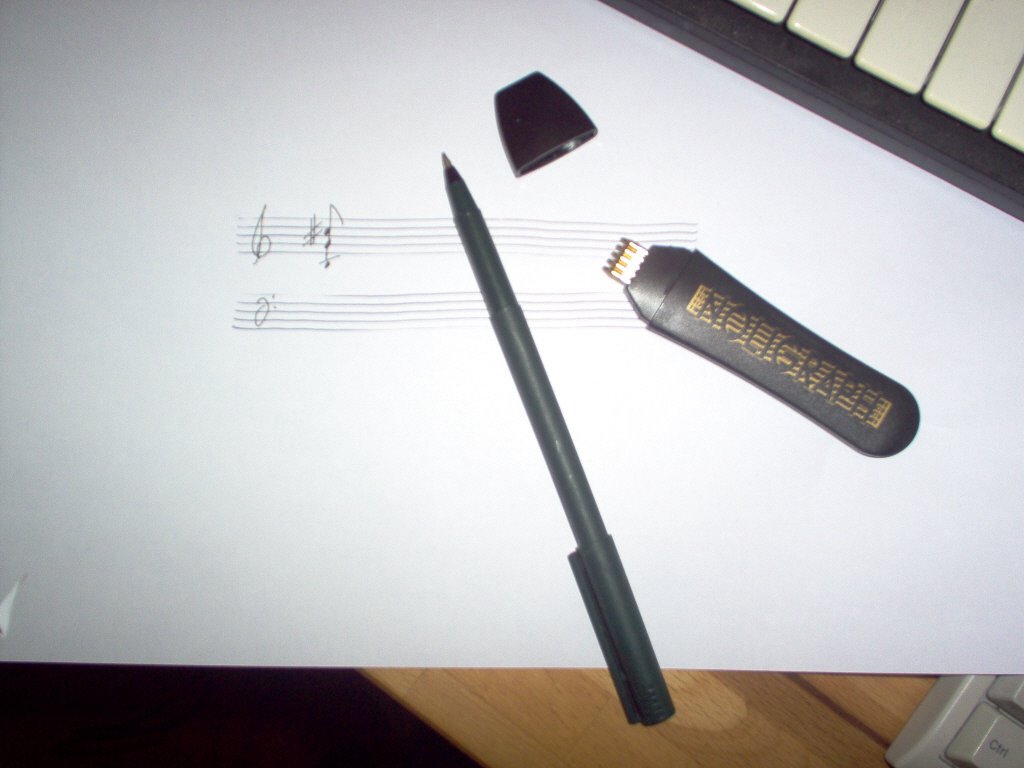
Every composer I know has their favorite tools -- pen, paper, chair, mouse, monitor. One of my favorites is the Noligraph, which is simply a holder for five ball-point fillers, alligned just right for drawing staves on the spot.
I had previously used a stave-maker which used a wheel with five points that turned through a trough with a cotton ink pad; Stravinsky himself invented a device with five pencil leads and there are also inkpens with five parallel nibs, but this ballpoint set is the most reliable I've found.
Saturday, December 24, 2005
More memerie
These memes are really just questionaires of the sort played in parlors in the late 19th and early 20th centuries. Musicians played them back then, too. Debussy, for example. The best know questionaires are the two answered by Proust, including such zingers as " What do you regard as the lowest depth of misery?", "What is your idea of earthly happiness?" or "To what faults do you feel most indulgent?." The meme going around these days asks for foursomes, so here goes:
Four jobs you've had in your life: paperboy, dishwasher, silk screener, instrument repairman
Four movies you could watch over and over: The Treasure of the Sierra Madre (Houston), The Devil, Probably (Bresson), Repo Man (Cox), The Spanish Prisoner (Mamet)
Four places you've lived: Mt. Baldy, CA, Middletown, CT, Frankfurt-am-Main, Budapest
Four TV shows you love to watch: Ernie Kovacs, The Prisoner, Firefly, You Bet Your Life
Four places you've been on vacation: Chaco Canyon, Cappoquin, Yogyakarta, Delos
Four websites you visit daily: Crooks and Liars, Der Spiegel Online, New Music ReBlog, The Pyongyang Metro
Four of your favorite foods: Birria de Chivo, Larb, Frankfurter Gruene Sosse mit Oxenbrust, Gan Pung Chicken at the Omei in Santa Cruz ca. 1982.
Four places you'd rather be: Dungarvan, Pahrump, Morro Bay, Hortobagy
Four jobs you've had in your life: paperboy, dishwasher, silk screener, instrument repairman
Four movies you could watch over and over: The Treasure of the Sierra Madre (Houston), The Devil, Probably (Bresson), Repo Man (Cox), The Spanish Prisoner (Mamet)
Four places you've lived: Mt. Baldy, CA, Middletown, CT, Frankfurt-am-Main, Budapest
Four TV shows you love to watch: Ernie Kovacs, The Prisoner, Firefly, You Bet Your Life
Four places you've been on vacation: Chaco Canyon, Cappoquin, Yogyakarta, Delos
Four websites you visit daily: Crooks and Liars, Der Spiegel Online, New Music ReBlog, The Pyongyang Metro
Four of your favorite foods: Birria de Chivo, Larb, Frankfurter Gruene Sosse mit Oxenbrust, Gan Pung Chicken at the Omei in Santa Cruz ca. 1982.
Four places you'd rather be: Dungarvan, Pahrump, Morro Bay, Hortobagy
Thursday, December 22, 2005
The Mozart Year Ahead of Us
The reputation of J.S. Bach took an interesting turn over the course of the "Bach Year" of 1985: he went into the year as the timeless universal musical genius and came out of it as a more parochial and specialized figure of his time, but also a more complex one. It was very useful to hear the church music again as the center of his work (as opposed, especially, to the late speculative instrumental works), but best of all, the quality of performances received a net benefit from the complex picture, happily (for me, at least) resolved into the thousand blooming flowers of performance practice we are likely to hear today.
I am very curious about the upcoming Mozart year. There have already been some serious shots at the bow of the current popular image of Mozart. (Norman Lebrecht's shot is so peculiar, that that it must be parody. Nothing could be more false than when Lebrecht identifies Mozart's music as "dissonance free" (if there is any single characteristic to identify Mozart's music, it's in his unique ability to maximize the dissonance-to-consonance ratio)).
That popular image does deserve some renewal, but it turns on some real subtleties, and I'm not terribly optimistic that those subtleties will be widely taken in. The Peter Schaffer play (and the Milos Foreman film) Amadeus has, for example, taken a central place in the image-making process, but this is due to the fundamental confusion that the play (and film) were biography. Amadeus was not a biography of Mozart; it was quite literally a study in the "love of God" (hence the name) and the creator's apparently arbitrary assignations of gifts on this planet. (It was also a great chance to show off Prague, but that's another case of arbitrarily assigned gifts!)
There are many Mozart's to choose from: the child prodigy, the court musician, or the freelance professional, the virtuoso or the master of simplicity, the provincial Salzberger or the urbane Viennese, the church and court organist or the freemason. Similarly, contemporary performance practice for Mozart's music is anything but the product of a consensus. I have no idea how well Mozart's music and reputation will survive the next year, but I expect that the question of Mozart's balancing between complexity and clarity will play a central role in the discussions to come.
I am very curious about the upcoming Mozart year. There have already been some serious shots at the bow of the current popular image of Mozart. (Norman Lebrecht's shot is so peculiar, that that it must be parody. Nothing could be more false than when Lebrecht identifies Mozart's music as "dissonance free" (if there is any single characteristic to identify Mozart's music, it's in his unique ability to maximize the dissonance-to-consonance ratio)).
That popular image does deserve some renewal, but it turns on some real subtleties, and I'm not terribly optimistic that those subtleties will be widely taken in. The Peter Schaffer play (and the Milos Foreman film) Amadeus has, for example, taken a central place in the image-making process, but this is due to the fundamental confusion that the play (and film) were biography. Amadeus was not a biography of Mozart; it was quite literally a study in the "love of God" (hence the name) and the creator's apparently arbitrary assignations of gifts on this planet. (It was also a great chance to show off Prague, but that's another case of arbitrarily assigned gifts!)
There are many Mozart's to choose from: the child prodigy, the court musician, or the freelance professional, the virtuoso or the master of simplicity, the provincial Salzberger or the urbane Viennese, the church and court organist or the freemason. Similarly, contemporary performance practice for Mozart's music is anything but the product of a consensus. I have no idea how well Mozart's music and reputation will survive the next year, but I expect that the question of Mozart's balancing between complexity and clarity will play a central role in the discussions to come.
Friday, December 16, 2005
First Annual
For what it's worth, I've now been posting for a year. The original intention was to do a group blog, but the rest of the group never got at it, and that's regrettable. As a solo effort by someone who writes uneasily at best, has children underfoot, has been through an international move in the past year, and usually is supposed to be composing for a living instead of blogging, I haven't been able to offer posts with either the eloquence or the frequency that really invites visitors to come back at regular intervals. My apologies, but also my thanks for stopping by in spite of these deficits.
(I'm still interested in doing a group effort. It could be a good vehicle for promoting new music and the world around it. But it would have to be a group of five to seven composers who are each equally committed to posting at least once a week in order to insure that the readers keep coming back at a regular rhythm. Anyone else?)
Among the musicians in the blogoplan* that I've encountered in the past year, it's possible that I most enjoy reading Fred Himbaugh of the Fredösphere. Now, given our differences in musical taste, religion, politics, etc., I would guest that if he and I were in the same room, it's possible that we'd either turn into pillars of salt or disappear into the interdimensional void in an act of spontaneous and total cancellation. But nevermind, for one of the joys of the blogoplan is never having to be in the same room, and that gives one the luxury of reading with as much or as little distance and passion as one wants. Fred Himbaugh really is a musician who likes to write about music more than himself, and does so always with good humor. That's plain decent.
Moreover, he likes dirigibles and cooking, two interest that are infinitely recommendable in my books.
*blogoplan: the set of blogs known to flat-earthers.
(I'm still interested in doing a group effort. It could be a good vehicle for promoting new music and the world around it. But it would have to be a group of five to seven composers who are each equally committed to posting at least once a week in order to insure that the readers keep coming back at a regular rhythm. Anyone else?)
Among the musicians in the blogoplan* that I've encountered in the past year, it's possible that I most enjoy reading Fred Himbaugh of the Fredösphere. Now, given our differences in musical taste, religion, politics, etc., I would guest that if he and I were in the same room, it's possible that we'd either turn into pillars of salt or disappear into the interdimensional void in an act of spontaneous and total cancellation. But nevermind, for one of the joys of the blogoplan is never having to be in the same room, and that gives one the luxury of reading with as much or as little distance and passion as one wants. Fred Himbaugh really is a musician who likes to write about music more than himself, and does so always with good humor. That's plain decent.
Moreover, he likes dirigibles and cooking, two interest that are infinitely recommendable in my books.
*blogoplan: the set of blogs known to flat-earthers.
Thursday, December 15, 2005
Too busy to post something new so here's that meme I forgot to post in March
You're stuck inside Fahrenheit 451, which book do you want to be?
Gravity's Rainbow. So I can happily quote Proverbs for Paranoids ("You hide, they seek") and tell my kids goodnight stories about Byron the Bulb, gauchos in the Alps, and explain the difference between Rossini and Beethoven.
Have you ever had a crush on a fictional character?
Could be. Among her names, my daughter has both Emma and Miranda.
What are you currently reading?
The Parmenides poem, The Winters Tale.
The last book you bought is:
A guide to the archaological sites on Delos.
The last book you read:
Iron Council by China Meliville.
Five books you would take to a deserted island:
Mason & Dixon by Thomas Pynchon
The Recognitions by William Gaddis
The Tempest (I assume that it's no fair to take a complete works!)
The Venture of Islam by Marshall G.S. Hodgson
Seeing is Forgetting the Name of the Thing One Sees: A Life of Contemporary Artist Robert Irwin by Lawrence Wechsler
Gravity's Rainbow. So I can happily quote Proverbs for Paranoids ("You hide, they seek") and tell my kids goodnight stories about Byron the Bulb, gauchos in the Alps, and explain the difference between Rossini and Beethoven.
Have you ever had a crush on a fictional character?
Could be. Among her names, my daughter has both Emma and Miranda.
What are you currently reading?
The Parmenides poem, The Winters Tale.
The last book you bought is:
A guide to the archaological sites on Delos.
The last book you read:
Iron Council by China Meliville.
Five books you would take to a deserted island:
Mason & Dixon by Thomas Pynchon
The Recognitions by William Gaddis
The Tempest (I assume that it's no fair to take a complete works!)
The Venture of Islam by Marshall G.S. Hodgson
Seeing is Forgetting the Name of the Thing One Sees: A Life of Contemporary Artist Robert Irwin by Lawrence Wechsler
Saturday, December 03, 2005
Liederzyklus
Adam Baratz has a nice item about Randy Newman. His comparison with Stravinsky is interesting, although with Newman, it's the names of Schumann, Ives, and Brecht/Weill that first come into my mind, all of them song composers who are able maintain yet simultaneously move seamlessly outside the receieved framework and conventions of the song genre, allowing comment on the genre itself. I agree with Baratz's characterization of Newman as a meta-songwriter, and I'll even go one further. Sail Away (1973) , Good Old Boys (1974) , and Little Criminals (1977) are the finest song cycles of our time, and perhaps the best ever in American English. With a technique that is close to Schumannesque, these cycles allow Newman to combine the everyday riffs and jetsam of low musical cultural into a whole that is smart and startling. Further, his songs are political yet without the usual ephemeral and local qualities of political song. Both Ives and Brecht/Weill are precents and among contemporaries, Chico Buarque (try Buarque's Construcao) is perhaps the only colleague to match Newman's craft and imagination.
Why not the best?
This week, Robert Gable at Aworks is asking:
The Second Orchestral Set
Second, Third, and Fourth Symphonies
The Piano Sonatas
Orchestral Set Nr. 1 ("Three Places in New England")
Variations on "America" for organ
The Two String Quartets
Set for String Quartet, Bass, and Piano
"Country Band" March
The Unanswered Question
Songs (Afterglow, Ann Street, At the River, The Cage, Charlie Rutlage, The Circus Band, Evening, General William Booth Enters into Heaven, The Greatest Man, Immortality...) and Sets for Chamber Ensembles based on Songs
The Second Orchestral Set is the Ives work which astounds me the most as a composition. Mind, heart, body: all are present. The Fourth Symphony is a work with a strange power; for Americans, a good performance of the Fourth is the equivalent of a good performance of Beethoven's Ninth for Europeans. And the little setting of At the River has everything.
is Igor Stravinsky America's greatest composer?I say no. There are real wonders among Stravinsky's American pieces (The Rake's Progress, Agon, Requiem Canticles, The Owl and the Pussycat), but you really want to have pieces from throughout Stravinsky's careet, and a passport can't make them all retroactively American. In my opinion, Charles Ives wins handily (and Cage comes in second, but that's for another post). Here are some pieces that make the case:
The Second Orchestral Set
Second, Third, and Fourth Symphonies
The Piano Sonatas
Orchestral Set Nr. 1 ("Three Places in New England")
Variations on "America" for organ
The Two String Quartets
Set for String Quartet, Bass, and Piano
"Country Band" March
The Unanswered Question
Songs (Afterglow, Ann Street, At the River, The Cage, Charlie Rutlage, The Circus Band, Evening, General William Booth Enters into Heaven, The Greatest Man, Immortality...) and Sets for Chamber Ensembles based on Songs
The Second Orchestral Set is the Ives work which astounds me the most as a composition. Mind, heart, body: all are present. The Fourth Symphony is a work with a strange power; for Americans, a good performance of the Fourth is the equivalent of a good performance of Beethoven's Ninth for Europeans. And the little setting of At the River has everything.
Thursday, December 01, 2005
Packages
There seems to be an awful lot of worry out there about the place of serious music in the world, it's getting a lot of bloggish chatter, and some of that is coming from people -- unlike myself -- who really know how to write about music.
I can't agree more with these words from New Yorker critic Alex Ross:
At first, Boyce's advice went into my head without registering any serious objections. Some of it I have said myself (e.g. why do so many composers begin their web pages or bios with lists of academic degrees and prizes instead of saying anything about their music?). However, the suspicion began nagging me this morning and has continued to nag at me for the rest of the day that this is probably just about the worst way to think about and care for our music. I believe that treating serious composers as brand names and pieces of serious music as market commodities both economically senseless and musically insensitive.
I believe that in the US a seriously wrong idea about how one goes about making serious music popular has been widespread -- call it the-Leonard-Bernstein-explains-it-all-to-the-kids-model -- although that idea depended largely on a large local audience still close to a recent European emmigrant experience. With that experience edging evermore into the past, Americans are at an interesting juncture now with regard to their European cultural inheritance. It's more of an elective affinity rather than a birthright. Perhaps that's one reason why performers coming out of places like CalArts or Mills are often more exciting interpreters than the cookie-cutter virtuosi turned out by the big conservatories. (Don't get me started on the suitability of the name "conservatory"!)
Ultimately, all I'm interested in are great pieces of music, and I'd like to encounter that music on its own terms. I'll confess to being interested in composers' biographies, but that's from a general interest in intellectual or creative biography, or maybe even vicarious living on my part, but not from any sense that the biography will reliably explain the work.* And even though a composer's worklist gets handled as a kind of track record for commissions and the like, I'm bound to be disappointed if the worklist is the only reason for recommending a new work. I'm more interested in repertoires than in catalogues of individual composers, and more interested in particular pieces than in repertoires, and maybe more interested in my favorite places in pieces than in whole pieces. (There is a series of tutti chords in the first movement of Harold in Italy that are dynamite; too bad you have to sit through the rest of Harold in Italy to hear them).
These are very rough ideas and I've said nothing concretely prescriptive. I've put Marcel Mauss's Essay on the Gift and Hermann Broch's Hugo von Hofmannsthal and his Time on my desk, perhaps they'll bring some clarity to the topic.
* Okay, I'll grant you that knowing that Berlioz had an overwhelming infatuation and then disappointing marriage might help with the Symphonie Fantastique, or knowing that Nancarrow liked good coffee is one way of getting into some of the Studies. But that kind of information is (a) more impressionistic than concrete, (b) may be misleading, possibly getting in the way of your own images, and (c) you can probably get a good handle on the music without any of it, anyway.
I can't agree more with these words from New Yorker critic Alex Ross:
classical music, for all its elite trappings, is actually a radical, disruptive force in American culture, whereas most popular culture, for all its rebellious trappings, is intensely conservative.A few minutes after reading Ross, I came across an article by composer Cary Boyce at the Sequenza 21 Composers Forum full of reasonable marketing advice to composers, summed up perhaps best by his command: Package yourself well.
At first, Boyce's advice went into my head without registering any serious objections. Some of it I have said myself (e.g. why do so many composers begin their web pages or bios with lists of academic degrees and prizes instead of saying anything about their music?). However, the suspicion began nagging me this morning and has continued to nag at me for the rest of the day that this is probably just about the worst way to think about and care for our music. I believe that treating serious composers as brand names and pieces of serious music as market commodities both economically senseless and musically insensitive.
I believe that in the US a seriously wrong idea about how one goes about making serious music popular has been widespread -- call it the-Leonard-Bernstein-explains-it-all-to-the-kids-model -- although that idea depended largely on a large local audience still close to a recent European emmigrant experience. With that experience edging evermore into the past, Americans are at an interesting juncture now with regard to their European cultural inheritance. It's more of an elective affinity rather than a birthright. Perhaps that's one reason why performers coming out of places like CalArts or Mills are often more exciting interpreters than the cookie-cutter virtuosi turned out by the big conservatories. (Don't get me started on the suitability of the name "conservatory"!)
Ultimately, all I'm interested in are great pieces of music, and I'd like to encounter that music on its own terms. I'll confess to being interested in composers' biographies, but that's from a general interest in intellectual or creative biography, or maybe even vicarious living on my part, but not from any sense that the biography will reliably explain the work.* And even though a composer's worklist gets handled as a kind of track record for commissions and the like, I'm bound to be disappointed if the worklist is the only reason for recommending a new work. I'm more interested in repertoires than in catalogues of individual composers, and more interested in particular pieces than in repertoires, and maybe more interested in my favorite places in pieces than in whole pieces. (There is a series of tutti chords in the first movement of Harold in Italy that are dynamite; too bad you have to sit through the rest of Harold in Italy to hear them).
These are very rough ideas and I've said nothing concretely prescriptive. I've put Marcel Mauss's Essay on the Gift and Hermann Broch's Hugo von Hofmannsthal and his Time on my desk, perhaps they'll bring some clarity to the topic.
* Okay, I'll grant you that knowing that Berlioz had an overwhelming infatuation and then disappointing marriage might help with the Symphonie Fantastique, or knowing that Nancarrow liked good coffee is one way of getting into some of the Studies. But that kind of information is (a) more impressionistic than concrete, (b) may be misleading, possibly getting in the way of your own images, and (c) you can probably get a good handle on the music without any of it, anyway.
Friday, November 25, 2005
Last Details
It's long been considered a compositional virtue for every single bit of information in a composition to formally relate to every other bit in one way or another. Sometimes this quality is called "organicism" or "cohesion"; this quality is often described in economical terms, with "economy" or "efficiency" being considered especially valuable qualities in a composition. A typical tactic taken by composition teachers with their students is compelling the student to make the case for the inclusion of any given aspect or detail, the assumption being that every part should be explainable in terms of its relationship to the whole. While this might have value in a large number of pieces, I think that it can't possibly be true for all pieces, and indeed, in many pieces, it may be highly undesireable.
The best mysteries, from Oedipus Tyrranus to Hamlet or from The Crying of Lot 49 to Lost, present an ensemble of details, creating the illusion of a real (or, at least, plausible) world. That ensemble contains elements that are directly relevant to the mystery's plot and other elements that are ultimately never more than noise. A large part of the mystery writer's craft is playfully bouncing the relevant and the irrelevant back and forth between the foreground and background of the story. We all have our tricks for sorting out whether a detail is relevant or not; we pay attention to redundancy, amplitude, connectedness. But sometimes a detail may be oft-repeated, loudly, and full of associations, but turn out, ultimately, to be unimportant. And that's okay, because we know going into the game that such misdirection is the main attraction of the genre. In other words: not every flap of a butterfly's wings in the Sahara will lead to a Hurricane in the Carribean.
I suspect that more music is composed of a playful mixture of relevant and irrelevant detail and noise than has been fashioned into a tightly organized whole whose parts all manifestly belong together. I cannot make any automatic value judgements about this, as good music can be made either way, but I do find it useful to ponder the idea that this element might be used more dynamically by composers, with works of music varying over time with regard to the level of cohesiveness, sometimes being very explicit about what is going on, and sometimes deliberately misdirecting the listeners about what, ultimately, is important and what is not.
The best mysteries, from Oedipus Tyrranus to Hamlet or from The Crying of Lot 49 to Lost, present an ensemble of details, creating the illusion of a real (or, at least, plausible) world. That ensemble contains elements that are directly relevant to the mystery's plot and other elements that are ultimately never more than noise. A large part of the mystery writer's craft is playfully bouncing the relevant and the irrelevant back and forth between the foreground and background of the story. We all have our tricks for sorting out whether a detail is relevant or not; we pay attention to redundancy, amplitude, connectedness. But sometimes a detail may be oft-repeated, loudly, and full of associations, but turn out, ultimately, to be unimportant. And that's okay, because we know going into the game that such misdirection is the main attraction of the genre. In other words: not every flap of a butterfly's wings in the Sahara will lead to a Hurricane in the Carribean.
I suspect that more music is composed of a playful mixture of relevant and irrelevant detail and noise than has been fashioned into a tightly organized whole whose parts all manifestly belong together. I cannot make any automatic value judgements about this, as good music can be made either way, but I do find it useful to ponder the idea that this element might be used more dynamically by composers, with works of music varying over time with regard to the level of cohesiveness, sometimes being very explicit about what is going on, and sometimes deliberately misdirecting the listeners about what, ultimately, is important and what is not.
Thursday, November 24, 2005
Talking Turkey
The following remarks are not intended for vegetarians or anyone with a sentimental attachment to domesticated animals.
Two tips for roast turkey: (1) debone it (2) brine it. Deboning is easy to do, and probably the only thing that Jr. High Biology class has prepared you for, but you need to be patient (give it 45 minutes for the first operation) and practice on a chicken or duck or two sure helps before trying to debone the big bird. If you have neither the time nor the confidence in your deboning skills, there are a few professional poultry people out there who will debone to order, but not one of them lives in Germany, so I had to teach myself. You basically cut a slit down the back, straight to the spine, starting an inch or two from the top and continuing to an inch or two from the bottom. Then, with a small knife, gently separate the soft tissues from the bones, moving around the ribcage until the the spine, ribcage and breastbone come out in one piece. Manually pop the wings out of the shoulders and the thighbones out of both hip and legs. I prefer to take out the rib cage, breast plate, shoulder blades and the thigh bones, leaving bones in the drumsticks and wings. Those bones don't get in the way of slicing and lend the bird a bit of structure for the presentation. Fill the bird with the stuffing of your choice to roughly the original form and sew it back up with strong cotton thread. (There is a urban cooking legend that dental floss will also work. Forget it.) Brining is soaking the bird beforehand in strongly salted water, roughly 1/4 cup salt for every five pounds of bird. Brining's not neccesary if you're working with a kosher turkey (which has already been treated with salt), and shouldn't be done with any bird that's been chemically treated (but you wouldn't buy one of those, would you?) but is essential for a fowl of any other provenance. Lightly rinse after brining and allow the turkey to completely airdry on a rack in the fridge before spicing, stuffing and roasting. I have brined before deboning and deboned before brining, and have noticed no difference in effect, but omitting the brining can lead to a dismal fowl, and omitting the deboning can lead to that dismal table game of "who really doesn't want to carve the turkey?".
And finally, remember the sage words of my old friend Kali Tal*: You can never have enough cranberry sauce.
*Yes, Kali, I do remember that JelloTM was invented by a woman.
Two tips for roast turkey: (1) debone it (2) brine it. Deboning is easy to do, and probably the only thing that Jr. High Biology class has prepared you for, but you need to be patient (give it 45 minutes for the first operation) and practice on a chicken or duck or two sure helps before trying to debone the big bird. If you have neither the time nor the confidence in your deboning skills, there are a few professional poultry people out there who will debone to order, but not one of them lives in Germany, so I had to teach myself. You basically cut a slit down the back, straight to the spine, starting an inch or two from the top and continuing to an inch or two from the bottom. Then, with a small knife, gently separate the soft tissues from the bones, moving around the ribcage until the the spine, ribcage and breastbone come out in one piece. Manually pop the wings out of the shoulders and the thighbones out of both hip and legs. I prefer to take out the rib cage, breast plate, shoulder blades and the thigh bones, leaving bones in the drumsticks and wings. Those bones don't get in the way of slicing and lend the bird a bit of structure for the presentation. Fill the bird with the stuffing of your choice to roughly the original form and sew it back up with strong cotton thread. (There is a urban cooking legend that dental floss will also work. Forget it.) Brining is soaking the bird beforehand in strongly salted water, roughly 1/4 cup salt for every five pounds of bird. Brining's not neccesary if you're working with a kosher turkey (which has already been treated with salt), and shouldn't be done with any bird that's been chemically treated (but you wouldn't buy one of those, would you?) but is essential for a fowl of any other provenance. Lightly rinse after brining and allow the turkey to completely airdry on a rack in the fridge before spicing, stuffing and roasting. I have brined before deboning and deboned before brining, and have noticed no difference in effect, but omitting the brining can lead to a dismal fowl, and omitting the deboning can lead to that dismal table game of "who really doesn't want to carve the turkey?".
And finally, remember the sage words of my old friend Kali Tal*: You can never have enough cranberry sauce.
*Yes, Kali, I do remember that JelloTM was invented by a woman.
Question about US English
Recently, I've noticed in conversations and in media that many Americans are pronouncing the contracted negation "n't" as a a reiterated d+short-i+nt instead of schwa+nt. Has anyone else noticed this? Is there a local dialect origin for this or is it novel? It has a subtle effect on the rhythm of the word, which might have repercussions for text setting (compare diduhnt with did-dint).
Wednesday, November 23, 2005
Baratz on Garland
Adam Baratz at Form/Content writes thoughfully about Peter Garland's Americas.
I can't overstate my debt to Peter Garland. I grew up in a corner of Southern California where new music was a fleeting -- but when so, astonishing -- presence. KPFK had great music programming from David Cloud, William Malloch, and Carl Stone. At 13, I bicycled to every concert of the last Claremont Music Festival (I then lived in Montclair, a very non-collegiate town, across the L.A./San Bernadino County border and south of the tracks from Pomona College in gentile Claremont) and heard pieces by Kohn, Leedy, Ives, Stravinsky that I can vividly recall to this day. I also cycled to libraries, in Ontario and Pomona, with much better collections of scores and recordings. Barney Childs was a presence in Redlands. Even strange old Gail Kubik brought Bert Turetsky and Stephen Scott to Scripps College for concerts. But this was not yet the real American experimental tradition, that came with a very special guidebook, called Soundings.
When I first learned of Soundings, I wrote to Peter directly and he sent me the only two issues he had in stock. The rest I had to read in the library at UC Riverside. Pomona College had a full set of Source, which was beautifully made and had an attitude, and a full run of the West Coast edition of Ear, which had character, but Soundings had -- as I think Charles Olson would have put it -- a posture. That posture was uniquely Peter Garland's. Peter did have precendents -- in the writings of Yates or Cowell, or in the enthusiasms of his teacher, Tenney. But Peter managed to connect the generations from Ives, Ruggles, Varese, Cowell and Seeger to Partch, Harrison, Cage, Beyer, Nancarrow, and Rudhyar, and on to Tenney, Childs, Oliveros, Ashley, Corner, Mumma, and finally to Garland's own contemporaries. I've run into Peter two or three times over the years, and we somehow got off on the wrong foot when I referred to him being in the next older generation from mine... but never mind. Soundings (alongside John Chalmer's microtonal journal Xenharmonikon) changed my musical life forever, and I think, for good.
I can't overstate my debt to Peter Garland. I grew up in a corner of Southern California where new music was a fleeting -- but when so, astonishing -- presence. KPFK had great music programming from David Cloud, William Malloch, and Carl Stone. At 13, I bicycled to every concert of the last Claremont Music Festival (I then lived in Montclair, a very non-collegiate town, across the L.A./San Bernadino County border and south of the tracks from Pomona College in gentile Claremont) and heard pieces by Kohn, Leedy, Ives, Stravinsky that I can vividly recall to this day. I also cycled to libraries, in Ontario and Pomona, with much better collections of scores and recordings. Barney Childs was a presence in Redlands. Even strange old Gail Kubik brought Bert Turetsky and Stephen Scott to Scripps College for concerts. But this was not yet the real American experimental tradition, that came with a very special guidebook, called Soundings.
When I first learned of Soundings, I wrote to Peter directly and he sent me the only two issues he had in stock. The rest I had to read in the library at UC Riverside. Pomona College had a full set of Source, which was beautifully made and had an attitude, and a full run of the West Coast edition of Ear, which had character, but Soundings had -- as I think Charles Olson would have put it -- a posture. That posture was uniquely Peter Garland's. Peter did have precendents -- in the writings of Yates or Cowell, or in the enthusiasms of his teacher, Tenney. But Peter managed to connect the generations from Ives, Ruggles, Varese, Cowell and Seeger to Partch, Harrison, Cage, Beyer, Nancarrow, and Rudhyar, and on to Tenney, Childs, Oliveros, Ashley, Corner, Mumma, and finally to Garland's own contemporaries. I've run into Peter two or three times over the years, and we somehow got off on the wrong foot when I referred to him being in the next older generation from mine... but never mind. Soundings (alongside John Chalmer's microtonal journal Xenharmonikon) changed my musical life forever, and I think, for good.
Saturday, November 19, 2005
Another opinion revised
I am clever enough to know I am clever. -- Steerpike
Just finished re-reading the three "Gormenghast" novels of Mervyn Peake (Titus Groan, Gormenghast, Titus Alone). I had last read them in high school, liking the strangeness of the impossible architecture of Gormenghast Castle and taking great pleasure in Peake's names: Dr. Prunesquallor, Barquentine, Opus Fluke, Muzzlehatch. But I did not carry much else out of the experience. Now, too many years later, I am completely taken in by the profound melancholy described by Peake's mixture of detail and nonsense as well as the ethical (for lack of a better word) force of the parallel stories of the kitchen boy Steerpike's rise and defeat and the heir to Gormenghast Titus's education and exile. The central narrative is much clearer than I had recalled, yet it still challenged all of my reading habits much in the same way that experimental literature (e.g. Harry Mathews or Walter Abish) does. Peake's trilogy is truly in a genre of its own, gothic-but-not-that-gothic, mannered-but-not-those-manners, and not at all to be mistaken for a work of fantasy or pseudo-epic.
Just finished re-reading the three "Gormenghast" novels of Mervyn Peake (Titus Groan, Gormenghast, Titus Alone). I had last read them in high school, liking the strangeness of the impossible architecture of Gormenghast Castle and taking great pleasure in Peake's names: Dr. Prunesquallor, Barquentine, Opus Fluke, Muzzlehatch. But I did not carry much else out of the experience. Now, too many years later, I am completely taken in by the profound melancholy described by Peake's mixture of detail and nonsense as well as the ethical (for lack of a better word) force of the parallel stories of the kitchen boy Steerpike's rise and defeat and the heir to Gormenghast Titus's education and exile. The central narrative is much clearer than I had recalled, yet it still challenged all of my reading habits much in the same way that experimental literature (e.g. Harry Mathews or Walter Abish) does. Peake's trilogy is truly in a genre of its own, gothic-but-not-that-gothic, mannered-but-not-those-manners, and not at all to be mistaken for a work of fantasy or pseudo-epic.
Stravinsky: Symphony in C
I struggled for a couple of hours last night to write something smart, or at least clever, about the Stravinsky Symphony in C. Without success. I've resigned myself to failure in the smart or clever department. So I'll just say that it's a piece I -- following the general consensus -- had previously discounted, but I am now convinced that the consensus is wrong and the piece works just fine, thank you. The subject of the Symphony in C is the "classical symphony", and it does everything a "classical symphony" should do as well as everything a "classical symphony" should not. Is the Symphony in C then itself an example of a "classical symphony"? I guess it depends entirely on how you hear those quotation marks.
Monday, November 14, 2005
Worst Sound
Sound 101 is a survey from the University of Salford looking for the "worst sound in the world". It's fun, if your nerves are in good shape. I learned that (a) I have a fair tolerance for mechanical noises and (b) I will never be a cat blogger.
Are they hedging it or is it honest conviction?
FREQUENTLY, and in good bourgeois company, among civilians largely unaquainted with the hows, whys and wherefors of the new, contemporary and experimental scenes, I am often pressed on the question of "why exactly?" I should not rather be composing like some long deceased colleague (preferentially these days Mozart or Brahms). I have taken of late to responding that I think that I do indeed compose like that colleague -- in that I take the material at hand and push it to some extreme of artful manipulation and cunning -- but that my music and the music of said dead colleague simply do not sound alike. That answer satisfies some, challenges others, and presumably disappears into background noise for most. Like most composers of experimental music, I suppose that growing used to such a response is a healthy mechanism.
But there are composers out there for whom composing with similitude to old masters remains a focus. Take, for example, Noam Elkies, also professor of mathematics at Harvard. He composes tonal music, closely following classical models, never getting too adventurous with pitches but sometimes throwing in a little rhythmic trick or two. It's the very model of amateur (in the best sense) music making: it comes directly from the habit of someone who plays music, and composing allows one to play a bit with the conventions of the repertoire one loves. Elkies seems to get some serious performances of his work, and they seem to be received with the appropriate spirit of -- as no one other than John Cage put it -- conviviality.
I just noticed an online community gathering composers who identify their work as "tonal"
The Delian Society (a membership list is here)
and another community where the common denominator is "consonant".
New Consonant Music
Now, my familiarity with both communities and their member composers is limited to a few hours of surfing, I do have a strong impression that the membership and their compositional output is both heterodox in the extreme and they shouldn't be dismissed outright. While there does seem to be a handful of genuine tonal archaicists or new consonant anachronists, and not a few of these striking my as simply -- as opposed to interestingly -- naive, there is also a good number of sophisticated musicians from classical, non-western, popular and even contemporary music backgrounds. While a couple of these may simply be trying to hedge the market through the appeal of an attractive surface, many of these composers seem to find "tonal" or "new consonant" as useful descriptions for work that is smartly historicist, often ironic, and even downright experimental in approach.
But there are composers out there for whom composing with similitude to old masters remains a focus. Take, for example, Noam Elkies, also professor of mathematics at Harvard. He composes tonal music, closely following classical models, never getting too adventurous with pitches but sometimes throwing in a little rhythmic trick or two. It's the very model of amateur (in the best sense) music making: it comes directly from the habit of someone who plays music, and composing allows one to play a bit with the conventions of the repertoire one loves. Elkies seems to get some serious performances of his work, and they seem to be received with the appropriate spirit of -- as no one other than John Cage put it -- conviviality.
I just noticed an online community gathering composers who identify their work as "tonal"
The Delian Society (a membership list is here)
and another community where the common denominator is "consonant".
New Consonant Music
Now, my familiarity with both communities and their member composers is limited to a few hours of surfing, I do have a strong impression that the membership and their compositional output is both heterodox in the extreme and they shouldn't be dismissed outright. While there does seem to be a handful of genuine tonal archaicists or new consonant anachronists, and not a few of these striking my as simply -- as opposed to interestingly -- naive, there is also a good number of sophisticated musicians from classical, non-western, popular and even contemporary music backgrounds. While a couple of these may simply be trying to hedge the market through the appeal of an attractive surface, many of these composers seem to find "tonal" or "new consonant" as useful descriptions for work that is smartly historicist, often ironic, and even downright experimental in approach.
Sunday, November 13, 2005
Studios

I was surprised to find this photo of my Frankfurt studio online, at Maria de Alvear's site. That's me (blond head in the foreground) with some Javanese friends, making a little Saturday afternoon music.
Composers' studios are interesting places. I've been to those of Ives, Bartok (actually, for five years time, I could actually see his house from my own studio window, on the next hillside in Buda), and I'm proud to say that I have a picture somewhere of La Monte Young and I standing in front of the re-created Schoenberg studio that was once housed at USC. These places tend to be warm and comfortable, rather than flashy. A good writing surface, lots of writing implements, overfilled shelves, a sturdy chair to sit for long hours, and often a place to crash. Lou Harrison often composed in a little trailer parked someplace out back of his house. There are often very special things that haven't anything directly to do with music, but say a lot about the craft: Schoenberg's homemade playing cards or toy violin. The way studios change over time is also interesting: when I first saw Gordon Mumma's (analog) studio, centerplace belonged to his soldering iron, some (digital) years later, that place was taken by a huge monitor. I like to have lots of instruments or noise makers around, but not necessarily the particular instruments I'm composing for at the moment. There's a piano in the house, but not in my studio. I will sometimes grab whatever instrument is closest to try something out: my father's Eb clarinet, a recorder, or a cornetto, maybe my son's cello. Stravinsky always had a piano, in L.A. with the moderator on all the time, but when he wrote Ragtime and Les Noces, he hired a cymbalon. In later years, John Cage had no piano at home. If he wanted to try something out on a piano, he would go to the Merce Cunningham dance studio.
I like to think that the room in which I compose is reflected or imprinted in the music itself, and that traces of the music hang in the air for a good long time. (Alvin Lucier, of course, has made this a great theme in his music.) As my music changes, this is reflected in the room, which is just as much a work in progress.
Friday, November 11, 2005
More lost and found
California quarter-tone composer Mildred Couper.
Not just 1/6 of Les Six: Germaine Tailleferre.
Mexican microtonal theorist and composer Augusto Novaro: here and here (a wav file).
The last of the red-hot ultramodernists, Leo Ornstein.
A nice repository of the surviving ancient Greek and Hellenistic music.
Never really lost, but still good to find: Josef Matthias Hauer.
An interesting chat about the Russian-American composer and cultural cold warrier Nicholas Nabokov; this is a composer whose catalog needs some sober evaluation.
The internet still needs a good site for Nicholas Obuchov (as well as the other Skryabinistes), William Denny (an interesting neoclassicist, and not a minor teacher: he played catch with Terry Riley in a Utah performance of La Monte Young's Poem for chairs, tables, benches etc.), Robert Erickson, Richard Maxfield, Barney Childs...
In another post, I'll list some of the living composers I think ought to have an internet presence.
Not just 1/6 of Les Six: Germaine Tailleferre.
Mexican microtonal theorist and composer Augusto Novaro: here and here (a wav file).
The last of the red-hot ultramodernists, Leo Ornstein.
A nice repository of the surviving ancient Greek and Hellenistic music.
Never really lost, but still good to find: Josef Matthias Hauer.
An interesting chat about the Russian-American composer and cultural cold warrier Nicholas Nabokov; this is a composer whose catalog needs some sober evaluation.
The internet still needs a good site for Nicholas Obuchov (as well as the other Skryabinistes), William Denny (an interesting neoclassicist, and not a minor teacher: he played catch with Terry Riley in a Utah performance of La Monte Young's Poem for chairs, tables, benches etc.), Robert Erickson, Richard Maxfield, Barney Childs...
In another post, I'll list some of the living composers I think ought to have an internet presence.
Wednesday, November 09, 2005
Dept. of Missing Composers
Some of our most interesting composers just disappear, leaving but the faintest traces; luckily, there are a few good souls out there trying to reverse the situation, for example:
Mary Jane Leach has a report on her search for the music of Julius Eastman. (Leach is a fine composer, check out her homepage).
Larry Polansky of Frog Peak Music has been recovering and leading the production of an edition of the works of Johanna Magdalena Beyer.
The MELA foundation has archives for composers Richard Maxfield and Terry Jennings. Let's hope that MELA can get the resources together to make their musics more available. (I think that Maxfield's is a critical case. Many of his earliest scored works are in the music library at UCB, and several are worth reviving, especially since the idioms are so out-of-fashion. The works on tape are a bit scattered. The Maxfield LP on late Barney Childs' Advance label recording has been re-released on CD, but that's far from the bulk of his electronic output.)
Mary Jane Leach has a report on her search for the music of Julius Eastman. (Leach is a fine composer, check out her homepage).
Larry Polansky of Frog Peak Music has been recovering and leading the production of an edition of the works of Johanna Magdalena Beyer.
The MELA foundation has archives for composers Richard Maxfield and Terry Jennings. Let's hope that MELA can get the resources together to make their musics more available. (I think that Maxfield's is a critical case. Many of his earliest scored works are in the music library at UCB, and several are worth reviving, especially since the idioms are so out-of-fashion. The works on tape are a bit scattered. The Maxfield LP on late Barney Childs' Advance label recording has been re-released on CD, but that's far from the bulk of his electronic output.)
Tuesday, November 08, 2005
Some Southpaw Pitching
Has anyone else wondered why all the one-handed piano music seems to be for left-handed monomanual pianists? Do pianists (Wittgenstein, Fleischer, some big names to start with) really injure their right hands more often than their lefts? Is there any significant repertoire for the right hand alone? Is there any left-handed repertoire that can be inverted for playing by the monomanually non-sinister?
How about injured hands and other instrument? The violinist Rudolph Kolisch, a central figure in transmission of the Viennese classical performance practice as well as an important figure in the performance of the second Viennese school, is an interesting example. His left-handed playing gave him a good excuse to specialize in chamber music and in teaching, instead of orchestral playing, where sharing a stand would have led to serious bowing conflicts.
How about injured hands and other instrument? The violinist Rudolph Kolisch, a central figure in transmission of the Viennese classical performance practice as well as an important figure in the performance of the second Viennese school, is an interesting example. His left-handed playing gave him a good excuse to specialize in chamber music and in teaching, instead of orchestral playing, where sharing a stand would have led to serious bowing conflicts.
Saturday, November 05, 2005
Cartesian reunions everywhere
William Houston, another former member of the Cartesian Reunion Memorial Orchestra, has his own website: williamhouston.com
Friday, November 04, 2005
Gelassenheit, or Breaking Up Is Hard To Do
My work in progress has pretty much stopped sounding like a sketch; the scale and proportions of the whole are emerging. In order to get to this point, I had to jetison a whole section, notes - if not quite music - of which I had grown fond, but ultimately couldn't fit into this piece. But getting over or around this act of excision has been tough and, if you'll bear with me, I'd like to try to explain why it's been so tough.
Since writing a piece called Dessins d'Enfants (1999, trombone & piano, written for Roland Dahinden & Hildegard Kleeb), my composing has been increasingly engaged with the idea that very different means of putting notes together can lead to astonishingly similar musical surfaces. Like the good experimentalist I trained to be, I still work with first principles applied to fairly raw musical materials, but the finished pieces often exhibit features that immediately recall historical musics, although sometimes that recollection may be a bit skewed, as if seen through a funhouse mirror.
All of my teachers, and Alvin Lucier especially, have what could be called a "classical" attitude. Getting a piece into the shape that most clearly presents the idea of the work without excess or expressive baggage is central to that attitude. Quoth Lucier: "I like my music clear, like gin". But in the music that I am making now, clarity is less on display and ambiguity is a frequent trope (in the world of potent potables, bourbon would be a closer equivalent than gin). But that lack of clarity is an accident of surface, not a direct or inevitable result of compositional methods. One composer whose music has been essential to me, Jo Kondo, describes his music as the "art of being ambiguous". Kondo is never explicit about what exactly he is being ambiguous, but I am fairly confident that it is an idea about tonal music. If my own music achieves a similar level of artful ambiguity, I would be mighty pleased.
A lot of the accidental resemblance between my current music and older music is simply due to the fact that I'm making conventionally notated music for voices and established instruments instead of electronics and found or invented instruments. Some conventions just come with the territory, and it's been a series of minor revelations to discover some features of that territory. For example, I had no idea how much almost-tonal music you could make just by bopping about long enough with a diatonic collection of pitches, or how sensitive a musical style could be to the repeated application of a single motive: if you don't repeat it enough, it falls under the tonal attention radar, if you repeat it a bit too often it becomes boring or annoying, and if you repeat it very much, it disappears into background noise. These minor revelations seem to confirm that -- to paraphrase Schönberg -- there really is still plenty of music in C major, especially when you are willing to rethink what "C major" might mean.
But compositional identity is something like brand marketing, and coming onto the market -- even a market as minor as that for serious new music -- with some music that sounds to any extent like something familiar is risky. And that's the source of my excision problem. The section that I have now removed was generated by operations done in the spirit of the rest of the piece, so it belonged abstractly and intellectually. But when heard with a musician's ears, with all of the experience and habits that a life of playing music brings, the section just didn't fit. In spite of all my experimentalist claims, by not taking the risk of letting the piece fail on terms external to the experiment, by removing a section through an appeal to musicality, do I run the risk of just writing another piece of music? I need to think more about this notion of risk.
David Feldman & I talked recently about making a game theory for new music. (This came about when we discussed the recent Nobel Prize winners in Economics, two game theorists). David pointed out that back in the early seventies, in New York, he was on a mailing list for new music events, and while most of the concerts advertised were same-old this, or same-old that, the postcards that Steve Reich mailed out to announce his concerts with sample score pages were real outliers. The music appeared to be tonal, so it was clearly not one kind of some-old, but it was repetitive in a way that could not have been the other kind of same-old. Reich was definitely introducing something new into the market, and he did it by adjusting the balance between the familar and the novel in an interesting way. Perhaps that's a good model.
Since writing a piece called Dessins d'Enfants (1999, trombone & piano, written for Roland Dahinden & Hildegard Kleeb), my composing has been increasingly engaged with the idea that very different means of putting notes together can lead to astonishingly similar musical surfaces. Like the good experimentalist I trained to be, I still work with first principles applied to fairly raw musical materials, but the finished pieces often exhibit features that immediately recall historical musics, although sometimes that recollection may be a bit skewed, as if seen through a funhouse mirror.
All of my teachers, and Alvin Lucier especially, have what could be called a "classical" attitude. Getting a piece into the shape that most clearly presents the idea of the work without excess or expressive baggage is central to that attitude. Quoth Lucier: "I like my music clear, like gin". But in the music that I am making now, clarity is less on display and ambiguity is a frequent trope (in the world of potent potables, bourbon would be a closer equivalent than gin). But that lack of clarity is an accident of surface, not a direct or inevitable result of compositional methods. One composer whose music has been essential to me, Jo Kondo, describes his music as the "art of being ambiguous". Kondo is never explicit about what exactly he is being ambiguous, but I am fairly confident that it is an idea about tonal music. If my own music achieves a similar level of artful ambiguity, I would be mighty pleased.
A lot of the accidental resemblance between my current music and older music is simply due to the fact that I'm making conventionally notated music for voices and established instruments instead of electronics and found or invented instruments. Some conventions just come with the territory, and it's been a series of minor revelations to discover some features of that territory. For example, I had no idea how much almost-tonal music you could make just by bopping about long enough with a diatonic collection of pitches, or how sensitive a musical style could be to the repeated application of a single motive: if you don't repeat it enough, it falls under the tonal attention radar, if you repeat it a bit too often it becomes boring or annoying, and if you repeat it very much, it disappears into background noise. These minor revelations seem to confirm that -- to paraphrase Schönberg -- there really is still plenty of music in C major, especially when you are willing to rethink what "C major" might mean.
But compositional identity is something like brand marketing, and coming onto the market -- even a market as minor as that for serious new music -- with some music that sounds to any extent like something familiar is risky. And that's the source of my excision problem. The section that I have now removed was generated by operations done in the spirit of the rest of the piece, so it belonged abstractly and intellectually. But when heard with a musician's ears, with all of the experience and habits that a life of playing music brings, the section just didn't fit. In spite of all my experimentalist claims, by not taking the risk of letting the piece fail on terms external to the experiment, by removing a section through an appeal to musicality, do I run the risk of just writing another piece of music? I need to think more about this notion of risk.
David Feldman & I talked recently about making a game theory for new music. (This came about when we discussed the recent Nobel Prize winners in Economics, two game theorists). David pointed out that back in the early seventies, in New York, he was on a mailing list for new music events, and while most of the concerts advertised were same-old this, or same-old that, the postcards that Steve Reich mailed out to announce his concerts with sample score pages were real outliers. The music appeared to be tonal, so it was clearly not one kind of some-old, but it was repetitive in a way that could not have been the other kind of same-old. Reich was definitely introducing something new into the market, and he did it by adjusting the balance between the familar and the novel in an interesting way. Perhaps that's a good model.
Wednesday, October 26, 2005
Landmarks (9)
Gordon Monahan: Piano Mechanics (1981-86). Uses the piano as is -- no preparations, no electronics, although it often sounds prepared or electronic -- to explore the complex potential of the instrument when used simply a "machine for the synthesis of sound". It is played mostly on the keyboard, but the technique is not traditional; one might even say that the techniques used are musically naive, being closer to the explorations made by patient children when left alone at the keyboard. The work is structured as a series of studies, concentrating on individual techniques or attributes; upon repeated hearings, I am ever surprised by how (literally) composed each individual etude is, and how elegantly the individual etudes are ordered into a whole. To be honest, Piano Mechanics was the first piece by one of my contemporaries which left me with a full case of composer's envy. The balance between clarity of purpose, minimal means, and novel but virtuoso execution is near-perfect, and the effect is maximal without appeal to any ordinary musical sensations.
Show us your URLs
A certain critic-and-professor-who-shall-not-be-named writes:
Even if such a passion were on broad display, what would be the real complaint? Does our critic-cum-professor really see a threat to his own musical culture from these fogies? No matter how you analyze the numbers, all we're talking about are small musical cultures, and all of them survive in delicate musical biotopes, under the most precarious of conditions. The real threat is that made to musical diversity by a mass, commercial music monoculture. This monoculture is as inhospitable to Elliot Carter as it is to Ellen Fullman, and it strikes me as urgent that before we start playing our little biotopes off against one another, we had damn well better make sure that everything has been done to insure the survival of the greatest amount of musical diversity.
Most music won't survive, and honestly I don't believe that every music should survive. The quality in music that I've come to call renewable seems to be a rare one, but without creating the circumstances where real musical variety can thrive, our judgments about musical quality are seriously limited and provisional.
It seems like every month another young composer shoots out of grad school and starts blogging, brimful of enthusiasm for the musics of Ligeti, Carter, Xenakis, Berio, Boulez.If this is really the case, then the critic/professor owes us a few URLs as evidence. My own perusals of blogs by younger composers have shown a real diversity of enthusiasms, from Howard Hanson to HipHop. I have yet to acertain anything approaching a critical mass of passion for the late 20th century modernists.
Even if such a passion were on broad display, what would be the real complaint? Does our critic-cum-professor really see a threat to his own musical culture from these fogies? No matter how you analyze the numbers, all we're talking about are small musical cultures, and all of them survive in delicate musical biotopes, under the most precarious of conditions. The real threat is that made to musical diversity by a mass, commercial music monoculture. This monoculture is as inhospitable to Elliot Carter as it is to Ellen Fullman, and it strikes me as urgent that before we start playing our little biotopes off against one another, we had damn well better make sure that everything has been done to insure the survival of the greatest amount of musical diversity.
Most music won't survive, and honestly I don't believe that every music should survive. The quality in music that I've come to call renewable seems to be a rare one, but without creating the circumstances where real musical variety can thrive, our judgments about musical quality are seriously limited and provisional.
Cartesian memories
Composer Lloyd Rodgers wrote to let me know that he's put a small treasure of recordings by the late and legendary Cartesian Reunion Memorial Orchestra (alongside his own fine work) online at: http://www.lloydrodgers.com/
Although sharing some common origins, west coast minimal music has a diversity and depth quite distinct from the east coast variety, and the Cartesians were very much a west coast phenomenon. Their music was tonal (but not always functional), cyclical, repetitive (except when it wasn't), sometimes closer to English minimalism, sometimes socio-political, and often blessed with that decent sense of irony that comes when a group of friends decide to make music for themselves. (East coast minimalism has many aspects; to the best of my knowledge, irony is not among them).
Postscript: I just listened to Rodger's trio (1975): a strange and beautiful piece, and (IMO as always) one of the better entries in the late piano trio repertoire (alongside the two trios by Clarence Barlow and those by Morton Feldman and Wolfgang von Schweinitz).
Although sharing some common origins, west coast minimal music has a diversity and depth quite distinct from the east coast variety, and the Cartesians were very much a west coast phenomenon. Their music was tonal (but not always functional), cyclical, repetitive (except when it wasn't), sometimes closer to English minimalism, sometimes socio-political, and often blessed with that decent sense of irony that comes when a group of friends decide to make music for themselves. (East coast minimalism has many aspects; to the best of my knowledge, irony is not among them).
Postscript: I just listened to Rodger's trio (1975): a strange and beautiful piece, and (IMO as always) one of the better entries in the late piano trio repertoire (alongside the two trios by Clarence Barlow and those by Morton Feldman and Wolfgang von Schweinitz).
Wednesday, October 19, 2005
Envoys
There has always been a deep connection between ethnography and poesis; the encounter with "the other" provokes precisely the kinds of misunderstandings and speechlessness that productively feed the imagination. The encounter with the unfamiliar is an opportunity to rediscover the strangeness of the familar. The habit of ethnographic production is addictive and infectious, and even forgoing physical travel altogether is insufficient propholaxis. Marco Polo's diaries or Castaneda's Don Juan "field notes" are not less readable because they are frauds; the imagined lands of Swift or Nabokov's Zembla are not less ethnographic because they are fictions.
Some musicians reimagine musical history and ethnography: Bach's "French" music is not French music, but German Baroque music with French music as a topic. Stravinsky played this game all the time; his music is inevitably music about some other music. But some musicians have gone beyond purely musical concerns, and have found that they need to imagine the whole culture around their music. Two favorites: Kraig Grady, an Angeleno composer and just intonation instrument builder in the Partchian tradition has become our Ambassador to the Island nation of Anaphoria, not only providing us with the music, music theory, and instrumentation, but also the shadow theatre, mythology, cultural geography, and fragments of everything else that is anaphoriana. This is a project of decades, no sudden impulse, and the development in his instrumental design, performance practice, and the emerging clarity of his compositional project show that. Another musician, Herman Miller, has chosen to report from several lands elsewhere unknown, and provides us with information about both their languages and musics (mostly in non-12-tone-equal temperaments).
Some musicians reimagine musical history and ethnography: Bach's "French" music is not French music, but German Baroque music with French music as a topic. Stravinsky played this game all the time; his music is inevitably music about some other music. But some musicians have gone beyond purely musical concerns, and have found that they need to imagine the whole culture around their music. Two favorites: Kraig Grady, an Angeleno composer and just intonation instrument builder in the Partchian tradition has become our Ambassador to the Island nation of Anaphoria, not only providing us with the music, music theory, and instrumentation, but also the shadow theatre, mythology, cultural geography, and fragments of everything else that is anaphoriana. This is a project of decades, no sudden impulse, and the development in his instrumental design, performance practice, and the emerging clarity of his compositional project show that. Another musician, Herman Miller, has chosen to report from several lands elsewhere unknown, and provides us with information about both their languages and musics (mostly in non-12-tone-equal temperaments).
The composition is the instrument
I went to a concert two weeks ago of music by Volker Staub, a local Frankfurt composer and instrument builder. Live performances by Michael Weilacher on a variety of percussion instruments and Staub himself on a long steel wire resonated by an oil drum were accompanied by a recording of Staub's "Witterungsinstrumente", weather-controlled instruments in an urban soundscape. The steel wire instrument was much less interesting than the percussion (to be fair, perhaps I am biased by a long relationship to extraordinary works of Lucier and Ellen Fullman for related long wire instruments), and the recording was often more vividly "composed" than the live performances, which sounded sometimes more like instrumental demos than compositions. However, this may be an altogether misplaced criticism on my part: none of Staub's instruments was built as a "general purpose" instrument for a large repertoire of music (for example, they don't try to represent all of the tones of a tuning system), but rather the instruments and compositions were built together, so that the instrument's resources and the demands of the score are mapped one-to-one.
One of Staub's instruments is a set of sliced and suspended glass bottles. Partch's Cloud Chamber Bowls are clearly an inspiration here, but the smaller, more fancifully-shaped, and multi-colored glass bells in Staub's instrument have a quality that sound (and look) more delicately chamber-musick'd than orchestrally cloud-chambered.
One of Staub's instruments is a set of sliced and suspended glass bottles. Partch's Cloud Chamber Bowls are clearly an inspiration here, but the smaller, more fancifully-shaped, and multi-colored glass bells in Staub's instrument have a quality that sound (and look) more delicately chamber-musick'd than orchestrally cloud-chambered.
Friday, October 14, 2005
Unstable systems
This interview with Stockhausen has been well-noted online. I don't have anything to say about Stockhausen's music, but am a bit bothered by one biographical detail. He says that he's from a planet around "the star Sirius". But Sirius is actually a double star system, and I can't reasonably expect that planets in such systems are especially hospitable to life. Or is that the explanation for Stockhausen's extraordinarily robust good health?
If Stockhausen wants to be from Sirius, fine, it's probably a better place to be from than a place to stay for any extended period of time. I'm happy being from here.
If Stockhausen wants to be from Sirius, fine, it's probably a better place to be from than a place to stay for any extended period of time. I'm happy being from here.
Subscribe to:
Posts (Atom)