Monday, December 18, 2006
Rzewski Scores
Composer Frederic Rzewski has placed a number of his scores online here. (A second site, here, does not appear to be working; Rzewski also has a note here (scroll down) on "copyleft"; I believe, however, that he intends the copyleft status to apply to his sheet music (which can be freely downloaded or printed out, or ordered from his manager, when properly attributed) but he has not released the performance rights into the public domain. I may be a broken record on this topic, but it is really the way to go for most composers).


Books on Composition (old item revisited)
Alex Ross has put up a swell quote from Charles Seeger's Dissonant Counterpoint. Seeger's essay has been an inspiration throughout my life as a composer and was one of the items on a list of books on composition, first posted here on February 12th:
These are a few of the books more-or-less directly about composition to which I have returned frequently over the years:
Cowell, Henry, New Musical Resources
De la Motte, Diether, Kontrapunkt (This, unfortunately, has not yet been translated into English).
Erickson, Robert, The Structure of Music, A Listener's Guide
(Erickson's later book, Sound Structure in Music, mostly about timbre, is also interesting, but for whatever reasons, I have never returned to it)
Harrison, Lou, Lou Harrison's Music Primer
Kühn, Clemens, Formenlehre der Musik (needs to be translated)
Morley, Thomas, A Plaine and Easy Introduction to Practical Music
Mozart, W.A., Attwood-Studien (The harmony and counterpoint notebooks of Mozart's student Thomas Attwood)
Seeger, Charles, Harmony (Sadly, very difficult to find!)
Seeger, Charles, Dissonant Counterpoint (article)
These come from the visual arts, and say nothing explicit about musical composition, let alone tuning, but they are so rich in ideas that I can't imagine not having them near my desk:
Klee, Paul, Pedagogical Sketchbook
Weschler, Lawrence, Seeing is Forgetting the Name of the Thing One
Sees: A Life of Contemporary Artist Robert Irwin
I'm not alone among composers in having found this valuable:
Thompson, D'arcy, On Growth and Form
These are more recent additions to my library, so have not yet faced
the test of time, but are certainly worth a look:
Andriessen/Schönberger, The Apollonian Clockwork: On Stravinsky
Ashley, Robert (ed.), Music with Roots in the Aether
Lucier, Alvin, Reflections/Reflektionen
Tenzer, Michael, Gamelan Gong Kebyar: The Art of Twentieth Century Balinese Music (a very important book on ensemble composition).
Wolff, Christian, Cues/Hinweise
I continue to be impressed by John Cage's contribution to the Hoover/Cage Virgil Thomson; Cage was a gifted writer about practical musical technique.
One of my students recommends this so strongly that I include it here despite my own reservations:
Mathieu, W.A., The Harmonic Experience
We still need a contemporary volume to replace Helmholz's The Sensations of Tone. William Sethares' Tuning, Timbre, Spectrum, Scale is an important book. Richard Parncutt's Harmony: A Psychoacoustical Approach is one of the more interesting pieces of scholarship in the field. It's out of print, but the publisher has admirably allowed for free downloads, via:
http://www-gewi.uni-graz.at/staff/parncutt/hapa.html
Addendum, December 2006:
Here are two books that I have recently found to be very useful:
Shere, Charles: Thinking Sound Music: The Life and Work of Robert Erickson
Scherchen, Hermann: Lehrbuch des Dirigierens
These are a few of the books more-or-less directly about composition to which I have returned frequently over the years:
Cowell, Henry, New Musical Resources
De la Motte, Diether, Kontrapunkt (This, unfortunately, has not yet been translated into English).
Erickson, Robert, The Structure of Music, A Listener's Guide
(Erickson's later book, Sound Structure in Music, mostly about timbre, is also interesting, but for whatever reasons, I have never returned to it)
Harrison, Lou, Lou Harrison's Music Primer
Kühn, Clemens, Formenlehre der Musik (needs to be translated)
Morley, Thomas, A Plaine and Easy Introduction to Practical Music
Mozart, W.A., Attwood-Studien (The harmony and counterpoint notebooks of Mozart's student Thomas Attwood)
Seeger, Charles, Harmony (Sadly, very difficult to find!)
Seeger, Charles, Dissonant Counterpoint (article)
These come from the visual arts, and say nothing explicit about musical composition, let alone tuning, but they are so rich in ideas that I can't imagine not having them near my desk:
Klee, Paul, Pedagogical Sketchbook
Weschler, Lawrence, Seeing is Forgetting the Name of the Thing One
Sees: A Life of Contemporary Artist Robert Irwin
I'm not alone among composers in having found this valuable:
Thompson, D'arcy, On Growth and Form
These are more recent additions to my library, so have not yet faced
the test of time, but are certainly worth a look:
Andriessen/Schönberger, The Apollonian Clockwork: On Stravinsky
Ashley, Robert (ed.), Music with Roots in the Aether
Lucier, Alvin, Reflections/Reflektionen
Tenzer, Michael, Gamelan Gong Kebyar: The Art of Twentieth Century Balinese Music (a very important book on ensemble composition).
Wolff, Christian, Cues/Hinweise
I continue to be impressed by John Cage's contribution to the Hoover/Cage Virgil Thomson; Cage was a gifted writer about practical musical technique.
One of my students recommends this so strongly that I include it here despite my own reservations:
Mathieu, W.A., The Harmonic Experience
We still need a contemporary volume to replace Helmholz's The Sensations of Tone. William Sethares' Tuning, Timbre, Spectrum, Scale is an important book. Richard Parncutt's Harmony: A Psychoacoustical Approach is one of the more interesting pieces of scholarship in the field. It's out of print, but the publisher has admirably allowed for free downloads, via:
http://www-gewi.uni-graz.at/staff/parncutt/hapa.html
Addendum, December 2006:
Here are two books that I have recently found to be very useful:
Shere, Charles: Thinking Sound Music: The Life and Work of Robert Erickson
Scherchen, Hermann: Lehrbuch des Dirigierens
Sunday, December 17, 2006
Boycott this competition!
Scott Spiegelberg has posted an annoucement for a composition competition conducted by the Music07 Festival and the eighth blackbird ensemble in Cincinnati. The entry fee for the competition is $25 and a single prize of $500 and a performance by eighth blackbird will be awarded, although there is the usual caveat: the competition reserves the right to not award any prizes.
Even a lowly composer with a California public school education can follow the money here. While I recognize that organizing and publicizing a competition has costs, and a professional rehearsal and performance have costs, and sometimes a mechanism is necessary to insure that the entries are both serious and of a manageable number, all of those costs can be held in check and other mechanisms can be devised to manage the pool of competitors without having to ask the competitors themselves to ante up. If the competition is well-advertised (which is cheap these days with web communications) and the applicant pool is similar to those found in other competitions, the organizers can easily expect 50 to 100 entries, thus ensuring that the competition will finance itself, if not make a profit, via the entry fees. That is obscene.
Competitions like this should be services to the community of musicians, with the prize, performance, and possible PR to the winning composer, the ensemble, and the organizing festival an added net benefit for all. This should be funded by a source external to these three interests. Instead, one of the parties, and that in the weakest position with regard to supply and demand for their work, is being asked to cover this net even though the relationship between aggregate cost to the composers entering the contest and the maximum possible rewards declines rapidly with the number of composers entering.
The fact that such a competition will probably get a sufficient number of entries to make the scam work is either further evidence of the desperate imbalances in the new music food chain, or, even worse, further confirmation that P.T. Barnum's wisdom still holds. Still thinking about entering? I hope not, and I hope that you'll spread the word.
Even a lowly composer with a California public school education can follow the money here. While I recognize that organizing and publicizing a competition has costs, and a professional rehearsal and performance have costs, and sometimes a mechanism is necessary to insure that the entries are both serious and of a manageable number, all of those costs can be held in check and other mechanisms can be devised to manage the pool of competitors without having to ask the competitors themselves to ante up. If the competition is well-advertised (which is cheap these days with web communications) and the applicant pool is similar to those found in other competitions, the organizers can easily expect 50 to 100 entries, thus ensuring that the competition will finance itself, if not make a profit, via the entry fees. That is obscene.
Competitions like this should be services to the community of musicians, with the prize, performance, and possible PR to the winning composer, the ensemble, and the organizing festival an added net benefit for all. This should be funded by a source external to these three interests. Instead, one of the parties, and that in the weakest position with regard to supply and demand for their work, is being asked to cover this net even though the relationship between aggregate cost to the composers entering the contest and the maximum possible rewards declines rapidly with the number of composers entering.
The fact that such a competition will probably get a sufficient number of entries to make the scam work is either further evidence of the desperate imbalances in the new music food chain, or, even worse, further confirmation that P.T. Barnum's wisdom still holds. Still thinking about entering? I hope not, and I hope that you'll spread the word.
Leedy: The Leaves Be Green

Here's another reminder that the roots of the music that is widely called "minimal" are broader than the received history. Before the term minimalism came into play, terms like "static" or "repetitive" were more commonly in use, and especially among a loose cadre of west coast musicians, including students at Berkeley and in San Francisco (in particular, those who studied with Robert Erickson, William Denney, and Darius Milhaud). Douglas Leedy was a classmate of Riley and Young at UC Berkeley, but did not have their background in Jazz. A hornist, singer, and keyboard player, his interests turned more towards early western music and, later, to South Indian classical music. An accomplished classicist, he has also made a deep exploration of ancient Greek and Latin literature and the music much of it once carried. Leedy's The Leaves Be Green (1975) is a particularly rich example of this other minimal tradition, connecting to the virtuoso early English keyboard music, as well as through extended pedal points, repetition, and subtle microrhythmic variations to South Indian music and to the music of his contemporaries. The pure major thirds of meantone tuning are also an essential feature of this music.
A PDF file of the entire score is available here. (Largish file)
Saturday, December 16, 2006
Charles Seeger, 120
Just noticed that Charles Seeger, composer, musicologist, ethnomusicologist, and general thinker-of-big-thoughts-about-music would have celebrated his 120th birthday on the 14th. Seeger's writings on music made a great impression on me as a student, especially on those sleepness nights spent pondering the question "what is music?" Perhaps the most encouraging quality of Seeger's work on this question was its provisional quality or incompleteness, with an refreshingly honest mix of authority and failure in the face of a difficult question. Anyone writing about music is touched by "Seeger's dilemma": that thinking and discoursing in the "language mode of communication" about the "music mode of communication" dominates, directs and, above all, limits research about music.
American music is also in debt to Seeger for his encouragement of the younger composer Henry Cowell, as well as the musical gifts of his more famous progeny. (The jury is out on Seeger's role in the career of his second wife, the remarkable composer Ruth Crawford). Seeger was also a founder or co-founder of several academic societies, including the American MusicologicalJunta Cartel Society and the Society for Ethnomusicology, perhaps in a restless search for the proper community in which to share his work.
American music is also in debt to Seeger for his encouragement of the younger composer Henry Cowell, as well as the musical gifts of his more famous progeny. (The jury is out on Seeger's role in the career of his second wife, the remarkable composer Ruth Crawford). Seeger was also a founder or co-founder of several academic societies, including the American Musicological
Friday, December 15, 2006
Getting ideas
This morning, bicycling home after dropping my daughter off at Kindergarten, I noticed a couple things. First, there were the white trucks. On the way, I passed by four unmarked, white, lorries. Commercial vehicles around here usually carry some advertisement, or at least a logo. These were blank. All were parked near crossroads, and none of them seemed to have a driver or passenger in them. Then there was the siren. I pulled to the right curb as usual, but the siren was unfamiliar, and the red emergency van blasting the siren belonged to the State of Hessen Catastrophe Protection Service. I'd never heard of that particular bureaucracy before. Finally, there were the flocks of geese headed north. Five or six huge flocks, in formation, moving in the wrong direction, and awfully late into the year.
Okay. That particular collection of factoids was probably adequate and sufficient material to sustain about two hundred pages of fiction, or, in the right frame of mind, at least a good morning's worth of paranoia. It usually takes a configuration somewhat like that for me to get committed to writing a new piece of music. It could be a couple of notes, memory of a lost shoelace, and the shape of a sweetpotato. Or it could be a tempo, a broken timepiece, and the sense of uncertainty-about-when-to-panic when my son is too late coming home from school.
Mostly, my ideas are musical (the extramusical ideas are usually private and so worked-over as not to be recoverable by anyone) and take the form of what would happen if a bit of familiar music went a slightly different way. I enjoyed the adventure (and even the touch of paranoia) of the actual route I took home this morning, but I only really started composing when I started contemplating the alternative routes not taken. The photographer Ansel Adams said something about waiting to click the camera until he saw something that was literally not there, and there's something like that to composing. You take all that you hear and all that you know about how music works and then wait for the moment when the music does something altogether new.
Okay. That particular collection of factoids was probably adequate and sufficient material to sustain about two hundred pages of fiction, or, in the right frame of mind, at least a good morning's worth of paranoia. It usually takes a configuration somewhat like that for me to get committed to writing a new piece of music. It could be a couple of notes, memory of a lost shoelace, and the shape of a sweetpotato. Or it could be a tempo, a broken timepiece, and the sense of uncertainty-about-when-to-panic when my son is too late coming home from school.
Mostly, my ideas are musical (the extramusical ideas are usually private and so worked-over as not to be recoverable by anyone) and take the form of what would happen if a bit of familiar music went a slightly different way. I enjoyed the adventure (and even the touch of paranoia) of the actual route I took home this morning, but I only really started composing when I started contemplating the alternative routes not taken. The photographer Ansel Adams said something about waiting to click the camera until he saw something that was literally not there, and there's something like that to composing. You take all that you hear and all that you know about how music works and then wait for the moment when the music does something altogether new.
Vriezen scores
Composer Samuel Vriezen has joined the brave and the wise and has started putting his scores online. At the moment, a long systematic chord progression piece called Within Fourths/Within Fifths and a string quartet can be found here. More scores are promised, so keep checking it out.
About those Landmarks
Question: How do you choose pieces for your "Landmarks" list?
The list of musical landmarks that's been compiled here was begun without any formally articulated criteria, other than the importance of the individual works to my own musical life. As time's gone by, the outlines of the criteria have become more clear to me, if perhaps murky to all of you. At the very least, it should be clear that the list is unranked, and the order, while sometime suggestive of connections or associations, is capricious, when not accidental. (That said, contrast between successive works may play a role). But some problems with the list have emerged. For example, there are some works of non-western music -- the Solonese Gambir Sawit or the Navajo Blessing Way -- that are extremely important to me, but including them in this list seems to risk some tokenism. If I were to include Etenraku, which is the best-known piece in the Gagaku (Japanese Court Music) repertoire, which I find to have one of the most gorgeous melodies ever conceived, it would be a bit dishonest, because other than it's familiarity, I can scarcely make a claim about a landmark status for the piece within its own repertoire.
What's next on the list? How many pieces will it include?
I always have a notion about the next two or three pieces on the list. At the moment, the Mozart Quintet in g minor, Ashley's Wolfman, Tenney's Spectral Canon for Conlon Nancarrow and an amazing orchestra piece by Carola Bauckholt are bopping about my brain, but I tend to bop a lot of pieces right out of my head and surprise myself with something from left field. It's either a bit like playing chess without knowing the rules or playing hold'em poker without ever looking at your own cards...
The list, in principle, is open ended (I'm optimistic). This blog (and this blogger), isn't (then again, who's optimistic?). Did I answer your question?
The list of musical landmarks that's been compiled here was begun without any formally articulated criteria, other than the importance of the individual works to my own musical life. As time's gone by, the outlines of the criteria have become more clear to me, if perhaps murky to all of you. At the very least, it should be clear that the list is unranked, and the order, while sometime suggestive of connections or associations, is capricious, when not accidental. (That said, contrast between successive works may play a role). But some problems with the list have emerged. For example, there are some works of non-western music -- the Solonese Gambir Sawit or the Navajo Blessing Way -- that are extremely important to me, but including them in this list seems to risk some tokenism. If I were to include Etenraku, which is the best-known piece in the Gagaku (Japanese Court Music) repertoire, which I find to have one of the most gorgeous melodies ever conceived, it would be a bit dishonest, because other than it's familiarity, I can scarcely make a claim about a landmark status for the piece within its own repertoire.
What's next on the list? How many pieces will it include?
I always have a notion about the next two or three pieces on the list. At the moment, the Mozart Quintet in g minor, Ashley's Wolfman, Tenney's Spectral Canon for Conlon Nancarrow and an amazing orchestra piece by Carola Bauckholt are bopping about my brain, but I tend to bop a lot of pieces right out of my head and surprise myself with something from left field. It's either a bit like playing chess without knowing the rules or playing hold'em poker without ever looking at your own cards...
The list, in principle, is open ended (I'm optimistic). This blog (and this blogger), isn't (then again, who's optimistic?). Did I answer your question?
Thursday, December 14, 2006
If I ran the orchestra (3)
Note to parents:
I went to my son's winter orchestra concert this evening. Once again, a massive over-supply of flutes, too many trumpets, only one viola, one bassoon, one oboe, only two horns. While this ensemble had some character of its own, and it doesn't matter too much with holiday music, when it comes to standard repertoire, some of those flutes and trumpets are going to be left on the bench. Do your kids a favor, encourage them to consider playing oboe or horn or viola or bassoon.
I went to my son's winter orchestra concert this evening. Once again, a massive over-supply of flutes, too many trumpets, only one viola, one bassoon, one oboe, only two horns. While this ensemble had some character of its own, and it doesn't matter too much with holiday music, when it comes to standard repertoire, some of those flutes and trumpets are going to be left on the bench. Do your kids a favor, encourage them to consider playing oboe or horn or viola or bassoon.
If I ran the orchestra (2)
From a wish list:
(1) Basset clarinets (or more properly, clarinets with basset extensions to written c (as opposed to basset horns, a different instrument, narrow bore alto clarinets in F with the same written c extension)) are useful. The Mozart Clarinet Concerto was probably written for such an instrument. Should be more of them.
(2) Ophicleides. The rattle made by these brass-winds is more terrifying than a tuba will ever achieve. Essential to the Symphonie Fantastique. (Check out the Norrington recording).
(3) Natural horns. Essential. With the proper handhorn technique, an entire repertoire, from Beethoven's Sonata in F to the Brahms Trio is taken to another timbral universe.
(4) Trumpets in (low) F. The move of orchestral players towards the higher-keyed trumpets (Bb and C, 4' keys, territory previously associated more with the cornet) is another timbral loss. The darkness of the F trumpet is particularly important in Mahler.
(5) Bassoon consorts. A few makers here and there are making smaller-sized instruments, at soprano/alto/tenor pitches, chiefly for children (or others with small hands), but opening up the possibility of full consorts of modern bassoons.
Addendum: Gordon Mumma wrote to add the following:
(1) Basset clarinets (or more properly, clarinets with basset extensions to written c (as opposed to basset horns, a different instrument, narrow bore alto clarinets in F with the same written c extension)) are useful. The Mozart Clarinet Concerto was probably written for such an instrument. Should be more of them.
(2) Ophicleides. The rattle made by these brass-winds is more terrifying than a tuba will ever achieve. Essential to the Symphonie Fantastique. (Check out the Norrington recording).
(3) Natural horns. Essential. With the proper handhorn technique, an entire repertoire, from Beethoven's Sonata in F to the Brahms Trio is taken to another timbral universe.
(4) Trumpets in (low) F. The move of orchestral players towards the higher-keyed trumpets (Bb and C, 4' keys, territory previously associated more with the cornet) is another timbral loss. The darkness of the F trumpet is particularly important in Mahler.
(5) Bassoon consorts. A few makers here and there are making smaller-sized instruments, at soprano/alto/tenor pitches, chiefly for children (or others with small hands), but opening up the possibility of full consorts of modern bassoons.
Addendum: Gordon Mumma wrote to add the following:
In your orchestra series, you justly
complement several neglected instruments.
Re the natural horn, it should be extended
earlier than Ludwig's Op. 17. It should be
heard it in J.S.B's Brandenburgs, and later
than the Brahms Trio into Ben Britten's
Serenade for Tenor, Horn & Strings.
Even my old HORNPIPE requires it, etc.
If I ran the orchestra (1)

After a small holiday (jaw, dentist, no picnic, no lightning), I've started practicing cornetto again. It's a fantastic instrument, if very difficult to control, but when matched with the right repertoire - especially long lines with lots of stepwise motion - it is unmatched among instruments in its vocal character.
Wednesday, December 13, 2006
Landmarks (21)
Walter Zimmermann: Lokale Musik (1977-81). A collection of pieces (from solos and chamber music through large orchestra), a project about the "manifold relationships between landscape and music", a private (autobiographical and psychological) and public (historical and social) working out (the German is better: Ausarbeitung) of those relationships in a particular -- and particularly complex -- landscape, that of Zimmermann's native Franconia. The source musical materials are traditional Franconian dances -- Walzer, Zwiefache, Schottisch, Mazurka, Rheinländer, Galopp, etc. -- collected by the composer in the course of fieldwork in rural Franconia. This is a musical corpus that was largely collected and notated in the 19th century, and has been played by instrumentalists for generations from notation, and as such is a repertoire in which the tension between a "cultivated" and an oral/folk music tradition is ever-present. The long-cultivated fields and over-managed forests of rural Germany carry precisely the same tension, and more recent history of Germany, in particular of Nuremberg and Franconia, under National Socialism, during the war, and through the decidely mixed working-out of history in the post-war environment (Zimmermann was born in 1949), casts an added shadow. Zimmermann's project is to listen beyond and behind these shadows, to recover the landscape through the prism of this music. His techniques are astonishly simple: removing tonally- and metrically-significant pitches from melodies, or having a pair instruments play tones whose difference tones articulate the traditional dance tunes , thus playing a melody by not playing the melody. His techniques are similar to those Cage used at about the same time to create new music by erasing parts of older music, in particular the syntax-driving cadential features (Cage used Revolutionary-era American music).
Lokale Music is a landmark, not only as a remarkable body of music, but as a model of a composing as a project that connects the musical to the historical, ethnological, social and psychological, and one in which these connections are never musically trivial.
Lokale Music is a landmark, not only as a remarkable body of music, but as a model of a composing as a project that connects the musical to the historical, ethnological, social and psychological, and one in which these connections are never musically trivial.
Tuesday, December 12, 2006
A Lucuna, Filled

Trevor Murphy was kind enough to include a link to this blog, noting a conspicuous absence of beer. Consider this now corrected, with a label from the Schierlinger Rye Beer produced by the house of Thurn und Taxis. While rye was once considered the optimal grain for beer, it was at one time restricted in order to reserve enough grain for bread-making and it is now extremely rare. I don't drink much beer these days, but if I did, this would certainly be my choice.
Monday, December 11, 2006
Goodnight Stories
My daughter, who'll be five in February, is very serious about having stories read or told to her. She pays close attention to every detail and takes great joy in discovering the slightest variation in a tale retold. Sometimes, it's next-to-impossible to find an end to storytime, and pleas of "just one more story" can enter an endless loop, delaying her sleep and a few child-free evening hours for the parents.
My responsibility in our bilingual household is for the English storytelling (or rather that approximation of English I make) and have tried to keep a broad repertoire. This includes all the trustworthy old songs and rhymes and stories, but lots of invention on my part and some off-beaten paths as well. Bits of Blake and Nash, Lewis Carroll and Gorey, to be sure. And lately, her favorite has also been one I committed to memory years ago, the tale of Jarl van Hoother and the prankqueen from Finnegans Wake. This little story (pages 21-23 of the Viking Centennial Edition) is a portmanteau of many fairy tales, beginning with a typical once-upon-a-time formula (It was of a night, late, lang time agone...), continues with the hero going through a typical set of three trials, and ends with everyone living happily ever after (The prankqueen was to hold her dummyship and the jimminies was to keep the peacewave and van Hoother was to git the wind up) and a heavy moral to boot (Thus the hearsomeness of the burger felicitates the whole of the polis).
While a selection from Finnegans Wake may seem like odd and overly-ambitious (if not pretentious) bedtime reading for a small child, a passage like this is actually perfect for a child. She recognizes the structure and all of the formulas or conventions of the fairy tale form, and and the same time, the strangeness and rough musicality of the actual words is an adventure and entertainment in which she takes great delight, and it's not more preposterous nonsense than much of the other literature she's already encountered or made up on her own.
It's also a great opportunity for Daddy to show off, and the climax of the tale, when Joyce's diction has modulated into stammering, short syllables and suddenly a paranthesis interrupts all with the thunderclap of a 100-letter word (Perkodhuskurunbarggruauyagokgorlayorgromgremmitghundhurthrumathunaradidillifaititillibumullunukkunun!), - the recitation of which is probably the closest I come to virtuoso performance nowadays - is always met with laughter and a smile that'll be kept forever.
(Originally intended to make a point here about the advantage of simultaneously acquiring traditional and experimental literature or music or cooking or what-have-you, but that's obvious enough, isn't it?)
My responsibility in our bilingual household is for the English storytelling (or rather that approximation of English I make) and have tried to keep a broad repertoire. This includes all the trustworthy old songs and rhymes and stories, but lots of invention on my part and some off-beaten paths as well. Bits of Blake and Nash, Lewis Carroll and Gorey, to be sure. And lately, her favorite has also been one I committed to memory years ago, the tale of Jarl van Hoother and the prankqueen from Finnegans Wake. This little story (pages 21-23 of the Viking Centennial Edition) is a portmanteau of many fairy tales, beginning with a typical once-upon-a-time formula (It was of a night, late, lang time agone...), continues with the hero going through a typical set of three trials, and ends with everyone living happily ever after (The prankqueen was to hold her dummyship and the jimminies was to keep the peacewave and van Hoother was to git the wind up) and a heavy moral to boot (Thus the hearsomeness of the burger felicitates the whole of the polis).
While a selection from Finnegans Wake may seem like odd and overly-ambitious (if not pretentious) bedtime reading for a small child, a passage like this is actually perfect for a child. She recognizes the structure and all of the formulas or conventions of the fairy tale form, and and the same time, the strangeness and rough musicality of the actual words is an adventure and entertainment in which she takes great delight, and it's not more preposterous nonsense than much of the other literature she's already encountered or made up on her own.
It's also a great opportunity for Daddy to show off, and the climax of the tale, when Joyce's diction has modulated into stammering, short syllables and suddenly a paranthesis interrupts all with the thunderclap of a 100-letter word (Perkodhuskurunbarggruauyagokgorlayorgromgremmitghundhurthrumathunaradidillifaititillibumullunukkunun!), - the recitation of which is probably the closest I come to virtuoso performance nowadays - is always met with laughter and a smile that'll be kept forever.
(Originally intended to make a point here about the advantage of simultaneously acquiring traditional and experimental literature or music or cooking or what-have-you, but that's obvious enough, isn't it?)
Friday, December 08, 2006
Looking back at the future

Dirigibles: the civilized alternative to airplanes and emblems of a modernity gone another way. (Image: air mail postage stamps, Tuva, 1936)
Note on margin of a music sketch: Refuse to accept arguments about the end of modernism/post-modernism/classical music/art music/the avant-garde etc.. All options remain open. Still plenty of good music to be writ. And yes, Emma, you can have archaic, and eat it, too.
Wednesday, December 06, 2006
Was it Chopin, in the Salon, with a Candelabra?
There's a story, and it doesn't really matter here whether it's true or not, that Laurie Anderson, while TA-ing an Art History Course, would come unprepared for her lectures and simply make things up, telling outrageously interesting but untrue stories about the paintings, as she would flip from slide to slide.
Another story: A well-known composer-conductor had once taken the job of music director for a regional US orchestra. After having avoided it for a number of years, the Orchestra's Board Chairman informed him that he could not once again skip conducting the annual Messiah Christmastime sing-along. The sing-along was an important PR event and the patrons were expecting to see the music director. So, he showed up for the rehearsal, began professionally but perfunctly, everything in order until he came to the Pastorale Symphony. A few bars in, he stopped the orchestra, and said, "That's not what Handel wanted..." "Maestro?", he called to a small man in the back of the second violin section, "Did you bring your mandolin?". The rehearsal began again, the melody now augmented "as Handel wanted" with a tremolo mandolin.
Another one: I had one professor in college, a composer, who was a fabulous teacher. He was an engaging figure in the classroom, a solid musician, and always very perceptive and encouraging about students' work. But damn, when it came to music history, he would just make things up. It wasn't a matter of not having ever really learned the music history, or having forgotten it, or having learned an earlier, out-dated, version of things. He was deliberately making the narrative stranger and more interesting than it actually was. While I initially took it as a kind of one-man campaign against musicology (or perhaps, and more personally, against his more pedantic musicologist colleagues), I soon realized that he was always looking for ways to communicate to his students something more than the banal generalization or trivial detail about music. His carefree attitude toward history was intentional and -- for those who listened closely -- always something substantially more than the BS it often appeared to be.
I have wondered, since starting this blog, what, exactly my own obligation towards "the truth" (i.e. historical facts about music, as well as we know 'em) ought to be. As a composer, my obligation towards music history is, gently put, to use it, recklessly, mining it for models and ideas, and then to make something new with those models and ideas, perhaps altering them beyond recognition in the process. To borrow a trope from literary folk, composing can often be the record of other music misheard or creatively re-imagined. Thus my compositional relationship to past musical practice may be three-dollar-bill inauthentic, and a casual mix of the historically informed, uninformed (when not willfully ignorant) and the wildly conjectural.
But what about this blog? Is my obligation here something more like that of a journalist, to be able to end each item with a Cronkitian "that's the way it was"? If so, I'm not sure that I'm altogether suited for the job. Certainly, I have neither the patience nor the energy to get into a heated argument over "rules" of notational practice (damn it, they're conventions, not rules) or terminology or historical performance practice or reception history. That's just not my portfolio.
(That should hammer the last nail in the coffin of my so-called academic career, the lid of which was already firmly closed by some earlier posts on music theory).
On the other hand, I do like a good story, and I will do my best to keep telling them. As to veracity, my caveats have been made, and I won't let a little truth get in the way of truthiness and a bit of suspense. So don't be surprised if you turn up here one day and learn that the culprit was either: (a) Gesualdo in the bedroom with a sword, (b) Lully in the ballroom with a dance master's staff, (c) Hugo Wolf in a brothel with the French Disease, (d) Charles Ives in Central Park (in the dark) with a Baseball Bat, (e) Anton Webern on the porch with a cigarette, or (f) Harry Partch in a boxcar with a tuning fork.
Another story: A well-known composer-conductor had once taken the job of music director for a regional US orchestra. After having avoided it for a number of years, the Orchestra's Board Chairman informed him that he could not once again skip conducting the annual Messiah Christmastime sing-along. The sing-along was an important PR event and the patrons were expecting to see the music director. So, he showed up for the rehearsal, began professionally but perfunctly, everything in order until he came to the Pastorale Symphony. A few bars in, he stopped the orchestra, and said, "That's not what Handel wanted..." "Maestro?", he called to a small man in the back of the second violin section, "Did you bring your mandolin?". The rehearsal began again, the melody now augmented "as Handel wanted" with a tremolo mandolin.
Another one: I had one professor in college, a composer, who was a fabulous teacher. He was an engaging figure in the classroom, a solid musician, and always very perceptive and encouraging about students' work. But damn, when it came to music history, he would just make things up. It wasn't a matter of not having ever really learned the music history, or having forgotten it, or having learned an earlier, out-dated, version of things. He was deliberately making the narrative stranger and more interesting than it actually was. While I initially took it as a kind of one-man campaign against musicology (or perhaps, and more personally, against his more pedantic musicologist colleagues), I soon realized that he was always looking for ways to communicate to his students something more than the banal generalization or trivial detail about music. His carefree attitude toward history was intentional and -- for those who listened closely -- always something substantially more than the BS it often appeared to be.
I have wondered, since starting this blog, what, exactly my own obligation towards "the truth" (i.e. historical facts about music, as well as we know 'em) ought to be. As a composer, my obligation towards music history is, gently put, to use it, recklessly, mining it for models and ideas, and then to make something new with those models and ideas, perhaps altering them beyond recognition in the process. To borrow a trope from literary folk, composing can often be the record of other music misheard or creatively re-imagined. Thus my compositional relationship to past musical practice may be three-dollar-bill inauthentic, and a casual mix of the historically informed, uninformed (when not willfully ignorant) and the wildly conjectural.
But what about this blog? Is my obligation here something more like that of a journalist, to be able to end each item with a Cronkitian "that's the way it was"? If so, I'm not sure that I'm altogether suited for the job. Certainly, I have neither the patience nor the energy to get into a heated argument over "rules" of notational practice (damn it, they're conventions, not rules) or terminology or historical performance practice or reception history. That's just not my portfolio.
(That should hammer the last nail in the coffin of my so-called academic career, the lid of which was already firmly closed by some earlier posts on music theory).
On the other hand, I do like a good story, and I will do my best to keep telling them. As to veracity, my caveats have been made, and I won't let a little truth get in the way of truthiness and a bit of suspense. So don't be surprised if you turn up here one day and learn that the culprit was either: (a) Gesualdo in the bedroom with a sword, (b) Lully in the ballroom with a dance master's staff, (c) Hugo Wolf in a brothel with the French Disease, (d) Charles Ives in Central Park (in the dark) with a Baseball Bat, (e) Anton Webern on the porch with a cigarette, or (f) Harry Partch in a boxcar with a tuning fork.
Sunday, December 03, 2006
||: repetition :||
For a time, say '78 through '84, my music used a lot of literal repetitions, notated often between happy pairs of ||: :||s. Repetition was a useful element in music which was more immediately static than dynamic, more about being somewhere, than going somewhere. Of course, no repetition was ever precisely identical to that which was being repeated, the most careful of human performances always carried traces of subtle alterations, and even in the most mechanical repetition, the context, of time delayed and experienced, altered the identity relationship in a fundamental way.
For a time, say say '78 through '84, my music used a lot of literal repetitions, notated often between happy pairs of ||: :||s. Repetition in music was useful for creating contexts that well self-sustaining and self-similar. Canons were a particularly useful extension of repetitive techniques, as the music was simultaneously asserting something about where one was, where one had been, and where one might be going. Canons became increasingly important to me in the late 1980's, and now I can't imagine working without them, but they are increasingly loose, rather than strict, in character. Letting a voice which had been trailing gradually move to a leading position in a contrapuntal environment (John Cage, borrowing an idea about Gagaku from Henry Cowell, called this a "Japanese Canon"; Morton Feldman would brilliantly use this same idea, borrowed perhaps from simultaneous Torah recitation in the Orthodox Schul, Jo Kondo's idea of a "shape" and its "shadow" was definitely in the same ballpark) was literally like getting ahead of oneself.
Before I get ahead of myself: For a time, say '78 through '84, my music used a lot of literal repetitions, notated often between happy pairs of ||: :||s. Attracted initially by the impossibility of the exact repetition, I became more attracted to the idea of an explicitly imperfect or quasi-repetition. An example of quasi-repetition which continues to haunt me is Jo Kondo's Sight Rhythmics, in which the same piece is "repeated" six times, but from each "repetition" to the next, one element in each measure is altered, with alterations accumulating until the sixth "repetition", called a Skolion, in which the material is rewritten altogether. But the changes here always remain clearly within the territory, the ballpark if you will, of repetitions rather than variations, because the sensation is always one of sameness rather than the variety a proper variation would demand.
But I'm getting ahead of myself: For a time, say '78 through '84, my music used a lot of literal repetitions, notated often between happy pairs of ||: :||s. I've recently been writing some music in which there are lots of literal repetitions, but repetitions which find themselves in conetxts which change enough that I'm not comfortable fitting them between pairs of ||: :||, no matter how happy they might be. The context has changed the material enough identifying any of it as a repetition now seems somewhat dishonest. I suppose I ought to write something now about not dipping into the same river twice, but having come 'round to recognizing that the same river is not a particularly useful idea (as a river is more of a process than an object), let's leave it at that, and you'll have some idea of the ballpark about which I'm currently bopping. Or something like that idea, but entirely your own...
For a time, say say '78 through '84, my music used a lot of literal repetitions, notated often between happy pairs of ||: :||s. Repetition in music was useful for creating contexts that well self-sustaining and self-similar. Canons were a particularly useful extension of repetitive techniques, as the music was simultaneously asserting something about where one was, where one had been, and where one might be going. Canons became increasingly important to me in the late 1980's, and now I can't imagine working without them, but they are increasingly loose, rather than strict, in character. Letting a voice which had been trailing gradually move to a leading position in a contrapuntal environment (John Cage, borrowing an idea about Gagaku from Henry Cowell, called this a "Japanese Canon"; Morton Feldman would brilliantly use this same idea, borrowed perhaps from simultaneous Torah recitation in the Orthodox Schul, Jo Kondo's idea of a "shape" and its "shadow" was definitely in the same ballpark) was literally like getting ahead of oneself.
Before I get ahead of myself: For a time, say '78 through '84, my music used a lot of literal repetitions, notated often between happy pairs of ||: :||s. Attracted initially by the impossibility of the exact repetition, I became more attracted to the idea of an explicitly imperfect or quasi-repetition. An example of quasi-repetition which continues to haunt me is Jo Kondo's Sight Rhythmics, in which the same piece is "repeated" six times, but from each "repetition" to the next, one element in each measure is altered, with alterations accumulating until the sixth "repetition", called a Skolion, in which the material is rewritten altogether. But the changes here always remain clearly within the territory, the ballpark if you will, of repetitions rather than variations, because the sensation is always one of sameness rather than the variety a proper variation would demand.
But I'm getting ahead of myself: For a time, say '78 through '84, my music used a lot of literal repetitions, notated often between happy pairs of ||: :||s. I've recently been writing some music in which there are lots of literal repetitions, but repetitions which find themselves in conetxts which change enough that I'm not comfortable fitting them between pairs of ||: :||, no matter how happy they might be. The context has changed the material enough identifying any of it as a repetition now seems somewhat dishonest. I suppose I ought to write something now about not dipping into the same river twice, but having come 'round to recognizing that the same river is not a particularly useful idea (as a river is more of a process than an object), let's leave it at that, and you'll have some idea of the ballpark about which I'm currently bopping. Or something like that idea, but entirely your own...
...that topic
I have a draft blog item that's now over a year old about how a composer comes to decide on the duration of a piece of music. The same topic is now receiving a healthy discussion over at Sequenza21's Composers' Forum. My item has remained in draft form because, honestly, I haven't figured out a way to talk about it without falling into language (length, density, duration etc.) that is inevitably more or less suggestive of concerns other than music. So let me leave it at this: the relationship between the the character and number of musical materials and the duration and pace of the context in which those materials appear, whether intuitive or calculated, is perhaps the most personal decision a composer can bring to her/his work and a telling mark of his/her own musicality.
Wednesday, November 29, 2006
Operatic potential
The unfortunate re-emergence of assasination (Ahmed Shah Massoud, Anna Politkovskaya, Pierre Gemayel), and of poisoning in particular (Yushchenko, Litvinenko), as a political instrument may well have an unintended side-effect: May I be the first to predict that we will soon see and hear a number of new music theatre works in which poisoning returns to its proper place in the arsenal of operatic action.
Tuesday, November 28, 2006
The case against over-notation
News item: a number European towns are removing traffic signage. Preliminary results suggest that an anarchic form of traffic control is as safe if not safer than an over-signed and over-controlled environment. The relevance to the long-standing music notation debate (too much/too little) seems clear.
I'm not a fanatic in the over/under-notation debate. In my own scores, I like to find the most efficient notation of those elements I consider essential and then leave interpretive possibilities open (and often ambiguous), which ought to put me in the minimally notated camp. But I've never been exactly comfortable in being a camp follower (especially, Groucho Marxist that I am, in those camps that would have me as a member) and some composers like to be more specific, and that's okay. And even if they push that specificity to the point of making a fetish out of a page that has more black marks than white space, I'm not about to deny this minor form of polymorphous perversity to anybody. On the other hand, if such a minor fetish is raised to an official standard in institutional admissions, concert programming or in competitions, then that's definitely entering the realm of non-consensual aesthetic power grabbing, and that's both uncivil and musically foul.
I'm not a fanatic in the over/under-notation debate. In my own scores, I like to find the most efficient notation of those elements I consider essential and then leave interpretive possibilities open (and often ambiguous), which ought to put me in the minimally notated camp. But I've never been exactly comfortable in being a camp follower (especially, Groucho Marxist that I am, in those camps that would have me as a member) and some composers like to be more specific, and that's okay. And even if they push that specificity to the point of making a fetish out of a page that has more black marks than white space, I'm not about to deny this minor form of polymorphous perversity to anybody. On the other hand, if such a minor fetish is raised to an official standard in institutional admissions, concert programming or in competitions, then that's definitely entering the realm of non-consensual aesthetic power grabbing, and that's both uncivil and musically foul.
Friday, November 24, 2006
Back to the wilderness, buckoes!
Leonard Bernstein on Aaron Copland (source):
"He was the composer who would lead American music out of the wilderness..."
Well, with all due respect to Messrs B & C, why the hell was leaving the wilderness necessarily a good thing? Much of the best music in the US has belonged and still belongs to that wilderness, happily rough edged, unruly, unapologetically unfit for Carnegie Hall.
"He was the composer who would lead American music out of the wilderness..."
Well, with all due respect to Messrs B & C, why the hell was leaving the wilderness necessarily a good thing? Much of the best music in the US has belonged and still belongs to that wilderness, happily rough edged, unruly, unapologetically unfit for Carnegie Hall.
Wednesday, November 22, 2006
Costs and benefits
A well-planned busy morning gets broken up by the unplanned task of retrieving a small but essential toy part from the vacuum cleaner. A picnic gone wrong is a reminder that the invention of the tin can was independent of and, in fact, preceeded the invention of a can-opener. A consortium of the EU and six states have agreed to spend 10bn Euro over 20 years on the Iter fusion reactor, outlook for success unknown. Equal temperament gradually became a standard keyboard tuning in the west (as well as in all the far east states which produce instruments for export to the west), allowing unlimited modulation at the cost of compromising the intonation of some intervals, and perhaps obliging one to said unlimited modulation. The US President pitches an invasion of anti-Islamicist Iraq as part of a war on Islamicist terrorism, creating countless new Islamicists in the course of a botched occupation. Electronic amplification makes it possible to have sophisticated sound in any location, including all the wrong places, and at large amplitudes, including too-large amplitudes. Once you've started your 12-tone row, chances are that you're going to keep going all the way to the end. Wonderbread. Robert MacNamara. Analog noise, as on a scratched record, is annoying, but usually conserves some of the continuity of the message, while digital noise can break up the message irretrievably.
Margo Schulter: the neo-medieval avant-garde
One of my goals here has been to identify some of the under-recognized niches in the experimental and contemporary music landscape. One scholar and composer who deserves more attention is Margo Schulter. She has specialized in the nexus between medieval and renaissance tuning concepts and voice leading practice in early repertoire, both analytically and synthetically, through locating unexplored potential in historical practice for new work. Her impressive, if modest-in-scale, compositions are in a style which she identifies as neo-medieval, featuring deliciously subtle alternative tunings. To a certain extent, it is a kind of historical fiction, imagining a music that could have happened in 1300 or 1400 had history taken a slightly different course in the generations after Perotin or Machault. Ms. Schulter, although working outside of the academy, is one of the most rigorous and thorough scholars out there, and, in addition, is one of the most generous spirits in the contemporary music world, paying attention to the work of others with rare intensity and always more interested in fruitful collaboration than in competition.
A selection of her writings are available here. Some of her pieces may be found here or here or here (ogg vorbis files prepared by Gene Ward Smith).
A selection of her writings are available here. Some of her pieces may be found here or here or here (ogg vorbis files prepared by Gene Ward Smith).
Tuesday, November 21, 2006
Fox on Feldman
The Guardian has an article online on Morton Feldman by composer Christopher Fox. It's a good introductory piece for a lay audience. One correction, though: Fox says that Feldman studied with Cage, a characterization which neither Cage nor Feldman would have accepted.
Talking Turkey
The following remarks are not intended for vegetarians or anyone with a sentimental attachment to domesticated animals.
Two tips for roast turkey: (1) debone it (2) brine it. Deboning is easy to do, and probably the only thing that Jr. High Biology class has prepared you for, but you need to be patient (give it 45 minutes for the first operation) and practice on a chicken or duck or two sure helps before trying to debone the big bird*. If you have neither the time nor the confidence in your deboning skills, there are a few professional poultry people out there who will debone to order, but not one of them lives in Germany, so I had to teach myself. You basically cut a slit down the back, straight down the spine, starting an inch or two from the top and continuing to an inch or two from the bottom. Then, with a small knife, gently separate the soft tissues from the bones, moving around the ribcage until the the spine, ribcage and breastbone come out in one piece. Manually pop the wings out of the shoulders and the thighbones out of both hip and legs. I prefer to take out the rib cage, breast plate, shoulder blades and the thigh bones, leaving bones in the drumsticks and wings. Those bones don't get in the way of slicing and lend the bird a bit of structure for presentation. Fill the bird with the stuffing of your choice to roughly the original form and sew it back up with strong cotton thread or light twine. (There is a urban cooking legend that dental floss will also work. Forget it. It's almost as nasty an idea as using a bidet for a Farce Double.) Brining is soaking the bird beforehand in strongly salted water, roughly 1/4 cup salt for every five pounds of bird. Brining's not necesary if you're working with a kosher turkey (which has already been treated with salt), and shouldn't be done with any bird that's been chemically treated (but you wouldn't buy one of those, would you?) but is essential for a fowl of any other provenance. Lightly rinse after brining and allow the turkey to completely airdry on a rack in the fridge before spicing, stuffing and roasting. I have brined before deboning and deboned before brining, and have noticed no difference in effect, but omitting the brining can lead to a dismal fowl, and omitting the deboning can lead to that dismal table game of "who really doesn't want to carve the turkey?".
And finally, remember the sage words of my old friend Kali Tal**: You can never have enough cranberry sauce.
_____
*If you aquire some virtuosity with deboning, you might try stuffing your turkey with a smaller boneless bird or two. The triple play of chicken-within-duck-within-turkey, each layer separated by its own variety of stuffing is considered the ultimate in this genre, slow cooked for most of a day, and with slices through the meat resembling a paté.
**Yes, Kali, I do remember that JelloTM was invented by a woman. But I still don't know why I should know this fact.
(By request, this is a revised and amplified encore of a post from November 2005.)
Two tips for roast turkey: (1) debone it (2) brine it. Deboning is easy to do, and probably the only thing that Jr. High Biology class has prepared you for, but you need to be patient (give it 45 minutes for the first operation) and practice on a chicken or duck or two sure helps before trying to debone the big bird*. If you have neither the time nor the confidence in your deboning skills, there are a few professional poultry people out there who will debone to order, but not one of them lives in Germany, so I had to teach myself. You basically cut a slit down the back, straight down the spine, starting an inch or two from the top and continuing to an inch or two from the bottom. Then, with a small knife, gently separate the soft tissues from the bones, moving around the ribcage until the the spine, ribcage and breastbone come out in one piece. Manually pop the wings out of the shoulders and the thighbones out of both hip and legs. I prefer to take out the rib cage, breast plate, shoulder blades and the thigh bones, leaving bones in the drumsticks and wings. Those bones don't get in the way of slicing and lend the bird a bit of structure for presentation. Fill the bird with the stuffing of your choice to roughly the original form and sew it back up with strong cotton thread or light twine. (There is a urban cooking legend that dental floss will also work. Forget it. It's almost as nasty an idea as using a bidet for a Farce Double.) Brining is soaking the bird beforehand in strongly salted water, roughly 1/4 cup salt for every five pounds of bird. Brining's not necesary if you're working with a kosher turkey (which has already been treated with salt), and shouldn't be done with any bird that's been chemically treated (but you wouldn't buy one of those, would you?) but is essential for a fowl of any other provenance. Lightly rinse after brining and allow the turkey to completely airdry on a rack in the fridge before spicing, stuffing and roasting. I have brined before deboning and deboned before brining, and have noticed no difference in effect, but omitting the brining can lead to a dismal fowl, and omitting the deboning can lead to that dismal table game of "who really doesn't want to carve the turkey?".
And finally, remember the sage words of my old friend Kali Tal**: You can never have enough cranberry sauce.
_____
*If you aquire some virtuosity with deboning, you might try stuffing your turkey with a smaller boneless bird or two. The triple play of chicken-within-duck-within-turkey, each layer separated by its own variety of stuffing is considered the ultimate in this genre, slow cooked for most of a day, and with slices through the meat resembling a paté.
**Yes, Kali, I do remember that JelloTM was invented by a woman. But I still don't know why I should know this fact.
(By request, this is a revised and amplified encore of a post from November 2005.)
Monday, November 20, 2006
(picnic, lightning)
Biography certainly plays a role in what a composer does and how she or he does it, but it doesn't work retroactively. In this Mozart year, we've been bombarded particularly hard with narratives about his final hours and final works, each narrator certain that this coincidence has some meaning beyond our simple despair that these works happened to be the last. There are similar narratives about final works for many composers. But, aside from those composers who decide consciously to stop, resting on their laurels, or to retire in a fadeout or with a bang, or just plain decide to quit, a concerted end to life and work is just not the stuff one plans. You don't compose your way off the stage. While we now recognize that many of the late works of Mozart have a unique maturity, and in particular an attitude towards musical history that had to have been a growing part of his musical consciousness, and it is immensely difficult for us to imagine what Mozart would have done next, it is even more difficult to believe that he heard those late works as either late or last. For the composer, those works were simply new, and his mind was surely already turning toward the next.
Hans Rott died at 25, leaving only one major work, a Symphony in E major (1880). A piece that should have been heard as a promising, if not brillant, beginning -- and one that was probably essential to Mahler's development -- thus gets (mis)heard as tragic and culminating, transfering it into the realm of requiems and the like.
I've written here previously about the case of Mahler, affected (perhaps) by the "Ninth Symphony Curse" yet managing in spite of it to write 10 or even 11 symphonies (depending upon how you count) before dying too early, at 50. Conventional wisdom assigns these to the stylistic category of late works. Late in chronology, but are they necessarily late and last in the composer's imagination? A narrative culminating at the Ninth or Das Lied von der Erde or the 10th, misses the point that, had he lived an average lifetime, at his pace of work, we'd now be listening to Symphonies 15 or 16, or perhaps an opera or two. Imagining the tonal directions that such pieces might have taken -- given Mahler's access to nearly complete chromatic collections in the tenth as well as his lament for the loss of meantone intonation with its pure thirds -- is tantalizing and a particular challenge to the Viennese chromatic language that would emerge after Mahler's death. And speculating about the formal invention that he might have achieved is perhaps even more of a challenge to that tradition.
Morton Feldman may have gotten it right with his Last Pieces (1959), which he composed while still young (if not youthful, a word that I find tough to use with Feldman at any age), and, in spite of the title, were neither his last pieces, nor even late pieces, not even by a longshot. But could it be that by detaching the notion of a late style from age or career chronology, Feldman usefully got over the anxiety of a late style, allowing himself, in the second half of his career, to compose as if he had all the time in the world?
Hans Rott died at 25, leaving only one major work, a Symphony in E major (1880). A piece that should have been heard as a promising, if not brillant, beginning -- and one that was probably essential to Mahler's development -- thus gets (mis)heard as tragic and culminating, transfering it into the realm of requiems and the like.
I've written here previously about the case of Mahler, affected (perhaps) by the "Ninth Symphony Curse" yet managing in spite of it to write 10 or even 11 symphonies (depending upon how you count) before dying too early, at 50. Conventional wisdom assigns these to the stylistic category of late works. Late in chronology, but are they necessarily late and last in the composer's imagination? A narrative culminating at the Ninth or Das Lied von der Erde or the 10th, misses the point that, had he lived an average lifetime, at his pace of work, we'd now be listening to Symphonies 15 or 16, or perhaps an opera or two. Imagining the tonal directions that such pieces might have taken -- given Mahler's access to nearly complete chromatic collections in the tenth as well as his lament for the loss of meantone intonation with its pure thirds -- is tantalizing and a particular challenge to the Viennese chromatic language that would emerge after Mahler's death. And speculating about the formal invention that he might have achieved is perhaps even more of a challenge to that tradition.
Morton Feldman may have gotten it right with his Last Pieces (1959), which he composed while still young (if not youthful, a word that I find tough to use with Feldman at any age), and, in spite of the title, were neither his last pieces, nor even late pieces, not even by a longshot. But could it be that by detaching the notion of a late style from age or career chronology, Feldman usefully got over the anxiety of a late style, allowing himself, in the second half of his career, to compose as if he had all the time in the world?
Sunday, November 19, 2006
Xenharmonikon 18
The 18th (and final) issue of Xenharmonikon has been published. An informal journal of microtonal music, XH was established by John H. Chalmers, Jr. in 1974. The long list of contributors has included Lou Harrison, Ervin Wilson, and Ivor Darreg, and issues have included theoretical and practical articles (notation, instrument design) and scores. The current issue includes substantial articles by George Secor and David Keenan on notation, Margo Schulter on the application of Secor's 17-tone well-temperament to her neo-medieval music, and Paul Erlich on a "middle path" between Just Intonation and equal temperaments. Copies are available through Frog Peak Music.
(For the record, I edited four issues in the 1980's, but Xenharmonikon has always really been Chalmers' feast, and I was just keeping the fire warm).
(For the record, I edited four issues in the 1980's, but Xenharmonikon has always really been Chalmers' feast, and I was just keeping the fire warm).
Saturday, November 18, 2006
Everything, dropped
Against the Day, the new novel by Thomas Pynchon, arrived this morning. I tried to put off starting the book, but couldn't help myself, and now, 100-some pages in, I'm beginning to suspect that I am basically lost to the world.
Pynchon's manages, as usual, to jam as many references together as possible while simultaneously parodying historical literary genres low and high, but his writing here has a remarkable smoothness. The book opens with "another" serial adventure of the "Chums of Chance", wildly but virtuously out-Swifting Tom as five chums are found half a mile up in the air in The Inconvenience, a hydrogen-filled balloon en-route to the 1893 World's Fair. (The aerial opening recalls both the screaming missiles of Gravity's Rainbow and the gentler snowflakes in Mason & Dixon. (Like M&D, ATD also features a sentient dog.)) The boys loyally follow the Charter of the Chums, which is nothing less than the 19th century version of Star Trek's Prime Directive... With airships, anarchists, psychic antigravity, pre-relativistic physics, and surprising ethnological encounters, I'm having a blast in the novel's pre-20th century landscape, and am not a little disturbed by its familiarity.
More later.
Pynchon's manages, as usual, to jam as many references together as possible while simultaneously parodying historical literary genres low and high, but his writing here has a remarkable smoothness. The book opens with "another" serial adventure of the "Chums of Chance", wildly but virtuously out-Swifting Tom as five chums are found half a mile up in the air in The Inconvenience, a hydrogen-filled balloon en-route to the 1893 World's Fair. (The aerial opening recalls both the screaming missiles of Gravity's Rainbow and the gentler snowflakes in Mason & Dixon. (Like M&D, ATD also features a sentient dog.)) The boys loyally follow the Charter of the Chums, which is nothing less than the 19th century version of Star Trek's Prime Directive... With airships, anarchists, psychic antigravity, pre-relativistic physics, and surprising ethnological encounters, I'm having a blast in the novel's pre-20th century landscape, and am not a little disturbed by its familiarity.
More later.
Wednesday, November 15, 2006
In response
One of the best things that has happened since this page started is that a series of younger composers have shared their work with me. As far as I'm concerned, there's nothing better than opening your email in the morning and, out-of-the-blue, finding a new score to read through and learning the name of a new colleague. It's an authentic sign of intelligent life in the universe, and (Ives knows) these are all-too-rare.
Some of the composers have asked me for comments or criticism, and I've done my best to take that request seriously. While I'll admit to be flattered by being asked for my opinion, and (misanthrope that I am) enjoy the sense of community and continuity that this implies, I think that it usually suggests something even more about the character of these young musicians, and that is that maybe they like and value music more than they like the apparatus that has grown around it. After all, I have little concrete to offer them in terms of their professional lives: I have no institutional connections, don't teach, don't sit on juries or grant committees, don't write reviews, and don't produce concerts or recordings. All I can offer is a word or two about their music, and the fact that they're willing to enter into an open dialogue about their music is something to be optimistic about.
If I have any model in doing this, I think that it may be the artist Robert Irwin, who, at one point, gave up his studio, and began to describe his work as being "in response". In response to individuals and situations. Or to John Cage, who made a point of keeping his phone number listed in the directory and answering the phone himself. My mailbox is open, and I look forward to whatever comes next.
Some of the composers have asked me for comments or criticism, and I've done my best to take that request seriously. While I'll admit to be flattered by being asked for my opinion, and (misanthrope that I am) enjoy the sense of community and continuity that this implies, I think that it usually suggests something even more about the character of these young musicians, and that is that maybe they like and value music more than they like the apparatus that has grown around it. After all, I have little concrete to offer them in terms of their professional lives: I have no institutional connections, don't teach, don't sit on juries or grant committees, don't write reviews, and don't produce concerts or recordings. All I can offer is a word or two about their music, and the fact that they're willing to enter into an open dialogue about their music is something to be optimistic about.
If I have any model in doing this, I think that it may be the artist Robert Irwin, who, at one point, gave up his studio, and began to describe his work as being "in response". In response to individuals and situations. Or to John Cage, who made a point of keeping his phone number listed in the directory and answering the phone himself. My mailbox is open, and I look forward to whatever comes next.
Getting it done
When I'm composing for myself, without a deadline to meet, the idea of finishing a piece tends to lose urgency. While I will readily admit to some less-than-optimal working habits, this is not procrastination, but a program: when the composing is going very well, it can be a manic experience; musically, intellectually, emotionally, a party I'd rather not end. Given the luxury of time to get things right, to be particular about details, I tend to take my time, and will often throw out five to ten times a much music as will eventually make it into the piece. And without the pressure of a deadline, I tend to be promiscuous about my musical projects, going from one to another, and sometimes dumping the both for a time to chase a new idea or fantasy.
But at some point, the piece is either going to get done, or join the file drawer full of sketches, drafts, the unfinished, the abandoned and unfinishable. In theory, this is material that can be returned to, but in practice, most of this will become permanent residents of the file drawer. A few pieces will be thrown away without delay or regret, usually the products of unfortunate ideas or faulty technique. Some pieces just get lost (one of my last pen-and-ink scores actually got washed away, sitting on a open window bank during an unexpected storm). The best ideas tend to lock themselves in my ears and mind, and when they return, it is usually unprompted by any written record.
How do you decide when a piece is done? Most other composers probably have some dynamic or dramatic ideas about this. Climax, release, arsis/thesis, all that rot. And many of them have some notions about the how a "professional" score should appear and what elements it must include. In some cases, the idea, nature, and terms of the project are so clear, that the premise defines its own conclusion. A lot of process pieces work this way. Much of the music of Alvin Lucier as well. Sometimes a piece is complete when it literally exhausts a list of possibilities. This is a premise of some serial music. But my own music isn't always that neat, and the end of composition comes not from an exhaustion of possibilities, but from a exhaustion of my engagement with the work, or a sense that I can't really do too much more without doing more damage than good, and the piece is simply declared "done" by fiat.
I suppose that the notion of getting a piece done is for me less a matter of achieving some kind of perfection but rather of getting over imperfections. I go with Wm. Blake, as in A Vision of the Last Judgement:
"Error is created. Truth is eternal. Error, or Creation, will be Burned up, & then, & not till Then, Truth or Eternity will appear. It is Burnt up the Moment Men cease to behold it. "
But at some point, the piece is either going to get done, or join the file drawer full of sketches, drafts, the unfinished, the abandoned and unfinishable. In theory, this is material that can be returned to, but in practice, most of this will become permanent residents of the file drawer. A few pieces will be thrown away without delay or regret, usually the products of unfortunate ideas or faulty technique. Some pieces just get lost (one of my last pen-and-ink scores actually got washed away, sitting on a open window bank during an unexpected storm). The best ideas tend to lock themselves in my ears and mind, and when they return, it is usually unprompted by any written record.
How do you decide when a piece is done? Most other composers probably have some dynamic or dramatic ideas about this. Climax, release, arsis/thesis, all that rot. And many of them have some notions about the how a "professional" score should appear and what elements it must include. In some cases, the idea, nature, and terms of the project are so clear, that the premise defines its own conclusion. A lot of process pieces work this way. Much of the music of Alvin Lucier as well. Sometimes a piece is complete when it literally exhausts a list of possibilities. This is a premise of some serial music. But my own music isn't always that neat, and the end of composition comes not from an exhaustion of possibilities, but from a exhaustion of my engagement with the work, or a sense that I can't really do too much more without doing more damage than good, and the piece is simply declared "done" by fiat.
I suppose that the notion of getting a piece done is for me less a matter of achieving some kind of perfection but rather of getting over imperfections. I go with Wm. Blake, as in A Vision of the Last Judgement:
"Error is created. Truth is eternal. Error, or Creation, will be Burned up, & then, & not till Then, Truth or Eternity will appear. It is Burnt up the Moment Men cease to behold it. "
Saturday, November 11, 2006
Autumn
This time of year, getting darker ever earlier, settling into the cold, is the time when all emotions associated with my distance from home, California, become most acute. And it's distance in time as well as space. Frankurt, relative to most of Germany -- or Europe for that matter -- has changed a bit in the past seventeen years. A skyscraper or two, a renovated square, a new underground line. Changes of regime in the musical scene. But nothing resembling the pace of change in California. My grandparents remembered orange groves being planted in the desert, my parents watched the last of the groves get replaced by tracks of houses, and I've seen some of the oldest tracks removed to make way for ever new developments. The freeway system built largely in the sixties is now a decaying object, the dry desert that I knew around Palm Springs in 1968-69 is now humid, thanks to golf courses fed by stolen water. There are deep wounds in both landscapes -- the dying forests in Europe, long a fragment of their selves, a product of over cultivation, or the Salton Sea in California, product of an accident, and now a useless monument to pride and stupidity.
But the urban landscapes that have grown out of those wounds have a vibrancy of there own, and I can't imagine my life without this. In Los Angeles and in Frankfurt, at night, there is a charge in the air. A bit of moisture in the air at night helps carry doppler-shifted sound from passing trains on the AT&SF line, or here from the U-Bahn, now overground in our neighborhood. I think I first really "got" La Monte Young's The Well-Tuned Piano listening to it in a pickup on the 10 Freeway during its first local broadcast. It took 16 years for me to actually hear the annual grand bell-ringing in Frankfurt, and all of a sudden, the layout of a town I had thought familiar, was transformed by tonal relationships made spatial by great hanging chunks of bronze, now from this tower, now from the Cathedral, now from across the river.
Change in landscape, demography, or culture is both inevitable and unpredictable. I refuse to join the chorus of laments over the "demise" (whether coming or complete) of classical music. That tradition has always been in transition: coming, going, returning, and sometimes unrecognizeably so. We are still registering the impact of sound recording on music, and doing so as the recording media are themselves in transition. Outcome unknown. (Hell, we're still registering the impact of notation on music: the jury on that is out, too!) In the States, earlier regimes of classical music culture were intimately connected with waves of immigration largely from Europe. As those immigrants generations have passed on, and newer patterns of immigration have been established, reception of that repertoire will necessarily change.
I was fortunate, I think, to have grown up on the edge of all this, on the coast that doesn't look immediately back to Europe, yet has been welcoming to the best of that tradition, as one tradition among many. And I've been equally fortunate to have lived for a time in the middle of Europe and to have heard and seen one particularly old culture in all of its thickness, if only within the limits of my alien ears (that's my ethnomusicological training writing). But is there any fortune greater that being able to recognize that all this evidence of historical capacity for change is also evidence for the potential to do new and interesting work, now, and tomorrow, and the day after that?
But the urban landscapes that have grown out of those wounds have a vibrancy of there own, and I can't imagine my life without this. In Los Angeles and in Frankfurt, at night, there is a charge in the air. A bit of moisture in the air at night helps carry doppler-shifted sound from passing trains on the AT&SF line, or here from the U-Bahn, now overground in our neighborhood. I think I first really "got" La Monte Young's The Well-Tuned Piano listening to it in a pickup on the 10 Freeway during its first local broadcast. It took 16 years for me to actually hear the annual grand bell-ringing in Frankfurt, and all of a sudden, the layout of a town I had thought familiar, was transformed by tonal relationships made spatial by great hanging chunks of bronze, now from this tower, now from the Cathedral, now from across the river.
Change in landscape, demography, or culture is both inevitable and unpredictable. I refuse to join the chorus of laments over the "demise" (whether coming or complete) of classical music. That tradition has always been in transition: coming, going, returning, and sometimes unrecognizeably so. We are still registering the impact of sound recording on music, and doing so as the recording media are themselves in transition. Outcome unknown. (Hell, we're still registering the impact of notation on music: the jury on that is out, too!) In the States, earlier regimes of classical music culture were intimately connected with waves of immigration largely from Europe. As those immigrants generations have passed on, and newer patterns of immigration have been established, reception of that repertoire will necessarily change.
I was fortunate, I think, to have grown up on the edge of all this, on the coast that doesn't look immediately back to Europe, yet has been welcoming to the best of that tradition, as one tradition among many. And I've been equally fortunate to have lived for a time in the middle of Europe and to have heard and seen one particularly old culture in all of its thickness, if only within the limits of my alien ears (that's my ethnomusicological training writing). But is there any fortune greater that being able to recognize that all this evidence of historical capacity for change is also evidence for the potential to do new and interesting work, now, and tomorrow, and the day after that?
Thursday, November 02, 2006
á la Rihm
More compositional culinaria. Sign and Sight, which summarizes and translates current items from German Feuilleton pages, has this item from Die Zeit:
Wolfgang Rihm, one of Germany's leading contemporary composers, talks to Claus Spahn and Thomas Assheuer about how lived experience corresponds to musical expression. "The two don't correlate on a one-to-one basis. But for example I always have a notebook with me where I can jot things down. Here for example (Rihm shows a page of his notebook with a list in point form), that was a talk with one of the best cooks in Strasbourg, Monsieur Emile Jung from Au Crocodile. He explained to me the principle behind spicing. One strong element is complemented by three medium-strength and six weak ones. That's a fantastic doctrine for composition, because it avoids a bland mishmash and gives you a dominant theme orchestrated from different sides. If you arrange the dynamics similarly in music - with one powerful, three intermediate and six weak elements - you get a balanced result, even if the form is asymmetrical. But don't worry, that's not how I cook up my compositions.I can't help but contrast Rihm's recipe Cage's advocacy of macrobiotic cooking, with its simple balance between yin and yang elements, or even better, with this classic item from La Monte Youngs Lecture 1960:
I used to talk about the new eating. One time Terry Riley said, "Yeah, even the cooks'll get rebellious. We'll walk into a hamburger stand and order something to eat. In a few minutes, the cook'll give us some salt. Just salt. Then one of us will say, 'What? Is this all?' And the cook'll answer, 'whatsamatter, don't cha like static eating?'"
Wednesday, November 01, 2006
Crossed
Sometimes the most brillant elements in music are subtle, materially small but registering with surprising weight. Here's an example in Ockeghem's Mort tu as navré de ton dart (yes, another Ockeghem item):
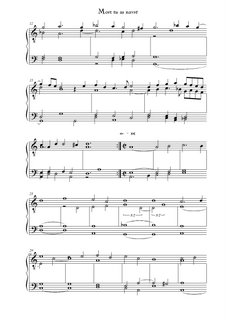 The piece is in two sections, the first in a triple division, the second, duple*, with contrasting tempi and densities. Ockeghem connects the two sections with a modest move, allowing the next-to-highest voice (contratenor altus) to change its tempus, first singing a division of three against the prevailing two, and then two dotted notes against three undotted in the other voices. This happen once only and then all four voices continue in the duple tempus to the end. That one triplet, and the following duplet add, at low levels of subdivision, a bit of breath into the second part, both connecting back to the tempus of the first section while introducing, perhaps, some ambiguity about how things will continue. At this low level, it is not the gesture of a slick musician articulating in-your-face polyrhythms with aggressive precision but rather a relaxed, almost rubato, gesture, and one which makes a whole out of the contrasting sections.
And then this: Ockeghem's modern editors, Wexler and Plamenac, suggest that the text underlaying the contratenor altus here is in cruce.
_____
* There is considerable debate about how such a transition is to be realized; most current scholars and performers appear to prefer a sesquitertia (4:3) relationship between the two tempi, with a common long duration divided into three parts in the first section, and four in the second. I find the sequitertia solution very convincing, however, a connection between the two parts is also vivid when note values have a constant duration. Note values in the example are halved.
 The piece is in two sections, the first in a triple division, the second, duple*, with contrasting tempi and densities. Ockeghem connects the two sections with a modest move, allowing the next-to-highest voice (contratenor altus) to change its tempus, first singing a division of three against the prevailing two, and then two dotted notes against three undotted in the other voices. This happen once only and then all four voices continue in the duple tempus to the end. That one triplet, and the following duplet add, at low levels of subdivision, a bit of breath into the second part, both connecting back to the tempus of the first section while introducing, perhaps, some ambiguity about how things will continue. At this low level, it is not the gesture of a slick musician articulating in-your-face polyrhythms with aggressive precision but rather a relaxed, almost rubato, gesture, and one which makes a whole out of the contrasting sections.
And then this: Ockeghem's modern editors, Wexler and Plamenac, suggest that the text underlaying the contratenor altus here is in cruce.
_____
* There is considerable debate about how such a transition is to be realized; most current scholars and performers appear to prefer a sesquitertia (4:3) relationship between the two tempi, with a common long duration divided into three parts in the first section, and four in the second. I find the sequitertia solution very convincing, however, a connection between the two parts is also vivid when note values have a constant duration. Note values in the example are halved.
Sunday, October 29, 2006
The Well-Fed Composer
Food, as a topic of discourse, comes a dangerously close second to music in my chatter, and it's almost always interesting to hear what others, composers among them, are cooking or eating. I'll go even further: a good menu is always a more interesting read than an iPod play list, and a recipe by Charles Baker* or Julia Child beats harmony instruction by Piston, Schenker, or Schoenberg any old day.
Here are some of the composers online with materials about the edible world: Charles Shere, with enviable connections to the wonder that is Berkeley's Chez Panisse, blogs about music, eating out, travel, theatre, eating out, literature, and did I mention, eating out? Dennis Báthory-Kitsz has written a nice diary of a week's home cooking, in a home with a kitchen that appears to have some distinction. John Mackey, a younger composer whose works I do not know, has made a point of including quite thorough photodocumentation of his meals in his blog. More gourmand than gourmet, Mackey's vivid photos may prove to be a valuable record of American eating habits in the early 21st century. (And, gawd help us, the consequent rise in American cholesterol and blood sugar levels.)
I'm sure that I've left someone off this list, but sorry: I've got to go fix something to eat.
_____
* The two volumes (eating, drinking) of Baker's The Gentleman's Companion are in a literary genre of their own. The account of the Saigon absynthe cocktail is alone worth the price of finding a set.
Here are some of the composers online with materials about the edible world: Charles Shere, with enviable connections to the wonder that is Berkeley's Chez Panisse, blogs about music, eating out, travel, theatre, eating out, literature, and did I mention, eating out? Dennis Báthory-Kitsz has written a nice diary of a week's home cooking, in a home with a kitchen that appears to have some distinction. John Mackey, a younger composer whose works I do not know, has made a point of including quite thorough photodocumentation of his meals in his blog. More gourmand than gourmet, Mackey's vivid photos may prove to be a valuable record of American eating habits in the early 21st century. (And, gawd help us, the consequent rise in American cholesterol and blood sugar levels.)
I'm sure that I've left someone off this list, but sorry: I've got to go fix something to eat.
_____
* The two volumes (eating, drinking) of Baker's The Gentleman's Companion are in a literary genre of their own. The account of the Saigon absynthe cocktail is alone worth the price of finding a set.
Friday, October 27, 2006
Yuji Takahashi
The composer (and fine pianist) Yuji Takahashi has a large number of scores online in PDF format at his website. His music is always interesting and makes a unique set of connections to other contemporary music -- to Xenakis, experimental music, improvisation, political music, as well as to traditional musics both Japanese and European.
Wednesday, October 25, 2006
Landmarks (20)
Johannes Ockeghem: Mort tu as navré de ton dart (ca 1460) & Josquin des Prez: Nymphes des bois (ca 1497).
These two pieces are links in a chain: the first is Ockeghem's lament for Gilles Binchois, the second is Josquin's La déploration de la mort de Johannes Ockeghem. In sequence, these compositions assert a historical continuity and re-imagination that characterizes and is unique to the European musical renaissance. They each combine settings of a contemporary secular poem in French (but one clearly rooted in the classical past of the Roman planctus) with a sacred cantus firmus in Latin. Ockeghem's upper voice sings a ballade (his only ballade) with a melodic shape more like those of Binchois than his own, and Josquin's upper voice begins with a citation, from the opening of the Kyrie to Ockeghem's Missa Cuiusvis toni.
(N.B. Actually, this chain could be extended further, with, for example, Nicolas Gombert's lament on the death of Josquin, Musae Iovis, thus setting the links -- corresponding to generations -- in alternating hues, one more clear and direct (Binchois, Josquin) , the next more complex and elusive (Ockeghem, Gombert)).
These two pieces are links in a chain: the first is Ockeghem's lament for Gilles Binchois, the second is Josquin's La déploration de la mort de Johannes Ockeghem. In sequence, these compositions assert a historical continuity and re-imagination that characterizes and is unique to the European musical renaissance. They each combine settings of a contemporary secular poem in French (but one clearly rooted in the classical past of the Roman planctus) with a sacred cantus firmus in Latin. Ockeghem's upper voice sings a ballade (his only ballade) with a melodic shape more like those of Binchois than his own, and Josquin's upper voice begins with a citation, from the opening of the Kyrie to Ockeghem's Missa Cuiusvis toni.
(N.B. Actually, this chain could be extended further, with, for example, Nicolas Gombert's lament on the death of Josquin, Musae Iovis, thus setting the links -- corresponding to generations -- in alternating hues, one more clear and direct (Binchois, Josquin) , the next more complex and elusive (Ockeghem, Gombert)).
Sunday, October 22, 2006
The Public Theorist
Scott Spiegelberg is a theorist, specializing in pedagogy and perception, who has made a point of making his work public, and in doing so in a way that doesn't restrict his audience to a narrow circle of professional colleagues. His lively blog, Musical Perceptions, has included a number of great items, including some compact and practical primers on Neo-Riemannian theory and realizing Figured Bass. Spiegelberg has also been a pioneer in using the blog as a medium for classroom teaching (his blog side-bars a number of these class blogs) and, again, his committment to the broadest definition of academic publication is well in evidence.
I have written a few outrageous things about theory on these pages, as part of my on-going attempt to articulate the distance between compositional and theoretical projects. Theory is an important service discipline for composers, a mirror to our own work, and a never-empty source of new ideas, but in order to take advantage of theory, composers will inevitably play fast and loose with the most elegant theoretical constructions. In this context, it's good to encounter a theorist like Spiegelberg, who seems comfortable writing about music theory in a way that balances perspectives and never gets too far away from either the practical issues of music making or the mysterious issues of musical perception.
I have written a few outrageous things about theory on these pages, as part of my on-going attempt to articulate the distance between compositional and theoretical projects. Theory is an important service discipline for composers, a mirror to our own work, and a never-empty source of new ideas, but in order to take advantage of theory, composers will inevitably play fast and loose with the most elegant theoretical constructions. In this context, it's good to encounter a theorist like Spiegelberg, who seems comfortable writing about music theory in a way that balances perspectives and never gets too far away from either the practical issues of music making or the mysterious issues of musical perception.
Getting 'em young
The Boy Scouts, in cooperation with the MPAA have now developed "an activity patch for learning about the evils of downloading pirated movies and music".
Thursday, October 19, 2006
Formal Dreams
I don't often remember my dreams, preferring, I suppose, to enjoy them. But here's an exception: I'm composing a big, complicated piece, and sketching it in a frenzy. In order to keep track of things, I start hanging the sketches on the walls, and when space runs out in my studio, these start spreading out onto the walls of every room in the house (in a physical replication of a classical theatre of memory, I now realize). Taking a walk, or in the dream, a mad rush, through the house becomes a tour through the piece in progress, with each room a section or movement with its own character. The childrens' rooms are scherzo-like little madhouses full of their toys and my musical toys, the kitchen is somewhat routine, with lots of repeat signs. There is some flexibility in the order of the sections/room, but that is constrained by the limited number of routes through my house. In order to get to the kitchen, you have to pass through the living room, which is the most massive and most detailed. As the piece begins to take on uncontrollable dimensions, I run out of rooms and start putting things in the boiler room and the garden shed. Even the mailbox is full. We start to talk about annexing the neighbors' house... and then I wake up.
Wednesday, October 18, 2006
More Movie Music
Just some questions, no firm opinions at all: is there a useful distinction to be made between the film music of composers who specialize in film music and those who come to film music from outside? Does the film music of Shostakovitch, Thomson, Copland, Glass, or Takemitsu fall into a different category than that of Korngold, Hermann, or any one of the Newmans? Does coming from inside or outside of the film branch give a composer a different perspective on the conventions of the genre?
And: What can be usefully said about the concert music composers who failed to break into the movies -- Schönberg and Stravinsky, for starters -- is that failure due to a mismatch in musical or personal temperaments? A variety of expressionism, with a real debt to Schönberg has become a familar trope in film music, but it seems to me to be more an import of external stylistic features than any deep structure (which shouldn't be surprising: musical concepts of coherence and closure take a back seat to those of film narrative, effect, and pacing*). On the other hand, with the exception of the famed disneyized dinosaurs, Stravinsky seems to have had less impact on film music.
(I've set aside the music of those composers working in experimental film environments, which are presumably less constraining).
___
* On the other hand, why can't you try to have it both ways? There was an interview somewhere recently with a Hollywood blockbuster composer who mentioned starting a job with some fibonacci-derived materials, and then giving them up in favor of more or less improvising to the screen image. While there's nothing necessarily good or bad about using fibonacci sequences in music, I believe that there was something terribly empty in the gesture of just giving up on the potential for a score to incorporate structural relationships of both music and film genres. What a loss!
And: What can be usefully said about the concert music composers who failed to break into the movies -- Schönberg and Stravinsky, for starters -- is that failure due to a mismatch in musical or personal temperaments? A variety of expressionism, with a real debt to Schönberg has become a familar trope in film music, but it seems to me to be more an import of external stylistic features than any deep structure (which shouldn't be surprising: musical concepts of coherence and closure take a back seat to those of film narrative, effect, and pacing*). On the other hand, with the exception of the famed disneyized dinosaurs, Stravinsky seems to have had less impact on film music.
(I've set aside the music of those composers working in experimental film environments, which are presumably less constraining).
___
* On the other hand, why can't you try to have it both ways? There was an interview somewhere recently with a Hollywood blockbuster composer who mentioned starting a job with some fibonacci-derived materials, and then giving them up in favor of more or less improvising to the screen image. While there's nothing necessarily good or bad about using fibonacci sequences in music, I believe that there was something terribly empty in the gesture of just giving up on the potential for a score to incorporate structural relationships of both music and film genres. What a loss!
Film music
At Slate, Jan Swafford makes a case for Toro Takemitsu as the best film composer of all time. Such a category is hopelessly qualified by context -- and the context is one in which a composer is only one part of a corporate effort, with very little influence how, in the end, her or his music will be used. That qualification taken, my personal choice would be Alex North (with Henry Brant orchestrating), although, as I have noted here before, Bernard Hermann remains the most influential.
Monday, October 16, 2006
Identicles
Years ago, in an analysis seminar with Gordon Mumma, we came up with the notion of an identicle, the smallest bit of information with which a single piece, the catalog of a single composer, a genre, or a repertoire might be identified. For example, a long series of triads in the upper voices with the bass one scale tone off might be an identicle for the music of William Schumann. An abundance of sonorities composed of a perfect fourth or fifth with an added augmented fourth or diminished fifth can frequently be a giveaway for music by Boulez. The identicle could be found in orchestration: A constant doubling of the first violins by the flute is an identicle for the orchestral music of Robert Schumann.* The examples are not limited to classical music: even those with a casual aquaintance with Central Javanese music can soon sort out Solonese from Yogyakartan style by paying attention to the peking, a high pitched metallophone, which in Yogyanese style anticipates the ensemble melody.
Identicles are, in and of themselves, usually fairly trivial, and perhaps most immediately useful for getting results on "name-that-tune"- or "drop-the-needle"-style listening exams. But the process of locating identicles can inform questions about the unity of a work or body of work. This process strikes me as intimately related to that used in discovering algorithms to construct a work or repertoire of works. David Cope's idea of a signature -- which he locates in the source repertoire from which he derives new works in the "same style" -- is perhaps a more tightly defined (in terms of parameters) and higher-level instance of an identicle.
While this is low-level, if not casual, stuff for analysis, I have found that watching out for identicles is useful for a composer. A composer has to find a balance in his or her work between asserting a recognizeably personal style and, at the same time, not getting stuck in a rut and too closely identified with particular stylistic features. Am I repeating myself? Is the music too much of the same? Or has it become too scattered, too disparate? Or even: is the music creeping into the identicle field associated with one of my contemporaries?** These are the sort of questions in which analysis that doesn't go too deeply into particulars is probably advantageous.
_____
* Schumann's flute writing was long a textbook example of how not to orchestrate; recent attempts to recover the performance practice style of Schumann's time suggest that this is far from the case. In the conjectured historical style, the strings do not play through the entire duration of their notes, or at least not with a constant intensity, allowing the flute tone to emerge from the composite tone in a synthetic timbre with considerable character.
** It is interested to note how carefully circumscribed the identicle fields are about the individual composers associated together in groups or schools or circles. The individual compositional identities of members of the Second Viennese School, Les Six, the New York School, the principle minimalists, or among the post-Ferneyhough complexists were very tightly defined. This is, perhaps, one of the lasting weaknesses of the camp followers of the mid-century American symphonic style, of the flute piece in stilo Gazzelloni, or of Princeton-style serial bebop.
Identicles are, in and of themselves, usually fairly trivial, and perhaps most immediately useful for getting results on "name-that-tune"- or "drop-the-needle"-style listening exams. But the process of locating identicles can inform questions about the unity of a work or body of work. This process strikes me as intimately related to that used in discovering algorithms to construct a work or repertoire of works. David Cope's idea of a signature -- which he locates in the source repertoire from which he derives new works in the "same style" -- is perhaps a more tightly defined (in terms of parameters) and higher-level instance of an identicle.
While this is low-level, if not casual, stuff for analysis, I have found that watching out for identicles is useful for a composer. A composer has to find a balance in his or her work between asserting a recognizeably personal style and, at the same time, not getting stuck in a rut and too closely identified with particular stylistic features. Am I repeating myself? Is the music too much of the same? Or has it become too scattered, too disparate? Or even: is the music creeping into the identicle field associated with one of my contemporaries?** These are the sort of questions in which analysis that doesn't go too deeply into particulars is probably advantageous.
_____
* Schumann's flute writing was long a textbook example of how not to orchestrate; recent attempts to recover the performance practice style of Schumann's time suggest that this is far from the case. In the conjectured historical style, the strings do not play through the entire duration of their notes, or at least not with a constant intensity, allowing the flute tone to emerge from the composite tone in a synthetic timbre with considerable character.
** It is interested to note how carefully circumscribed the identicle fields are about the individual composers associated together in groups or schools or circles. The individual compositional identities of members of the Second Viennese School, Les Six, the New York School, the principle minimalists, or among the post-Ferneyhough complexists were very tightly defined. This is, perhaps, one of the lasting weaknesses of the camp followers of the mid-century American symphonic style, of the flute piece in stilo Gazzelloni, or of Princeton-style serial bebop.
Saturday, October 14, 2006
Loquacity
I was shocked, shocked (1) to discover, this morning, that Renewable Music had entered the top ten reblog sources over at New Music ReBlog. This being a distress signal for over-production, I promise now to do my very best to return to the respectable second tier where scoundrels, artists, and the constitutionally lazy ought to reside.
The truly shocking thing about this is that I'm someone who has run hot and cold when it comes to talking or writing about music. There have literally been years when I've thought that there was nothing to be said or, at least, I had nothing to say about music. During those times, I've usually done my best to simply shut up. The Age of the Blog (2) just happened to arrived during a spell when this was not the case.
From time-to-time, in these pages, I have written things that are provocative. But so far, complaints have been limited. While I suppose that this is mostly a measure of low readership and low readability (3), I do have to wonder if in part this is because new music has entered the Age of the Blog at a time in its development when its capacity to provoke, excite, or, indeed shock, is at a low point. If so, we've simply got to get back to work.
_____
1. Shamelessly sentimentality-betraying movie reference.
2. Shamelessly age-betraying allusion to the "Age of the Feuillton" in Das Glasperlenspiel.
3. Slight exaggeration. A reading level analysis of this blog notes that the average number of words in a sentence was 18.2, the percentage of words with three or more syllables is 17.55%, the average syllables per word is 1.62, the Gunning Fog Index is 14.32, the Flesch Reading Ease is 51.54, and the Flesch-Kincaid Grade 10.61. On the basis of the Gunning Fog Index, readership here is expected to be somewhat higher than (College) sophomoric, the Flesch Index indicates that it is slightly more difficult that the 60-70 score desired for general audiences, and the Flesch-Kinkaid grade is higher that that of the New York Times, but lower than that of Academic Papers. Okay, dudes, I can live with that.
The truly shocking thing about this is that I'm someone who has run hot and cold when it comes to talking or writing about music. There have literally been years when I've thought that there was nothing to be said or, at least, I had nothing to say about music. During those times, I've usually done my best to simply shut up. The Age of the Blog (2) just happened to arrived during a spell when this was not the case.
From time-to-time, in these pages, I have written things that are provocative. But so far, complaints have been limited. While I suppose that this is mostly a measure of low readership and low readability (3), I do have to wonder if in part this is because new music has entered the Age of the Blog at a time in its development when its capacity to provoke, excite, or, indeed shock, is at a low point. If so, we've simply got to get back to work.
_____
1. Shamelessly sentimentality-betraying movie reference.
2. Shamelessly age-betraying allusion to the "Age of the Feuillton" in Das Glasperlenspiel.
3. Slight exaggeration. A reading level analysis of this blog notes that the average number of words in a sentence was 18.2, the percentage of words with three or more syllables is 17.55%, the average syllables per word is 1.62, the Gunning Fog Index is 14.32, the Flesch Reading Ease is 51.54, and the Flesch-Kincaid Grade 10.61. On the basis of the Gunning Fog Index, readership here is expected to be somewhat higher than (College) sophomoric, the Flesch Index indicates that it is slightly more difficult that the 60-70 score desired for general audiences, and the Flesch-Kinkaid grade is higher that that of the New York Times, but lower than that of Academic Papers. Okay, dudes, I can live with that.
Serious
There's been a lot of lamentation about the absence of new music reviews in the Village Voice. But has anyone noticed that contemporary dance continues to get covered? Take, for instance, this review of the new Merce Cunningham season. You have to wonder why dance continues to be covered. Is it because of some quality intrinsic to dance or because of a larger audience base? In any case, it is nice to know that if you compose for dance, you might still get a review in the Voice.
Friday, October 13, 2006
Some reading
Here are a pair of books for thinking musicians, and those who just like to think about music:
Christopher Small: Musicking: The Meanings of Performing and Listening (Wesleyan 1998) This was recommended by Adam Baratz at his blog Form/Content and I second his recommendation. Small is not afraid of the hard questions: "Is there something built into the nature of the works of that repertory that makes performing and listening to them under any circumstances go counter to the way I believe that human relationships should be? (...) Was even Mozart wrong?"
Bart Kosko: Noise (Viking 2006) This is unabashedly popular science writing, but the breadth is remarkable, going far beyond acoustical noise. I think the topic can very useful for those of us who spend our lives intentionally putting sounds out into the world or telling others to put sounds out into the world, i.e. composers.
Christopher Small: Musicking: The Meanings of Performing and Listening (Wesleyan 1998) This was recommended by Adam Baratz at his blog Form/Content and I second his recommendation. Small is not afraid of the hard questions: "Is there something built into the nature of the works of that repertory that makes performing and listening to them under any circumstances go counter to the way I believe that human relationships should be? (...) Was even Mozart wrong?"
Bart Kosko: Noise (Viking 2006) This is unabashedly popular science writing, but the breadth is remarkable, going far beyond acoustical noise. I think the topic can very useful for those of us who spend our lives intentionally putting sounds out into the world or telling others to put sounds out into the world, i.e. composers.
Prized
It's good to hear that the Nobel Prize in Literature was awarded to Orhan Pamuk. He's a fine writer, and I can recommend both Snow and Istanbul. The award was accompanied by some grumbling in Turkey, but Pamuk is a writer whose work can sometimes make the reader uncomfortable, and that is, in this case, a very good thing.
There is something to be said about translatable authors and their audiences. Imre Kertész was awarded the prize while I was living in Budapest, and I was initially shocked by the cool response from Hungarians to the selection. I had thought that there would be near-universal pride in the country's first Nobel laureate in literature, but instead the reaction was very mixed. There were a lot of petty jealousies in play, and one often heard: "yes, it was time for a Hungarian to win, but why this one?" There was also a mixture of near- and full-blown anti-semitism at play. But the truth was, that very few Hungarians realized that Kertész was one of the few major Hungarian writers who work could be translated both out of the Hungarian language and the often parochial concerns of Hungarian literary culture for a wider, not-exclusively Hungarian, public. He is, paradoxically, perhaps not a major Hungarian writer, but certainly a writer of international stature who happened to write in Hungarian.
The reaction in Turkey now to that country's first winner in literature appears to be similar to or even stronger than that in Hungary. Pamuk has been willing to talk and write truthfully about topics that are highly sensitive in his country, and the consequences have been serious. But even with his critical eye, Pamuk is always a writer for whom pride, wonder, and joy in his home, Istanbul, is central to his work. He has a special role in guiding westerners through his culture, and Istanbul in particular, and we are all aware of the danger, when such guidance is not available.
There is something to be said about translatable authors and their audiences. Imre Kertész was awarded the prize while I was living in Budapest, and I was initially shocked by the cool response from Hungarians to the selection. I had thought that there would be near-universal pride in the country's first Nobel laureate in literature, but instead the reaction was very mixed. There were a lot of petty jealousies in play, and one often heard: "yes, it was time for a Hungarian to win, but why this one?" There was also a mixture of near- and full-blown anti-semitism at play. But the truth was, that very few Hungarians realized that Kertész was one of the few major Hungarian writers who work could be translated both out of the Hungarian language and the often parochial concerns of Hungarian literary culture for a wider, not-exclusively Hungarian, public. He is, paradoxically, perhaps not a major Hungarian writer, but certainly a writer of international stature who happened to write in Hungarian.
The reaction in Turkey now to that country's first winner in literature appears to be similar to or even stronger than that in Hungary. Pamuk has been willing to talk and write truthfully about topics that are highly sensitive in his country, and the consequences have been serious. But even with his critical eye, Pamuk is always a writer for whom pride, wonder, and joy in his home, Istanbul, is central to his work. He has a special role in guiding westerners through his culture, and Istanbul in particular, and we are all aware of the danger, when such guidance is not available.
Wednesday, October 11, 2006
Vanishing manuscript
Here's an article in the Washington Post about the decline of cursive skills among American schoolchildren. Is there a similar general decline in music manuscript skills among the notationally-literate? Do all institutions now permit their students to turn in computer-generated scores for assignments?
Tuesday, October 10, 2006
Rapid transit
With the news of an underground explosion in North Korea (which may or may not have been nuclear), it may be useful to learn a little bit more about the country. I find these pages about the Pyongyang Metro to be fascinating, and perhaps a reasonable indication of the level of our knowledge of the entire DRK.
Monday, October 09, 2006
Music Notation: Sins and Fibs
Too often, talk about music notation gets reduced to a question of using Fin(ale) or Sib(elius), the two leading commercial notation packages. I happen to use Finale, but not for all my notational needs, and -- this probably sounds like a broken record -- I am a serious advocate for the maintenance of a diversity of products with alternative features and functions.
First of all, many of us still do some or all of our work by hand, and there's no reason to change if it works for you. For the most gifted calligraphers, a switch to computer notation, will save some time, but if you're picky about the layout, probably not as much time as you'd wish. I felt that I had to switch for the sake of my eyesight, but the jury's still out on that one. Moreover, the composer's own, hand-drawn, manuscript, will always have an aesthetic caché of its own, an aura of authenticity, if you will.
Some of us will decide to roll our own notation programs. I tried this, myself, writing in a mix of postscript and forth on my old Atari, but the result wasn't especially pretty, and I am now, officially, a SWIRP, someone-who-is-retired-from-programming. David Feldman, a composer who does a lot of algorithmic works, remarkably, is able to program in Postscript so that he can go directly from algorithm to finished score.
(Many more composers design their own fonts, or at least tweak the designs of existing fonts. The font which composer and copyist James Ingram made for Stockhausen's scores is one good example. Clarence Barlow did all of his own text and music fonts for his Atari environment. Having your own house fonts as well as layout style can be a cool thing.)
Some notation programs are purely graphic -- play-back of a score is not part of their schtick -- but, and in-part precisely because they are not obliged to come up with a realistic play-back -- they can be extremely flexible on the graphic front. Score, the granddaddy of notation programs, still has a small loyal user-base, and can do almost anything in standard notation. Graphire Music Studio can do even more -- circular scores, exploding sections etc. -- with a more contemporary interface, while Lilypond, from the free/open source software world, aspires to reproduce the results of classical engraving techniques through some very clever algorithms. Lilypond has less capacity and is less flexible than either Score or Music Studio, but as open source, it's a moving object -- if you need or don't like a feature, you can add your own.
Notion and Harmony Assistant emphasize playback, but both have respectable out-of-the-box notation faculties, and both, I believe have features that may point to the next generation of notation and production programs. I bought Harmony Assistant myself, and have learned a lot from it, but I am still not fluent enough with the interface to really test its limits. Writing additional "rules" scripts for Harmony Assistant is very easy, and I am especially excited about its capacity to render microtones live directly from notation into digital audio. In the Linux world, Rosegarden has native notation capacity, but sophisticated users will probably want to export from Rosegarden into Lilypond.
Finale and Sibelius are the two best-sellers in the music notation world, and they can both keep most users perfectly satisfied, or perfectly frustrated, which ever comes first. I believe that there is some consensus that Sibelius will give most users an acceptable output straight out of the box, as the house styles and the entry techniques for newbies are well-designed for newbies, but more complicated things get rapidly more difficult to do. Finale, on the other hand, has a steeper learning curve, partially due to a long development history and backwards compatability, and the out-of-the-box house styles are notoriously inadequate, but once you've oriented yourself, the power of the program becomes quite evident, and I believe that more elements in a score are tweakable than in Sibelius. This makes it easier, in the long run, to attain a specific house style, whether you want to imitate Henle or the best Broadway arranger, or invent your own house style. (I believe that Finale also offers more flexibility as to entry, but am not certain. I like to use command-line entry in Finale, and, as far as I can tell , this is not possible in Sibelius, but I'm happy to be corrected on this point).
But not every element is tweakable... for example, barlines in Finale are present at a low level in the data structure, so they remain fairly rigid elements in the program. If you want to have non-alligned barlines, as in Ockeghem or Ives, you're in for some elaborate kludges. Or, you could try, as an alternative, the program Lime, which has some serious limitations on other details, but makes non-alligned barlines in a snap (and has a built-in-tuning table function for ready microtonality). Lime only costs US$65, and for many users, it may very well be sufficient for all their other needs.
And there are a number of other programs in the landscape which are less powerful, but also much less expensive than Fin or Sib. Finale offers its own scaled-down version. Capella, Igor, Berlioz, Mozart, and Turandot have each a loyal, often local, user community, and each can produce attractive scores. While in Hungary, I purchased Turandot, the local notation product. While certainly nothing as radical as Harmony Assistant, it has an interesting interface, and for common practice era-style scores, the out-of-the-box-styled output can be excellent, very close in fact, to that of the Editio Musica Budapest.
First of all, many of us still do some or all of our work by hand, and there's no reason to change if it works for you. For the most gifted calligraphers, a switch to computer notation, will save some time, but if you're picky about the layout, probably not as much time as you'd wish. I felt that I had to switch for the sake of my eyesight, but the jury's still out on that one. Moreover, the composer's own, hand-drawn, manuscript, will always have an aesthetic caché of its own, an aura of authenticity, if you will.
Some of us will decide to roll our own notation programs. I tried this, myself, writing in a mix of postscript and forth on my old Atari, but the result wasn't especially pretty, and I am now, officially, a SWIRP, someone-who-is-retired-from-programming. David Feldman, a composer who does a lot of algorithmic works, remarkably, is able to program in Postscript so that he can go directly from algorithm to finished score.
(Many more composers design their own fonts, or at least tweak the designs of existing fonts. The font which composer and copyist James Ingram made for Stockhausen's scores is one good example. Clarence Barlow did all of his own text and music fonts for his Atari environment. Having your own house fonts as well as layout style can be a cool thing.)
Some notation programs are purely graphic -- play-back of a score is not part of their schtick -- but, and in-part precisely because they are not obliged to come up with a realistic play-back -- they can be extremely flexible on the graphic front. Score, the granddaddy of notation programs, still has a small loyal user-base, and can do almost anything in standard notation. Graphire Music Studio can do even more -- circular scores, exploding sections etc. -- with a more contemporary interface, while Lilypond, from the free/open source software world, aspires to reproduce the results of classical engraving techniques through some very clever algorithms. Lilypond has less capacity and is less flexible than either Score or Music Studio, but as open source, it's a moving object -- if you need or don't like a feature, you can add your own.
Notion and Harmony Assistant emphasize playback, but both have respectable out-of-the-box notation faculties, and both, I believe have features that may point to the next generation of notation and production programs. I bought Harmony Assistant myself, and have learned a lot from it, but I am still not fluent enough with the interface to really test its limits. Writing additional "rules" scripts for Harmony Assistant is very easy, and I am especially excited about its capacity to render microtones live directly from notation into digital audio. In the Linux world, Rosegarden has native notation capacity, but sophisticated users will probably want to export from Rosegarden into Lilypond.
Finale and Sibelius are the two best-sellers in the music notation world, and they can both keep most users perfectly satisfied, or perfectly frustrated, which ever comes first. I believe that there is some consensus that Sibelius will give most users an acceptable output straight out of the box, as the house styles and the entry techniques for newbies are well-designed for newbies, but more complicated things get rapidly more difficult to do. Finale, on the other hand, has a steeper learning curve, partially due to a long development history and backwards compatability, and the out-of-the-box house styles are notoriously inadequate, but once you've oriented yourself, the power of the program becomes quite evident, and I believe that more elements in a score are tweakable than in Sibelius. This makes it easier, in the long run, to attain a specific house style, whether you want to imitate Henle or the best Broadway arranger, or invent your own house style. (I believe that Finale also offers more flexibility as to entry, but am not certain. I like to use command-line entry in Finale, and, as far as I can tell , this is not possible in Sibelius, but I'm happy to be corrected on this point).
But not every element is tweakable... for example, barlines in Finale are present at a low level in the data structure, so they remain fairly rigid elements in the program. If you want to have non-alligned barlines, as in Ockeghem or Ives, you're in for some elaborate kludges. Or, you could try, as an alternative, the program Lime, which has some serious limitations on other details, but makes non-alligned barlines in a snap (and has a built-in-tuning table function for ready microtonality). Lime only costs US$65, and for many users, it may very well be sufficient for all their other needs.
And there are a number of other programs in the landscape which are less powerful, but also much less expensive than Fin or Sib. Finale offers its own scaled-down version. Capella, Igor, Berlioz, Mozart, and Turandot have each a loyal, often local, user community, and each can produce attractive scores. While in Hungary, I purchased Turandot, the local notation product. While certainly nothing as radical as Harmony Assistant, it has an interesting interface, and for common practice era-style scores, the out-of-the-box-styled output can be excellent, very close in fact, to that of the Editio Musica Budapest.
Monday, October 02, 2006
Landmarks (19)
La Monte Young: Chronos Kristalla (Time Crystals) from The Magic Chord x 4 (1990- ) for string quartet.
Since the mid-1960's, Young's works can be be heard as belonging to one of two major projects. I identify the first project as including the ensemble music and installations composed for the Theatre of Eternal Music, including The Tortoise, His Dreams and Journeys, which reached a provisional definition in the restrictions of a theoretical document, The Two Systems of Galactic Light Intervals Tracery, and, more recently, has received new impetus through a series of installations and live vocal/instrumental/electronic performances in which the selection of pitches is based instead upon symmetrical arrays of pitches found high in a harmonic series. The performance practice used in these pieces, in particular that used in Young's own vocal performances, as developed in this project is deeply connected to -- without ever materially quoting -- Young's long-term study of North Indian Classical Music.
The second project, and the one to which Chronos Kristalla belongs, was initially defined by The Well-Tuned Piano (1964- ), which can be understood as a particular instrument, a particular tuning scheme for that instrument, a developing technique for playing that instrument within that tuning environment, and as a single, evolving, composition. In much of Young's work, the distinction between composition and improvisation is difficult: the composition clearly changes over time, from performance to performance, but the improvisation (perhaps extemporization is the better word) is done within incredibly strict parameters, demonstrating a discipline that again finds a close parallel in his study of North Indian Classical Music.
The Well-Tuned Piano is a piece of music for a piano, but it is also something more than that. One effect of the tuning and the playing techniques developed by Young (in particular, the rapid chordal figurations, known as "clouds", which Young intuitively hammers in a highly sensitive play between interference beating, reinforced upper harmonics, and just intervals between the fundamentals) is to remove the instrument from the narrowly-defined timbral world of the piano. In this wider timbral space, the listener is often party to illusions of voices, horns, electronic instruments, and indeed, certain areas of the tuning have long-been associated by Young with instruments other than the elegant Börsendorfer: the "Opening Chord" of the work was clearly music for brass, and in Chronos Kristalla, the potential of "The Magic Chord" as music for strings has received an initial realization.
"The Magic Chord", an eight-toned complex perhaps most immediately identified by the poignantly narrow 28:27 minor seconds and wide 9:7 major thirds, is played here two octaves higher than it is played in The Well-Tuned Piano, and played entire in natural harmonics by the quartet. Tuning precision is achieved by tuning the harmonics (not the fundamentals!) precisely to a special synthesizer. The immediate sensation of the tuning, the tessitura, and the natural harmonics is astonishingly close to that of the Japanese Sho, the freed-reed instrument which provides the tonal backdrop for the Court music, Gagaku, a musical tradition with which Young has been familiar since the 1950's.
I have cautiously called this an "initial realization". This is for two reasons: the first is that the performance style of this music remains a project in development. The score -- the most detailed, more-or-less conventially notated score that Young has produced since his student years -- is to some extent a direct transcription from portions of a performance of The Well-Tuned Piano. The nature of that transcription, and in particular the transcription of the clouds from Young's distinctive keyboard style to an ensemble string texture, remains a work in progress. But as importantly, the larger potential of The Well-Tuned Piano remains unexplored. Young's intention to transcribe the "The Opening Chord" for brass ensemble is already known and it is not difficult to extrapolate from there and to imagine that the string and brass music could combine into something of orchestral dimensions, and that this orchestra might eventually be joined with the solo piano.
Since the mid-1960's, Young's works can be be heard as belonging to one of two major projects. I identify the first project as including the ensemble music and installations composed for the Theatre of Eternal Music, including The Tortoise, His Dreams and Journeys, which reached a provisional definition in the restrictions of a theoretical document, The Two Systems of Galactic Light Intervals Tracery, and, more recently, has received new impetus through a series of installations and live vocal/instrumental/electronic performances in which the selection of pitches is based instead upon symmetrical arrays of pitches found high in a harmonic series. The performance practice used in these pieces, in particular that used in Young's own vocal performances, as developed in this project is deeply connected to -- without ever materially quoting -- Young's long-term study of North Indian Classical Music.
The second project, and the one to which Chronos Kristalla belongs, was initially defined by The Well-Tuned Piano (1964- ), which can be understood as a particular instrument, a particular tuning scheme for that instrument, a developing technique for playing that instrument within that tuning environment, and as a single, evolving, composition. In much of Young's work, the distinction between composition and improvisation is difficult: the composition clearly changes over time, from performance to performance, but the improvisation (perhaps extemporization is the better word) is done within incredibly strict parameters, demonstrating a discipline that again finds a close parallel in his study of North Indian Classical Music.
The Well-Tuned Piano is a piece of music for a piano, but it is also something more than that. One effect of the tuning and the playing techniques developed by Young (in particular, the rapid chordal figurations, known as "clouds", which Young intuitively hammers in a highly sensitive play between interference beating, reinforced upper harmonics, and just intervals between the fundamentals) is to remove the instrument from the narrowly-defined timbral world of the piano. In this wider timbral space, the listener is often party to illusions of voices, horns, electronic instruments, and indeed, certain areas of the tuning have long-been associated by Young with instruments other than the elegant Börsendorfer: the "Opening Chord" of the work was clearly music for brass, and in Chronos Kristalla, the potential of "The Magic Chord" as music for strings has received an initial realization.
"The Magic Chord", an eight-toned complex perhaps most immediately identified by the poignantly narrow 28:27 minor seconds and wide 9:7 major thirds, is played here two octaves higher than it is played in The Well-Tuned Piano, and played entire in natural harmonics by the quartet. Tuning precision is achieved by tuning the harmonics (not the fundamentals!) precisely to a special synthesizer. The immediate sensation of the tuning, the tessitura, and the natural harmonics is astonishingly close to that of the Japanese Sho, the freed-reed instrument which provides the tonal backdrop for the Court music, Gagaku, a musical tradition with which Young has been familiar since the 1950's.
I have cautiously called this an "initial realization". This is for two reasons: the first is that the performance style of this music remains a project in development. The score -- the most detailed, more-or-less conventially notated score that Young has produced since his student years -- is to some extent a direct transcription from portions of a performance of The Well-Tuned Piano. The nature of that transcription, and in particular the transcription of the clouds from Young's distinctive keyboard style to an ensemble string texture, remains a work in progress. But as importantly, the larger potential of The Well-Tuned Piano remains unexplored. Young's intention to transcribe the "The Opening Chord" for brass ensemble is already known and it is not difficult to extrapolate from there and to imagine that the string and brass music could combine into something of orchestral dimensions, and that this orchestra might eventually be joined with the solo piano.
Not a monoculture

Browsers used by visitors to Renewable Music.
BTW: I've recently switched to Opera, which I like very much. The only downside I've found is that the Blogger editor only runs properly with either Firefox/Mozilla or IE.
Sunday, October 01, 2006
New Music, a Mixed Economy
Dennis Báthory-Kitsz has an excellent blog article on a number of serious topics, in part responding to my comments on his productivity survey.
I am at the limit of my economic expertise here, so the following is a tentative clarification of my position. It was, in fact, a rhetorical exaggeration when I identified our new music economy as a gift economy. It is, in fact, a mixed economy with elements of gift, market, and command economies all playing a role. Some composers will, in fact, find that their works can be measured in terms of supply and demand, and the labor involved can be measured as an investment, from which one can estimate cost, return, and perhaps even profit, in terms of money. Other composers may have their works supported by some command processes, with compensation related to their productivity as a composer, but in non-negotiable monetary values. This form of patronage, whether state or private, institutional or private, can be direct -- immediately supporting muscial labor in the form of commissions and recordings, or indirect, for example by hiring composers as teachers or administrators, and expecting some creative work on the side. (Even Milton Friedman, as market-oriented as they come, recognizes the societies must support the maintenance of their "monuments"). However, I am satisfied that our work largely falls into a gift economy, and this is not an altogether bad thing. For one, it is more inclusive, not limiting the category of new music to some narrowly defined class of professionals or full-time specialists or those in the biggest urban centers or associated with the biggest institutions.. Not all of us can become a Philip Glass, with his market successes, but more importantly: not all of us would want to. I like receiving compensation for my musical labor, but it is not always expected, and the level of compensation is for a large part, non-negotiable, when not entirely capricious. Moreover, when Dennis writes that:
I have to respond that I see no significant act of responsibility in participating in the trade society. Our participation is that society is already de facto, as we have to feed, cloth, and house ourselves, and we will do what it takes within that society to make survival possible. Some musicians will to build structures or institutions for their music within that economy, and the more power to them. However, I happen to see my responsibility as participating in mechanisms and processes that are alternatives, if not active resistance, to that de facto trade society.
(I'll note that as bad as it seems to be for new music in the real world, in many ways it's never been better. There is more -- and more diverse -- music available, in one form another, to more people. The possibility of a work of serious music dropping off the face of the planet is less likely than ever, as once it has entered the web, in whatever state, it is apparently eternal. It is, in fact, the popular music monoculture which is doing poorly. After decades of consolidating their businesses, they have found themselves unprepared to compete in a marketplace in which shelfspace is virtual and consumer choice is practically unlimited and the recent power grabs at places like GEMA are signs of desperation at shrinking market share in a market that is ever-more difficult to oversee.
I disagree with Dennis, here:
I am at the limit of my economic expertise here, so the following is a tentative clarification of my position. It was, in fact, a rhetorical exaggeration when I identified our new music economy as a gift economy. It is, in fact, a mixed economy with elements of gift, market, and command economies all playing a role. Some composers will, in fact, find that their works can be measured in terms of supply and demand, and the labor involved can be measured as an investment, from which one can estimate cost, return, and perhaps even profit, in terms of money. Other composers may have their works supported by some command processes, with compensation related to their productivity as a composer, but in non-negotiable monetary values. This form of patronage, whether state or private, institutional or private, can be direct -- immediately supporting muscial labor in the form of commissions and recordings, or indirect, for example by hiring composers as teachers or administrators, and expecting some creative work on the side. (Even Milton Friedman, as market-oriented as they come, recognizes the societies must support the maintenance of their "monuments"). However, I am satisfied that our work largely falls into a gift economy, and this is not an altogether bad thing. For one, it is more inclusive, not limiting the category of new music to some narrowly defined class of professionals or full-time specialists or those in the biggest urban centers or associated with the biggest institutions.. Not all of us can become a Philip Glass, with his market successes, but more importantly: not all of us would want to. I like receiving compensation for my musical labor, but it is not always expected, and the level of compensation is for a large part, non-negotiable, when not entirely capricious. Moreover, when Dennis writes that:
Calling it such (and acting upon it as such) is a capitulation of responsibility for participation in the de facto trade society. It rejects understanding the dynamics of the 'micro-economy' and setting out to change it, enlarging opportunity and enhancing the ability to move from micro-economy to sustaining economy.
I have to respond that I see no significant act of responsibility in participating in the trade society. Our participation is that society is already de facto, as we have to feed, cloth, and house ourselves, and we will do what it takes within that society to make survival possible. Some musicians will to build structures or institutions for their music within that economy, and the more power to them. However, I happen to see my responsibility as participating in mechanisms and processes that are alternatives, if not active resistance, to that de facto trade society.
(I'll note that as bad as it seems to be for new music in the real world, in many ways it's never been better. There is more -- and more diverse -- music available, in one form another, to more people. The possibility of a work of serious music dropping off the face of the planet is less likely than ever, as once it has entered the web, in whatever state, it is apparently eternal. It is, in fact, the popular music monoculture which is doing poorly. After decades of consolidating their businesses, they have found themselves unprepared to compete in a marketplace in which shelfspace is virtual and consumer choice is practically unlimited and the recent power grabs at places like GEMA are signs of desperation at shrinking market share in a market that is ever-more difficult to oversee.
I disagree with Dennis, here:
Low productivity is a symptom of a greater compositional disease, a disease whose vector is starvation and sickening of opportunity. Like a body that feeds upon itself to stay alive under stress, the body of new nonpop composition, presentation, and audition has been feeding upon itself for nearly a century. If nutrition is so badly needed for this patient, it matters little where it comes from. Consciously increasing productivity places nutrients in our feeding tube.
First of all, I have to challenge the assumption that this condition can be dated "for nearly a century". The economic situation for composers has never been good, and without patronage or a day job, very few composers would have ever composed anything, even the most famous cases of hyperproductivity. But more importantly, we each come to music with different sensibilities, interests, ambitions, experiences, and talents. Some composers simply don't have many pieces in them, and they are not necessarily lesser composers because of it. While some composers do improve their art by composing more pieces, others improve by working more intensively on a small number of pieces, composing and recomposing, getting every detail right. Some compose out of lightning bolts of inspiration, others simply work long and hard. The problem here is that productivity will inevitably be measured by quantity, whether in number or length of pieces or in the amount of time spent on a piece. However, not all composers are gifted in the same way, so no single measure of those gifts is going to work. (There's that word, gift, again). Do we value Webern, Varese, Ruggles, Kurtag, Chowning any less for the small size of their catalogs? Do we value them more for their scruples? Do we value a Clemens Non Papa or a Hovhaness more? I sure don't view my own low quantitative productivity as symptom of an illness, but rather -- and perhaps, optimistically -- as a sign of the standards I set for myself. I'd estimate that I compose about a minute of music every day, but most of those minutes I cheerfully abandon, for the potential of making something better.
I think that new music plays an important role the real world, if only, at the very least, it is constant irritation to that world, a constant reminder that affairs can be different, indeed, better. I have to return, once again, to Nagg's joke, in Beckett's Endgame, about the tailor, who takes longer to make a pair of trousers than God took to create the world: "But my dear Sir...look at the world...and look at my trousers!"
Subscribe to:
Posts (Atom)