Sunday, November 07, 2010

A Veritable Cornucopia

Some late, loose items:

(1) China Miéville has a new-ish blog, rejectamentalist manifesto.  It's aperiodic, often fragmental or pictoral, but reliably interesting.   The recent posts on the the UK coalition government's plans for cut-and-burn reductions in cultural and social spending are on the mark, and much of what is noted in the UK applies equally well to the Netherlands, the Republicans in the US, and the German coalition government.

(2) Here's a recent small item at The Eastside View, Charles Shere's blog, which is a model of engaging and useful critical writing: honestly sorting out opinion and taste from just-the-facts-ma'am reporting, making interesting connections, and not treating the musical as an autonomous category of cultural activity.  Charles, a fine composer as well as critic, is a treasure in the musical landscape. 

(3) Pliable notes that 95% of Gramophone magazine's readers are male.  Why is this the least surprising factoid of the week?  Gramophone is the UK classical music bidness's equivalent of a mixture of Sports Illustrated and Model Railroader.   It's about "industry" gossip, sport, and collecting, a particular constellation that is only sustainable in a high testosterone environment (one from which my better angels have protected me!)  Moreover, as the magazine's title honestly indicates, it's about recordings, commodified recording.  It's about buying, trading, and collecting recordings and it's about ranking them, like baseball statistics (and yes, as often fantasy as real.)  Boys with toys. The classical music live performance world, on the other hand, which includes everything from music education to professional performance and audition, is one in which participation, with exceptions for the recalcitrant fields of conducting, management, and a pair of European orchestras,  is no longer so decisively dominated by one gender or the other. Audiences for classical music concerts are often predominantly women and the most important figures introducing classical music to young people are women as well — music teachers, whether in school or privately.  That's the real news of the day, not the readership of a magazine devoted to a male hobby rapidly going the way of the dodo.  


Saturday, November 06, 2010

Follow the Money, Impending Firesale Edition

Always on the right path, Pliable has been following the story of EMI's descent.  With the latest successful claims by creditor Citigroup against EMI, what can we expect will happen to the back catalogue in classical music? I suspect that there is a real opportunity to be had here in picking up that catalogue at fire sale prices and immediately turning it into digital goods.  Sure, the amortization may be long-term — and in terms longer than any major financial concern is now willing to consider — but these goods are reliably durable audibles. (If the present UK coalition government really had their capitalist chops about them, they would find some way to claim these as assets of national interest, make the modest investment to create the platforms required to sell downloads, and then reinvest the income in contemporary music making. Unfortunately, I suspect that there are interests in the present government who actively hold any engagement by the state in culture in such low regard that they would just as soon lose money and let assets like these disappear into the portfolio of a creditor with no idea what the assets are, let alone what they might be worth, as actually exploit the potential of the assets.)

Friday, November 05, 2010

Signal, too.


In principle, I'm on the "side of the noises" (as Cage put it), but I'm not altogether certain that that is actually saying anything particularly significant or interesting anymore.  I remember being thrilled to read, in the pre-Sokal-discount days of Social Text, the first excerpts of Attali's Bruits to appear in translation.  Attali's use of the Breughel Battle between Carnival and Lent remains a brilliant metaphor, AFAIC, but when I finally put paws on the whole little book of Noise, it was serious disappointment time, as he really took things no further than the equally deterministic schemes of either Weber or Adorno.  And, more critically, he seemed not to have anything particularly deep to say about how music is actually put together.*  (A more useful, it seems to me, treatment of the topic of noise, and largely because its discussion is not exclusively or even primarily about musical noise, is in Bart Kosko's Noise.)   An identification of one's own musicking with and/or as noise has some fashion currency now, particular among those using electronics (the more analog, hacked, and bent, the better) but also (as this thoughtful review of the recent anthology Noise & Capitalism, points out) among the so-called "free" improvisors (note that both areas of activity represent traditions with considerable vintage.)  Cage's "side of the noises" was a parallel/echo/extension of the "emancipation of the dissonance"; music history took sides decisively for both in the ultra-modern music which apex-ed in the early 1930s (Cowell, Varese, Antheil, Crawford, Wm. Russell, Brant, Ornstein, etc. in the US with similar cohorts elsewhere)  only to make an equally decisive u-turn away from noise and towards consonance in the strongly statist — whether left, right, authoritarian or consensual — era which followed and continued through the second world war. This shift, from noise to notnoise, from dissonance to consonance, was in the form of moves along a spectrum, stylistic shifts which still recognized the accumulated increase in variety of each spectrum.  And if you think about this, even casually, these processes have always marked music history — hunting horns, martial trumpets and drums, and tower trombone choirs once represented alien invasions of concerted music, noisy additions to the orchestra by members of guilds (foresters, soldiers, civil/religious servants) whose membership had not yet merged with the local musicians' union, and all of the audio special effects requisite to the opera stage were added to the back-of-the-pit toy box of the timpanist/proto-percussionist, a job category that only the last century universally regarded as the work of proper musicians; likewise, the category of the consonant gradually overtook that of the dissonant, embracing ever-denser harmonic configurations (in itself, a move along the spectrum towards noise)  as the distinction became one of formal context rather than abstract category. So now, having experienced all of that opening of the spectra of the acoustically possible, doesn't describing oneself as on the side of the noises or of the dissonances have more the tenor of a consumer choice than an authentically oppositional stance?  What is noisy or dissonant, any more, of a music made solely of noises or dissonances? 

* This is not unusual.  In my student days, and particularly in my Santa Cruz days,  "theory", as used in the humanities was all the rage, from structuralism forward, and I read as much as I could, especially when it seemed that something useful or relevant to music was supposed to be present.  Although I don't regret the reading (Debord, of course, the Deleuze of The Logic of Sense, too; I'll always have a soft spot for Barthes's Empire of Signs and Levi-Strauss was simply a pleasure to read) , as a working musician, I was usually disappointed, as the musical content was inevitably superficial.  The appropriation of musical forms in Levi-Strauss's analysis of myths, for example, should be enough to send anyone running ASAP to read their Tovey to see that there is a profound, accurate, and relevant tradition for writing about musical form and structure that has more to offer theory in other disciplines than they may have offer music. 


Wednesday, November 03, 2010

Comparing Notation/Engraving Programs for New Music

I propose the design of a comparison survey of the present music notation/engraving program landscape; should there be interest in such a project, this is an open invitation to make suggestions as to its form and content.

This is an interesting moment for notation software in that we are not limited to Finale and Sibelius, for — as good/bad/ugly/useful/useless as those two programs may be — no single program has (or even should have) universal functionality or flexibility and having the additional options provided alternative or auxiliary software is a very good thing. At the moment, there are some interesting new-ish programs available as free or commercial software and a couple of older programs with useful features have become available as legacy items.

The comparison ought to have two components, the first a comparison chart (this program can or cannot do this) with some evaluation (how easy or well the program does this or that) and the second, if possible, a comparison of output engraving from the individual programs based on a model piece, with a lot of hoops to jump through and hurdles to jump over, including both graphic-only output with graphic+ audio output.

Among the features that ought to be investigated are (1) complex rhythms, including nested tuplets, broken or partial tuplets, aligned and non-aligned polymeter scores, and non-measured or "spatial" notation (all of the above with and without playback); (2) microtonal accidentals, whether of a fixed set or of your own design, and playback; (3) continuous linear items like crescendi/diminuendi, portamenti/glissandi, accellerandi, and their playback; (4) house style capacity, including choice of fonts, symbols, and layout flexibility; (5) graphic capacity, including cutaway scores, insertion of graphics, export of graphics including ps and pdf formats; (6) playback capacity, including midi and audio commands, generation of midi and audio files; (7) input methods: text or command line, computer keyboard +/- keypad (and a description of the keyboard layout used), mouse/pen/joystick/etc., midi keyboard, midi or audio file, import from (and export to) other engraving software or earlier versions of the same software; (8) general interface and workflow design.

Any additions, corrections or suggestions about this would be most appreciated, as would any suggestions for a model piece.

Tuesday, November 02, 2010

Dead-Dropped Music?

Artist Aram Bartholl is embedding usb drives into walls, buildings and curbs for public but anonymous data up- and downloads. Not surprisingly, the comments focus in on the risks of acquiring viruses or having your equipment sabotaged, making this media equivalent of anonymous sex or sharing used needles; sad how modern public life gets stuck with such risks. In any case, it's certainly one way to try to get your music out there via sound files and sound-playing applications.

Thursday, October 28, 2010

On and Off the Grid

I've been digging into the work of the anthropologist and political scientist James C. Scott.  His Seeing Like A State: How Certain Schemes to Improve the Human Condition Have Failed is particularly interesting*,  showing how authoritarian modernism can disastrously simplify and fail to "read" traditional cultures and the body of knowledge and techniques that these bring to working in complex environments.  His examples come both from state regimes both right and left and both villainous and rather more benign (i.e. Soviet collectivization and Tanzanian Ujaama villagification)  and include intriguing oppositional voices, for example Rosa Luxemburg contrasted with Lenin and Jane Jacobs with Le Corbusier, oppositional voices from the left making the case for the complexity, sophistication, and value of traditional cultural practices.

A startling juxtaposition here for me is that that between modernism and simplification, from the need to make things clear (Scott's term of art is "legible") — roads straightened, cities drawn to grids, fixed units of measurement, a fixed system of personal and family names, monocultural agriculture, etc. —  in order for a modern authoritarian state to assert greater degrees of management and control.  A more startling quality is that the impulse for much of this is more aesthetic (or even "faith-based") in nature than rational.  Yet,  as it often enough happens, these become objects of real, if often subtle, revolt and subversion from forces at the base and margins of societies and beyond state control, taking the opportunity of the failures of planning, through their ability to deal with real material conditions more effectively, indeed rationally, than the statist or corporate planners.  (I suspect that the most successful modern societies succeed from a carefully, if tacitly, negotiated compromise between these forces.  If I have a criticism of Scott, it is perhaps that he does not give enough consideration to the notion that these responses to the state are themselves, as tied to tradition as they may be, a form of modernism.  Yes, we want the universal high quality drinking supply the modern state provides (or promises to provide), but no, we don't want forests with third generations of dying, monocultural Standardbäume.   Yes we want modern highways, no we don't want them next to our homes and schools or straight through the middle of our communities.  Yes, we want modern utilities, but if we are able to provide our own utilities more cheaply and cleanly by going off the grid, then we want to be able to do that.)     

In recent art music we have, of course, our own dynamic between simplification and complexity, as well as between tradition and modernism.  This dynamic is full of interesting and productive contradictions and even paradoxes.  Minimalism in music, for example, can be a means toward recovering and projecting complexity, while notationally complex music may be such a reification of the note as a musical atom, ripped out of either larger tonal contexts or sealing off attentions from any inner activity within the span of that note, that much complexity is lost.  

While there is a relationship of the modernist projects of both states and corporations (and these both authoritarian and consensual), the existence of experimental art music has been either highly controlled or completely deprecated (in authoritarian political regimes) or ignored (under multinational capitalism or consensual republican states).  (Interesting how all of these regimes tend to treat culture as non-essential superstructur; for me at least, a complete reversal of hpw things ought be valued.)  The relationship of music to the authority can then either be collaborationist, creating propaganda or commodities for the state or the market; oppositional; or autonomous, operating in parallel to but unengaged with the authority.

One of the most interesting ways in which modern art music has been engaged as an oppositional force has been in the project of playing with and around and circumventing rigid lines of demarcation and identity.  As I mentioned in a post last week, in the musical use of time,  syncopation and rubato are means of going against the grid.  A constant in the work of Morton Feldman, for example, was the investigation of ways to compose directly within a graphical rigid score (early on, on graph paper; then in works with an imprecisely defined single graphic note value, later on score paper with pre-drawn measure lines) that blurred, disrupted or even defeated pulse, metre or barlines.  (Contrast this with the School of Babbitt's "time point system", which was ostensibly ametrical but in practice a rigid reinforcement of both a fixed pulse and metric accent.) 

_____

* Doesn't that title recall John Cage's Diary: How to Improve the World (You Will Only Make Matters Worse), another text with decidedly anarchist sympathies?   

From the Dept. of Film Music Clichés

An old friend, pointing to the soundtrack to The Day the Earth Stood Still, remarked that Nothing says, "Little green men approaching" quite like a theremin...in this case, TWO theremins!,  to which I had to reply that  "Nothing says 'here comes an ass in a perm and a leisure suit' better than a vibraslap and a heavy brass section."  So between the two of us, we've just got the 1950s sci-fi and 1970's action film music genres down.  

[We're still working on a pithy formulation of the early 21st century aspiring-to-hipness genre, with the obligatory faux-Philip Glass enharmonic common tone arpeggiated turn-around chord sequences.]  

Thursday, October 21, 2010

Musicians using Science

A note on the recent passing of the mathematician Benoît B. Mandelbrot.   Whether directly, via close study, or indirectly, even impressionistically, from a condensed version in the popular science press or from the illustrations in his coffeetable book The Beauty of Fractals, Mandelbrot had an impact on contemporary music.  While the heyday of enthusiasm for compositional applications of fractals and other related self-similar and non-linear phenomena was probably back in the 1980's, the resonance has been long and lively.  As each piece of information about this stuff came out in the press or from battered photocopies of off-prints, many composers would immediately start to ponder how to turn these things into sounds.  How about a Nancarrowish canon with tempos based around the Feigenbaum number?  One of the first pieces directly citing Mandelbrot which I can recall was Larry Austin's Canadian Coastlines (1981) and another composer with a lasting relationship to Mandelbrot's ideas was György Ligeti.  I believe that Ligeti's approach to these ideas was not formal, down to the details, but many younger composers, particularly those working in computer music, found stricter applications.  (The coincidence of the emergent chaos theory and more accessible computing power was not unimportant for scientists and mathematicians, nor was it for musicians.)  

Fractals were only one of the ideas that composers in the last generation or so have eagerly grabbed at, if only from readingf over the shoulder's of our friends in the natural sciences.  That Scientific American article about generating music from pink and white noise sent many composers productively back to their manuscript paper and their computers.  Many of us were enthusiastic for Gregory Bateson's Mind and Nature, others for the ideas of Buckminister Fuller still more for cybernetics, information theory and algorithmic composition. Linguistic theory has had a long resonance with composers.  I never found a compositional interest in chaos theory myself, but one of my youthful yet enduring enthusiasms was for another area of dynamical systems, catastrophe theory; René Thom's Structural Stability and Morphogenesis (1972) was an eye opener, and perhaps more importantly, it sent me to the pages of D'arcy Wentworth Thompson's classic On Growth and Form (1917)  which had a tremendous effect on my sensibility for the overall shape and continuity of a piece and its relationship to particular events or details in the music. Inasmuch as no calculation I ever use in a piece of music is larger than can fit on an index card,  I fall more into the impressionistic than calculating category of science-indebted composers, but however modest my own scientific insights may be, this stuff has registered in my music in an honest, useful, and productive way.     

Follow the money, again

E.L. Cory Doctorow (hat tip: Paul Bailey): "If you think about it, this is a rather curious circumstance, because it means that once a technology company puts a lock on a copyrighted work, the proprietor of that copyright loses the right to authorize his audience to use it in new ways, including the right to authorize a reader to move a book from one platform to another. At that point, DRM and the laws that protect it stop protecting the wishes of creators and copyright owners, and instead protect the business interests of companies whose sole creative input may be limited to assembling a skinny piece of electronics in a Chinese sweatshop." 

Tools of unknown power

Here's an item by Daniel Silliman about writers and their preferred working tools.  Some like pencils, others pens; some like 3x5 cards, others notebooks, still others quad-ruled paper; some still like typewriters (whether acoustic or electric),  others embrace whatever technology is latest.  Composers are particular about their implements as well.  I've written here about favorite pens (in the past a handful of Rapidographs and a calligraphy pen, now exclusively (and exclusively for sketching) a uni-ball micro.)   Some composers insist on pencil and eraser (Schoenberg used to insist on the importance of the eraser end of a pencil), some field armies of colored pencils (Elliot Carter, is such a General; I happen to follow Cage and write only in ink.)  "Onion skin" ozalid prints were once the masonic handshake of a certain class of composers; I've always been a xerographic composer, but do insist on off-white, creme, or pale lime paper, heavy stock.  There are composition teachers who insist on archaic paper sizes and only portrait orientation as a "professional" standard; I call BS and will wager my "professional" status on A-sized paper in any damn orientation I want.   Back when, some composers did their own engraving, hammering and scratching plates of metal while others stockpiled sets of stencils and rub-on letters, numbers, and signs.  Now the passionate concern is for notation/engraving programs, and not just the market-leading Sins and Fibs.  (At last count, i had 12 notation programs on my desktop computers and have used each of them at least once for a feature not possible — or not readily possible — in another.) And let's not get started on the question of the right table, desk, chair (see Morton Feldman on chairs), lighting, etc., or whether one should compose sitting, standing, or as horizontally as possible.  (Let alone accounting for the right amp and loudspeakers, right keyboard, right coffee machine or ersatz-Mini Bar, exercise bike or rowing machine, and don't ask me about the gamelan or the terrier which usually co-inhabit my  studio.)   Daniel Silliman's article concludes that these tools are fetishes, and thinking about them is "another way not to think about writing."  And while there's a great deal of truth to that characterization, it's avoiding the fact that we fuss and worry about these things because the act of writing or composing inevitably has a component that is mysterious or even magical: we don't know exactly what it is that allows us to get our work done when all of the forces of the universe and our own natural inertia conspire to keep us from going forward.  As productive as one may be, we are always on the edge of the dreaded block, and so we cling on to all elements just in case the absence of even the apparently least significant will affect the magic.

Monday, October 18, 2010

Richard Buhlig


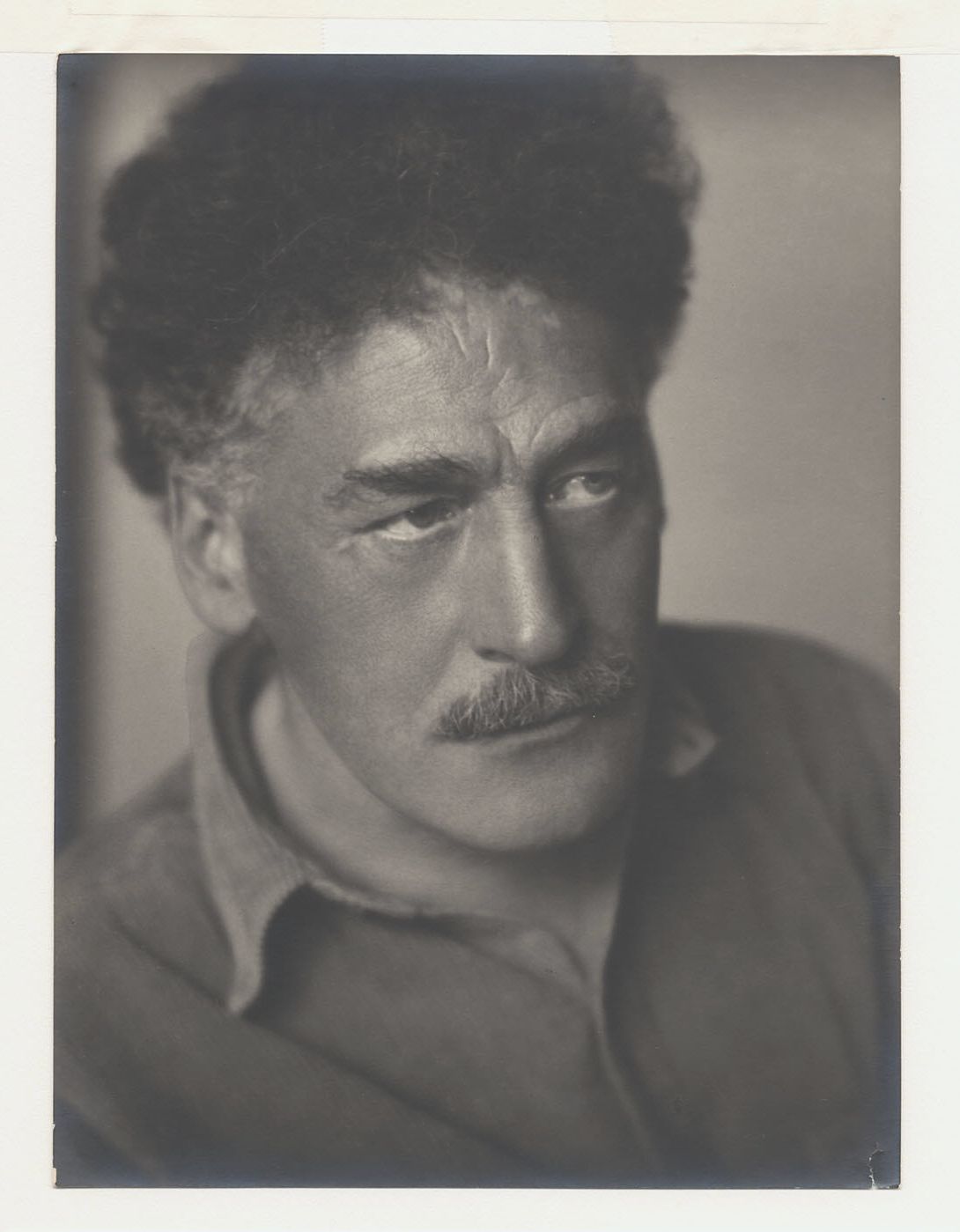
The name of the pianist and composer Richard Buhlig (1880-1952)  is now probably best known as having been a teacher of John Cage (and for having given Cage a strict lecture on the value of time.)  I had never before seen a picture of Buhlig, so was pleased to find an image from 1930, photographed by Johan Hagemeyer, courtesy of the Online Archive of California. (Another archive has a home movie with Arnold Schoenberg and Buhlig together, the latter in "pith helmut"; that I would like to see.)   American-born of German parents, Buhlig studied in Vienna with Teodor Leszetycki, concertized widely in Europe and the US with a repertoire balanced between classical and modern works (among them, Buhlig gave the US premiere of Schoenberg's Opus 11, and Busoni's Fantasia Contrappuntistica was dedicated to Buhlig), taught for a time at The Institute for Musical Art (now Juilliard), and eventually settled in Los Angeles, where he primarily taught.  His students, in addition to Cage, included Grete Sultan, Henry Cowell, Wesley Kuhnle, Leonard Stein and Peter Hewitt.  Buhlig apparently sponsored Sultan's immigration to the US.  As far as I can tell,  Buhlig and Kuhnle's performance of Buhlig's two piano transcription of The Art of the Fugue and a solo recording of the Chromatic Fantasy and Fugue are the only available recordings of his playing.  (Buhlig, Kuhnle, and Cowell gave a concert tour of the Soviet Union together in 1928.)  I have been unable to locate any examples of Buhlig's own compositions.  

Taking Time

This article, by Bunita Marcus, on Morton Feldman, notation, and rubato, is well worth a look. I've gone out on a speculative limb before in these pages in placing Feldman within the Skryabiniste* tradition with regard to rubato and to its equivalent in the pitch domain, and perhaps also to timbral issues — a certain delicacy of tone without any sacrifice of drive and the use of the pedal to create an ensemble blur or an indistinct, often edgeless, but internally lively tone.  (This is a perfect example of the utility of recordings: I highly recommend the recordings made of piano rolls punched to Skryabin's own performances.)  

Feldman did have a legitimate connection to Skryabin, through his piano teacher Madame Press, but I'm not sure exactly what of Skryabin's music Feldman knew; he certainly did not talk about Skryabin as a model as he did about Schubert or Debussy. To some degree this is unimportant as enough of Skryabin's style is certainly as well represented as a style of performance practice as it is by the compositions themselves.  Skryabinism did have a fairly wide reach, within Russia, in France through Lourie, Obouchov and Wyschnegradsky (and through the latter to Messiaen and Boulez) as well as in the US, with Dane Rudhyar and the great Nicholas Slonimsky (particularly in his Minitudes).  Much of this reach was more about mysticism than musical technique (though certainly not for either Boulez or Slonimsky), but shared influences on technique can clearly be decerned — a supple rhythm, fine-grained ensemble textures, and a harmonic language that tends more towards static samplings of collections of tones than to functional harmony. 

Let me briefly identify a few salient features in Skryabin's rhythmic practice. The first is a flexible subdivision of the beat, whether moving with a great sense of direction from two to three to four to five to six or more subdivisions (which connects Skryabin both back to Chopin and forward to the Henry Cowell of Fabric or the Quartets Euphometric and Romantic**), or in static ensemble textures of multiple divisions (ultimately an extension of Monteverdi's concitato style), with extended five-against-three passages, for example, as a favorite texture.  


This is the first phrase from the first of Skryabin's Seven Preludes, Op. 17. In three-quarters time, against the steady eighth notes in the right hand, the left hand moves from three quarters, to four quarters in the space of three, to five in the space of three, and then to the eighth notes (i.e. 6 in the space of three), coming back in sync with the right hand. Through this written-out accelerando in the left hand, there is an increase in rhythmic dissonance that resolves as the hands return to rhythmic synchronization as well as to the d minor tonic harmony.  

This accelerando is straightforward, in that the tuplets in the left hand should be played as subdivisions of the dotted half pulse uniting measure and harmonic rhythm.  But other examples are not so clear, suggesting that an acellerando should be phrased as a continuous movement over several measures, rather than precisely "chunked" into complete measure-length equal-division tuplets.

Another feature is that Skryabin is often breaking phrases over bars, and not always as a metric  anacrusis, leading into a phrase, but often as a sustained syncopation throughout whole phrases or sections.  This play with the rigidity of the barline is clearly continued  in Feldman's music, and not only at the level of the measure, but at larger scales, frequently coinciding with whole systems and pages (which Feldman usually barred prior to composition).  

_____

* I use the spelling "Skryabin" here (instead of the more common "Scriabin" or any of the alternatives) not out of any orthographic insight but exclusively out of personal aesthetics: I  happen to like the shape that particular combination and sequence of letters makes together on the page; perhaps appropriate for this blog item, inasmuch as it is about notation and performance.

** I assume that Cowell's rhythmic experiments began well prior to any familiarity with Skryabin.  Fabric is dated to 1920 and, although he may have become familiar via Slonimsky or Rudhyar with Skryabin in the 1920s, there is probably no certainty here until the time of Cowell's concert tour of Russia, co-billed with Richard Buhlig (later, a teacher of John Cage) and Buhlig's partner Wesley Kuhnle (who would become well known on the West Coast as a pioneering harpsichordist and authority on historical tunings and temperaments).     

Saturday, October 16, 2010

What Samuel Says

Composer and poet Samuel Vriezen  writes about the struggle of art and its relationship to the public space.  (Scroll down for the English version.) The immediate cause is the new Dutch minority government's plans to radically cut cultural spending,  but the principles are universal and timely, indeed urgent.  

I've long insisted here that the function of [culture, art, music] is to comfort the disturbed and to disturb the comfortable, and that insuring quality, diversity, and liveliness in our lives — our musical lives in particular — is a serious business demanding that we call out any petty abuses of musical-partisan micro-politics as a distraction from our common cause.   In any case, Samuel puts it far better than I can. 

Turning Thumbscrews

It's always useful for a composer to try to work through her or his dislikes. John Cage disliked the vibraphone, recordings, and improvisation, yet managed to come to some productive terms, late in life, with the latter two.  (At least we have Morton Feldman's use of the vibraphone as some compensation.)

One of my greater dislikes is the music of Benjamin Britten.  Since High School, I seem to perpetually find myself in the company of people I treasure but who find themselves massively disappointed in this particular dislike of mine. These advocates have constantly pushed scores, recordings and concert tickets in my direction.  Way back when, I dutifully studied much of the music closely, was a rehearsal pianist for some works for a high school choir and even once played the recorder solo in Noye's Fludde.  But my opinion hasn't much budged. There are aspects I do admire — the conductorless, often only loosely coordinated ensemble music in the Church parables, for example, but the vocal music is really the center of Britten's work and I can't get around my dislike for the edgeless envelope that seems to be the official, Peter-Pearsish production style, just puffs and swells of air with minimal intervention by the consonants which ought be in-between.  

I recently saw The Turn of the Screw, which from its constructive aspects — its formal architecture and tonal discipline — ought to be my favorite of the Britten operas, which it is, but also because of the musical dramaturgy which gradually — even gently — tells its deeply disturbing story, almost without ever making matters explicit or having anything actually eventful happen, a style deeply faithful to the source text. But the work is flawed, to my ears, by three things which could have easily been fixed, (1)  by eliminating the prologue — narration works only in operas for puppets (Lou Harrison made the same mistake in trying to turn Young Ceasar into an opera for real boys*), and anything in the text of the prologue which was necessary to the opera should have been saved for dialogue in the first scene, thus very usefully reserving the only adult male voice for a strategic later appearance —, (2) by cutting the scene with the ghosts — which unfortunately removes any ambiguity about the central question of their existence independent from the Governess's imagination —; and (3) finally by thinning out the scoring of the celesta and the tubular bells, which play continuously through one scene — some instruments just demand discretion, thinned out either in number of appearances or in dynamic level (providing another reminder that Morton Feldman really understood how to write for celesta and tubular bells).**

Okay, I haven't moved much in my opinion about Britten, but working with the material nevertheless can still provide some useful composition lessons.***  [Also this note to self: should I ever have to write a James opera, let it be William rather than Henry; The Varieties of Religious Experience or Essays in Radical Empiricism, perhaps?] 

_____

* Manuel de Falla's El retablo de maese Pedro smartly uses Master Pedro's narration and comments to mediate between levels in a puppet-play-within-a-puppet-opera structure.

** My daughter also pointed out that it was unfair that the male child, Miles, actually got to be sung by a boy, but the role of the sister, Flora, was — and is, conventionally — sung by an adult. We had a long discussion about such conventions, the abundance and prestige of boys' choirs compared to girls' and mixed childrens' choirs, and similar topics, concluding that it probably should be possible, nowadays, to cast the role with a girl of approximately the same age as the character. 

*** Much of the critical literature on The Turn of the Screw focuses on the 12-tonish aspects of the work and the question of their greater or lesser importance to the piece as well as the question of the composer's relationship to 12-tone and serial musics in general.  I think that the 12-tone "theme" usefully provides for both an immediate and a general circulation of tones and it sets up some useful reference pitches and intervals. As to a relationship to other musics, Britten's practice may make a nod to Berg, but it is really a species of the hybrid informal 12-tone-cum-tonal music that was more widespread in postwar music than any strictly classical 12-tone or serial practice.        

Friday, October 15, 2010

Drawing straight lines and following them

Today, one tube of the Gotthard Basis Tunnel broke through, making the longest tunnel on the planet, 57 kilometers long, cutting through two- and three-thousand foot mountains.  The whole purpose of the new railroad tunnel is to get as much of the North/South traffic that jams through Switzerland in and out of the country on rail and as fast and unobtrusively as possible and that seems laudable enough, particularly when the promised increases in rail speed will eliminate unnecessary car, truck and plane travel. But there are still several years left before the project is really finished and the moment now is one to spend in a little bit of awe at the tunnel as an engineering and, yes, aesthetic achievement, for long tunnels of this sort are indeed major earthworks, with the curves of their surfaces remarkably smooth, minimal art made on an unprecedented scale.  It's a healthy thing, Ithinks, to take some awe from time to time at a large scale human achievement other than war or pro sports or consumerism or mass entertainment. (David Foster Wallace's Great Ohio Desert (catch the acronym) in his novel The Broom of the System was designed and built precisely to provide some awe in a state which, by nature's gifts, was rather devoid of same.)   Ives's Fourth Symphony always leaves me in awe, Cage's Rozart Mix certainly did it,  and there are moments in Mozart, Berlioz, even Beethoven's Seventh in the Kleiber recording that do it for me.  Alvin Lucier's I am sitting in a room and La Monte Young's Chronos Kristalla are reliable sources of awe.  Hearing the late great Carnatik musician K.V. Narayanaswamy sing and playing the great Javanese Gendhing Bonang Tukung and Gadhung Mlathi were experiences which still summon awe.  Often it's not the composition per se, but a performance that transcends the limits of the composition.  Last night, I heard an Olympia in The Tales of Hoffmann sung by Brenda Rae — music that usually leaves me cold — that was both so precise and gracefully musical that there it was again.  What a piece of work and all that. But now, this is a moment of awe at a very long hole dug right straight through a good part of the Alps, before we take another breath and remember that the Alps themselves are pretty awesome in their own right, with or without the tunnel.         

Performance Practice

A student and I recently worked on a realization of a portion of Stockhausen's Studie II (1954), as a way of getting into the piece in a more concrete way.  Like many pioneering pieces of electronic music, it is best known in its original realization, with the then-state of the art resources of the WDR Studio for Electronic Music in Cologne.  Although I have heard that Stockhausen preferred his realization to other, later versions made by others — a thought I will come back to —, the limits of the equipment available are obvious and, if we are to take the score of the work (Universal Edition 1956) at its word that "it provides the technician with all of the information necessary for the realization of the work", then questions about the faithfulness of that first realization to the requirements of both the score and the composer's stated conceptions of the work provide some incentive for trying, with contemporary resources, to hear what, precisely, a more faithful realization might sound like.

For example, by using multi-layered recording of individual sine waves, Stockhausen was unable to synthesize his tone complexes in a way that fused as one supposes he had intended and the pitch accuracy of his plan was seriously compromised first by rounding off to the next Hertz in the score and then accepting whatever amount of resolution error the oscillators then had. Today, neither fusing of composite wave forms nor the accuracy of pitch resolution are significant issues; the score can readily be realized on a home computer, whether in recorded form, via something like CSound, or as live synthesis.  (We happened to be trying the latter, using PD, a program authored by Miller Puckette, who has admirably used PD in his teaching to re-create a number of works of "classical" electronic music.)    Despite these improvements, in trying to realize the score, issues of authenticity in performance practice were persistent.  

For example, the tuning:  without having an equipment limitation of a one Hertz resolution, should the realization use the notated frequencies, or should they be a better approximation of Stockhausen's intended 25th-root-of-five tuning scheme?  If we chose a one Hertz resolution, with digital accuracy to several decimal places, strictly speaking the piece will then be realized in a kind of expanded just intonation (without getting into an argument about the definition of just intonation, which is something for another time...) and, aside from the interval 5:1, that is not what the composer was after.  Should we realize the score with a more accurate representation of the 25th-root-of-five tuning?  It's certainly worth trying out both options.  

Or this: Stockhausen combined his sine waves by overdubbing and then played back and re-recorded the composite tones in a reverberant room to get a better fused and what might be described as a warmer tone. We can now begin with a better fused composite tone and add reverb electronically or acoustically.   (For that matter, we can realize the score directly with the specified sines and eliminate the middle step of creating a library of composites.) 

Or, how about dynamics: Stockhausen's score differentiates dynamics over a 31-step scale, in which each step represents a difference of one decibel.  Should we instead take a bit of psychoacoustics in consideration and adjust this scale to compensate for the Fletcher-Munson curve?   I suspect that such a consideration would be taken into account in the equalization of a playback of the recording, but it's nice to have the option to build this into the realization itself.  The original attack envelopes were made by hand, by raising a pot, but we can now do this with precision.  On what basis do we decide how to shape and time these envelopes?

Finally, Studie II is a monophonic piece and, arguably, all of the tones and composites in the work belong, conceptually, to a single scale/spectrum.  Is our realization limited to a single channel of sound, or might it be useful and musicial to project the sound onto multiple channels; if we do use additional channels, on what intutional or analytic basis would such a project be made? 

Stockhausen's preference for the first realization deserves some thought.  While a purely mechanical reading of the score could have been made,  I suspect that the series of musicianly interventions made necessary by the equipment produced a result which while necessarily introducing inaccuracies, ultimately created a more approachable, even endearing sound. Likewise, in the 13th hour of his final compositional project Klang, Cosmic Pulses, a work with 24 layers of looped melodies with tones connected by portamenti, the actual speed of the portamenti was done by hand, perhaps a similar expression of preference for a human intervention in the surface of an otherwise through-calculated process. 

Thursday, October 14, 2010

Follow the money, once more

Ron Silliman's blog — which has become my reliable one-stop shop for everything in new and experimental American poetics — is approaching three million visitors.  As is to be expected, his celebratory post gets to the point, the state of the art:

Amazon’s offer to pay authors 70% of e-book royalties is, we should note, a deeply defensive gesture. What they are trying to prevent is watching the authors collect 100%.


Tuesday, October 12, 2010

Follow the money

This thread at The Rambler is well worth reading and ought to be fuel for some long-overdue discussion.*

_____

 * The degree to which "commercial recordings" of new music are actually commercially viable has, for the most part, always been small.  The exceptions are all exceptional — Harry Partch did earn some money from his own Gate Five label (taking advantage of having no middle man and minimal overhead), I assume that Phillip Glass's recordings have generally been income generating, and sometimes there's actually the odd hit that makes a speculative investment in musical obscura pay off: the Nonesuch Subotnick recordings, that Gorecki Symphony or such. 

Even in the days in which only a handful of labels existed with any interest in the vanguard, unless the label had deep enough pockets and an inventory-friendly tax code to risk a long amortization periods it was a common expectation that a composer would front the costs of the recording, either out of his/her own pocket or with grant money or the largess of the few patrons we've had.  There was really no great problem with this — indeed it put music out there in the world in a useful form that the market participants were not otherwise rushing to produce — so long as the simple existence of a recording was not viewed as anything more that it was, for example as C.V. filler for academic hiring and tenure decisions or for the awarding of grants and prizes and residencies. In the big world of commercial music making, the medium may be the message, but in our little niche, any question of substance has got to turn on the music itself, not on the arbitrary fact of whether it got captured as a vinyl, plastic or downloadable commodity.   

Nowadays, actually getting a high quality recording made and pressed, burned or uploaded is cheaper and easier than ever. (A good comparison is to my high school years, in the late '70s, when vinyl was produced by a small cartel of factories owned by multinational firms and in increasingly bad quality, often little more than cardboard sandwiches prone to falling apart.)  It has become clear that a prime function of cd recordings now is that of calling cards for composers and performers, as advertisement for the real action: getting gigs. (AFAIC, not an entirely bad state of affairs.)  (A friend recently told me that it has become a custom in circles of the well-recorded to inspect the shelves of those who have received their calling cards — to see if the plastic wrap has actually been removed from the jewel cases! No, in the privacy of their own living room, even your best friend may not be your most loyal listener...)  Yes, there will always be a small number of "serious" composers for whom a purchasing audience for their recordings exist, sometimes even approaching the conditions of a market, but let's try to be up-front about this, so we fall neither into the trap of over-estimating the prestige value of a recording nor into viewing every recording firm as a vanity press. 


Saturday, October 09, 2010

The advantages of making music under the radar

The current dramatic cuts in cultural funding — whether due to market or political forces, and whether done in slow steps (as in Germany, where the rapidly rising costs of the rights for soccer broadcasts, for example, are gradually eating up state broadcasting budgets whose fee-supported funding would otherwise be stable or growing) or in sudden cuts (as in the Netherlands, where a nationalist/populist political coalition has found common cause in attacking "elitist" arts organizations, even when some of these organizations are best evidence of what that nation can be) — have been well-described and commented upon elsewhere.  All I can usefully add is a firm expression of solidarity with the protests, as these reductions are being made to institutions which are a essential part of lives led together, if those lives together are to be lived with any purpose more than simple survival, entertainment-fed passivity, and assent to a status quo.

My realistic assessment of times to come, however, is that we will probably have to get used to the largest cultural institutions, if they are able to survive the current rounds, functioning only with dramatically reduced resources and forced to cut back their activities to minima.  That usually means very little for the most adventurous programming, even when such programming ought to be seen and heard, at the very least, as an investment in the future vitality of the institutions. It's a vicious downward spiral, but I take some heart in the fact that no institution can or should be viewed as immortal, and this mortality is actually a good thing in the long term. So long as resources and interest remain or are found for the invention and support of new institutions, there is potential for the creative renewal and reinvigoration of institutional art making.

In the meanwhile, it is useful and heartening  to recognize that most of the work done in experimental and innovative forms and idioms takes place well outside of large institutions. Most new and experimental music does not require the resources of orchestras, state radio stations or opera houses, but is made for soloists (often composer-performers), small ensembles (often composed of collaborating composers-performers sharing resources) and can now include a technical sophistication that is no less that formerly monopolized by the large institutions.  Every composer can now carry the equivalent of a Kontakte-era WDR Studio, RCA Synthesizer and the complete apparatus of Repons in their own laptop.  Most new and experimental music can be performed and heard away from the formality and expensive of large concert halls, can be recorded on equipment and media that one owns at home, and no longer requires a licensed radio station for its broadcasting, nor is that broadcasting limited to the reach of a single broadcast antenna. (It can, however, be limited by the censorship of the PRC or North Korea, or perhaps by an end to net neutrality in the US.)

Perhaps more importantly, in these times, the fact that new and experimental music is essentially invisible/inaudible to the state and corporate apparatus can be very useful.  (James C. Scott's Seeing Like a State is a superb introduction to the limits of the legibility of real, existing traditional structures to the modern state and the disasters that the best of wills have led to because of that inflexibility.)  States and corporations alike prefer and tend to respond only to structures which follow radically reduced schemes and orders.  States and corporations draw straight lines and grids and group things according to least common denominators, losing detail, texture, tone, the nature of which is often more essential than crude, uniform measures. Recognition of this may not make states and corporations pay for our rent or lunch (that's what day jobs are for, buckaroos), but it does suggest a considerable artistic advantage of going under the radar.  

In recent protests against funding cuts in the Netherlands, the police were apparently able to control crowds of protesters because the protesters moved together, with a recognizable front line, and the police are said to have used the protester's own concerted music-making as a cue for their own actions.  How much more effective it would have been had the protesters moved, not as a coordinated mass, but as individuals roughly flocking in a general, but not manageable motion?  And however could the police have taken a cue from the music had it been, instead, sung quietly but independently by hundreds of individuals moving at the own time and trajectories through public spaces?  There's an interesting invitation to compose!  


Thursday, October 07, 2010

Getting Started

How to get started is a very nice project, extending a late work of John Cage, a lecture/performance which, among other things, is an example of Cage's attempt to work through a productive relationship between composition and improvisation. (The audio excerpt online includes mention of Walter Zimmermann's beautiful piano piece Abgeschiedenheit, the title of which roughly, very roughly, translates as "seclusion".)

*****

Is it necessary to try to explain, once again, how important Cage was?  The continuing controversies and misunderstandings about his work suggest that it is still necessary. I often have the impression that his reputation as a composer suffers because of a focus on his reputation for almost any other one of his activities — writing, collecting mushrooms, studying zen, Buckminister Fuller, etc. et al — rather than on the actual music that he made. Well, kids, it's the music that's important.  Not all of it (he was as uneven as the best of them and much of it was written for rather specific use, with questions of lasting importance rather beside the point), but there's plenty to pay attention to, and so much above and beyond the oxygen-stealing 4'33": the best of the percussion and prepared piano music, the Concerto for  Prepared Piano and Chamber Orchestra, The Seasons, Sixteen Dances, all of the string quartet music, the music for magnetic tape (Williams Mix, Rozart Mix, Message to Erik Satie and Roaratorio, in particular), Winter Music, Cheap Imitation, Etcetera, Lecture on the Weather, Inlets, the virtuosic sets of Etudes for piano and violin, The Wonderful Widow of Eighteen Springs and much of the Song Books, some configurations of Music for ___, a very large number of the "number pieces", and the five Europeras. (There is also a small group of pieces — Music of Changes, the various pieces for Carillon, Atlas Eclipticalis, the orchestral version of Cheap Imitation among them— for which I reserve opinion, simply because I haven't yet heard an honest live performance.)

(Not a bad track record for an experimentalist, steadily courting failure.)

***** 

There has always been a great deal of dancing about the question of Cage's influence, with some preferring to talk instead about Cage providing an example through his work that became a form of "permission" to do one's own work.  I don't dance well enough, and I've never liked the idea of having to get permission, even if done — as Cage did — from example rather than from a position of music-political power; instead, I admit readily to being under the influence.  

Cage taught me how to organize my desk as a composer: into materials, methods, structure and form. He asked: "Composing's one thing, performing's another, listening is a third. What can they have to do with one another." which I have taken as a productive rather than rhetorical question.  And more than for his use of any particular materials (percussion, the prepared piano, gamuts, tape splicing...) or methods (chance, indeterminacy, contingency, cheap imitations, erasures...), it is in the area of structure, the musical use of time in a work's division of the whole into parts, that Cage seems to me to be most inventive, radical, and — for us — most potentially influential.  

Indeed, Cage's development as a composer is best traced through his treatment of musical time, from the early works — in which a time structure is used instead of a tonal structure, with pieces carrying their proportions as a form of temporality equivalent to the key signature a work of tonal music carried — to the late works in which metre and measure are replaced by space on a page, clock time and/or time brackets with individual notes freed of their proportional and/or durational values.  If some music can be identified with an "atonality", then this is a species of "ametricality" or even "atemporality." That said, as rich a model for structuring time as Cage's is, it is also an example which opens up productive doubts.  For one, just as atonal music made it possible to hear tonal music in a fundamentally different way, the experience of music without fixed measure practically forces one to appreciate and reconsider the particular qualities of measured musical time, which include — paradoxically, perhaps — the possibility of its own deformations and abnegation in the forms of syncopation, cross-rhythms, rubato and dynamic changes of tempo, none of which are possible in a music without a pulse or metre for reference. (There is also a question to be asked about whether the use of clock time was self-defeating, in that it didn't actually erase a pulse or metre — with their fluid, flexible relationships to "real", mundane, clocktime —  but simply substituted the inflexible units of the second and minute and hour.) Here, the utility of Cage's example is found as much in continuing the particular path he chose as in exploring the apparent cul de sacs he left alone.

*****

And this, too:

I miss Cage's voice,

the fundamental of which

— as he grew older —

would waver in and out of audibility

and often just disappear.


Wednesday, October 06, 2010

That sweet space


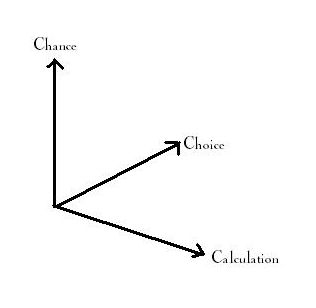
...composing is all about finding a particular location in the space of all possibilities, that sweet place where all the forces — those you plan, those that you have chosen to leave beyond your control, and those that come to you like a lightning strike from your own habits, taste, and imagination — are in balance: calculation, chance, choice. It's exactly like poker, that near-perfect game, in which the rules are set, the probabilities are clear, the cards are dealt at random, you know what's in your own hand and the other players are real people, with all the experience, hopes, habits, bluffs and tells that real people unavoidably bring to the table. With as cool a calculation as possible, you consider, weigh, balance all these elements and then let your intuition (itself a mysterious mix of experience, calculation, and raw instinct) lead to that particular place of action, to see, raise, or fold...  

Saturday, October 02, 2010

Composerly Bloggery

"Some people do things before they are fashionable. Ned Rorem blogged before it was electronic." - David Feldman
Given the fact that we're supposed to be witty, wise, and creative people, it's striking how prosaic writing by composers -- and blogging composers in particular -- usually is. The weblog format is a young medium, but it seems to have already settled comfortably into some fairly rigid formal and stylistic boundaries. Too comfortably, methinks.* If I ran the circus, the model would definitely be Cage's Diary: How to improve the world (you'll only make matters worse) rather than The Paris/New York/Later/Final (...) Diaries of Ned Rorem, and invest both content and form with a little more composerly invention and a lot less confession and self-promotion.**

I've tried some modest experiments with form here, and a few readers have even caught on to the fun and games (picnic, lightning), but words have a way of failing me, and my items are a pale fire when you begin to imagine the potential bonfire of words music might ought inspire.

At the moment, perhaps the best we can expect from blogs, is precisely the same we expect from critics: a well-worded and unexpected observation, a provocation from a set of ears and eyes independent from your own. How about this one, from Virgil Thomson who, describing a production of the Ring said: "And there stood Valhalla, looking all the world like the Cornell Medical Center."

A gift certificate for a 5 lb. canned ham will be awarded to the first reader to reconstruct the algorithm and data base from which this item was composed.
______
*Remember: the function of music is to comfort the disturbed and to disturb the comfortable.

**There is a notion that the orginal, poetic, form of language descended into prose when it became necessary to communicate more concretely in order to survive. If that's true, then it speaks to a sorry state of affairs for new music. However, all the evidence is to the contrary: new music is not only surviving, but being made in a quantity and diversity previously unknown. Sure, there are naysayers still fighting sorry little turfwars (see this interview for an example from someone directly threatened by that quantity and diversity), and sure, it's often tough going, but when has it ever been any better?

(An encore posting from July 2, 2007)

Tuesday, September 28, 2010

Orellana

I have been seriously remiss in not including a link to the very nice website dedicated to the work of the remarkable Guatemalan composer Joaquin Orellana.  This is it, and it's well worth a long visit.   While studying in Buenos Aires in the late 1960s, Orellana became familiar with a state-of-the-art electronic music studio, but on his return to Guatemala City, the then-conventional resources available to him for making electronic music were seriously limited, so Orellana devised acoustical instruments — utiles sonoros (sound utensils) — fashioned out of available local materials, including bamboo, hardwoods, and scrap metal, which he used in place of the banks of oscillators and filters and other modules that were then featured, elsewhere, in analog synthesis studios, as sound sources.  These utensils proved to be much more than simple tools for subsequent tape manipulation, and would frequently be featured as accompaniment instruments to increasingly lyrical melodic material.   

Friday, September 24, 2010

About those landmarks

To date, over the past almost-six years, I've written about 46 personal musical "landmarks" on this blog.  These are not exactly items in the usual "best of" list, but pieces that stand out, for one reason or another, as landmarks in a musical autobiography.  Most of the pieces I've lived with for a longer time, but some — the most recent of which is an orchestral work by Richard Ayres — are new discoveries, Eurekas! from first hearing.  With one exception (the Buckinx 1001 Sonates, of which I've only heard a fraction, as the whole lasts about 24 hours!), I've heard all the concert works live. Some I've performed myself, in most cases I've spent time with the scores, and with the electronic pieces, I've spent hours with the recordings.  Charles Shere recently reminded us on his blog of the traditional sense of the term "Discrimination has to do with specific choices, not categorical ones." And discriminatory the list is, indeed, made of specific choices, allowing complete works only in the case of Machaut and sets of works in the case of the Purcell viol music.   The only meaningful categories under which these landmarks fall is my own biography and taste, so it is a bit of an indulgence, but it seems the process of list-making has a life of its own and inevitably starts to assert its own set of rules.  One of the rules has been that I have avoiding, to date, naming a single composer twice.  This has been very hard in some cases (among them Monteverdi, Debussy, Ives, Cage, Lucier, and Young) and in one case, Berlioz, indecision over which piece, exactly, to include, has long kept me from adding a work even though it is insanely obvious that a half-dozen pieces by Berlioz ought to be long overdue for inclusion.  In a couple of cases, the personality of the composer gets in the way of a piece I treasure — is Ruggles's racism a roadblock for Sun Treader or Angels, for example? (I did put Hyperprism on the list, knowing about the anti-semitic streak in some of Varese's letters, so I'm not altogether consistent on this score.)  Finally, for all of the diversity on this list, it's definitely a western-classical-tradition-based assemblage and there certainly aren't enough women.  I can only defend myself here in that in the cases of non-western repertoire that I value highly, even with years of exposure, I don't believe that I am always able to really discriminate wisely among the repertoire. Etenraku is a gorgeous piece, one that I've known since High School, but it's the one piece people know of Gagaku when they know only one piece of Gagaku and including it would be more a marker of my ignorance of a repertoire I don't know well enough.  In the case of Javanese music, which I know much better, the more I know about fantastic pieces like Gadhung Mlathi or Gendhing Bonang Tukung, the more obvious it is how little I really know.  And then, in many other cases, for example South Indian classical music or Diné (Navajo) ceremonial music, using a term like "composition" or "work" or "piece" seems so clumsily inaccurate.   Finally, the list is getting close to the number 50; while it would be easy to name 100 or many 100s of landmark pieces, I think that an honest number — of pieces that I know well enough to stand behind them as a musician — has got to stop around 50 or 60, otherwise it's the equivalent of teenage boys bragging about the size of their record collections.  Anything more than that would be presumptuous.  Or maybe, once I reach 50 or so, the better idea would be to keep that total as a limit and then, if I decide to add anything, I have to strike something else off the list to make room...  

Why is climbing a flight of stairs like listening to Bruckner?

In the study, published Friday in Science, they showed how they measured the effect on a scale of about one foot (33 centimeters) to demonstrate how people age faster when standing a couple of steps higher on the staircase. (Hat tip: here.)

Wednesday, September 22, 2010

Too much, too little

For many composers, for centuries apparently, part of the primal ritual of establishing a composerly identity has been an obligatory period of conflict with one's teacher(s).  I was lucky in that I was spared that period of conflict.  I got along with my teachers and they (mostly) got along with me and we even continue to get along pretty well.  Now, some of my teachers — Lucier and Young, in particular — came out of their own obligatory periods of conflict with composerly identities employing an absolute minimum of means to achieve a particular maximum of musical quality.  For their perspective, it is probably the case that my music tends to do too much or have too much, but thankfully they have been consistently gracious about it.  

On the other hand, there are certainly a large number of musicians for whom my music appears pretty minimal.  I just emailed a copy of a wind quintet to a friend in the Netherlands who got rather cross with me because the score, with plenty of notes, has no dynamics. There happens to be a reason for the absence — the piece is about something other than dynamics, so as long as the loudness or softness of the players doesn't get in the way of all the things that the piece actually is about, or better yet, brings out some of those things, it's really all the same to me — but for my friend, I was was being irresponsibly minimal.  No matter that I had explained that I had really worked on the issue of the dynamics, that not including them was a serious, not a casual, decision, and that while I could have come up with some system or just written in some dynamics extemporaneously, that would have been, to my ear and mind and taste and temperament, essentially an arbitrary act.  Never mind,  I had violated his notions about the minimum contents of a respectable score.  

People really get angry about these issues and while never quite getting angry, I have worried about them as well.  (See this post about fat crayons and musical pidgins  from 2005.)  I suspect not a few experimentalists and complexists have had some envy for the ability of mainstream composers to sort of skip the issue entirely, riding along on the autopilot of conventional practice.  If I have acquired any wisdom on the topic it's this: The problem is never too many or too few notes, it's having the right ones. My own druthers are for a lower limit, but the choice of a minimum of ways or means requires a certain amount of confidence in your choices.  On the other hand, being more inclusive, more expansive, and/or more complicated can be a good way of covering up a lack of confidence, with a surfeit of apparent labor providing a tempting measure of cover for that lack.  Neither approach is automatically going to be more likely to produce the right notes, so if someone starts to knock you for having too many or too few notes, just knock 'em right back with notice that quantity alone is an inadequate substitute for actually having some criteria. 


Tuesday, September 21, 2010

Landmarks (46)

Karel Goeyvaerts: Nummer 1 (1950) (Sonata for two pianos).

The name of the Belgian composer Karel Goeyvaerts is probably encountered most in discussions over who did or didn't compose the earliest completely serialized work (a pissing contest that won't be entered here.) The handful of serial pieces Goeyvaerts composed in between 1950 and 1957, for instruments or magnetic tape, are each remarkable, on their own immediate musical terms, above and beyond their technical features. Nummer 2, for thirteen instruments, for example, is a work that finds company well next to pieces like Babbitt's Composition for Twelve Instruments or Wolff's Nine, which are a pair of pieces you wouldn't ordinarily expect to encounter in the same neighborhood.  

Nummer 1, originally given the title Sonata for two pianos and also known as Opus 1, is something of a strict process piece, and to some extent, this process-character makes the piece more like some experimental repertoire than other "classic" serial pieces.*  It is frequently mentioned for a controversial public reading, by the composer and Karlheinz Stockhausen, at Darmstadt, a performance that definitely troubled some critical listeners (Adorno among them) for the piece's stubborn refusal to appeal to traditional musical rhetoric.  Goeyvaerts's ideal was not a music in which tonal relationships unfolded in and articulated time dynamically but rather tonal events were placed in time as elements of a larger, static tone structure.  There is a closeness here, both to Cage's filling-in of a predetermined time structure from charts of possible materials and the static harmony of the radical music with reduced means that would later emerge on the west coast of the US with La Monte Young and his cohort. At the time of composition, Goeyvaerts's closest professional friend was Stockhausen, and it is impossible not to recognize shared elements of both technique and aesthetic in the subsequent work of the two composers (Kreuzspiel, for starters), but one is equally aware of the substantial aesthetic difference between the two, and that, I think, can be located in Goeyvaerts's dark, gentle, and slightly grotesque choice of tones, which would later allow the composer to fashion a more-generalized notion of a static harmony underlying materials more conventionally tonal in character (indeed, sometimes close to later minimal musics) as well.   

At the time of their most active exchanges, both Goeyvaerts and Stockhausen were reading Sein und Zeit and Doktor Faustus and Das Glasperlenspiel, continental philosophical and literary sources with a mixture of ratio and mysticism which were perhaps even more urgent influences than in the music of Messiaen, Schoenberg, or Webern.  The handful of works Goeyvaerts made under this influence, however, hovered around a existential minimum that Stockhausen did not seriously approach in any completed work, and this was perhaps the immediate cause of a halt in compositional output for several years until his re-emergence as a para-minimalist in the late 1960s.    

*A technical footnote, for those inclined: Let me describe some of the procedures in the second (of four) movements, whose retrograde makes up the third movement.  It involves the simultaneous rotation of two ordered seven-tone sets, each sharing two common pitches which are fixed in register, the eb below middle c and the second a above middle c.  The remaining pitches contract in register through the movement, a process that is perfectly audible, especially when you have the two fixed-register pitches in the back of your ears.  Goeyvaerts serializes additional parameters in a way that ingeniously associates pitches with durations, dynamics, and types of articulation through assigning numerical values to a pitch's intervallic distance from the two fixed pitches; a value to each available duration based on distance above or below a median durational value; a value to each of four dynamic levels; and a value to each of two forms of articulation.  Each individual tone then, through the combination of interval, duration, dynamic, and articulation, has a sum numerical value that Goeyvaerts does not allow to exceed seven. The effect is a net, if subtle, reinforcement of the attraction of the two tonal poles of attraction.  The ways in which the two sets are distributed between the pianos and then between each pianist's hands are fascinating as well, partitioning organized as broad gestures in pitch space, yet not parse-able as thematic material.  


Saturday, September 18, 2010

Pareidolia

I was out about town today doing some field recordings.  I was focusing on public transportation, conversing passers-by, skateboarding, and water, especially public fountains.  (There are vague plans to make a piece incorporating such bits of acoustical realia.)  One of the most fascinating things about many continuous or repetitious sounds is that when listening, even idly, we all start grouping events into rhythmic, indeed metric, patterns, finding stress accents in stimulus that is essentially undifferentiated, vague, or random.  This phenomenon, usefully, has a name, pareidolia, and is familiar with visual as with auditory sensations, whether finding poodles in cloud formations or rhythmic grooves in streetcar clatter.  Pareidolia definitely has a downside, in that it can provide the stuff to feed some serious misapprehensions about the world (it may well be the root of half the conspiracy theories floating around), but the upside, as a composer, is obvious, as we're actually in the business of turning misapprehensions about the sounding world into musical surprises.

Monday, September 13, 2010

Deep Style

The opera season here in Frankfurt has begun again, and I find myself once again chaperoning an eight-year-old supernumerary to rehearsals and performances of Don Carlo.  While waiting around, I've heard a lot of Don Carlo, and heard it now with several changes of cast.  Verdi is not the turf that experimental composers usually tread, but I've been honestly impressed, and especially by those elements of the music which are simply not to be found in the score.  These, mostly of micro-timing, of tempo, rhythm, and rubato, are constantly in flux at the smallest level, and the practice here is one that comes honestly out of a real aural tradition. It helps, here in Frankfurt, that the orchestra and the conductor have a long relationship of playing Verdi together — more than thirty years — but the key here, I think, is the conductor, Carlo Franci (83 years old, if Wikipedia has it right), who has every note of the score in solid memory and it seems that every nuance of timing and pitch between those notes, each nudge of rubato, or grace of portamento, comes from a strange and wonderful place poised between an absolute identification with the performance tradition and an ability to spring at the possibilities of the moment.  To work with such confidence and security as well as continued discovery is a sign of a performing tradition at its best, style that is anything but surface, anything but facile.

Saturday, September 11, 2010

Pak Cokro


A video portrait on the occasion of Pak Cokro's 100th birthday. Pak Cokro (also known as KPH Notoprojo, KRT Wasitodiningrat, KRT Wasitodipuro), was one of the most important musicians of the 20th century, born into the royal house of Pakualaman, the minor court in Yogyakarta, Java, Pak Cokro eventually became music director of the Pakualaman and of the Yogyanese radio station. He was central to a movement to combine the classical gamelan styles of the two Central Javanese kingdoms, Surakarta and Yogyakarta, and became known in the west first through the Nonesuch recording produced by Robert E. Brown, and then directly, through many years of teaching in California. In California, his many students included the composer Lou Harrison. A performance of the Pakualaman's traditional royal entry piece, Puspawarna, under Pak Cokro's leadership was included in the recording which accompanied the Voyager spacecraft, a perfect example of human music-making at its very best.  This informal documentary is a valuable record of one of the last musicians to have worked as a functionary in the semi-autonumous court environment in the colonial era under the Dutch and then during the Japanese occupation of Indonesia and finally functioning as a state composer in the independent Republic of Indonesia.  

Friday, September 10, 2010

An American is a complex of occasions...


Charles Olson reads 'Maximus to Gloucester, Letter 27 [withheld]' (Mar 1966)

(Hat tip: Silliman's Blog)

Wednesday, September 08, 2010

This is not a guillotine.

A list I subscribe to recently had a small item about Francis Poulenc's Dialogues of the Carmelites (1957), which is not exactly the kind of thing I write about here.  Dialogues may well be the most-performed opera of the second half of the 20th century.  It's a lush piece, requires limited stage resources, has forgiving vocal writing and is not overly long.  But it's not really a work which pushes any boundaries.  

But this item did mention an interesting feature in the work: two players from the percussion section are assigned the responsibility for the sound of the (off-stage) guillotine, "one producing a crescendo-glissando with a metal object on the edge of a tam-tam(laid flat in order to create a dry scraping sound) as a grace-note to a hammer-stroke on a large wooden box produced by the other player."

This happens to be a superb illustration of musical representation:  Poulenc, writing in 1957, could well have used a recording of real guillotine, or even positioned a real guillotine offstage and have it slice through something head-like (a ham, or perhaps a melon?) for each decapitation in the score, that is to say, treated it like a film or stage sound effect (in film, this would probably be assigned to a sound effects artist, possibly a foley artist, although, not being produced by visible hands or feet, it is not, technically, a foley effect).  But Poulenc decided to treat it as a musical representation, timed to the score, produced by percussionists in the pit, and with not only a technical description of the sound production but a precise musical description of the sounds required and their placement in musical time.  

This sound in Dialogues is thus something that the listener will immediate identify within the narrative as a guillotine, but it is also more than that as the noises are tightly integrated into a rhythmic and tonal context.  It is even possible to imagine the same striking sound occurring in different works of music, completely divorced from its representative function. This is, of course, typical of the history of the European orchestral franchise as, for example, horns and trumpets and trombones gradually became members of the ensemble, initially representing functional sounds, associated, respectively, with the hunt, battle, and the church tower, yet eventually becoming integrated into the ensemble for more strictly — and abstractly — musical functions.   Aside from occasional visits by instruments like the saxophone (an instrument carrying its own associations), the last two centuries in the history of orchestration have featured the gradual addition of percussion instruments, often introduced first in the opera, typically first through either such literal representations of diegetic sounds or the invocation of the exotic.      


Erring on the Side of the Angels

At the end of his recent blogged series, The Anosognosic’s Dilemma, Errol Morris quotes Noam Chomsky on the limits of human cognition: 

“We are after all biological organisms not angels . . . If humans are part of the natural world, not supernatural beings, then human intelligence has its scope and limits, determined by initial design. We can thus anticipate certain questions will not fall within [our] cognitive reach, just as rats are unable to run mazes with numerical properties, lacking the appropriate concepts. Such questions, we might call ‘mysteries-for-humans’ just as some questions pose ‘mysteries-for-rats.’ Among these mysteries may be questions we raise, and others we do not know how to formulate properly or at all.” 

It strikes me that musical experiment, the radical music, is always going to tease out such questions, such mysteries, sometimes with success but often courting failure (i.e. music which doesn't "work" or makes no "sense").  In doing so, particularly in accepting the possibility of failure, experimental music distinguishes itself from conventional music-making which more safely plans its effects and affects, using known materials and methods.  Yet, more than that, the radical music errs, when it errs, — and err it does — on the side of the optimistic assumption that the extents and limits of our human musical perception and cognition are just a little bit closer to those of the angels.   


Sunday, September 05, 2010

Well, that was short...

It took eight years to go from the Leif Inge's 9 Beet Stretch to the Justin Bieber stretch-out, and from there, I reckon that it's taken about two weeks to officially become a audio production cliché, which is probably a typical rate of idea consumption and exhaustion in the transition from art to commercial music. In the past week, I've received links to about a half-dozen new stretched pieces, all made, one assumes, in the wake of the Bieber.  Now, as an experimentalist, I have nothing against the use of clichés — there still being plenty (to paraphrase Schoenberg) of good music to be made from stretched out bubble gum — but the music can't stand alone on its slow motion.  Stretching is now just additional material, and a work of music using it will have to have other compelling qualities to sustain that material. 

Friday, September 03, 2010

Passacaglia from FIGURE & GROUND (1994-5)

[The]

There's a new website documenting the new music duo of Ed Harkins and Philip Larson, otherwise known as [The], here.  (Hat tip from the composer Steed Cowart.)  Based in the Music Department at UC San Diego since the early 1970s, Harkins (a virtuoso trumpeter and a specialist in complex rhythm) & Larson (a fine bass-baritone) are definitely not your typical academics, academic musicians, or just plain musicians (or are they dancers?)  [The] grew out of the now-legendary Extended Vocal Techniques Ensemble resident at UCSD from 1973 to 1983 and rapidly became a favorite on the new music circuit, with fans including John Cage and George Carlin.  New music is not necessarily a sombre affair.   (The video above is an excerpt from [The]'s signature piece, "for trumpet and dancer," a piece with perhaps the drollest page turn of all time.)

Thursday, September 02, 2010

Writing as if Composing

Run-on and runaway sentences; hanging sentence fragments; needling repetition; odd punctuation; obscurities and neologisms;  abrupt shifts of register, both up and down; anacoluthons; non-sequitors; too much stuffed away between ellipses, brackets, braces, or parentheses (when not hidden in footnotes below); seemingly arbitrary settings of text in italic or boldface character; metaphors mixed and mashed; knowingly faulty logic; opinions presented as facts; abused rhetoric (all 38 of Schopenhauer's Arts of Being Right on display and then-some)...  Guilty as charged!  All I can ask is that you, dear reader, bear with me even if these aspects of Renewable Music's house style book grate like so many fingernails on blackboards or even more ants in a bento box on a Saturday picnic turned to thunder, lightning, rain, gentle rain, then too much rain... The idea — and there really is one, here — is that the webblog is still a new medium, and one which has not yet found its extents and limits as a form of prose (or not-prose), and one which is not yet immune to the methods of an experimental composer, thus the breathless and short-of-breath and stuttered lines, the sudden interjections, jarring accents, and ragged articulations, and all those sounds, those troubled, troubling, consoling, caring, sweet, everyday, exotic, exhalted sounds...  What could be better than to aspire to a condition of music?  My fault, my failure then, may not be the experimenting but rather the stubborn fact of not having experimented enough. 

[Except, of course, for careless errors in spelling, grammar, or typos.  The fault, there, belongs to the damn computer.]

Sunday, August 29, 2010

From the Armed Man to Single Ladies

The Rambler, Tim Rutherford-Johnson, has investigated a recent Proms score by Mark-Anthony Turnage, discovering that it is, in part, an amped-up transcription of a recent pop hit  (here and, most astonishly, here).   Between this and the 800% slowed down Justin Bieber tune, noted on this page a few days ago, one starts to wonder if we are moving into a new era in which art music parodies of popular material become a central genre.  While I'm certain that there are some intellectual property thickets to cross through here, if this phenomenon establishes itself, it would seems to be placing the relationship between commercial and art music production back onto a more comfortable plain, and a plain long familiar to composers.  Just think of all those masses built around the Renaissance pop song L'Homme Armé, many of them stretching the melody or hiding it in a dense texture beyond immediate recognition, or the complexes of remembered tunes and landscape in Ives (and, to some extent, Mahler). I've long subscribed to the notion that composers compose out of their acoustical  environments, and such popular musical material is often — and unavoidably — as much a part of the environment as the bird songs, stormy weather, or traffic noises that can appear in musical works.  

Saturday, August 28, 2010

How Ideas Come, Get Spent, And Go (And Sometimes Come Back Again)

I really like this list of ten lost technologies.  How do good ideas get forgotten? Often because they have been kept secret (typical in family-run enterprises or with military technologies, in which secrecy has a commercial or strategic value.)  Sometimes, however, good ideas wear out their usefulness and get replaced by alternatives.  There has been a great exchange on this process in economic theory among some prominent social science bloggers (here is a good place to start).  Among music scholars, ethnomusicologists have long been occupied with the process of theoretical change and the so-called new musicologists took up this theme in the '80s (and now, having become institutionalized itself, the new musicology is increasingly confronted with an offense by a more traditional musicology).  Curiously, it is in music theory proper (and its speculative counterpart, composition) that discussion of the patterns of theoretical change seems to be handled at greatest distance.  I suspect that this is, at least in part, due to some deep uncertainty about music theory's status as a theory (e.g. a theory of what, precisely?) and not simply description of compositional practice that lies behind this reticence,  but I may well be very wrong about this. 

In music, generally, there has been an accretion of ideas and techniques over time, making ever-more resources available to a composer and generally increasing the complexity of music produced.  Instrument builders, like those in the Stradivarius workshop mentioned in the article cited above, may keep their trade secrets close, but music itself is essentially "open source", so that musical techniques can usually be decoded and reproduced.   This is not, however, universally the case.  Clarino trumpet playing, for example, largely disappeared after the mid-18th century, and the virtuoso cornett technique disappeared even earlier, with both techniques returning, conjecturally and with mixed effect, in the early music "revival" of the later 20th century.  The subtleties of musical change are best demonstrated in the history of musical style.  Sometimes, stylistic change goes in the direction of simplifying one or more dimensions of music. Thus, some late fourteenth century music is, in some major parameters, more complex than the music which succeeded it, and similar phenomena can be found at several other junctions in music history.  In general, stylistic change is a mixed bag: post-serial musics, for example, may often be computationally less sophisticated than classical serial works, but they can be much richer in historical references and contextual associations.

Stylistic change in music seems to me, however, to be most tightly bound to the life of the institutions which cultivate and present music.  The change from chapel and court patronage to that of American universities and Western European radio stations is significant, as is the change from the live public concert or private music-making to broadcasts and recorded media.  These changes have contributed mightily to the continued liveliness and variety of music itself (indeed, they made the notion of a renewable music possible.)   In this context, it's been somewhat distressing to read the controversy over music in an age of digital technology which has been going on in the recent issues of MusikTexte.  The most distressing item in the exchange is a new article "Against the Deinstitutionalization of Music" by C.-S. Mahnkopf, who appears determined to become the Joseph Ratzinger of of new music in his defense and plea for the extension of the present, state-organized and financed music-institutional landscape in Germany.  Mahnkopf's ex cathedra statements about new music have been part of the background noise in German new music for some time, but this time the noise level has moved beyond  irritation to outright disturbance with his failure to recognize that large institutions inevitably support an ever-smaller variety of music and necessarily put long-tenured bureaucrats into positions of authority over the determination of which music gets made, where and when.  The central mission of such institutions inevitably becomes that of sustaining their own lives and accumulating control over any available resources.  Equally problematic is Mahnkopf's failure to recognize the importance of private initiatives and alternative institutions to music's liveliness, in that each are willing to risk failure in going forward and — like Phoenixes emerging from their own ashes — are better able to respond to the forces of both success and failure, to regroup, and to reinvent or reform themselves around the particular challenges of new musical ideas.  (One readily imagines that Mahnkopf's goal is to set himself up as a central arbitrator of new musical life in Germany, akin to Boulez in France a generation ago, with his inability to recognize that the strength in German post-war new music has largely been its decentralization, which contrasts positively with France's ultra-montane Boulez-led centrism, a definite signal of his intentions.) 

Mahnkopf complains that the discussion in on economic and not purely cultural terms, but we are, inescapably, going to have to talk about economics — at the very least in terms of revenue sources and the allocation of resources;  the notion that culture can exist in an economics-free vacuum, I will simply leave alone.  Mahnkopf further mistakenly confuses the path of deinstitutionalization with economic neo-liberalization, when what is in question is not a strict privatization of the arts, but rather a diversification of the portfolio in investments in the arts in an attempt to optimize the relationship of the arts to contemporary technologies, resources, and opportunities. 

While I would certainly like to see music, and new music in particular, the beneficiary of ever-greater state (and corporate and private) largesse,  that largesse should be spread as widely as possible.  I don't want it to come with any greater degree of state control and I don't believe that simply perpetuating the existing structures of commissioning, presenting and distributing new music in Germany or extending those structures to the rest of Europe, or indeed the entire planet, as Mahnkopf proposes, is a useful idea.  Large institutions can be extremely useful, even essential for making some works possible, and they should have a role in any future mixed economy of musical presentation, but they can also become less useful or even destructive and we shouldn't automatically assume that the end of any given institution, however large or venerable, is necessarily a bad thing. Moreover, no institution should be viewed as an all-purpose,  cookie cutter-model to be arbitrarily reproduced in each and every possible location. It's not hard to recognize that a great deal of the individual character of each institution and the liveliness of the work produced is due in large part to their particular location in geography as well as time.  (Case in point: the acoustics of the Bayreuth Festspielhaus pit are wonderful — if entirely an accident, due to Wagner's desire to make the hall absolutely dark — and it is absolutely possible to reproduce those acoustics in a new hall anywhere, but there is no reason in the world to do that. A reproduction would remove something special about Bayreuth and create something somewhere else that was not special at all!)


Friday, August 20, 2010

True Stories (1)

So... two composers, a hard-core complexist and an equally hard-core experimentalist, happen to meet in the lumber department of a hardware store, waiting in line to get some plywood cut to order. The experimentalist asks the complexist why he's there. The complexist answers that he's "working on a very big piece, and I'm using so many oversize charts and graphs and tables and arrays" that he needed a piece of plywood so he could add an extension to his desk in order to accommodate all his paperwork. "Why are you here?" asked the complexist in return. The experimentalist smiled: "I like the sound of plywood going through a really big table saw."

Thursday, August 19, 2010

Bacon for the Ears

What bacon is for food, stretching is for electronic music.  It can make anything sound better. Here's a prime example, made with Paul's Extreme Sound Stretch.  

Slowing things down, widening the perceptual frame, was one of the initial impulses in the minimal side of the radical music.  La Monte Young's goal was to be able to "get inside the sound", to bring out all of the detail and complexity of acoustic events which on first impression may appear to  be simple, minimal.  (The ability to slow down music without altering pitch was also one of Steve Reich's initial concerns; not satisfied with the technical possibilities in the analog electronic studio of his day, this kind of process was eventually realized by real live players in Reich's Four Organs.) 

Now that stretching has become so ubiquitous, has it already achieved the status of a cliché?  In film music, I suspect that this is already the case. Fortunately, in experimental music, there are no clichés, just resources worth reconsidering.

(Excuse the sparse posting here.  My recovery is taking longer than I expected.)