So I'm on the road, now in Albuquerque (missed connections and twice rerouted, but three airports with mountain views to compensate) , and blogging on a borrowed PC in a hotel lobby. I don't have a laptop. There is a definite trend these days, when composers gather, to see them huddled over their portable computers (usually Macs) in cafes and other public places, either composing or wifing away. Am I missing some essential tool of the trade, have I made a counter-current lifestyle choice, am I just a semi-luddite, or am I always the last kid on the block to get the cool toys? I don't have a cell phone either, refuse to carry one; I even hate carrying timepieces around with me, preferring public clocks and querying strangers for the time).
Discuss.
Sunday, March 30, 2008


Wednesday, March 26, 2008
Event Horizon
Self-criticism, on the edge of a manuscript:
... have to remember that music is not a collection of objects -- notes -- but rather sequences and ensembles of events. Both notation and certain favored compositional tools tend to push musicians into an object orientation. Notes are markers of similitudes (pitch, duration, etc.) between events but not the reiteration of sound-objects, which on any level other than the most casual is impossible, both physically and psychologically. The common preference for composers to use certain instruments -- keyboards, in particular -- as compositional tools is sometimes a liability, in that a "push-the-button-out-comes-the-sound" mentality often distracts from the extemporal uniquity of sounds within a musical context.
But isn't there also, compositionally speaking, something of an advantage in using an object orientation, whether via notation or a push-button instrumentation, to clarify and focus on the event aspect, if only through the notation's isolation of the least interesting features in a music?
Twentieth century music, in part, was all about the note, and the most vital work now at hand, it seems to me, is, at least in part, all about forgetting whatever it was we had once decided the note was supposed to be.
... have to remember that music is not a collection of objects -- notes -- but rather sequences and ensembles of events. Both notation and certain favored compositional tools tend to push musicians into an object orientation. Notes are markers of similitudes (pitch, duration, etc.) between events but not the reiteration of sound-objects, which on any level other than the most casual is impossible, both physically and psychologically. The common preference for composers to use certain instruments -- keyboards, in particular -- as compositional tools is sometimes a liability, in that a "push-the-button-out-comes-the-sound" mentality often distracts from the extemporal uniquity of sounds within a musical context.
But isn't there also, compositionally speaking, something of an advantage in using an object orientation, whether via notation or a push-button instrumentation, to clarify and focus on the event aspect, if only through the notation's isolation of the least interesting features in a music?
Twentieth century music, in part, was all about the note, and the most vital work now at hand, it seems to me, is, at least in part, all about forgetting whatever it was we had once decided the note was supposed to be.
Thursday, March 20, 2008
Slow Listening
Don't like the label "classical"? We could always follow the "slow food" movement and go with the phrase "slow listening", making a virtue out of the fact that the features we treasure in music are not only those that are immediate and on the surface, but require listening that consumes meaningful amounts of time but is rewarded by meaningful amounts of content. The economist Tyler Cowan (pointing to an Economist article) writes of a rumored new single fee, all-the-music-you-can-download, program for Apple. The money line for us slow folk:
One point is that songs will get shorter and their best riffs will be held to higher standards of immediate accessibility. If the marginal cost of a song is free, people will sample lots more and they will give fewer songs a second listen (higher opportunity cost); of course the opening bits of a song are already free in many cases but this will make sampling even easier.
One point is that songs will get shorter and their best riffs will be held to higher standards of immediate accessibility. If the marginal cost of a song is free, people will sample lots more and they will give fewer songs a second listen (higher opportunity cost); of course the opening bits of a song are already free in many cases but this will make sampling even easier.
A Decisive Musicality

A young person is most fortunate when he or she has a decisive and early encounter with a real musician with a gift for teaching. In parallel to playing trombone in school bands and fitful piano playing, I studied recorder with Shirley Robbins throughout high school, and that time with Mrs. Robbins was my decisive musical encounter. Her musicality still drives my life and work as a composer. She was often frustrated with me as a recorder student; I practiced too little and all my other interests (tangential, juvenile) were a distraction, but studying with your Mrs. Robbins was always about more than playing the recorder, and to be honest, the recorder was simply an excuse to spend time in her world, which was one apart from suburban Southern California. Her home was a musical and cultural salon in a land where television sets had long occupied most living rooms.
Working with her was about music in a larger sense, and about history and literature (how many recorder students are sent home with books on medieval Sephardim or Samuel Beckett novellas?), about ethics and attitude, no, not attitude: posture. (No surprise that she would later have a second career as an Alexander technique instructor). Being with her was persimmon pudding (with the fruit fresh from her garden) in the winter and getting an awkward adolescent onto the dance floor to galliard and bransle, and it was always her dark alto voice, the only voice I ever allowed to get away with calling me Danny.
Shirley Robbins passed away in late February. The photo above is my first conducting gig, at a very thin 15, with Mrs. Robbins looking on, in one of her backyard concerts.
Monday, March 17, 2008
Tearing Down the Great Firewall
I have written previously here about Chinese censorship of web sites, including a large number of musical blogs. I advocated an avoidance of Chinese products, including information products like broadcasts of the Olympic Games. With the current violent repression of protest in Tibet, this situation has become more critical, and the Chinese government is using its censorship instruments to effectively deny its own citizens any objective information about their behavior in Tibet, a basic right due to all citizens in any state.
Aboves and beyond the relationships between states, the government of China has a vital interest in maintaining a relationship with individual consumers of their products. I believe that the best action for individuals is to indicate publicly that until the status of Tibet is resolved non--violently and to the advantage of the Tibetan people that one intends not to buy products made in China nor consume information distributed by China, for example broadcasts of the Olympic Games. Targeting Chinese-government sourced information is appropriate as the Chinese extensively censor information coming into the country, including web sources that Chinese citizens could use to gather objective information about the current situation in Tibet. Voluntarily not reading Chinese government propaganda is not a form of self-censorship, but a measured response to censorship from the position in which we, as individuals, are most important to China, as consumers, indicating that we consumers recognize the real market value of their products and refuse to buy them.
I personally will avoid buying products made in China and will not watch one minute of the Olympic games unless the status of Tibet is resolved non-violently and to the advantage of the Tibetan people. I urge readers to consider doing the same and to be public about their decision.
Aboves and beyond the relationships between states, the government of China has a vital interest in maintaining a relationship with individual consumers of their products. I believe that the best action for individuals is to indicate publicly that until the status of Tibet is resolved non--violently and to the advantage of the Tibetan people that one intends not to buy products made in China nor consume information distributed by China, for example broadcasts of the Olympic Games. Targeting Chinese-government sourced information is appropriate as the Chinese extensively censor information coming into the country, including web sources that Chinese citizens could use to gather objective information about the current situation in Tibet. Voluntarily not reading Chinese government propaganda is not a form of self-censorship, but a measured response to censorship from the position in which we, as individuals, are most important to China, as consumers, indicating that we consumers recognize the real market value of their products and refuse to buy them.
I personally will avoid buying products made in China and will not watch one minute of the Olympic games unless the status of Tibet is resolved non-violently and to the advantage of the Tibetan people. I urge readers to consider doing the same and to be public about their decision.
Sunday, March 16, 2008
Practice
Elaine Fine has a great post about that phrase "classical training". Musicians don't exactly have an equivalent to the (varieties of) classical technique practiced by dancers in daily classes (or Cunningham or Graham technique, for that matter), at least not beyond the warm-ups and exercises native to each instrument. As for practicing composition, there's probably no closer equivalent than a counterpoint exercise; I often find myself in a train or plane or waiting room doing a series of solutions to a single cantus firmus or inventing some fugal answers. Perhaps it is a bit archaic, but it does keep ear and mind nimble, in practice, and ready for something more.
Friday, March 14, 2008
Allen Strange is gone
I just got the sad news that Allen Strange has died. I did not know enough of his music, but I knew his writings (he wrote the book on modular analog synthesis, used by two generations of students, even in these days of virtual analog synthesis, and later, with his wife Pat Strange, wrote the book on contemporary violin techniques) and was staggered when I heard back in the '70s, at the Cabrillo Festival (when the Cabrillo when still maverick territory) his group, the Electric Weasel Ensemble, play the apparent premiere of a work by the extraordinary composer Johanna Beyer, Music of the Spheres, written in 1938. (See also here) . I got to know Allen a bit by email while he was working on the violin book, and it was a real and immediate friendship, with a couple of friends-in-common, and a shared interest in musical tuning. A native of Calexico, California, he was a genuine west coaster, and I've praised his online taqueria-style cookbook here before.
Thursday, March 13, 2008
An unbirthday wish list
Today's my unbirthday, too old again by half, and I happen to have a small wish list of the commissions I'd like to have:
1) a piece for chamber orchestra, Passagework, in which conventions of surface and depth are reversed.
2) a piece for solo cello, in which the suite's traditional contrast between dance tempi in a succession of movements are replaced by foci on individual qualities of playing: range, line, timbre, velocity. Both minimal and virtuosic.
3) a set of social dances, in Székely style, starting very slow and getting ever faster, until very fast indeed.
4) two sets of small pieces for solo instruments, one A Spice Box, with each piece named for a different spice (Cardamom, Cinnamon, Galanga, Wattle Seed...) , the other From the Dim Sum Wagon. The one set would be highly focused, concentrated, the other more composite.
What would you like to write?
1) a piece for chamber orchestra, Passagework, in which conventions of surface and depth are reversed.
2) a piece for solo cello, in which the suite's traditional contrast between dance tempi in a succession of movements are replaced by foci on individual qualities of playing: range, line, timbre, velocity. Both minimal and virtuosic.
3) a set of social dances, in Székely style, starting very slow and getting ever faster, until very fast indeed.
4) two sets of small pieces for solo instruments, one A Spice Box, with each piece named for a different spice (Cardamom, Cinnamon, Galanga, Wattle Seed...) , the other From the Dim Sum Wagon. The one set would be highly focused, concentrated, the other more composite.
What would you like to write?
The Counterforce
(This is fragmentary, but I have go to get it down:)
When the arts are lively in a community there are inevitably going to be those artists who get along well (or well enough), both aesthetically and politically, with the local institutional structure and there are artist for whom "getting along with" is simply not part of the program.
I've been reading Carolyn Brown's superb account of her days with the Merce Cunningham Dance Company, Chance and Circumstance, and one story in the narrative is that of the excitement as the company formed within the downtown artistic community (and with tendrils outside the city -- to Black Mountain College, to the communal project in Stony Brook, and wherever in the world company tours would eventually take them) while individuals negotiated their own relationships to the official institutional scene which remained stubbornly uptown.
Brown herself took daily classes in classical ballet with Tudor and Craske during (and beyond, with Craske) all of her years of study and performance with Cunningham. She even subbed in the corps during a guest appearance by the Sadler's Wells Company while Margot Fonteyn soloed in Sleeping Beauty; Brown's awed description of Fonteyn's performance is one of the best parts of the book; her take on Balanchine's supposed abstraction is also refreshingly objective). I reckon that, in time elapsed, Brown probably spent years on the subway commuting between halves of Manhattan.
We are fortunate that, before the last memories fade altogether, there are still memoirs being written of this critical time in American Arts. Brown's memoir points outward at countless points to the connectedness of this era. In the 1950's, the immediate rapport at the Cedar Bar between painters and composers is important, and the model of artists, living downtown, selling and exhibiting further north, is a critical one for the rest of us. The important figure of M.C. Richards is here, too, someone who connects to Black Mountain, to David Tudor, to the emergent crafts movement, to poets, and to her work on Artaud or Rudolph Steiner. Richard's Artaud, of course, connects immediately to Beck and Malina's Living Theatre. Malina's own autobiography, from a few years back, connects to an earlier "New York School" of composers, with Cage, Harrison, Hovhaness present and , as the Living Theatre was on the knife's edge of the Old and New Lefts, forward to the downtown scene that would include Cage and MacLow collaborations at the Living Theatre, Cage's (inherited from Henry Cowell, and eventually handed over to Richard Maxfield) courses at the New School, La Monte Young's concerts in Yoko Ono's loft, Fluxus, and eventually the Judson Dance group, which emerged from all of this, but most immediately Robert Dunn's composition course at the Cunningham Company. The downtown theatre and dance scenes that follow the Living Theatre and Cunningham and the Judson's continue to mean a lot, and not least to musicians. It is no small coincidence that Stravinsky and Cage, and, later, Phillip Glass were composers for whom music for the theatre was central.
(When some critic-who-shall-not-be-named insists that "downtown" music began in Yoko Ono's loft... )
So much activity, all of it with only provisional institutional support, if at all; at constant risk of being without rehearsal or performance space, seldom paid, and when, poorly. But good ideas eventually survive, I think. Charles Ives got theatre pit bands to read scores that classical orchestras could not then digest, the ultra-modernists of the '20's had to go underground in the nationalist-modal/tonal-'30s, Cage and Harrison trained bookbinders to play their percussion scores, and later made party pieces, "exquisite corpses", in collaboration with Cowell and Thomson. Those evenings of co-composition presage the days spent splicing together in the project for magnetic tape by Cage and Earle Brown. And when one reads about Cunningham's 1953 dance Fragments, to Boulez's tape piece Deux Études, you get a sense of yet another set of connections at play (do those pieces even exist any more?).
When the arts are lively in a community there are inevitably going to be those artists who get along well (or well enough), both aesthetically and politically, with the local institutional structure and there are artist for whom "getting along with" is simply not part of the program.
I've been reading Carolyn Brown's superb account of her days with the Merce Cunningham Dance Company, Chance and Circumstance, and one story in the narrative is that of the excitement as the company formed within the downtown artistic community (and with tendrils outside the city -- to Black Mountain College, to the communal project in Stony Brook, and wherever in the world company tours would eventually take them) while individuals negotiated their own relationships to the official institutional scene which remained stubbornly uptown.
Brown herself took daily classes in classical ballet with Tudor and Craske during (and beyond, with Craske) all of her years of study and performance with Cunningham. She even subbed in the corps during a guest appearance by the Sadler's Wells Company while Margot Fonteyn soloed in Sleeping Beauty; Brown's awed description of Fonteyn's performance is one of the best parts of the book; her take on Balanchine's supposed abstraction is also refreshingly objective). I reckon that, in time elapsed, Brown probably spent years on the subway commuting between halves of Manhattan.
We are fortunate that, before the last memories fade altogether, there are still memoirs being written of this critical time in American Arts. Brown's memoir points outward at countless points to the connectedness of this era. In the 1950's, the immediate rapport at the Cedar Bar between painters and composers is important, and the model of artists, living downtown, selling and exhibiting further north, is a critical one for the rest of us. The important figure of M.C. Richards is here, too, someone who connects to Black Mountain, to David Tudor, to the emergent crafts movement, to poets, and to her work on Artaud or Rudolph Steiner. Richard's Artaud, of course, connects immediately to Beck and Malina's Living Theatre. Malina's own autobiography, from a few years back, connects to an earlier "New York School" of composers, with Cage, Harrison, Hovhaness present and , as the Living Theatre was on the knife's edge of the Old and New Lefts, forward to the downtown scene that would include Cage and MacLow collaborations at the Living Theatre, Cage's (inherited from Henry Cowell, and eventually handed over to Richard Maxfield) courses at the New School, La Monte Young's concerts in Yoko Ono's loft, Fluxus, and eventually the Judson Dance group, which emerged from all of this, but most immediately Robert Dunn's composition course at the Cunningham Company. The downtown theatre and dance scenes that follow the Living Theatre and Cunningham and the Judson's continue to mean a lot, and not least to musicians. It is no small coincidence that Stravinsky and Cage, and, later, Phillip Glass were composers for whom music for the theatre was central.
(When some critic-who-shall-not-be-named insists that "downtown" music began in Yoko Ono's loft... )
So much activity, all of it with only provisional institutional support, if at all; at constant risk of being without rehearsal or performance space, seldom paid, and when, poorly. But good ideas eventually survive, I think. Charles Ives got theatre pit bands to read scores that classical orchestras could not then digest, the ultra-modernists of the '20's had to go underground in the nationalist-modal/tonal-'30s, Cage and Harrison trained bookbinders to play their percussion scores, and later made party pieces, "exquisite corpses", in collaboration with Cowell and Thomson. Those evenings of co-composition presage the days spent splicing together in the project for magnetic tape by Cage and Earle Brown. And when one reads about Cunningham's 1953 dance Fragments, to Boulez's tape piece Deux Études, you get a sense of yet another set of connections at play (do those pieces even exist any more?).
Material
Robert Bresson:
Someone who can work with the minimum can work with the most. One who can work with the most cannot, inevitably, work with the minimum.
(from Notes on the Cinematographer)
Someone who can work with the minimum can work with the most. One who can work with the most cannot, inevitably, work with the minimum.
(from Notes on the Cinematographer)
Tuesday, March 11, 2008
A quiet suggestion from Bali
This seems like a good, modest, grass roots project from Bali that musicians around the planet might well want to join:
The Bali Collaboration on Climate Change is inviting people to switch off electronic appliances for four hours, from 10:00 am to 2:00 pm on the 21st of March 2008 "as a first step towards WORLD SILENT DAY."
This is inspired by the traditional Nyepi or Silent day practiced by the Balinese for many centuries, in which, for 24 hours, people do not travel, work or light the lamps at night. One Silent Day in Bali is estimated to reduce at least 20,000 tons of CO2, the largest contributor of green house gas.
For more information, see www.worldsilentday.org
The Bali Collaboration on Climate Change is inviting people to switch off electronic appliances for four hours, from 10:00 am to 2:00 pm on the 21st of March 2008 "as a first step towards WORLD SILENT DAY."
This is inspired by the traditional Nyepi or Silent day practiced by the Balinese for many centuries, in which, for 24 hours, people do not travel, work or light the lamps at night. One Silent Day in Bali is estimated to reduce at least 20,000 tons of CO2, the largest contributor of green house gas.
For more information, see www.worldsilentday.org
Monday, March 10, 2008
Bourland has Ives wrong
Roger Bourland repeats a commonplace about Ives, and one that is sorely wrong:
Charles Ives could have been even more formidable had he heard more of his music, especially the music he took chances with.
Ives heard all of his music, as many great composers hear his or her music: as ideal, imagined performances, but also through playing for himself, through scattered tryouts with other musicians, sharing the ears of trusted musicians and loved ones, as well as the occasional performance. Listening to recordings of Ives playing from scores and improvising at the keyboard is listening to an experienced musician translating from his imagination into immediate, physical, sounds, with all the license to play about the score that a composer/performer is allowed; reading the scores and sketches of Ives is an encounter with a musician going profoundly beyond the extemporaneous and negotiating the translation of the wildest musical thoughts into practical performance materials.
Did Ives' music suffer from not being immediately performed by real life musicians in concert halls? While audiences -- and subsequent music history -- may well have suffered from the absence of Ives' music, so much of the music, and especially that in which Ives is "taking chances", represented (and, to be honest, often still represents) such a challenge to musicianship that it is hard to believe that the situation could have been much different without Ives significantly altering, i.e. simplifying, his work to meet contemporary performance practice standards and rehearsal conditions. In his test-runs with New York theatre orchestras, Ives was arguably working with the most fluent and flexible musicians available at that time in the US, and his mature scoring techniques amply reflect this practical experience. Not only is Ives' sense of ensemble balance is especially remarkable for a composer supposedly underexperienced with real performing situations, but one can immediately recognize that Ives' sense of temporal proportions matured considerably, for example from the excessive Second Symphony to the economic Third and the masterful Fourth.
The interpretive problems with Ives' catalogue, the problems which would supposedly have been solved by more performances, are broadly the same as those with any other major art music composer: tempo, balance, expression. Ives did leave a mess of manuscripts, but given his unanticipated and tragically curtailed composing career, one has to consider it our good fortune that he left so many rich ideas, even in partial or ambiguous form, than had he limited himself to leaving a far smaller number of pieces in perfected, clean-copied form. Even then, he did publish a substantial number of pieces in a form that he considered sufficiently finished, and it is clear from the 114 Songs, for example, that Ives recognized that musical works could exist in various degrees of performability -- from the immediately so, to songs that likely never find an ideal performance.
If Roger wants to support his claim -- and them's fightin' words to me, Doc Bourland -- then he's got to identify, concretely, what would have been different in Ives' music had it been more widely performed, and then to make the case that those differences would have been improvements, especially for the works which are more experimental in nature. Until then, we have the examples of works by Ives that are among the most performable and successful in the classical repertoire, including some works that were playable from the get-go (from The Unanswered Question to the extraordinary Second Orchestral Set) to works that we are still learning how to play (from the Concord Sonata to the Fourth Symphony).
We are still learning how to play (and to hear!) The Art of the Fugue and the Grosse Fuge, works which seriously tested the musical skills commonly available in their times as well as now, and we do not find them any less formidable for that fact. In fact, it is precisely the characteristic that these works share with much of Ives -- the unwillingness to accept the state of affairs as is, and the openness to a state of affairs that might be -- that continues to keep this music exciting, enriching, and, dare I say, still worth renewing our acquaintance.
Charles Ives could have been even more formidable had he heard more of his music, especially the music he took chances with.
Ives heard all of his music, as many great composers hear his or her music: as ideal, imagined performances, but also through playing for himself, through scattered tryouts with other musicians, sharing the ears of trusted musicians and loved ones, as well as the occasional performance. Listening to recordings of Ives playing from scores and improvising at the keyboard is listening to an experienced musician translating from his imagination into immediate, physical, sounds, with all the license to play about the score that a composer/performer is allowed; reading the scores and sketches of Ives is an encounter with a musician going profoundly beyond the extemporaneous and negotiating the translation of the wildest musical thoughts into practical performance materials.
Did Ives' music suffer from not being immediately performed by real life musicians in concert halls? While audiences -- and subsequent music history -- may well have suffered from the absence of Ives' music, so much of the music, and especially that in which Ives is "taking chances", represented (and, to be honest, often still represents) such a challenge to musicianship that it is hard to believe that the situation could have been much different without Ives significantly altering, i.e. simplifying, his work to meet contemporary performance practice standards and rehearsal conditions. In his test-runs with New York theatre orchestras, Ives was arguably working with the most fluent and flexible musicians available at that time in the US, and his mature scoring techniques amply reflect this practical experience. Not only is Ives' sense of ensemble balance is especially remarkable for a composer supposedly underexperienced with real performing situations, but one can immediately recognize that Ives' sense of temporal proportions matured considerably, for example from the excessive Second Symphony to the economic Third and the masterful Fourth.
The interpretive problems with Ives' catalogue, the problems which would supposedly have been solved by more performances, are broadly the same as those with any other major art music composer: tempo, balance, expression. Ives did leave a mess of manuscripts, but given his unanticipated and tragically curtailed composing career, one has to consider it our good fortune that he left so many rich ideas, even in partial or ambiguous form, than had he limited himself to leaving a far smaller number of pieces in perfected, clean-copied form. Even then, he did publish a substantial number of pieces in a form that he considered sufficiently finished, and it is clear from the 114 Songs, for example, that Ives recognized that musical works could exist in various degrees of performability -- from the immediately so, to songs that likely never find an ideal performance.
If Roger wants to support his claim -- and them's fightin' words to me, Doc Bourland -- then he's got to identify, concretely, what would have been different in Ives' music had it been more widely performed, and then to make the case that those differences would have been improvements, especially for the works which are more experimental in nature. Until then, we have the examples of works by Ives that are among the most performable and successful in the classical repertoire, including some works that were playable from the get-go (from The Unanswered Question to the extraordinary Second Orchestral Set) to works that we are still learning how to play (from the Concord Sonata to the Fourth Symphony).
We are still learning how to play (and to hear!) The Art of the Fugue and the Grosse Fuge, works which seriously tested the musical skills commonly available in their times as well as now, and we do not find them any less formidable for that fact. In fact, it is precisely the characteristic that these works share with much of Ives -- the unwillingness to accept the state of affairs as is, and the openness to a state of affairs that might be -- that continues to keep this music exciting, enriching, and, dare I say, still worth renewing our acquaintance.
Fumbling
It appears that yet another critic has either skipped a concert, or dashed out in the middle of a concert, or, and let's be charitable, although the chances be slim, simply made a mess of a review. The paper has not responded with an explanation or formal correction, but has instead allowed the online copy to "correct itself", albeit over several stumbling revisions which have been duly noted by readers. While the substance of the matter is trivial, or at least trivial to all of us outside of opera culture, the Parterre Box blog gets the journalism right:
True, Holland’s gaffe is not so grave as to bamboozle a nation into a bloody and futile war, but, on the other hand, Judith Miller never mistook Saddam Hussein for Valerie Plame.
I believe that the standard for critics is well-established: you can't write a review of a concert you haven't physically attended for the complete duration. It's possible to get around this -- by previewing a concert, or by being upfront if you chose to duck out early or for an emergency at some point -- but the standard is so well-known and prior examples of critics getting fired for this are equally well-known that it is a bit of a shock to encounter it once again. The biggest problem here with the uncommented online corrections is that, for everyone aware of the corrections, the credibility of the entire review, and with it, the reviewer, must be called into question until an explanation comes.
On the lighter side, I'm sure that we'll soon be treated to an entertaining new item by A.C. Douglas in praise of Mr. Holland, which should be further evidence that Douglas's blog is, in fact, parody.
_____
Update: the most recent Times correction reads: "Correction: March 11, 2008
A music review on Saturday about the Opera Orchestra of New York, at Carnegie Hall, misidentified the singer who performed a duet with Aprile Millo. The singer was Stephen Gaertner, not Dolora Zajick. The review also misidentified the work they performed. It was “Mira, di acerbe lagrime” from Verdi’s “Trovatore,” not a duet from Bellini’s “Norma.” (The errors resulted from the reviewer’s confusion over his notes.)" This reads as if a very tolerant editor is at work -- can you really imagine that after having heard a male-female duet, one would not question notes which change the gender of one of the singers?
True, Holland’s gaffe is not so grave as to bamboozle a nation into a bloody and futile war, but, on the other hand, Judith Miller never mistook Saddam Hussein for Valerie Plame.
I believe that the standard for critics is well-established: you can't write a review of a concert you haven't physically attended for the complete duration. It's possible to get around this -- by previewing a concert, or by being upfront if you chose to duck out early or for an emergency at some point -- but the standard is so well-known and prior examples of critics getting fired for this are equally well-known that it is a bit of a shock to encounter it once again. The biggest problem here with the uncommented online corrections is that, for everyone aware of the corrections, the credibility of the entire review, and with it, the reviewer, must be called into question until an explanation comes.
On the lighter side, I'm sure that we'll soon be treated to an entertaining new item by A.C. Douglas in praise of Mr. Holland, which should be further evidence that Douglas's blog is, in fact, parody.
_____
Update: the most recent Times correction reads: "Correction: March 11, 2008
A music review on Saturday about the Opera Orchestra of New York, at Carnegie Hall, misidentified the singer who performed a duet with Aprile Millo. The singer was Stephen Gaertner, not Dolora Zajick. The review also misidentified the work they performed. It was “Mira, di acerbe lagrime” from Verdi’s “Trovatore,” not a duet from Bellini’s “Norma.” (The errors resulted from the reviewer’s confusion over his notes.)" This reads as if a very tolerant editor is at work -- can you really imagine that after having heard a male-female duet, one would not question notes which change the gender of one of the singers?
Saturday, March 08, 2008
Music Historians Write About The Music They Have Not The Music They'd Like To Have
The most provocative observation of the day is not Morag Grant describing Alex Ross's The Rest is Noise as "the Donald Rumsfeld view of music history" (thanks to On An Overgrown Path for catching the link) but rather another observation, by my daughter, that if Stravinsky had been a Simpson's character, he'd have written The Four Fingers.
As for The Rest Is Noise, I think the BBC reviewers sounded a bit silly as it began with a complaint about the under-covered English repertoire, when the book did in fact put a major focus on at least one English composer (Britten) and the book as a whole is less a reassessment of trans-Atlantic currents than a reassessment of the art/entertainment boundary, which necessarily places more emphasis on American repertoire. But any review which begins with a catalogue of topics believed to have been under- or un-addressed is going to be silly anyway: you can't reduce a review to a list of grievances. A book like The Rest is Noise is a personal survey, not a comprehensive survey, and critique has to be located in the strength of the narrative presented, not in the tales left untold. I do think that there are serious questions to ask about Ross's narrative, and while Ross deserves praise, for example, for his assessment of Sibelius, a composer with genuinely radical musical ideas which have been neglected by most musical histories, the emphasis on Britten and Copland is -- to my ears, at least -- a conservative move, and one that does not focus on the potential for music to live in human history as neither accompaniment nor lament to political and social history but rather as an experience which changes over time in its own terms. Britten and Copland, accomplished as they were, and certainly illustrative of particular elements of cultural and political history, were not, in the end, composers of music which challenge, indeed change, the way we listen. But I suppose that's the criteria I use in composing my own narrative (such as it is, scattered through my music and writings), and being able to recognize that is a perfect illustration of how valuable a book like Ross's can be.
As for The Rest Is Noise, I think the BBC reviewers sounded a bit silly as it began with a complaint about the under-covered English repertoire, when the book did in fact put a major focus on at least one English composer (Britten) and the book as a whole is less a reassessment of trans-Atlantic currents than a reassessment of the art/entertainment boundary, which necessarily places more emphasis on American repertoire. But any review which begins with a catalogue of topics believed to have been under- or un-addressed is going to be silly anyway: you can't reduce a review to a list of grievances. A book like The Rest is Noise is a personal survey, not a comprehensive survey, and critique has to be located in the strength of the narrative presented, not in the tales left untold. I do think that there are serious questions to ask about Ross's narrative, and while Ross deserves praise, for example, for his assessment of Sibelius, a composer with genuinely radical musical ideas which have been neglected by most musical histories, the emphasis on Britten and Copland is -- to my ears, at least -- a conservative move, and one that does not focus on the potential for music to live in human history as neither accompaniment nor lament to political and social history but rather as an experience which changes over time in its own terms. Britten and Copland, accomplished as they were, and certainly illustrative of particular elements of cultural and political history, were not, in the end, composers of music which challenge, indeed change, the way we listen. But I suppose that's the criteria I use in composing my own narrative (such as it is, scattered through my music and writings), and being able to recognize that is a perfect illustration of how valuable a book like Ross's can be.
Wednesday, March 05, 2008
Unanswered Questions
If you're just present, hanging around the internet, people come to you with all sorts of questions. Here are a few recent, genuine, questions from emails for which I have no answers, or at least no smart or snappy answers:
1. Is cryptography applicable to composition?
2. Is contemporary opera a queer genre?
3. What is the viscosity of the void?
4. Is it more progressive to compose with or without a system?
5. Do you clap if you like the politics but hate the music?
Actually, I do have an answer for one question:
6. Who is the first postmodern composer?
That'd be Telemann.
1. Is cryptography applicable to composition?
2. Is contemporary opera a queer genre?
3. What is the viscosity of the void?
4. Is it more progressive to compose with or without a system?
5. Do you clap if you like the politics but hate the music?
Actually, I do have an answer for one question:
6. Who is the first postmodern composer?
That'd be Telemann.
Trade Secrets
Paul Bailey writes:
That said, there are a precious handful of composers who write or talk brilliantly and usefully about compositional technique. Get yourself first, children, to Lou Harrison's Music Primer, or to the Andriessen & Schoenberger The Apollonian Clockwork. John Cage's analytical half of the Virgil Thomson life and works is a remarkably clear and under-appreciated book. Henry Cowell's New Musical Resources remains, well, new and resourceful. I also turn for compositional instruction to sources outside of music: anything by or about artist Robert Irwin, for example, Paul Klee's fantastic little Pedagogical Sketchbook, or Robert Bresson's Notes on the Cinematographer. The best compositional lesson I ever had was either an afternoon spent posing for the painter Stanley Goldstein or learning to cook sambar with the vina virtuoso K.S. Subramanian.
And as to the statement that "composers are a strange bunch": you'll find no argument on the facts here. But as strange as we are, we also have to get our cars to the mechanic, buy groceries, fox leaky faucets, peel potatoes, shuttle the kids to school (and all the places they go after school), and pretty much all of the other mundane tasks of modern life. I sometimes wonder if that wouldn't be a better -- and more poetic -- point of departure for discussing contemporary composers than beginning with our eccentricities. In fact, I probably could tell you more about my composing if we started talking about cooking, or paramutual thoroughbred betting, or mumblety-peg -- things I like to do and do well -- rather than going right to my favorite voice leadings or scoring patterns or why I prefer to do chance operations with a poker deck instead of yarrow rods.
composers are a strange bunch. i can hang out with my mused friends and we swap our successes and failures, but i have found that composers are not really type of people to hang out and talk shop. we like to dish on the politics and philosophy that surround art music, but i think its like we each think we are guarding the secrets to our own personal alchemy and are afraid to expose our process to to the masses for fear that me might get called out for being a fraud. its too bad, the sharing of ideas, strategies, techniques and “best practices” is a great way to pass on the tools of our craft, yet the most common transmission of this information is only to our private students and not to each other.One reason we don't trade our trade secrets is that they're not really so secret -- for anyone with well-trained ears, the code to a piece of music is open, and every composer with adequate ears engages in music-industrial espionage at every opportunity. Another reason is that for any given musical surface, there are a sufficiently large number of alternative methods for generating that surface with no one methods necessarily better than any other. Another reason is that there is some prejudice out there against talking too concretely about the nuts and bolts of music, for fear of "destroying the magic"; one wants the musical end product to speak for itself and not for the technical legerdemain behind it. There is a not-so-small contingent of musicians for whom music which is accompanied by extensive technical discourse is somewhat suspect. (One of the reasons that old volumes of Perspectives of New Music are filled with discussion of that particular repertoire is simply that it was a repertoire which was amenable to such discussion). Another reason is that the more technical the discussion is, the more it feels like work. When accountants or dentists get together over beer, do they really want to chat about tax returns or tooth decay? When a composer has put down a manuscript paper or closed a notation file for the day, the mind, eyes, and ears are often ready for anything but more shop talk. Another reason is that talking in an engaging way about compositional technique is very rare. Sure, there are good historical repertoire-based harmony and orchestration teachers (I'm a damn good counterpoint teacher myself), but pre-compositional, or speculative theory is something altogether different
That said, there are a precious handful of composers who write or talk brilliantly and usefully about compositional technique. Get yourself first, children, to Lou Harrison's Music Primer, or to the Andriessen & Schoenberger The Apollonian Clockwork. John Cage's analytical half of the Virgil Thomson life and works is a remarkably clear and under-appreciated book. Henry Cowell's New Musical Resources remains, well, new and resourceful. I also turn for compositional instruction to sources outside of music: anything by or about artist Robert Irwin, for example, Paul Klee's fantastic little Pedagogical Sketchbook, or Robert Bresson's Notes on the Cinematographer. The best compositional lesson I ever had was either an afternoon spent posing for the painter Stanley Goldstein or learning to cook sambar with the vina virtuoso K.S. Subramanian.
And as to the statement that "composers are a strange bunch": you'll find no argument on the facts here. But as strange as we are, we also have to get our cars to the mechanic, buy groceries, fox leaky faucets, peel potatoes, shuttle the kids to school (and all the places they go after school), and pretty much all of the other mundane tasks of modern life. I sometimes wonder if that wouldn't be a better -- and more poetic -- point of departure for discussing contemporary composers than beginning with our eccentricities. In fact, I probably could tell you more about my composing if we started talking about cooking, or paramutual thoroughbred betting, or mumblety-peg -- things I like to do and do well -- rather than going right to my favorite voice leadings or scoring patterns or why I prefer to do chance operations with a poker deck instead of yarrow rods.
Tuesday, March 04, 2008
A WINTER ALBUM is closed, A SPRING ALBUM is opening
A WINTER ALBUM of new small pieces for piano is now finished. The last piece to join is Bhisma Xenotechnites' 88 more, more or less for 4 players or more, up to a dozen or so, at 1 piano. It's a companion piece to Douglas Leedy's well-known 88 is great for piano, 18 hands. The entire album of 15 pieces is online here. Many thanks to all of the composers who participated
The next project, methinks, should be A SPRING ALBUM of small pieces for percussion, solo or in small ensembles. The instrumentation is free, but there is probably a performance advantage to those composers using modest and/or variable resources. Deadline for receipt of pdf files: May 1st, 2008.
The next project, methinks, should be A SPRING ALBUM of small pieces for percussion, solo or in small ensembles. The instrumentation is free, but there is probably a performance advantage to those composers using modest and/or variable resources. Deadline for receipt of pdf files: May 1st, 2008.
Sunday, March 02, 2008
Land of Enchantment
I don't make it home to the US often, so I'm happy to write that I'll be in Albuquerque from the 30th of March to the 2nd of April for the John Donald Robb Composers' Symposium at the University of New Mexico (the program is here). Making the even more happy is the fact that the headlining composer will be Gordon Mumma. Since I haven't spent much time in Universities either since grabbing my academic traveling papers and, well, traveling, figuring out the right decorum to take for a visit to a University has been a bit of a puzzle. On reflection, I suppose it's probably best to take the advice David Tudor gave John Cage upon receiving an invitation to a University and act "like a hit and run driver".
Friday, February 29, 2008
Exemption
The twenty-ninth of February is a day to cherish; it's an extra 24 hours squeezed into the calendar at regular, but sufficiently distant, intervals, so that when it comes 'round again, it's always a bit of surprise, and I think we could generally do a better job of celebrating the surprise of this welcome surplus by treating it as a day of exemption from the routine, an excuse to break any regular rhythms one has fallen into, and to dare do something one would otherwise not.
Rossini, my secret favorite composer*, was born on a 29th of February, so today is also an opportunity to celebrate the 52nd birthday of a composer for whom the interior figures and accompaniment were often of more interest than the surface, a profligate composer who also knew how and when to be usefully lazy, a composer who retired publicly from music to better delights in his kitchen, leaving, however, some musical sins of his old age, remarkably forward looking pieces of music, assembled with wit and wisdom surely connected to the leisure of a man whose life, from birth, could be taken at one-quarter the tempo of the 99.931...% of us without leapday birthdays.
_____
*Everyone needs a secret favorite composer, and may even reserve the right to have more than one.
Rossini, my secret favorite composer*, was born on a 29th of February, so today is also an opportunity to celebrate the 52nd birthday of a composer for whom the interior figures and accompaniment were often of more interest than the surface, a profligate composer who also knew how and when to be usefully lazy, a composer who retired publicly from music to better delights in his kitchen, leaving, however, some musical sins of his old age, remarkably forward looking pieces of music, assembled with wit and wisdom surely connected to the leisure of a man whose life, from birth, could be taken at one-quarter the tempo of the 99.931...% of us without leapday birthdays.
_____
*Everyone needs a secret favorite composer, and may even reserve the right to have more than one.
Thursday, February 28, 2008
Public musicians and intellectuals
In the political blogosphere, there is a bit of lamentation that the US is now lacking in the prominent public intellectuals, that there is a fall in public discourse from the days of Galbraith Buckley to the Coulters and Moores of our time. But isn't it rather the case that the Galbraiths and Buckleys were never that deep and we've always had entertainers who have seized upon political themes, and run reckless with them?
However, even a quick look at one very small sample of blogging today, those by contemporary composers, reveals an encouraging state of affairs, with public discourse that is both elevated and approachable, as well as deep or light as the muse requires. From today's offerings alone (and Thursday is the slow day for blogging!): Charles Shere, a lifelong reader of Gertrude Stein, finds a way into her Blood on the Dining Room Floor, a work with an unlikely surface genre; Nico Muhly has a path to Peter Grimes that is both charmingly autobiographical (the prodigious are always charmingly autobiographical) and dares to introduce a few musical-technical ideas to a lay audience while simultaneously, if only suggestively, staking out some of his own aesthetic and technical territory; and Steve Hickens opens a dialogue about the complex issues located in what might be thought of as a three-dimensional space with axes for medium, genre, and the continuum between art and entertainment. And this is all is on top of widespread discussion of the New York Philharmonic's junket to the dim lights of Pyongyang.
I don't expect that composers will ever play a central role in partisan public political discourse (in fact, composers have often been embarrassing when playing such roles), but we should insist both that our music is important and talking or writing about our music is relevant to public life in general. At the very least, knowing our music makes the listener a more interesting, more critical listener, which seems to me to be a reasonable public good. A few of the more established political bloggers* have picked up on this; if they paid more attention, perhaps they would not be so glum.
_____
* Curiously, I've noted more attention from libertarians (Tyler Cowan, Julian Sanchez) than leftists -- perhaps a legacy of the left's long embrace of popular culture, and the possible over-identification of that culture with only those musical commodities which receive mass marketing?
However, even a quick look at one very small sample of blogging today, those by contemporary composers, reveals an encouraging state of affairs, with public discourse that is both elevated and approachable, as well as deep or light as the muse requires. From today's offerings alone (and Thursday is the slow day for blogging!): Charles Shere, a lifelong reader of Gertrude Stein, finds a way into her Blood on the Dining Room Floor, a work with an unlikely surface genre; Nico Muhly has a path to Peter Grimes that is both charmingly autobiographical (the prodigious are always charmingly autobiographical) and dares to introduce a few musical-technical ideas to a lay audience while simultaneously, if only suggestively, staking out some of his own aesthetic and technical territory; and Steve Hickens opens a dialogue about the complex issues located in what might be thought of as a three-dimensional space with axes for medium, genre, and the continuum between art and entertainment. And this is all is on top of widespread discussion of the New York Philharmonic's junket to the dim lights of Pyongyang.
I don't expect that composers will ever play a central role in partisan public political discourse (in fact, composers have often been embarrassing when playing such roles), but we should insist both that our music is important and talking or writing about our music is relevant to public life in general. At the very least, knowing our music makes the listener a more interesting, more critical listener, which seems to me to be a reasonable public good. A few of the more established political bloggers* have picked up on this; if they paid more attention, perhaps they would not be so glum.
_____
* Curiously, I've noted more attention from libertarians (Tyler Cowan, Julian Sanchez) than leftists -- perhaps a legacy of the left's long embrace of popular culture, and the possible over-identification of that culture with only those musical commodities which receive mass marketing?
Monday, February 25, 2008
Classical Music: Cranked up to 11
Since the 15th of February, a new directive has been in place in the European Union to protect the safety and health of employees from endangerment through physical effects. It included a noise limit with an upper level of 87db. An article in the Süddeutsche Zeitung describes the problem for classical music, here and much of what follows is cribbed from there.
Orchestras regularly exceed such a dynamic level, with brass instruments especially problematic. However, the duration of the peak loudnesses is surely an additional factor, and live musics without amplification tend to have a differentiated dynamic profile.
Some orchestras have taken pro-active measures to better protect their players from possible risks. Plexiglass shields, for example, have sometimes been introduced (via player contracts) to protect the players directly in front of the brass, but the reflections of sound from the plexiglass results in an increase for the brass players themselves. Other orchestras have experimented with orchestral seating arrangements, with the needs to create a coherent, communicative, and well-mixed ensemble sometimes conflicting with acoustical safety.
The situation is particularly difficult in opera houses, with small and semi-enclosed orchestral pits and no more so than in the famous pit at Bayreuth, in which the sound projected to the audience is remarkably clear, focused, and attenuated, but the sound for the players in the all-but-enclosed pit is both muddy and extremely loud (the heat in the pit is also intense, and well-above existing standards for worker safety, but that's another topic). Instrumentalists playing there often report that it takes several weeks, if not months, time for their ears to recover from the experience.
Many musicians have taken to using ear protection, but this is usually a private initiative, and musicians lack concrete and reliable information and advice from acoustic and medical professionals. Given the diversity of playing environments, I would suspect that a greater investment in research and analysis of particular halls and ensemble layouts with recommendations based on that research would probably be more appropriate than a blanket regulation for a single decibel level.
Orchestras regularly exceed such a dynamic level, with brass instruments especially problematic. However, the duration of the peak loudnesses is surely an additional factor, and live musics without amplification tend to have a differentiated dynamic profile.
Some orchestras have taken pro-active measures to better protect their players from possible risks. Plexiglass shields, for example, have sometimes been introduced (via player contracts) to protect the players directly in front of the brass, but the reflections of sound from the plexiglass results in an increase for the brass players themselves. Other orchestras have experimented with orchestral seating arrangements, with the needs to create a coherent, communicative, and well-mixed ensemble sometimes conflicting with acoustical safety.
The situation is particularly difficult in opera houses, with small and semi-enclosed orchestral pits and no more so than in the famous pit at Bayreuth, in which the sound projected to the audience is remarkably clear, focused, and attenuated, but the sound for the players in the all-but-enclosed pit is both muddy and extremely loud (the heat in the pit is also intense, and well-above existing standards for worker safety, but that's another topic). Instrumentalists playing there often report that it takes several weeks, if not months, time for their ears to recover from the experience.
Many musicians have taken to using ear protection, but this is usually a private initiative, and musicians lack concrete and reliable information and advice from acoustic and medical professionals. Given the diversity of playing environments, I would suspect that a greater investment in research and analysis of particular halls and ensemble layouts with recommendations based on that research would probably be more appropriate than a blanket regulation for a single decibel level.
Friday, February 22, 2008
Blocked in China? Forget the Olympics.
Following Pliable's lead, I pointed out earlier (here) that this blog is blocked in the People's Republic of China. Matthew Guerrieri found out that his blog, too, is blocked. As far as I'm concerned, if Chinese Internet users cannot view this or any other blog due to censorship, the Chinese government should not expect me to be a customer for their products or a audience to their propaganda, so I will avoid both as much as possible, and, in particular, will not watch any of the upcoming Olympics.
I encourage all bloggers to check this out for their own sites and consider a similar boycott.
I encourage all bloggers to check this out for their own sites and consider a similar boycott.
Thursday, February 21, 2008
Je m'appelle
Here's a minor annoyance: when I joined GEMA (which is the German rights organization equivalent to ASCAP or BMI in the States), I was told that I had to use my whole name (first, middle, last) because another Daniel Wolf (whose works include the apparently immortal Birdie McGinnis, Stand by the Navy and French Lessons) was already registered with ASCAP, and that there was an agreement 'tween the organizations not to duplicate names. I didn't mind so much, as I had often used my whole name, or at least the abbreviations (some close friends call me Deej, others Dan'l; Mrs. Robbins is the only person on the planet allowed to call me Danny, but that's another story), and it wasn't like poor Johannes Walter, who, born without a middle name (zweite Vorname), had to GEMA-fy his name with the addition of a "Caspar" up front, which was sort of cool (i.e. like the painter Caspar David Friedrich) until strangers started addressing him as Caspar (BTW, Caspar Johannes Walter is a superb composer. See here.) But it is a hassle to always have to insist to concert organizers that the name on programs, recordings, and broadcast reports always has to be in one form. GEMA and ASCAP and BMI are nothing if not companies with huge investments in computing technology. So, it ought to be clear to even the data base of littl'est brain that ASCAP's Daniel Wolf, who is long gone from this coil, is not adding any more titles to his catalogue, so as long as I never call a piece French Lessons, it ought not be a problem with matching my name, without middle name, to any of my titles.
On the other hand, maybe I really ought to write a piece with the title French Lessons.
On the other hand, maybe I really ought to write a piece with the title French Lessons.
Wednesday, February 20, 2008
George Brecht
Jill Johnston has an article about George Brecht and the event-score here. Johnston's writings are always an experience of their own, as they are so cheerfully ill-behaved, mixing the autobiographical with the scholarly and running on from one thought to the next, allowing the argument to take its own course, rather than force it into a conventional essay format. I've long admired Brecht's notebooks (Walther König : Köln 1991- ), which began during his composition course with John Cage at the New School, which are both the best available record of Cage as a teacher and the record of an artist following the rigorous consequences of one line of inquiry.
Searching
Search is a new online open access "Journal for New Music and Culture." The editorial staff and authors in the first issue come -- without apologies -- from the complexier corners of Newmusicland. I'm pretty much a foreigner in those parts of our little republic, but from what I've read here and elsewhere, as much as the content interests me, I have to register some disappointment that the prose style common in those corners tends to slip into an acceptable dialect of current academic English, with well-made essays and all the essential emblematic phrases, instead of venturing even a bit of the formal experimentation that one finds in the music itself. In other words, it bores before it has a chance to provoke and it ought to be the other way around. So, to the gents (and the ed board and writers in the first issue happen all to be male) of Search: I wish you well, but I hope that you will take some opportunity to apply the same compositional courage summoned up by your music to the words you choose to accompany the music.
Tuesday, February 19, 2008
Landmark Triangulation
One or the other among the three of you reading this page might have noticed the series of "Landmarks" (an index of all the Landmarks to date is to be found on the right-hand sidebar). I began the list without any conscious constraints upon it other than the individual pieces must be pieces that have changed the way I listen to and understand music and that continue to challenge. As time has gone on, the list has taken on a certain structure and life of its own, and each new entry has to conform to a set of rules that have emerged seemingly on their own. Each entry has to distinguish itself from its neighbors in some way, and some spread over time and geography within a very broadly taken "western art music" tradition seems to be implied. I've struggled with a few pieces that have been essential personally, but would seem to break some rules the precise nature of which remain obscure -- for example, to date, not a single composer has been represented by more than one work and I'm not sure if holding out for the K. 516 Quintet is in response to an implicit rule about this, or just biding time; or, I've often been tempted to add a Javanese work -- Gambir Sawit, the Patalon Wayangan, Gadhung Mlathi, or Gendhing Tukung -- or the Navajo Blessing Way, but my sense of the list is that adding any of these exquisite works might be taken as a form of musical tourism or worse. In any case, at any moment, I've got two or three pieces which are wrestling for a position in the series but the decision to actually add one always comes suddenly and unexpectedly: yes, damn it, this is important music and I have something, however small, to share about it.
Putting A Face On It
An item in the paper this morning mentioned a Scottish anthropologist, Caroline Wilkinson, who has reconstructed the face of J.S. Bach on the basis of Bach's death mask, a bronze cast of his skull, and other data. According to the report, the only great uncertainty in this project is the color of the composer's eyes, as some contemporary paintings rendered them blue, others brown.
Why we should be interested in what Bach -- or any other historical composer, for that matter -- looked like? A desire to hear what his organ playing, for example, sounded like, is natural (although tempered, in my case at least, by joy in the astonishing variety of interpretations possible for the written scores), but curiosity about the face that had once been attached to the musical works is something else altogether. I am frequently disappointed by portraits of composers; they never match the intensity of emotion that has built in my relationship to individual pieces of music, and the portraits always belong to particular moments in a life (think: portly, barbate Brahms), and so are hardly a match for an entire catalogue of music and rarely a match for a single piece in that catalogue, that life.
There are exceptions, of course -- that forward-leaning photo of Ives, the intense stare of Schoenberg, Cage's wide-open-mouthed laugh, even some caricatures of Wagner -- but a composer doesn't get into this business because of his or her good looks, and those looks, the physiognomy as Teddy Adorno put it, are not to be confused with our sounds, however handsome, they too, may be. If there is resemblance between musical and bodily physiognomies, it is probably accidental, and always a matter of surface. Need one mention the handful of composers who happen to be honestly ugly folk yet produce music that angels envy? Yeah, there's a face for every piece of music, but most need not become familiar.
Why we should be interested in what Bach -- or any other historical composer, for that matter -- looked like? A desire to hear what his organ playing, for example, sounded like, is natural (although tempered, in my case at least, by joy in the astonishing variety of interpretations possible for the written scores), but curiosity about the face that had once been attached to the musical works is something else altogether. I am frequently disappointed by portraits of composers; they never match the intensity of emotion that has built in my relationship to individual pieces of music, and the portraits always belong to particular moments in a life (think: portly, barbate Brahms), and so are hardly a match for an entire catalogue of music and rarely a match for a single piece in that catalogue, that life.
There are exceptions, of course -- that forward-leaning photo of Ives, the intense stare of Schoenberg, Cage's wide-open-mouthed laugh, even some caricatures of Wagner -- but a composer doesn't get into this business because of his or her good looks, and those looks, the physiognomy as Teddy Adorno put it, are not to be confused with our sounds, however handsome, they too, may be. If there is resemblance between musical and bodily physiognomies, it is probably accidental, and always a matter of surface. Need one mention the handful of composers who happen to be honestly ugly folk yet produce music that angels envy? Yeah, there's a face for every piece of music, but most need not become familiar.
Saturday, February 16, 2008
Food
Wolf's Law: There are composers who don't care about what they eat and there are good composers. Several blogging composers feature food from time to time, whether it's a spontaneous recipe for seared whale or some seriously expensive dining, but the best is Charles Shere's food diary: simple, elegant, local, ethical, and delicious.
And some more food for thought for the paranoid: this posting by aimai at If I Ran The Zoo.
And some more food for thought for the paranoid: this posting by aimai at If I Ran The Zoo.
Wednesday, February 13, 2008
Stopped in my tracks
I haven't been able to put two notes together in any meaningful way for a couple of weeks. This isn't being blocked but being shocked. One source of this shock was my recent "hats off, Gents" moment after hearing Richard Ayres orchestral piece No. 37B . I'm willing to go out on a limb, having heard the piece only once, and say that it's the best and liveliest work by a composer of my generation, and that Ayres is the most technically accomplished and imaginative orchestrator around, with any given moment in the work both strikingly new and punningly close to the familiar. Moreover, his apparent ability to compose serenely in the middle of the minefield between the traditional, the systematic (whether experimental or complex) and the intuitive just adds to one serious case of composers' envy. (For some audio excerpts of other works by Ayres, see here). But even putting such subjective assertions of the superlative aside, No. 37B has been a call for me to radically reassess ideas about musical continuity (i.e. what follows what else), and here I am, in the middle of that reassessment. The recognition that I might have been seriously underestimating musics capacity for a variegated continuity is a terrific opportunity and I can't wait to hear what happens next.
Tuesday, February 12, 2008
The Illusionist
I finally saw The Illusionist (2006), with its score by Phillip Glass. Two features in the score are worth mention -- the first is the slow burn of its build-up over the course of the film, from piano to not much more than mezzo-forte, with the most dense activity saved for the musical coda which accompanies the dramatic denouement*; and the second is that while the tonal and rhythmic materials (arpeggios, tuplets, top-of-the-minor-scale chromatism etc.) never stray from from familiar Glass territory, the orchestration is disciplined down to a scale appropriate to the turn-of-the-century Vienna shown in the film, with the musical continuity carried, in classical fashion, by the string ensemble, colored by winds, and just the lightest amount of orchestral percussion (I found that the use of tambourine, at one point, was touching; an oddly registered celesta, over the closing credits kept things nicely out of balance, and made clear that the credits were something apart from the film proper). Glass never writes fake Viennese music here, as many others would have been tempted, and his style never allows for even a touch of Wiener espressivo, but instead, and wisely so Ithinks, he uses the orchestration to allow the music to maintain Viennese classicism as a topic in the music.
_____
* There is a nice musical-visual counterpoint throughout, but particularly in the coda, in which the tendency to tonal stasis in Glass's music gets mirrored by the director's focus on actor Paul Giamatti's face.
_____
* There is a nice musical-visual counterpoint throughout, but particularly in the coda, in which the tendency to tonal stasis in Glass's music gets mirrored by the director's focus on actor Paul Giamatti's face.
Monday, February 11, 2008
These Bagatelle Days
The Winter Album (online here *) is not alone. Universal Edition has just announced a new volume of shorter piano pieces by composers Georges Aperghis, Pierre Boulez, Ivan Fedele, Cristóbal Halffter, Michael Jarrell, György Kurtág, Peter Eötvös, Luis de Pablo, Salvatore Sciarrino. A page with score samples is here.
Two more pieces have been received for A WINTER ALBUM. Perhaps we should start planning the next volume -- A Spring or Summer Album? For what instrument(s)? Perhaps with singing? Any ideas?
Two more pieces have been received for A WINTER ALBUM. Perhaps we should start planning the next volume -- A Spring or Summer Album? For what instrument(s)? Perhaps with singing? Any ideas?
Just another new music blog you can't read in China
Yep. I just followed a tip from On an Overgrown Path's Pliable, and visited WebSitePulse, which indicated that this blog also is blocked in the PRC. The failure of western countries not to press for liberalization in the PRC while pursuing all economic opportunities is perhaps the single ugliest story of the past two decades. The fact that this particular page can't be read in China is trivial, but in aggregate with all the other blocked sites, it's a tragedy.
Friday, February 08, 2008
Guilty Pleasures
Mozart, Fantasie K.475. If I were drinking and eating chocolate, playing this at home, for myself, would be accompanied by a shot of Laphraoig and bar of Munz dark chocolate inlaid with those huge slices of orange. Theorists and musicologists are troubled by this Fantasy -- they want to make it work as a composition, when it's really an improvisation, and one that refuses to grown up and become a real boy. In its refusal, it's playful and indulgent (hence the Scotch and the Swiss chocolate). Yes, they laughed when I sat down at the keyboard, the music meandered, stuffed with diminished seventh chords and tremolo'd dominants and cadential runs both chromatic and diatonic, but I broke their hearts with the Andantino, and the sudden changes from piano to forte soon lost their lightness as the legs of the lightly-framed fortepiano must have shaken in their wake. The Fantasie was published as a prelude, to the C minor Sonata, K.457, a piece carefully balanced between classical form and more progressive concerns, and one recognizes in this Fantasy the perfect satisfaction of a need to warm up, cogitate, and play before settling down into the well-ordered and -composed world of the Sonata.
Selling Musical Science
It's fascinating to watch how bits of scientific research on musical topics get picked up by the mainstream press. The latest example concerns three Australian researchers who have studied the use of vocal tract resonances in saxophone playing. Although seldom couched in scientific terms, it's no secret to teachers of wind technique that, in addition to embouchure and breathing techniques, vocal tract resonances play an important role in sound quality and range. Stuart Dempsters The Modern Trombone: A Definition of Its Idioms (1979), for example, emphasizes the importance of vocal resonances in trombone tone color. The team from New South Wales has demonstrated that altissimo range sax playing is achieved by the player tuning the second partial of their vocal tract resonance slightly above the desired pitch. What's interesting now is to read how the press treats this storu. A google on "vocal tract resonances in saxophone playing" will now turn up a long series of articles on the newly discovered secret of sexy sax playing.
Landmarks (32)
Harry Partch: Castor and Pollux (1952) for kithara, surrogate kithara, harmonic canon,
diamond marimba, cloud chamber bowls & bass marimba.
One of three Plectra and Percussion Dances, Castor & Pollux is at once Partch's most formally clear and compact composition and the work which decisively embraces the capacity of his instruments to enjoy a full spectrum of tonal relationships well beyond the simple harmonic relationships usually favored by practitioners of just intonation. [The emphases in Partch's music changed and developed over time: the initial impulse was to accompany the microtonal contours of a speaking/reciting voice; later, his harmonic ideas (the tonality diamond, in which a harmonic series is crossed with its subharmonic inversion, ironically duplicating the structure of the twelve-tone array) took precedence, but the translation of these tonal materials to his ever-increasing ensemble featuring idiophones and plucked strings, invited Partch to apply his tonal materials with ever greater freedom, eventually even using the word "atonal".*]
The form carries the narrative of the dance: the seduction of Leda by Zeus-disguised-as-a-Swan, followed by conception, incubation, and the birth of twins is assigned to a repeated structure of three duets and a sextet made of the superimposed duets: first Castor and then Pollux. This "process" -- Partch's own word, and it's use here is significant and prescient -- ritualizes the sequence of rape, gestation, and birth, in a pattern not unknown in some traditions outside of the west (the Javanese Patalon, for example, the overture to shadow puppet plays, in which each part represents a successive stage of life). One suspects that Partch, never a simple man, and someone who elsewhere referred to birth as a "decent and honorable mistake", was very much intent on this surprising mixture of emotional distance in the duets and celebratory violence in the sextets. I have never seen Castor & Pollux on the stage, but as the dance world is always in need of more work for evil swans, it ought to be a repertoire item.
*****
I first encountered the music of Partch when I was 13, from a chance encounter with a public TV documentary. I was hooked and then quickly spent paper route money on the two then-available discs, and, a few years later, Partch's book Genesis of a Music. The workbench in my parents' garage soon became the scene of countless instrument-building experiments, as much a musical education as practicing my trombone or doing harmony exercises from MacHose or Piston. Eventually, through the good offices of Erv Wilson and Lou Harrison who owned sets of scores, I was able to transcribe a good number of Partch pieces into a notation of my own devising, and got something of a handle on how he did what he did. That was quite an education in itself, but perhaps more importantly, Partch showed me an example of a how "a music" (that indefinite article means everything!) could be built from research and experiment, negotiating between first principles and traditions.
*****
* The cloud chamber bowls contributed to this in no small way, due to breakage, the parts for this array of suspended glass carboys had to be rewritten many times, with Partch each time re-imagining the harmonic, melodic, and timbral qualities of an unpredictably evolving instrument.
diamond marimba, cloud chamber bowls & bass marimba.
One of three Plectra and Percussion Dances, Castor & Pollux is at once Partch's most formally clear and compact composition and the work which decisively embraces the capacity of his instruments to enjoy a full spectrum of tonal relationships well beyond the simple harmonic relationships usually favored by practitioners of just intonation. [The emphases in Partch's music changed and developed over time: the initial impulse was to accompany the microtonal contours of a speaking/reciting voice; later, his harmonic ideas (the tonality diamond, in which a harmonic series is crossed with its subharmonic inversion, ironically duplicating the structure of the twelve-tone array) took precedence, but the translation of these tonal materials to his ever-increasing ensemble featuring idiophones and plucked strings, invited Partch to apply his tonal materials with ever greater freedom, eventually even using the word "atonal".*]
The form carries the narrative of the dance: the seduction of Leda by Zeus-disguised-as-a-Swan, followed by conception, incubation, and the birth of twins is assigned to a repeated structure of three duets and a sextet made of the superimposed duets: first Castor and then Pollux. This "process" -- Partch's own word, and it's use here is significant and prescient -- ritualizes the sequence of rape, gestation, and birth, in a pattern not unknown in some traditions outside of the west (the Javanese Patalon, for example, the overture to shadow puppet plays, in which each part represents a successive stage of life). One suspects that Partch, never a simple man, and someone who elsewhere referred to birth as a "decent and honorable mistake", was very much intent on this surprising mixture of emotional distance in the duets and celebratory violence in the sextets. I have never seen Castor & Pollux on the stage, but as the dance world is always in need of more work for evil swans, it ought to be a repertoire item.
*****
I first encountered the music of Partch when I was 13, from a chance encounter with a public TV documentary. I was hooked and then quickly spent paper route money on the two then-available discs, and, a few years later, Partch's book Genesis of a Music. The workbench in my parents' garage soon became the scene of countless instrument-building experiments, as much a musical education as practicing my trombone or doing harmony exercises from MacHose or Piston. Eventually, through the good offices of Erv Wilson and Lou Harrison who owned sets of scores, I was able to transcribe a good number of Partch pieces into a notation of my own devising, and got something of a handle on how he did what he did. That was quite an education in itself, but perhaps more importantly, Partch showed me an example of a how "a music" (that indefinite article means everything!) could be built from research and experiment, negotiating between first principles and traditions.
*****
* The cloud chamber bowls contributed to this in no small way, due to breakage, the parts for this array of suspended glass carboys had to be rewritten many times, with Partch each time re-imagining the harmonic, melodic, and timbral qualities of an unpredictably evolving instrument.
Tuesday, February 05, 2008
Stephen Scott
NPR has a nice spot here on Stephen Scott and his music for bowed piano. I can recall hearing this for the first time at a concert at Scripps College sometime in the late '70s, using techniques greatly amplified from those developed first by C. Curtis-Smith. The concert was introduced by Gail Kubik, of all people, an extremely conservative composer on the faculty at Scripps (best known perhaps for his Oscar-winning score to Gerald McBoing-Boing), who was nevertheless completely bowled over by Scott's music and the virtuosity of his Colorado College-based ensemble.
Spaghetti Non-Western
This is a film score to wait for: According to yesterday's Süddeutsche Zeitung (which cites the dpa, which in turn cites the Iranian press service Mehra), the 79-year old Ennio Morricone has been commissioned to score a film about Ayatollah Ruhollah Khomeini, to be directed by Behrouz Afkhami. As much as I like the idea of a Morricone score -- in addition to his well-known film scores, Morricone has real avant garde street creds, even participating in Franco Evangelisti's Nuova Consonanza project -- I was kinda hoping for something more like an Indian musical. As Emma Goldman put it, "if I can't dance I don't want to be in your revolution," and unless the militants and Mullahs are willing to sing and dance, I sure don't want to watch their revolution.
Astounding
I guess that if you're a big name dead tree critic you can get away with just making stuff up. Here's a Norman Lebrecht column on Stockhausen with an astonishing number of simple factual errors. Here are a few --
"Gyorgy Ligeti, hearing the first broadcast in 1956 as Soviet tanks rolled through Budapest, fled the country and turned up at Stockhausen’s apartment, where he lived for several months." Ligeti and his wife fled to Vienna in December 1956; in February 1957, Ligeti went on alone to Cologne where he arrived first at Herbert Eimert's house, and then stayed for six weeks with Stockhausen.
"...in Hymnen (1968) he experimented with Indian mantras and Californian minimalism." (Has Lebrecht even heard Hymnen? Got it confused with Stimmung, a piece directly related to Stockhausen's contact with the music of La Monte Young?)
"In Wednesday, a string quartet tried to make itself heard from an airborne helicopter." (The quartet is distributed among four helicopters, and their radio signals are mixed together for the audience in the hall.)
"Isolated, adulated, fenced in by his own myth, he left the final two days of his opera unfinished and apparently unwanted. " (All seven operas of Licht were finished and the music had all been premiered; Stockhausen had moved on to near-completion of his next project, Klang, and plans for complete performances of the Licht cycle were in progress at the time of his death.)
Lebrecht also gets the history and rationale for Stockhausen's separation from UE and DG spectacularly wrong -- they were either unable or unwilling to produce the works in his desired formats, to do so in a timely fashion, or to keep the works in print and distributed. Further, his speculation about the future of the estate and works is completely misinformed, as Stockhausen, with excellent legal counsel, created a foundation for these purposes and secured (through agreement or buy-outs) the agreement of his heirs.
Finally, may I simply note that Stockhausen's demand to keep the recording of his interview with Lebrecht is entirely wise, and not the plea of an eccentric. If a journalist is prepared to go into hard print with as many errors as Mr Lebrecht produces here, then any interviewee damn well will want to have the recording for their own potential self-defense.
"Gyorgy Ligeti, hearing the first broadcast in 1956 as Soviet tanks rolled through Budapest, fled the country and turned up at Stockhausen’s apartment, where he lived for several months." Ligeti and his wife fled to Vienna in December 1956; in February 1957, Ligeti went on alone to Cologne where he arrived first at Herbert Eimert's house, and then stayed for six weeks with Stockhausen.
"...in Hymnen (1968) he experimented with Indian mantras and Californian minimalism." (Has Lebrecht even heard Hymnen? Got it confused with Stimmung, a piece directly related to Stockhausen's contact with the music of La Monte Young?)
"In Wednesday, a string quartet tried to make itself heard from an airborne helicopter." (The quartet is distributed among four helicopters, and their radio signals are mixed together for the audience in the hall.)
"Isolated, adulated, fenced in by his own myth, he left the final two days of his opera unfinished and apparently unwanted. " (All seven operas of Licht were finished and the music had all been premiered; Stockhausen had moved on to near-completion of his next project, Klang, and plans for complete performances of the Licht cycle were in progress at the time of his death.)
Lebrecht also gets the history and rationale for Stockhausen's separation from UE and DG spectacularly wrong -- they were either unable or unwilling to produce the works in his desired formats, to do so in a timely fashion, or to keep the works in print and distributed. Further, his speculation about the future of the estate and works is completely misinformed, as Stockhausen, with excellent legal counsel, created a foundation for these purposes and secured (through agreement or buy-outs) the agreement of his heirs.
Finally, may I simply note that Stockhausen's demand to keep the recording of his interview with Lebrecht is entirely wise, and not the plea of an eccentric. If a journalist is prepared to go into hard print with as many errors as Mr Lebrecht produces here, then any interviewee damn well will want to have the recording for their own potential self-defense.
Monday, February 04, 2008
Some Politics
I got an email asking for a blog item on politics. "Big politics in the sky", as Terry Riley once put it, as opposed to our narrow musical politics.
*****
I just voted online in the Democrats Abroad primary. It's good that Dems Abroad have got their act together so well, and good for me personally, given the fact that my county back home has rarely been able to get me a ballot before election day. But it definitely does not have the same feeling as going to your local fire station or school or a neighbor's garage and doing your civic duty with a mark on a piece of paper that is eventually counted, by hand, by some of your fellow or sister citizens.
*****
May I make one prediction about the election in 2008? Because of the accelerated primary schedule, I predict that the candidate who sews up their party nomination first will be the loser in the general election. Yep, voter fatigue and remorse will only increase with the length of their tenure as the nominee-elect, so the longer that uncertainty reigns in any nomination race, the better. The greatest gift that Obama and Clinton (or Romney and McCain) could give one another is a deadlocked convention.
*****
One interesting thing about the Democratic debates was that the final three candidates, each accomplished attorneys, displayed three distinct lawyering styles -- Clinton was a model corporate attorney, an insider in command of her facts, Edwards an tort attorney, making a plea that attempted to match emotions to pocket books, and Obama a professor of consitutional law, interested most in articulating broad principles, but at the ready with case examples. I'm surprised not to have read such a characterization anywhere.
As for the Republican debates, the parochiality of their style and the primitive reductionism of the content were astonishing, and, I've frequently found, impossible to explain with any success to non-Americans. The political range of both large US parties is narrow, as both are (clasically) liberal parties with bits of social democracy or social conservatism thrown in, and populism floating between the parties over generations. Both parties are nationalist in character, but take great sport in diminishing the other as insufficiently patriotic on decidedly different grounds. Both parties are actually coalitions of interests, and changes in power from one party to the other are achieved by slicing the coalitions just large enough to acquire majorities in winner-take-all districts and states. It appears that the Democratic currently have the edge, and this is in no part due to the managerial incompetency of the present Republican presidency. As an anarchist by inclination, I don't have long-term faith in either party, as both are statist enterprises, but in the short term, I can recognize that the Democrats are less likely to use the state apparatus for violence, self-enrichment, or the upward redistribution of wealth and more likely to assure equal access to resources, opportunities, and basic services and to act diplomatically in the world. It's a compromise, but all democratic politics is compromise.
*****
Enough said.
*****
I just voted online in the Democrats Abroad primary. It's good that Dems Abroad have got their act together so well, and good for me personally, given the fact that my county back home has rarely been able to get me a ballot before election day. But it definitely does not have the same feeling as going to your local fire station or school or a neighbor's garage and doing your civic duty with a mark on a piece of paper that is eventually counted, by hand, by some of your fellow or sister citizens.
*****
May I make one prediction about the election in 2008? Because of the accelerated primary schedule, I predict that the candidate who sews up their party nomination first will be the loser in the general election. Yep, voter fatigue and remorse will only increase with the length of their tenure as the nominee-elect, so the longer that uncertainty reigns in any nomination race, the better. The greatest gift that Obama and Clinton (or Romney and McCain) could give one another is a deadlocked convention.
*****
One interesting thing about the Democratic debates was that the final three candidates, each accomplished attorneys, displayed three distinct lawyering styles -- Clinton was a model corporate attorney, an insider in command of her facts, Edwards an tort attorney, making a plea that attempted to match emotions to pocket books, and Obama a professor of consitutional law, interested most in articulating broad principles, but at the ready with case examples. I'm surprised not to have read such a characterization anywhere.
As for the Republican debates, the parochiality of their style and the primitive reductionism of the content were astonishing, and, I've frequently found, impossible to explain with any success to non-Americans. The political range of both large US parties is narrow, as both are (clasically) liberal parties with bits of social democracy or social conservatism thrown in, and populism floating between the parties over generations. Both parties are nationalist in character, but take great sport in diminishing the other as insufficiently patriotic on decidedly different grounds. Both parties are actually coalitions of interests, and changes in power from one party to the other are achieved by slicing the coalitions just large enough to acquire majorities in winner-take-all districts and states. It appears that the Democratic currently have the edge, and this is in no part due to the managerial incompetency of the present Republican presidency. As an anarchist by inclination, I don't have long-term faith in either party, as both are statist enterprises, but in the short term, I can recognize that the Democrats are less likely to use the state apparatus for violence, self-enrichment, or the upward redistribution of wealth and more likely to assure equal access to resources, opportunities, and basic services and to act diplomatically in the world. It's a compromise, but all democratic politics is compromise.
*****
Enough said.
Blogging New Music
For new musics to have a real and useful presence online we must better convey the fact that we believe that our musics are both lively and deep and that they are well worth paying some attention. Our web presences have to be thicker with sounds, scores, useful information and opinions, we have to be more active, updating and introducing new material at a more rapid and regular pace, and we have go to take greater risks, with both our sounds and our statements. We have to bring more voices to the table and cultivate contrariness and controversy.
Composing is (usually) an individual sport, and most composing bloggers have, naturally, been soloists, sometimes in isolated blogs, other times imbedded into their webpages. That's my excuse (well, that and a little problem with getting along well with others). But this isn't the only way to blog and a group blog, like that at Sequenza 21, has some advantages. I like the fact that Sequenza 21 does not have a staff style, and the loose community that has grown around it is a real achievement. But I miss a sense of urgency there -- days go by with no new postings, and conveying urgency is an essential factor in conveying the vitality of our music. The Score, the New York Times' attempt at a blogging platform for four selected composers, came in March last year, with little fanfare (to be fair, being hidden behind paid admission didn't help) and went out again in April with less fanfare and no laments. I think that the fit of blogging to an institution like the Times was not quite right (the exception, proving the rule, would later be Erroll Morris's blog, Zoom, but even that seems to have ceased activity).
A group blog for new music should bring some advantages -- a variety of voices and interests, even if the authors share some general aesthetic ideas, introducing some discipline to insure regular posting (so that readers feel invited to turn up just as regularly), perhaps a bit more editorial control for typos and layout (not to mention verbal excess, a la Dr Wolf), and finally a bit of coaching within the group to encourage both controversy and cooperation -- that it would be a shame not to try it.
Composing is (usually) an individual sport, and most composing bloggers have, naturally, been soloists, sometimes in isolated blogs, other times imbedded into their webpages. That's my excuse (well, that and a little problem with getting along well with others). But this isn't the only way to blog and a group blog, like that at Sequenza 21, has some advantages. I like the fact that Sequenza 21 does not have a staff style, and the loose community that has grown around it is a real achievement. But I miss a sense of urgency there -- days go by with no new postings, and conveying urgency is an essential factor in conveying the vitality of our music. The Score, the New York Times' attempt at a blogging platform for four selected composers, came in March last year, with little fanfare (to be fair, being hidden behind paid admission didn't help) and went out again in April with less fanfare and no laments. I think that the fit of blogging to an institution like the Times was not quite right (the exception, proving the rule, would later be Erroll Morris's blog, Zoom, but even that seems to have ceased activity).
A group blog for new music should bring some advantages -- a variety of voices and interests, even if the authors share some general aesthetic ideas, introducing some discipline to insure regular posting (so that readers feel invited to turn up just as regularly), perhaps a bit more editorial control for typos and layout (not to mention verbal excess, a la Dr Wolf), and finally a bit of coaching within the group to encourage both controversy and cooperation -- that it would be a shame not to try it.
Saturday, February 02, 2008
Just What My Library Needs
From the inbox:
Dear Amazon.com Customer,
We've noticed that customers who have purchased or rated Treatise on Instrumentation by Hector Berlioz have also purchased Music Composition For Dummies (For Dummies (Lifestyles Paperback)) by Scott Jarrett.
Friday, February 01, 2008
The News
This evening, Roland Kluttig conducted a brilliant program with the hr-Sinfonieorchester: Elliot Carter: Three Occasions, Earle Brown: Cross Sections and Color Fields, Richard Rijnvos: Times Square Dance, and Richard Ayres: No. 37b.
Having the Carter and Brown played side-by-side by an orchestra that has the chops in ready reserve to go beyond reading the scores and offers reasonable rehearsal time to actually make real music was instructive. I have never heard orchestral works by either composer played as well, and when well-played, the differences in the achievements of the two composers were a revelation. Although the three Carter pieces were models of a certain style -- which might be called academic, with each note probably the product of reason and craft, each line appearing to do just what a well-made line should do, and the ensembles holding those lines together (or letting them come apart, as is often the case) with considerable clarity -- the pieces just didn't sound, with chord after chord just falling flat with a lack of resonance and character. Further, the amount of work given to the musicians in order to realize their notated parts suggests inefficiencies that are a scarce return on the investment.
I have not had a good handle on Brown's music, until this evening. I had played a number of pieces from Brown's early Folio, in an ensemble including the composer, in Hartford many years ago, and as much as I enjoyed, indeed treasured, his company, the music never really came together and he was far from clear about how we were to navigate the graphic notation. But tonight, the orchestra and conductor were both tightly together -- with sonority after sonority just taking off in terms of resonance, beating, and overtones popping out of the texture -- and flexible enough to place the extemporaneously-selected elements into a lively and intense sequence. The orchestra that played the Brown was cheerfully musical and this was due to the formal efficiency of the score, more than a few extraordinary sounds, and the clear direction from Kluttig. There are weaknesses in the piece -- the sequencing is in the conductor's hands, so there is some inevitable delay in ensemble articulation and the effect is usually monolinear -- but it was as if it were an entirely different orchestra from that which had played the Carter.
The News of the Day, however, was Ayres No. 37b (2003/2006) which -- never mind the neutral title -- was symphonic and of classical formal proportions. The composer, a gifted and exuberant orchestrator, invited the orchestra to do everything that an orchestra can do well, and the orchestra honored the challenge with equal exuberance. The writing for the brass and string harmonics was especially good, some passages for the trumpets touched my heart with a drag that resembled something in-between New Orleans funeral marches and mariachi playing. Ayres has also raised the process of muting a tuba to a musical skill of the first art. Ayre's score is a more than a bit of a madcap adventure, comic in genre, but with the entire range of comic expression in use, from droll to intense and from gentle to slapstick. A comic symphony is naturally more classical than romantic, and the rapid cuts and transitions, always moving forward, if sometimes detoured by cul de sacs and hairpin curves, seize that same cinematic impulse that was captured in the some of the best works of early 20th century neo-classicism. In fact, I kept asking myself: Why isn't real movie music ever this good?
Having the Carter and Brown played side-by-side by an orchestra that has the chops in ready reserve to go beyond reading the scores and offers reasonable rehearsal time to actually make real music was instructive. I have never heard orchestral works by either composer played as well, and when well-played, the differences in the achievements of the two composers were a revelation. Although the three Carter pieces were models of a certain style -- which might be called academic, with each note probably the product of reason and craft, each line appearing to do just what a well-made line should do, and the ensembles holding those lines together (or letting them come apart, as is often the case) with considerable clarity -- the pieces just didn't sound, with chord after chord just falling flat with a lack of resonance and character. Further, the amount of work given to the musicians in order to realize their notated parts suggests inefficiencies that are a scarce return on the investment.
I have not had a good handle on Brown's music, until this evening. I had played a number of pieces from Brown's early Folio, in an ensemble including the composer, in Hartford many years ago, and as much as I enjoyed, indeed treasured, his company, the music never really came together and he was far from clear about how we were to navigate the graphic notation. But tonight, the orchestra and conductor were both tightly together -- with sonority after sonority just taking off in terms of resonance, beating, and overtones popping out of the texture -- and flexible enough to place the extemporaneously-selected elements into a lively and intense sequence. The orchestra that played the Brown was cheerfully musical and this was due to the formal efficiency of the score, more than a few extraordinary sounds, and the clear direction from Kluttig. There are weaknesses in the piece -- the sequencing is in the conductor's hands, so there is some inevitable delay in ensemble articulation and the effect is usually monolinear -- but it was as if it were an entirely different orchestra from that which had played the Carter.
The News of the Day, however, was Ayres No. 37b (2003/2006) which -- never mind the neutral title -- was symphonic and of classical formal proportions. The composer, a gifted and exuberant orchestrator, invited the orchestra to do everything that an orchestra can do well, and the orchestra honored the challenge with equal exuberance. The writing for the brass and string harmonics was especially good, some passages for the trumpets touched my heart with a drag that resembled something in-between New Orleans funeral marches and mariachi playing. Ayres has also raised the process of muting a tuba to a musical skill of the first art. Ayre's score is a more than a bit of a madcap adventure, comic in genre, but with the entire range of comic expression in use, from droll to intense and from gentle to slapstick. A comic symphony is naturally more classical than romantic, and the rapid cuts and transitions, always moving forward, if sometimes detoured by cul de sacs and hairpin curves, seize that same cinematic impulse that was captured in the some of the best works of early 20th century neo-classicism. In fact, I kept asking myself: Why isn't real movie music ever this good?
A Most Modern Listening Machine
John Cage famously separated musical labours in composition, performance, and audition and then posed the question "what do they possibly have to do with one another?" When musicians get hooked up with electronics, our engagements typically reflect this division of labour: like many composers, computer-assisted composition has gotten more of my attention than computer-assisted performance, and even less, computer-assisted audition. Music Matters, a blog on music cognition that has passed under my radar until now, recently posed the very smart question: What should a listening machine be able to do? A listening machine is a marvelous and non-trivial idea. A "listening machine" of some sort has been the component of several online services designed to advise purchasers of recorded music that "if you like this, you'll like that". But such programs are usual just manipulating data bases constructed around the evaluations of real human listeners, and that's a very weak version of the idea, which is really about music cognition writ large. And that's something that should be very interesting to composers and performers, as listening is still filled with mysteries -- especially, methinks, regarding the extent and limits of our listening capacities and regarding the nature of musical time (especially regarding our conflicting perceptions of music as stretches of time and as moments -- "now"s -- in time, and how we reconcile the two).
||: Repetition :||
For a time, say '78 through '84, my music used a lot of literal repetitions, notated often between happy pairs of ||: :||s. Repetition was a useful element in music which was more immediately static than dynamic, more about being somewhere, than going somewhere. Of course, no repetition was ever precisely identical to that which was being repeated, the most careful of human performances always carried traces of subtle alterations, and even in the most mechanical repetition, the context, of time delayed and experienced, altered the identity relationship in a fundamental way.
For a time, say say '78 through '84, my music used a lot of literal repetitions, notated often between happy pairs of ||: :||s. Repetition in music was useful for creating contexts that well self-sustaining and self-similar. Canons were a particularly useful extension of repetitive techniques, as the music was simultaneously asserting something about where one was, where one had been, and where one might be going. Canons became increasingly important to me in the late 1980's, and now I can't imagine working without them, but they are increasingly loose, rather than strict, in character. Letting a voice which had been trailing gradually move to a leading position in a contrapuntal environment (John Cage, borrowing an idea about Gagaku from Henry Cowell, called this a "Japanese Canon"; Morton Feldman would brilliantly use this same idea, borrowed perhaps from simultaneous Torah recitation in the Orthodox Schul -- in the same breath he said that had he thought that he had been writing a canon he would have killed himself --, and Jo Kondo's idea of a "shape" and its "shadow" was definitely in the same ballpark) was literally like getting ahead of oneself.
Before I get ahead of myself: For a time, say '78 through '84, my music used a lot of literal repetitions, notated often between happy pairs of ||: :||s. Attracted initially by the impossibility of the exact repetition, I became more attracted to the idea of an explicitly imperfect or quasi-repetition. An example of quasi-repetition which continues to haunt me is Jo Kondo's Sight Rhythmics, in which the same piece is "repeated" six times, but from each "repetition" to the next, one element in each measure is altered, with alterations accumulating until the sixth "repetition", called a Skolion, in which the material is rewritten altogether. But the changes here always remain clearly within the territory, the ballpark if you will, of repetitions rather than variations, because the sensation is always one of sameness rather than the variety a proper variation would demand.
But I'm getting ahead of myself: For a time, say '78 through '84, my music used a lot of literal repetitions, notated often between happy pairs of ||: :||s. I've recently been writing some music in which there are lots of literal repetitions, but repetitions which find themselves in conetxts which change enough that I'm not comfortable fitting them between pairs of ||: :||, no matter how happy they might be. The context has changed the material enough identifying any of it as a repetition now seems somewhat dishonest. I suppose I ought to write something now about not dipping into the same river twice, but having come 'round to recognizing that the same river is not a particularly useful idea (as a river is more of a process than an object), let's leave it at that, and you'll have some idea of the ballpark about which I'm currently bopping. Or something like that idea, but entirely your own, so not quite a repetition.
(An encore posting from December 2006).
For a time, say say '78 through '84, my music used a lot of literal repetitions, notated often between happy pairs of ||: :||s. Repetition in music was useful for creating contexts that well self-sustaining and self-similar. Canons were a particularly useful extension of repetitive techniques, as the music was simultaneously asserting something about where one was, where one had been, and where one might be going. Canons became increasingly important to me in the late 1980's, and now I can't imagine working without them, but they are increasingly loose, rather than strict, in character. Letting a voice which had been trailing gradually move to a leading position in a contrapuntal environment (John Cage, borrowing an idea about Gagaku from Henry Cowell, called this a "Japanese Canon"; Morton Feldman would brilliantly use this same idea, borrowed perhaps from simultaneous Torah recitation in the Orthodox Schul -- in the same breath he said that had he thought that he had been writing a canon he would have killed himself --, and Jo Kondo's idea of a "shape" and its "shadow" was definitely in the same ballpark) was literally like getting ahead of oneself.
Before I get ahead of myself: For a time, say '78 through '84, my music used a lot of literal repetitions, notated often between happy pairs of ||: :||s. Attracted initially by the impossibility of the exact repetition, I became more attracted to the idea of an explicitly imperfect or quasi-repetition. An example of quasi-repetition which continues to haunt me is Jo Kondo's Sight Rhythmics, in which the same piece is "repeated" six times, but from each "repetition" to the next, one element in each measure is altered, with alterations accumulating until the sixth "repetition", called a Skolion, in which the material is rewritten altogether. But the changes here always remain clearly within the territory, the ballpark if you will, of repetitions rather than variations, because the sensation is always one of sameness rather than the variety a proper variation would demand.
But I'm getting ahead of myself: For a time, say '78 through '84, my music used a lot of literal repetitions, notated often between happy pairs of ||: :||s. I've recently been writing some music in which there are lots of literal repetitions, but repetitions which find themselves in conetxts which change enough that I'm not comfortable fitting them between pairs of ||: :||, no matter how happy they might be. The context has changed the material enough identifying any of it as a repetition now seems somewhat dishonest. I suppose I ought to write something now about not dipping into the same river twice, but having come 'round to recognizing that the same river is not a particularly useful idea (as a river is more of a process than an object), let's leave it at that, and you'll have some idea of the ballpark about which I'm currently bopping. Or something like that idea, but entirely your own, so not quite a repetition.
(An encore posting from December 2006).
Budget Cuts
Tim Rutherford-Johnson has a post on budget cuts by the Arts Council England. I am not familiar with the situation in England in any detail, but it is possible to recognize patterns that appear to be true across borders, and funding reductions for the arts are as global a phenomena as any:
- the cuts are made first to the younger and more innovative groups; they affect musicians with the least institutional pull first;
- working musicians -- ensemble players -- are greatly disadvantaged in comparison with the international class of name soloists and conductors;
- and when the cuts are announced, the last voices in protest to be heard, if at all, are far too often those from the most select class.
Thursday, January 31, 2008
Elementary Set Theory
 The internet is a great way to meet people with common interests. In all seriousness, however, it is useful (or at least useful for an old anarchist like myself) to distinguish between ensemble works that may be conducted and those which may not: dirigibles, and non-dirigibles.
Momentary excess
It's an irony of our times that the most excessive compositional activity is no longer the composition of a singular monster of the imagination, a romantic ideal, but something rather more classical, to venture a series, indeed a repertoire, of pieces within a genre. There's no more juice in writing the great (fill in your nationality) symphony or string quartet, but writing 1001 Sonatas or 151 (and counting) Symphonies will still be taken as a sign of serious excess. Neither the single masterwork nor the volume discount masterwork-through-near-repetition necessarily represents a quantitative measure of greater or lesser originality, and in times like these-- in which the first performance is usually the last -- each working model carries the same probability that the composer's labours will ultimately be lost. But there is a distinct stylistic difference, and in that difference I recognize that the idea of writing many pieces rather than trying to writing the one ideal piece allows one to better embrace error as a resource and risk as a virtue.
Monday, January 28, 2008
PR
I just sent off some materials for program notes. Jeez, composing music is sure easy compared with assembling p.r. materials. The organizer wanted a short bio, and I wanted to write something that was suggestive of my music rather than just compile a list of my embarassingly extensive credentials, awards, prizes and other brownie points (none of which would have been meaningful to anyone outside the fraternity). This is the kind of work that makes a more anonymous career, like data processing or motel night clerking, an attractive alternative.
The organizer wanted a photo, too, and being increasingly camera shy and/or adverse to graven imagery, finding anything more recent than adolescence was almost impossible. As a matter of fact, I was just about an inch away from submitting this nice picture of the young Brahms (a kid with a lifetime of bad haircuts and overeating still well ahead of him) instead:
The organizer wanted a photo, too, and being increasingly camera shy and/or adverse to graven imagery, finding anything more recent than adolescence was almost impossible. As a matter of fact, I was just about an inch away from submitting this nice picture of the young Brahms (a kid with a lifetime of bad haircuts and overeating still well ahead of him) instead:
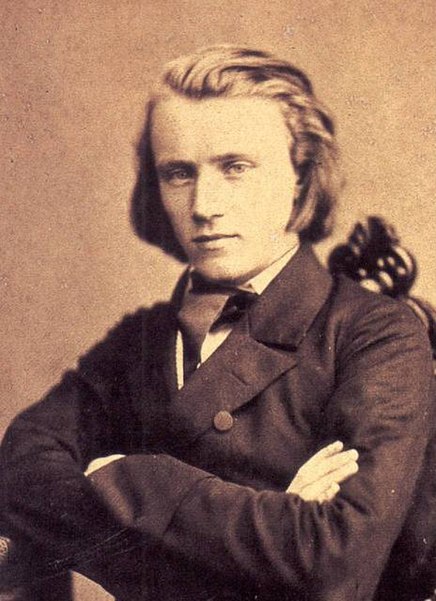
Sunday, January 27, 2008
What's controversial around here?
When a topic on a new music blog inspires passion, you have to pay attention. I've learned, for example, that expressing any reservation about the music of Shostakovich will guarantee a passionate response, but not necessarily a response informed by any musical argument. Shostakovich was a composer with brilliant technique and a tragic biography; he just wasn't an inventive or subtle composer, in my book. Having been burned on Shostakovich, I have generally refrained from bringing up music that doesn't work for me and instead concentrated on music that does. Risking further passionate controversy, I will readily admit that there are a number of composers -- including Shostakovich, Krenek, Britten, Bernstein, Henze, Zorn, and Kernis -- whose music just doesn't take me anywhere interesting, and I really do demand that music take me someplace never travelled.
Two topics, musical economics and musical institutions, are guaranteed to fill my email inbox with messages, both of approval and disapproval, but seldom do they appear as online comments. This was particularly true of my items critical of composition competitions, for which I received a striking amount of support. However, disappointingly few were willing to go public about wanting better competitions.
As to economics, I will readily admit that it's a field well outside the expertise of this musician, but nevertheless I can't help but be fascinated with little data points that add to a thick description of the world that's bopping about my music. Marginal Revolution often touches on cultural issues, Brad DeLong is a very smart guy, I've learned more about the recent credit crisis in the US from the Irvine Housing Blog, and this paper, An Empirical Analysis of Street-Level Prostitution by Levitt and Venkatesh, which noted that prostitutes with pimps may have some advantages in terms of marketing and protection, raised interesting questions for me about the comparative advantages of composers as free-lancers and with managers or institutional affiliations, and specifically in those areas of marketing and protection (e.g. provision of health care insurance).
I probably catch the most flak for my critical stance towards big musical institutions. Let me be clear that I'm perfectly aware that a certain amount of institutional structure is necessary to make some musical things happen, but one has to be persistently vigilant that the institutions not turn away from their service function for the music itself and invest ever more money, time, and oxygen in their own self-support. In a way, it's curious that my institutional critique receives any attention at all, in that the critics and bloggers and devotees of those very same institutions often spend as many words on changes in, say, opera house management or gossipy materials leaked by publicists, as the do on the aesthetics of opera.
As long as we're talking about opera houses, my critique is the opposite of the famous one of Pierre Boulez, who suggested blowing the places up. In fact, I think that if they're going to be mammoth places for upper class spectacle, simulcast in cinemas and on pay-per-view, they really don't go far enough. I would suggest that they instead follow the model of mega-churches. Put a parking lot in front of the house and glass-in one wall of the theatre for those who like to worship/watch without leaving the familiar comforts of their cars. Embrace amplification and other contemporary theatrical technologies. Let George Lukas and Joel Osteen stage these things. Opera loves stage magic and there's no reason that operas shouldn't be as vivid as a Rodger Rabbit cartoon. Heck, maybe they should even incorporate as churches -- they won't have to charge admission, as tax-deductible love offerings and cinema/pay-per-view income will surely more than cover costs. And then, the rest of us, who happen to like hearing unamplified voices in intimate surroundings can get to it.
That's probably enough to feed the passions for today.
Two topics, musical economics and musical institutions, are guaranteed to fill my email inbox with messages, both of approval and disapproval, but seldom do they appear as online comments. This was particularly true of my items critical of composition competitions, for which I received a striking amount of support. However, disappointingly few were willing to go public about wanting better competitions.
As to economics, I will readily admit that it's a field well outside the expertise of this musician, but nevertheless I can't help but be fascinated with little data points that add to a thick description of the world that's bopping about my music. Marginal Revolution often touches on cultural issues, Brad DeLong is a very smart guy, I've learned more about the recent credit crisis in the US from the Irvine Housing Blog, and this paper, An Empirical Analysis of Street-Level Prostitution by Levitt and Venkatesh, which noted that prostitutes with pimps may have some advantages in terms of marketing and protection, raised interesting questions for me about the comparative advantages of composers as free-lancers and with managers or institutional affiliations, and specifically in those areas of marketing and protection (e.g. provision of health care insurance).
I probably catch the most flak for my critical stance towards big musical institutions. Let me be clear that I'm perfectly aware that a certain amount of institutional structure is necessary to make some musical things happen, but one has to be persistently vigilant that the institutions not turn away from their service function for the music itself and invest ever more money, time, and oxygen in their own self-support. In a way, it's curious that my institutional critique receives any attention at all, in that the critics and bloggers and devotees of those very same institutions often spend as many words on changes in, say, opera house management or gossipy materials leaked by publicists, as the do on the aesthetics of opera.
As long as we're talking about opera houses, my critique is the opposite of the famous one of Pierre Boulez, who suggested blowing the places up. In fact, I think that if they're going to be mammoth places for upper class spectacle, simulcast in cinemas and on pay-per-view, they really don't go far enough. I would suggest that they instead follow the model of mega-churches. Put a parking lot in front of the house and glass-in one wall of the theatre for those who like to worship/watch without leaving the familiar comforts of their cars. Embrace amplification and other contemporary theatrical technologies. Let George Lukas and Joel Osteen stage these things. Opera loves stage magic and there's no reason that operas shouldn't be as vivid as a Rodger Rabbit cartoon. Heck, maybe they should even incorporate as churches -- they won't have to charge admission, as tax-deductible love offerings and cinema/pay-per-view income will surely more than cover costs. And then, the rest of us, who happen to like hearing unamplified voices in intimate surroundings can get to it.
That's probably enough to feed the passions for today.
Friday, January 25, 2008
The truth about the Jedi
My old friend Tom Hilton has a brilliant and timely analysis of Jedi politics, here.
Our economic history
Blogging economist Brad DeLong, in explaining why he thinks historians should study economic history, writes:
I have written before that our continuous music-historical memory extends only into the late 18th century, with musical repertoires predating that era all to be re-discovered, and, in their way, remade as contemporary musics. (The various forms of "nationalist" musics that emerge (and continue to emerge) in the past two centuries are less instances of the faithful transmission of local traditions but of local assertion of participation in the global music culture with local colors, often without much traditional precedent.) A partially economic explanation for pre-classical musical amnesia seems reasonable.
Art and literary history already follow economic history and identify modernity roughly with the turn of the 19th century. I'm now curious as to how music came to unique identify modernity with the 20th century. (No, the invention of sound recording can't be the initial impulse for this.) In fact, it might be more than interesting to rethink classical music history since 1789 or so without 1900 as the major turning point, but rather as just another marker of generational change in a more complex historical texture, with waves to and fro greater or lesser complexity, additions of new resources, ensemble or textural density, etc. while paying closer attention to the patterns of geographical transmission and reception.
...certainly since 1800 and perhaps since 1500, what is most extraordinary and salient about our global society is primarily economic and scientific, so you cannot do post-1500 history without knowing economics anymore than you can do early Byzantine history without knowing theology.I'm not certain how much economic history music historians should know, but those two dates -- or a generation earlier for 1800 -- do ring all sorts of music-historical bells. They locate moments in which local European musical traditions innovate in connection with reception by new music-consuming classes and simultaneously begin to have reach beyond local communities, across European borders and, eventually, globally.
I have written before that our continuous music-historical memory extends only into the late 18th century, with musical repertoires predating that era all to be re-discovered, and, in their way, remade as contemporary musics. (The various forms of "nationalist" musics that emerge (and continue to emerge) in the past two centuries are less instances of the faithful transmission of local traditions but of local assertion of participation in the global music culture with local colors, often without much traditional precedent.) A partially economic explanation for pre-classical musical amnesia seems reasonable.
Art and literary history already follow economic history and identify modernity roughly with the turn of the 19th century. I'm now curious as to how music came to unique identify modernity with the 20th century. (No, the invention of sound recording can't be the initial impulse for this.) In fact, it might be more than interesting to rethink classical music history since 1789 or so without 1900 as the major turning point, but rather as just another marker of generational change in a more complex historical texture, with waves to and fro greater or lesser complexity, additions of new resources, ensemble or textural density, etc. while paying closer attention to the patterns of geographical transmission and reception.
Wednesday, January 23, 2008
Who's your teacher?
While some composers are entirely self-taught, and the best composers inevitably have to become self-taught, most classical composers have teachers, and -- usually with pride, but sometimes in defiance -- add their names to our resumes, sometimes even the names of our "grandteachers", attaching ourselves through that lineage to a tradition.
But the precise nature of the teacher-student relationship, however institutionalized in CVs and dictionary entries, is far from fixed, and indeed, often very mysterious. While there are some lineages in which the students' music can be heard to be continuing the work of the master, there are as many in which the relationship to the master's music is ambivalent, critical, negative, or simply not recognizable. But neither of these styles of musical relationships to the teacher and her/his tradition says one bit about the personal relationship, which may be tender or tendentious either way.
The composition classes at UC Berkeley in the late 1950s and early 1960's are illustrative. These classes were one of the birthplaces of the radical music which would come to include the more promoted minimalism of the early 1970's, and included a number of students (Young, Riley, Rush, Leedy, Oliveros) who have become well-known. The composition staff at UCB was, however, a bit difficult to square with the nascent radical aesthetic, including names like Andrew Imbrie, Juaquin Nin-Culmel, Seymour Shifrin, and William Denny. The first two of these names were active opponents of the young radical, while the latter two, although coming from very different aesthetics became important teachers. Shifrin, a friend from youth of Morton Feldman, was committed both to a high art tradition and an atonal style that is best described as academic. One member of Shifrin's seminar said "we argued all the time with Seymour, but we loved him to death, he was a mensch." And Denny was game enough for the new ideas that he accompanied his graduate students to a festival in Provo, Utah, where he took part in a performance of La Monte Young's Poem for Chairs, Tables, Benches, etc., by playing catch onstage with Terry Riley. A visiting professorship by Robert Erickson brought a more like-minded teacher into the mix, but the fact is that these young musicians found a positive impulse in working with teachers whose own music was far from their own.
A further complication is the quantitative aspect of a teaching relationship. Some students can go in week after week for years of lessons with the same teacher and never profit from the effort. Other students are sparked for life by a pair of words at the right moment from a composer who will otherwise be a perfect stranger. A lot of resumes are padded these days with "studied with" lines for a visit to Tanglewood or Darmstadt, in which the relationship was transient, while the more decisive orchestration or counterpoint teacher back home goes unmentioned. What of all the composers who have made a summer pilgrimage to the Stockhausen Courses in Kürten in recent years? Stockhausen lectured on his own works but did not give private compositional instruction as he did earlier. While one might now speak of a small contemporary "School of Stockhausen", it's not quite accurate to identify the members of this school as Stockhausen's students.
The relationship to a teacher changes over time, too. I had the luck to have some great composition teachers, and one of the pleasures of this life has been the gradual unfolding over time -- and a long time, at that -- of what exactly I learned from these good people. It's a continual surprise. I was recently writing a eccentric little passacaglia, and suddenly realized that my fussiness about balance and symmetries owed everything to Gordon Mumma, with whom I did not explicitly study counterpoint; indeed I do think that he ever used the term in my presence. But it turns out Gordon taught me a lot about counterpoint and his ideas about balance and density are inescapable parts of my toolkit.
But the precise nature of the teacher-student relationship, however institutionalized in CVs and dictionary entries, is far from fixed, and indeed, often very mysterious. While there are some lineages in which the students' music can be heard to be continuing the work of the master, there are as many in which the relationship to the master's music is ambivalent, critical, negative, or simply not recognizable. But neither of these styles of musical relationships to the teacher and her/his tradition says one bit about the personal relationship, which may be tender or tendentious either way.
The composition classes at UC Berkeley in the late 1950s and early 1960's are illustrative. These classes were one of the birthplaces of the radical music which would come to include the more promoted minimalism of the early 1970's, and included a number of students (Young, Riley, Rush, Leedy, Oliveros) who have become well-known. The composition staff at UCB was, however, a bit difficult to square with the nascent radical aesthetic, including names like Andrew Imbrie, Juaquin Nin-Culmel, Seymour Shifrin, and William Denny. The first two of these names were active opponents of the young radical, while the latter two, although coming from very different aesthetics became important teachers. Shifrin, a friend from youth of Morton Feldman, was committed both to a high art tradition and an atonal style that is best described as academic. One member of Shifrin's seminar said "we argued all the time with Seymour, but we loved him to death, he was a mensch." And Denny was game enough for the new ideas that he accompanied his graduate students to a festival in Provo, Utah, where he took part in a performance of La Monte Young's Poem for Chairs, Tables, Benches, etc., by playing catch onstage with Terry Riley. A visiting professorship by Robert Erickson brought a more like-minded teacher into the mix, but the fact is that these young musicians found a positive impulse in working with teachers whose own music was far from their own.
A further complication is the quantitative aspect of a teaching relationship. Some students can go in week after week for years of lessons with the same teacher and never profit from the effort. Other students are sparked for life by a pair of words at the right moment from a composer who will otherwise be a perfect stranger. A lot of resumes are padded these days with "studied with" lines for a visit to Tanglewood or Darmstadt, in which the relationship was transient, while the more decisive orchestration or counterpoint teacher back home goes unmentioned. What of all the composers who have made a summer pilgrimage to the Stockhausen Courses in Kürten in recent years? Stockhausen lectured on his own works but did not give private compositional instruction as he did earlier. While one might now speak of a small contemporary "School of Stockhausen", it's not quite accurate to identify the members of this school as Stockhausen's students.
The relationship to a teacher changes over time, too. I had the luck to have some great composition teachers, and one of the pleasures of this life has been the gradual unfolding over time -- and a long time, at that -- of what exactly I learned from these good people. It's a continual surprise. I was recently writing a eccentric little passacaglia, and suddenly realized that my fussiness about balance and symmetries owed everything to Gordon Mumma, with whom I did not explicitly study counterpoint; indeed I do think that he ever used the term in my presence. But it turns out Gordon taught me a lot about counterpoint and his ideas about balance and density are inescapable parts of my toolkit.
A Recipe for Hard Times
In the face of a recession, it looks like the White House and US Congress will soon put together a massive economic stimulus package with some mixture of tax reductions and spending, the latter perhaps in the form of direct grants. The idea is to get additional money circulating in the economy as fast as possible through both spending and investment. The economist Lawrence Summers writes that: "...fiscal stimulus only works if it is spent so it must be targeted . Targeting should favour those with low incomes and those whose incomes have recently fallen for whom spending is most urgent." May I make the suggestion that a modest portion of this package be directed the way of musicians, and composers in particular? Our incomes tend to be low and, in these days, falling, and we're particularly well suited to spending money as fast as possible. Without a doubt, any direct grants sent our way will be disposed of with astonishing velocity.
Subscribe to:
Posts (Atom)